
On this page
- The world of this age
- Language and public debate
- Poetry
- Prose and political thought
- Religion and everyday writing
- Theatre during the closure
- How the age ends
- Literature in focus
- The absence of a king becomes a problem in language
- Hobbes: the fear behind the argument for authority
- Milton: writing for a cause and writing for readers
- Marvell: praise can remain complicated
- Vaughan: another way of measuring the world
- Quiet subjects in an unsettled time
- The return of the stage has a history
- A small reading method for a large disagreement
- Key terms
- Writers and works
- Important points to remember
- Quick revision - 10 points
- Quick quiz - 15 questions
- Frequently asked questions
- Sources and further reading
The Caroline chapter ends with the execution of Charles I. The next chapter has to answer a question that would once have seemed almost unimaginable: what does English public life look like without a king? Political arguments become urgent, and writers have to think about obedience, conscience and the limits of authority. Milton serves the new government, Hobbes argues for a power strong enough to prevent disorder, and poets continue to explore faith and the passing of time. This is not a blank space between two royal ages. Follow the books, poems and arguments through the interruption. They help explain both what the Restoration changed and what its writers inherited from the years before it.
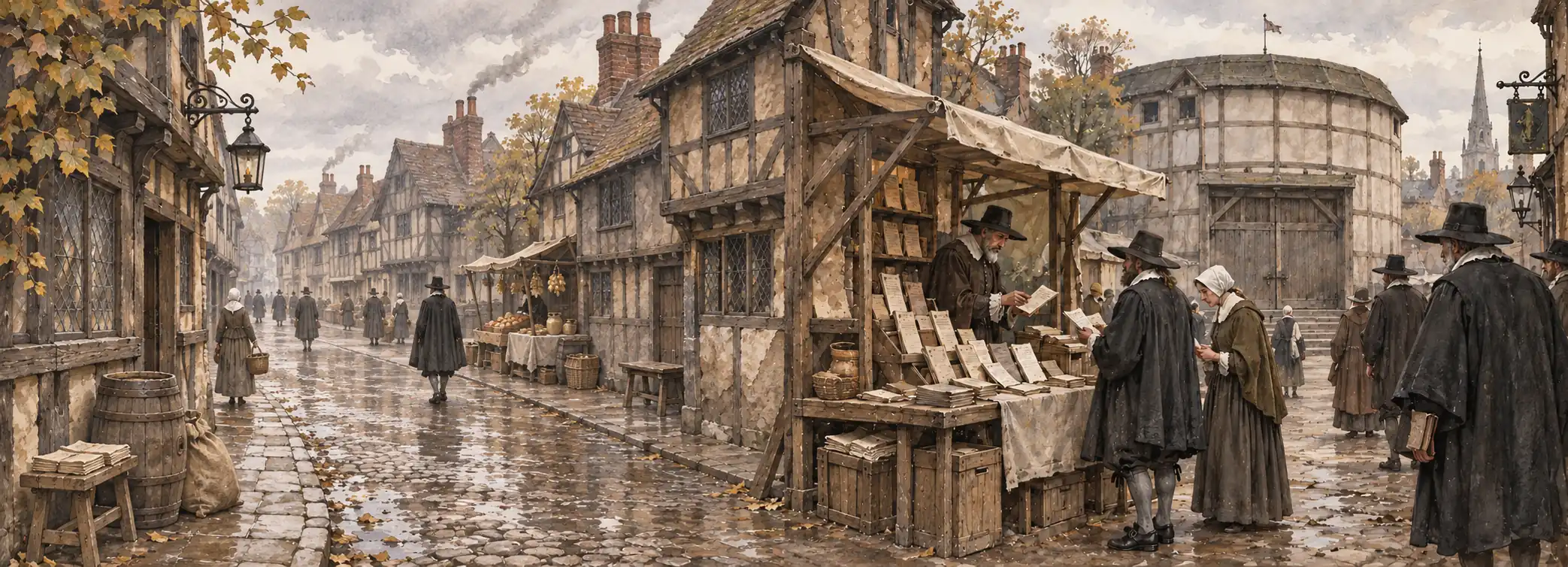
After the execution of Charles I, England became a republic and later a Protectorate under Oliver Cromwell. The public theatres remained closed, and printed argument about religion and government was central to public life. "Commonwealth" is a useful timeline label for these years, though the political arrangements changed within them.
The world of this age
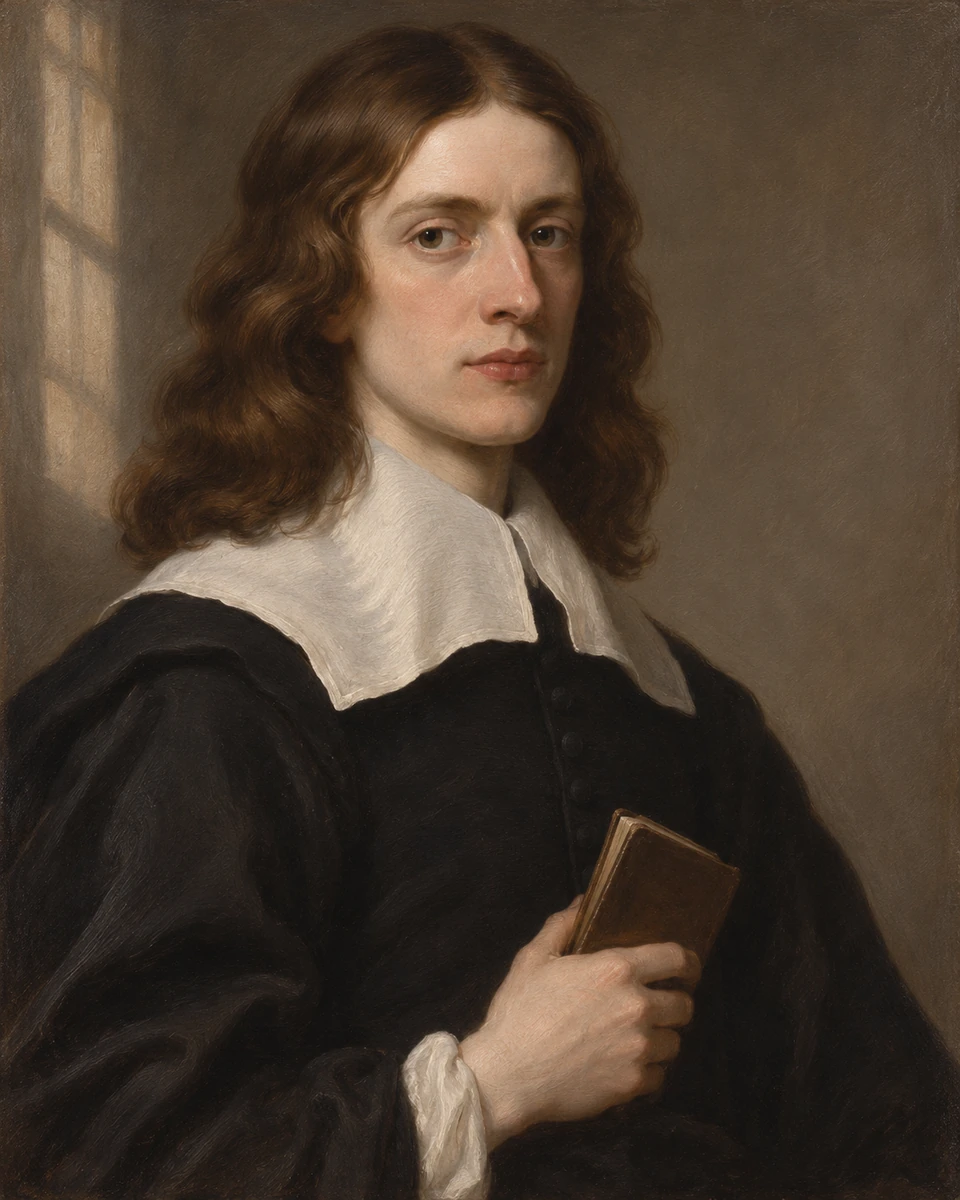
England now became a republic, called the Commonwealth. Its strongest man was Oliver Cromwell, a country gentleman who had become a great general. After he put down resistance in Ireland and Scotland, he took the title Lord Protector in 1653. He died in 1658. His son Richard could not control the army, and the country drifted. In early 1660 General George Monck marched from Scotland to London, a new Parliament was chosen, and it invited Charles's son to return. Charles II entered London on 29 May 1660, his thirtieth birthday.
Society was divided into clear ranks. At the top stood the king and the great lords. Below them came the gentry, who owned land and ran the counties, then merchants, craftsmen and farmers, and a large body of labourers and servants. Rank decided a person's clothes, schooling and manners. Girls were mostly taught at home to run a household, few learned Latin, and a married woman had very few rights under the law. Even so, a small number of women found ways to write and publish.
Language and public debate
The English of these years is called Early Modern English. It is the language of Shakespeare and the King James Bible. It is close enough to read today, but spelling had no fixed rules, and people still used "thou" and "thee" for close friends, for inferiors and for God. The language was also growing fast. It had borrowed words from Latin, Greek, French and Italian, and many readers felt lost among them. In 1604 a schoolmaster named Robert Cawdrey published A Table Alphabeticall, a small list of hard English words with plain meanings. It is regarded as the first English dictionary.
Writers chose their styles with care. Jonson and Bacon liked short, firm sentences. Donne wrote as if arguing aloud, with sudden starts. Thomas Browne preferred long, rolling sentences full of Latin words, and Milton shaped English as if it were Latin, with long, balanced sentences.
Poetry
Younger poets followed. Henry Vaughan, a Welsh doctor, wrote of nature as a glimpse of heaven in Silex Scintillans (1650) and openly admired Herbert. Richard Crashaw, who became a Catholic, wrote passionate, almost dazzling religious verse. Andrew Marvell wrote one of the most famous argument poems of all, "To His Coy Mistress", in which a lover reasons that if time were endless he could court slowly, but since time is short, they should love now. Marvell also wrote the "Horatian Ode" in 1650, which praises Cromwell's power yet speaks with respect of the king's calm courage on the scaffold. His lyric poems were printed only after his death, in 1681.
Prose and political thought
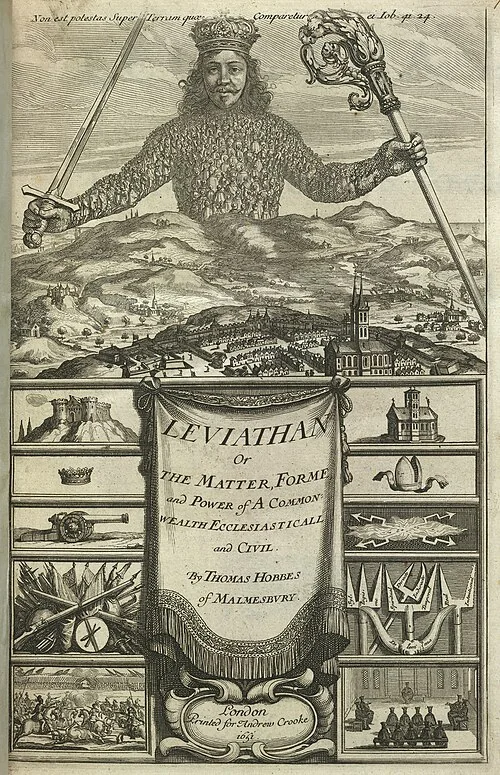
Then the Civil War turned prose into a weapon. Thomas Hobbes, who feared disorder, had gone to live in Paris in 1640, and there he wrote Leviathan, published in 1651. He argued that people must give up some freedom to a strong ruler, or life will be "solitary, poor, nasty, brutish, and short". John Milton argued in the opposite direction. In 1643 Parliament passed a law requiring books to be licensed before printing. Milton answered in 1644 with Areopagitica, a speech-like pamphlet saying that destroying a good book is like killing reason itself, and that truth grows stronger in a free contest with falsehood. After the king's execution he defended it in The Tenure of Kings and Magistrates (1649) and answered the popular book Eikon Basilike, which pictured Charles as a holy martyr, with Eikonoklastes. The new Commonwealth employed him as Latin Secretary, to write its letters to foreign powers, and he was blind by 1652. Others wanted more than a change of rulers. Gerrard Winstanley and his Diggers set up a farming community on common land in Surrey in 1649, claiming that the earth should be shared. These were years of fierce pamphlets, thousands of them.
Religion and everyday writing
After the Civil War began, the Royalist clergyman Jeremy Taylor wrote Holy Living (1650) and Holy Dying (1651), guides to a good life and a good death. Izaak Walton, also a Royalist, wrote The Compleat Angler (1653), a gentle book about fishing and friendship that offers calm in a violent time.
Theatre during the closure
After the king's death, the Puritans who now governed England tried to reshape national life. They had never liked the theatre. Parliament's order of 2 September 1642 had told actors to stop playing while the "sad causes" of the war lasted. Later orders in 1647 and 1648 went further. They treated actors as rogues, ordered playhouse seats and galleries to be pulled down, and punished spectators. The stage did not die completely. Actors performed in secret, and short comic scenes taken from old plays, called drolls, were acted in private. In 1647 the government also banned the celebration of Christmas.
Yet writing did not stop. Poets, scholars and preachers who had no stage turned to the study and the printing press. William Davenant found a way round the ban in 1656 by staging The Siege of Rhodes with music at a private house, as an entertainment rather than a play. It is often called the first English opera.
How the age ends
In 1658 Cromwell died, and the Puritan government began to break up. In January 1660, as the country waited to see who would rule, a young clerk named Samuel Pepys began a diary in which he wrote about everything around him. It continued for nearly ten years. In May the king returned. In the summer Charles II gave Thomas Killigrew and William Davenant the right to run theatre companies in London, and plays came back to the stage. Milton, who had defended the king's execution, hid for a time, was briefly arrested in 1660 and was then freed. Blind and far from rich, he went on to finish Paradise Lost, published in 1667. A new age with new fashions had begun.
Literature in focus
Commonwealth and Protectorate
The monarchy was abolished after Charles I's execution in 1649. The years without a reigning English monarch are also called the Interregnum. The Commonwealth and Cromwell's Protectorate were not identical arrangements: Cromwell became Lord Protector in 1653. The timeline uses Commonwealth as a convenient label for the whole 1649–1660 interval.
Milton as a public writer
Milton served the republican government as a writer of Latin correspondence and defended its cause in prose. The Tenure of Kings and Magistrates and Eikonoklastes belong to 1649. His earlier Areopagitica belongs to 1644 and should be treated as background. His later Paradise Lost was first published in 1667, after the monarchy returned. It must not be listed as a Commonwealth publication.
Reading political prose
Hobbes and Milton give readers contrasting ways of thinking about authority. Read the argument in each work rather than turning the authors into a simple pair of slogans. The political emergency matters: what danger does the writer fear, what kind of power does he defend, and what does he expect that power to do? The answer must be supported by the text.
Poetry and publication dates
Vaughan's Silex Scintillans appeared in 1650, with an enlarged edition in 1655. Marvell's "Horatian Ode" concerns Cromwell's return from Ireland in 1650. These works engage faith, time and public change in different ways. Much of Marvell's verse appeared in print only after his death; an event described in a poem is not automatically its publication date.
Reading the theatrical gap
The closure of public theatres did not mean that every kind of performance disappeared. Davenant's The Siege of Rhodes in 1656 is an important exception to simplistic accounts of complete cultural silence. The relationship among spoken drama, music, private performance and official permission matters. The stage of the Restoration emerged from that interrupted history, rather than from eighteen years in which nobody wrote or performed anything.
The absence of a king becomes a problem in language
When a political order changes, familiar words begin to carry new difficulties. Loyalty, obedience and freedom may still sound like shared values, but people can disagree sharply about what they require. A writer must decide whom to address and what authority the reader is expected to recognise. This is one reason prose becomes so important to the literary life of the Interregnum.
A pamphlet does not merely record that disagreement existed. It tries to make a reader take a position. Its opening can define a danger, its examples can give a particular version of the past, and its conclusion can present one action as necessary. Reading the argument means noticing that design. The writer is doing something with the account of events.
This connection between language and action makes the period interesting even for a reader who finds constitutional history difficult. Begin with the ordinary questions behind the public terms. What should a person do when conscience and obedience pull in different directions? How much power is needed to prevent violence? Who can judge whether a ruler has failed? Different works develop different answers from those starting points.
Hobbes: the fear behind the argument for authority
Leviathan is easier to approach when the danger of disorder is kept in view. Hobbes asks what people need from a common power strong enough to secure peace. The argument connects political authority with a judgement about the risks of human conflict. The reader should follow the steps rather than reduce the book to the statement that a strong ruler is good.
An important distinction is the difference between describing a fear and proving a solution. Once the danger is named, a writer must explain why the proposed arrangement answers it. What does each person give up, what protection is expected, and what makes the agreement effective? These questions help a reader see political theory as an organised argument rather than a list of famous quotations.
The Civil War provides a setting for the urgency, but context does not replace close reading. Not every sentence is a report of a particular battle or dispute. A work of theory tries to make claims beyond one event. A useful answer shows how the historical pressure and the general argument relate, while keeping the difference between them clear.
Milton: writing for a cause and writing for readers
Milton's service to the republican government connects literary skill with public work. Latin correspondence addressed an international setting, while other prose defended political positions before readers. The range matters. A writer known now mainly for poetry also worked through arguments meant to intervene in the affairs of his own time.
The Tenure of Kings and Magistrates raises questions about the grounds and limits of political authority. Eikonoklastes answers another book's presentation of the king. In the second case, interpretation itself becomes a public contest: the same life and death can be arranged into different accounts, encouraging different loyalties. A text can try to change not only what a reader knows, but how a reader feels about what is known.
This does not make every public argument equally trustworthy. A reader still needs to examine evidence, reasoning and omissions. Notice how a writer characterises an opponent, what a quotation is used to prove, and whether the conclusion follows from the example. These habits are as useful for a seventeenth-century pamphlet as for a modern argument.
Milton's later reputation should not obscure the sequence of publication. Areopagitica precedes the Commonwealth; the political works of 1649 belong to its beginning; Paradise Lost appears after the Restoration. The career connects the periods, but the dates of the books tell us what kind of connection is being made. That sequence is a safeguard against several misleading summaries.
Marvell: praise can remain complicated
A political poem can appear to praise a public figure while leaving difficult questions active. Marvell's Horatian Ode is a useful example because it asks readers to attend to power, change and the dignity of the defeated. The historical event gives the poem an occasion, but the poem's interest also lies in how it distributes attention.
Do not assume that a respectful description of one person cancels admiration for another. Literature can hold judgements together that a slogan would force apart. The reader's task is to explain the relation among them. Which qualities are acknowledged? What seems necessary, what seems admirable, and what remains troubling? The answers may not fall into one neat political category.
This is a reason to distinguish the poem's speaker and movement from a simple statement of the author's permanent beliefs. Read the shape of the whole work. A change of focus can complicate an earlier impression, and the ending can leave an image more powerful than a direct declaration. Political poetry is still poetry: its rhythm, language and arrangement contribute to its judgement.
Vaughan: another way of measuring the world
Vaughan's devotional verse directs attention beyond the urgency of immediate public events. Nature can become a way of thinking about spiritual perception, while memory can reveal a difference between present experience and a desired understanding. The poem may ask how a person can see what habit has made difficult to notice.
That concern does not mean the writer had no historical setting. It shows that writers living through the same years can choose different scales of attention. A pamphlet addresses a public controversy; a devotional lyric may consider a person's relation to time, loss and belief. Both belong to the literary life of the age without having the same subject or method.
Compare Vaughan with Herbert through a particular feature rather than only the label metaphysical. How does an image become an argument? Does the poem sound like a struggle, a recollection or a moment of recognition? Where does its movement turn? These questions make an influence visible while allowing the later writer a distinct voice.
Quiet subjects in an unsettled time
Walton's writing about fishing and friendship offers an apparently quiet subject beside the period's public arguments. That contrast is worth considering without inventing a secret message for every detail. A work can value a way of living, a kind of conversation or a relation to place. Such choices help define what the writer wishes to preserve or imagine.
Likewise, guides to living and dying give prose a task different from political controversy. They address conduct and preparation, bringing religious teaching into the shape of an ordinary life. Their presence reminds us that the reading public was not occupied only with the next change of government. Literature also helped people organise private hopes and fears.
The range of subjects is one reason the Commonwealth cannot be described as cultural silence. The interruption of public theatre was serious, but books, manuscripts, poems and other kinds of performance continued. Understanding which activity was restricted is more accurate than saying that all artistic life stopped.
The return of the stage has a history
Davenant's work during the closure complicates a simple division between a theatrical age and an age without performance. Music, permission and the setting of an entertainment could affect what was possible. The example invites us to ask about institutions rather than assume that every performance was treated in the same way.
When the monarchy returns, the theatre does not resume as if nothing has happened. The Restoration chapter will show changes in companies, stages, audiences and the place of women in performance. The intervening years belong to that story. An institution's interruption can help explain the different form in which it later returns.
Carry this question into the next age: what does restoration actually restore, and what does it create anew? A political name may suggest a return, while the literary evidence reveals both inheritance and change. That tension connects the Commonwealth's arguments with the wit, performance and prose of the world that follows.
A small reading method for a large disagreement
When a political passage feels difficult, reduce its argument to three stages. First, identify the problem the writer says must be solved. Next, identify the action or principle offered as the answer. Finally, ask what evidence connects the answer with the problem. This gives you a route through the prose without pretending its disagreements are simple.
Then return to the language. A vivid image can make a danger feel immediate; an account of an opponent can make one conclusion seem unavoidable. Those effects may be powerful, but the reasoning still needs examination. Good literary reading notices how persuasion works and asks whether the claim has earned the reader's trust.
This method also brings Hobbes and Milton into a fair comparison. Both address questions of public authority, but the comparison must begin with the particular argument and danger in view. A slogan about freedom or order can be a starting point, never the whole explanation. The books become more interesting when we see why a writer wants a reader to accept a position and what accepting it would require. That connection between a form of language and a proposed way of living makes the period's prose part of literature's human history.
Key terms
- Interregnum - the gap between kings, from 1649 to 1660.
- Conceit - a surprising comparison that is stretched far and worked out with logic.
Writers and works
| Writer | Works | What to remember |
|---|---|---|
| John Milton | The Tenure of Kings and Magistrates (1649) | Argument about political authority |
| Andrew Marvell | An Horatian Ode upon Cromwell’s Return from Ireland | Verse on public events in 1650 |
Important points to remember
- The timeline uses 1649–1660 for this chapter. Literary boundaries are approximate.
- Check the date of a work separately from its writer's lifetime.
- Read this chapter alongside the wider period guide when comparing neighbouring ages.
Quick revision - 10 points
Open the 10 pointsClose the list
- The Interregnum — Interregnum means the gap between kings.
- Public stage plays must stop — The order said plays should cease while the "sad causes" of the war lasted.
- A surprising comparison worked out at length — Donne's comparison of lovers to the legs of a pair of compasses is a famous example.
- Thomas Hobbes — Hobbes wrote the book after going to live in Paris in 1640.
- 1653 — The Protectorate was a distinct political arrangement within the Interregnum.
- 1667 — Its first publication belongs after the Restoration.
- Henry Vaughan — The first edition appeared in 1650.
- The Tenure of Kings and Magistrates — It argues about political authority.
- The Siege of Rhodes — It complicates the idea that all performance ceased during the theatrical closure.
- The return of Charles II in 1660 — The Restoration brought back the monarchy.
Quick quiz - 15 questions
Tap an answer to see at once if it is right. You do not need to log in.
Open the 15 questionsClose the quiz
1What name is given to the years 1649 to 1660, when England had no king?
Answer: C. Interregnum means the gap between kings.
2What did Parliament order on 2 September 1642?
Answer: A. The order said plays should cease while the "sad causes" of the war lasted.
3What is a conceit?
Answer: D. Donne's comparison of lovers to the legs of a pair of compasses is a famous example.
4Who argued in Leviathan (1651) that people must give up some freedom to a strong ruler?
Answer: A. Hobbes wrote the book after going to live in Paris in 1640.
5In which year did Cromwell become Lord Protector?
Answer: A. The Protectorate was a distinct political arrangement within the Interregnum.
6When was Paradise Lost first published?
Answer: B. Its first publication belongs after the Restoration.
7Who wrote Silex Scintillans?
Answer: C. The first edition appeared in 1650.
8Which work by Milton appeared in 1649?
Answer: D. It argues about political authority.
9Which work by Davenant belongs to 1656?
Answer: A. It complicates the idea that all performance ceased during the theatrical closure.
10What event marks the end of the Interregnum?
Answer: B. The Restoration brought back the monarchy.
11What danger is central to understanding Hobbes's argument?
Answer: C. His account of authority is connected with securing peace.
12Why should Marvell's political poetry not be reduced to a slogan?
Answer: D. Respect, admiration and unease can coexist within a poem.
13How does Vaughan's devotional verse broaden the chapter?
Answer: A. Writers of the same years can choose different scales of attention.
14What distinguishes a pamphlet from a neutral list of events?
Answer: B. Its organisation and examples contribute to an argument.
15Why does the Commonwealth belong in theatre history?
Answer: C. The later return of performance involved both inheritance and change.
Frequently asked questions
Does this chapter use exact historical boundaries?
The dates are the timeline's study convention. Language, literary forms and writers' careers can cross them. Use the date of the particular work when a question asks about a narrower age.
Where can I read the wider historical context?
The full period guide contains the longer background. This chapter concentrates on the age named above and keeps its own revision and practice sections.
Are these pictures historical documents?
The artwork is illustrative. Captions identify representative or imagined scenes and modern painted interpretations; those images are not evidence that the pictured scene happened exactly as shown.
How should I use the quiz?
Read the explanations after answering. Questions about earlier events or later criticism are background questions, not claims that every named date falls inside the chapter's boundaries.
Sources and further reading
The relevant background, text references and public practice material are retained from the original jacobean and caroline age guide. Publication dates, authorship and period boundaries should be checked against the source editions listed there.
- UK Parliament: 1640–1660 chronology
- Cambridge University Library: Milton editions and publication dates
Afsar Khan, Ph.D. English
Test your knowledge
Check what you have learned with quizzes and MCQs.