

On this page
- The world of this age
- The language
- Drama and its audience
- Poetry and satire
- Prose and ideas
- Criticism
- Literature in focus
- Why return to classical writers?
- The couplet can make a thought feel complete
- Mock-heroic writing changes the size of an event
- An essay can create a companion for the reader
- The novel changes the scale of moral judgement
- Johnson and the need to examine the evidence
- A connection worth keeping
- Key terms
- Writers and works
- Important points to remember
- Quick revision - 14 points
- Quick quiz - 19 questions
- Frequently asked questions
- Sources and further reading
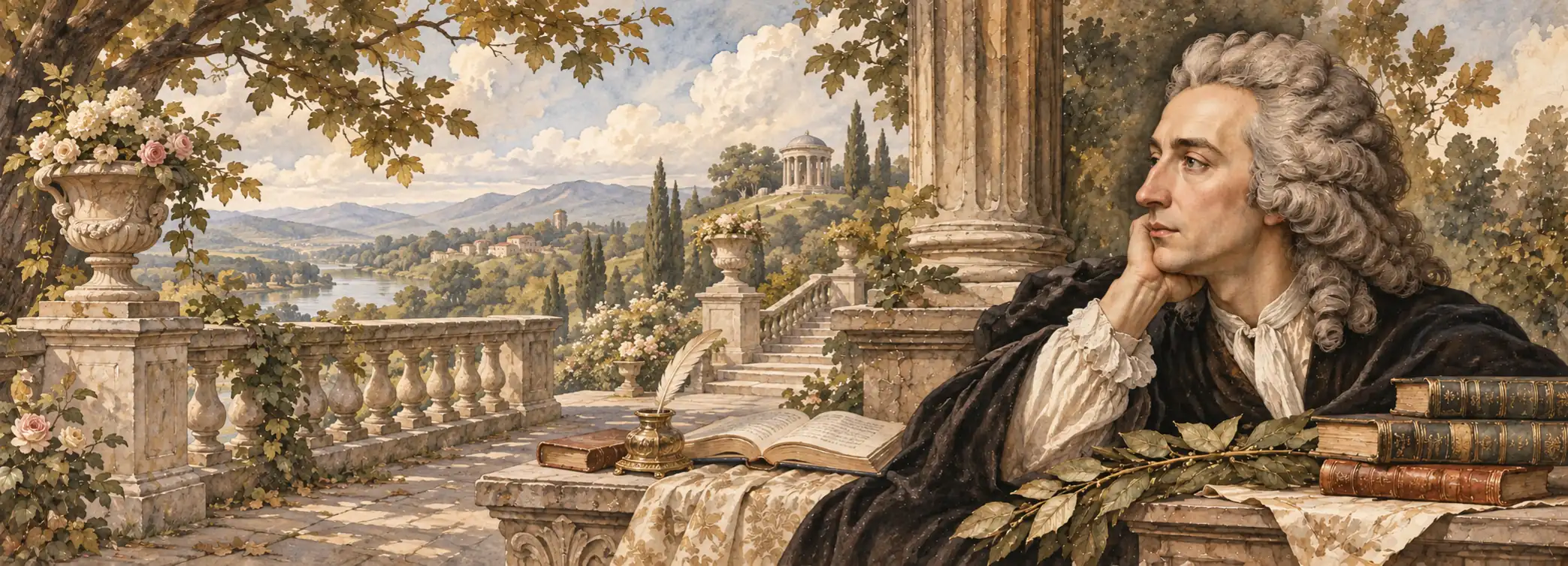
The Commonwealth ends with the return of the monarchy, but literary history does not simply return to its earlier position. New theatres, new readers and new forms of public debate reshape the world of writing. The broad Neoclassical label brings several stages of that change into view: Dryden's Restoration, Pope's Augustan years and the later world of Johnson and sensibility. The connecting thread is a continuing conversation with classical models, order and judgement. That thread does not make every text sound alike. A satire can attack vanity, an essay can teach a reader to look more carefully, and a novel can test conduct through a life story. This chapter follows those different uses of literary judgement.
"Neoclassical" describes a long taste for order, proportion and classical models in English writing. On this timeline it covers 1660–1785, crossing the Restoration, Augustan age and Age of Sensibility. These shorter periods differ, so the broad label should not be used as if Dryden, Pope and Johnson wrote in one political moment.
The world of this age
The republic did not last long after Oliver Cromwell died in September 1658. His son Richard became Lord Protector but had none of his father's authority, and in 1659 the army pushed him aside. England drifted toward new disorder. General George Monck, who commanded the army in Scotland, marched south to London in early 1660. A new Parliament met and invited Charles to come home.
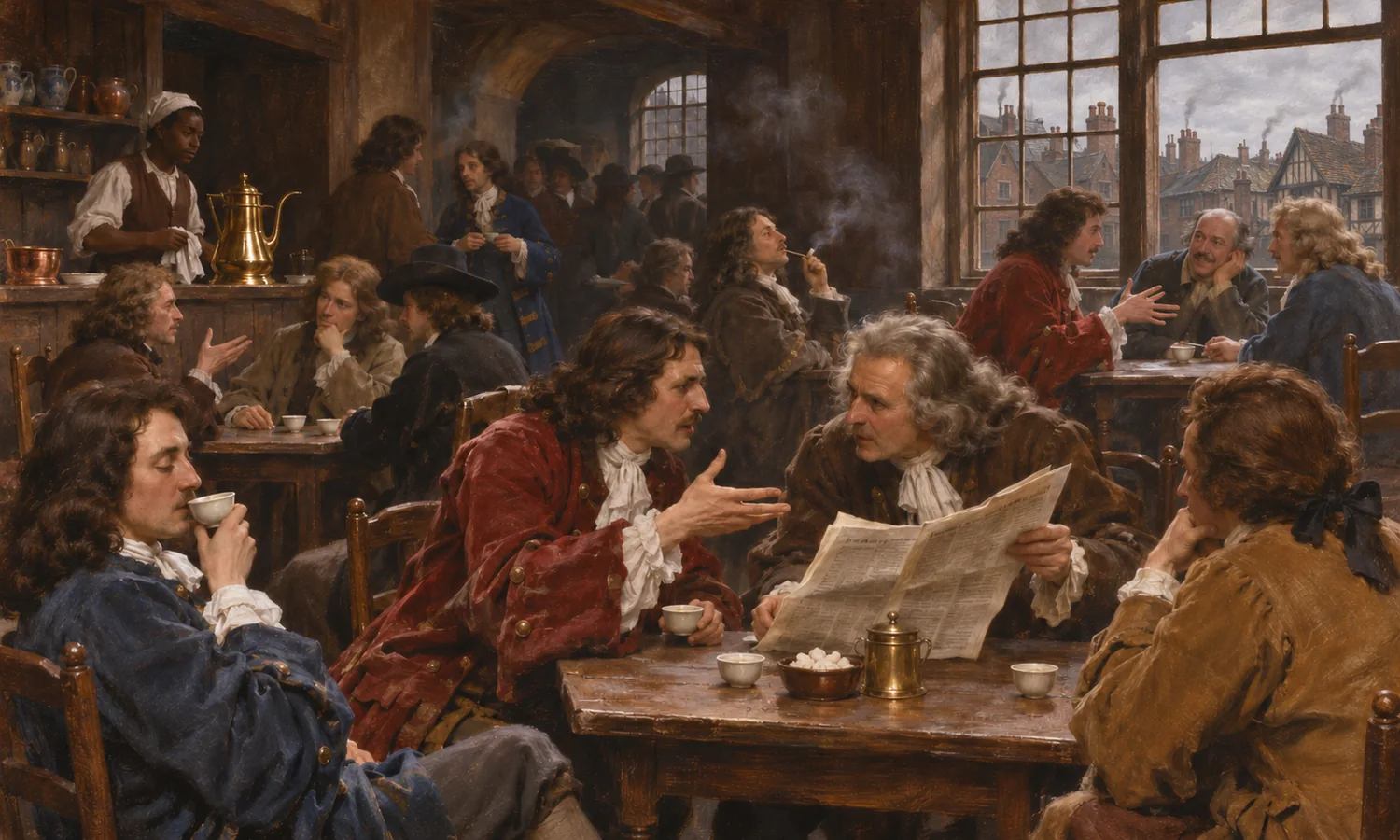
London was by far the largest city in the country, and much of its talk happened in the coffee houses, where men drank coffee, read the news and argued about politics and poetry. Writers had favourite houses. Dryden is linked with Will's Coffee House in Covent Garden.
London was also a great port. Ships carried cloth, sugar, tobacco and spices, and tea and coffee were becoming common. Parliament passed Navigation Acts in the 1660s to make sure that trade with the English colonies travelled in English ships. English ships also carried enslaved Africans across the Atlantic, a cruel trade that grew in these years.
Religion mattered as much as politics. When Charles came home, the Church of England came home with him. The bishops returned, and the Book of Common Prayer was revised in 1662. It stayed the main Anglican prayer book for about three hundred years.
The language
The writers of the Restoration had grown up in a time when words were weapons. Preachers, pamphleteers and politicians had filled the air with fiery speeches and very long sentences. Many readers now wanted calm, clear writing.
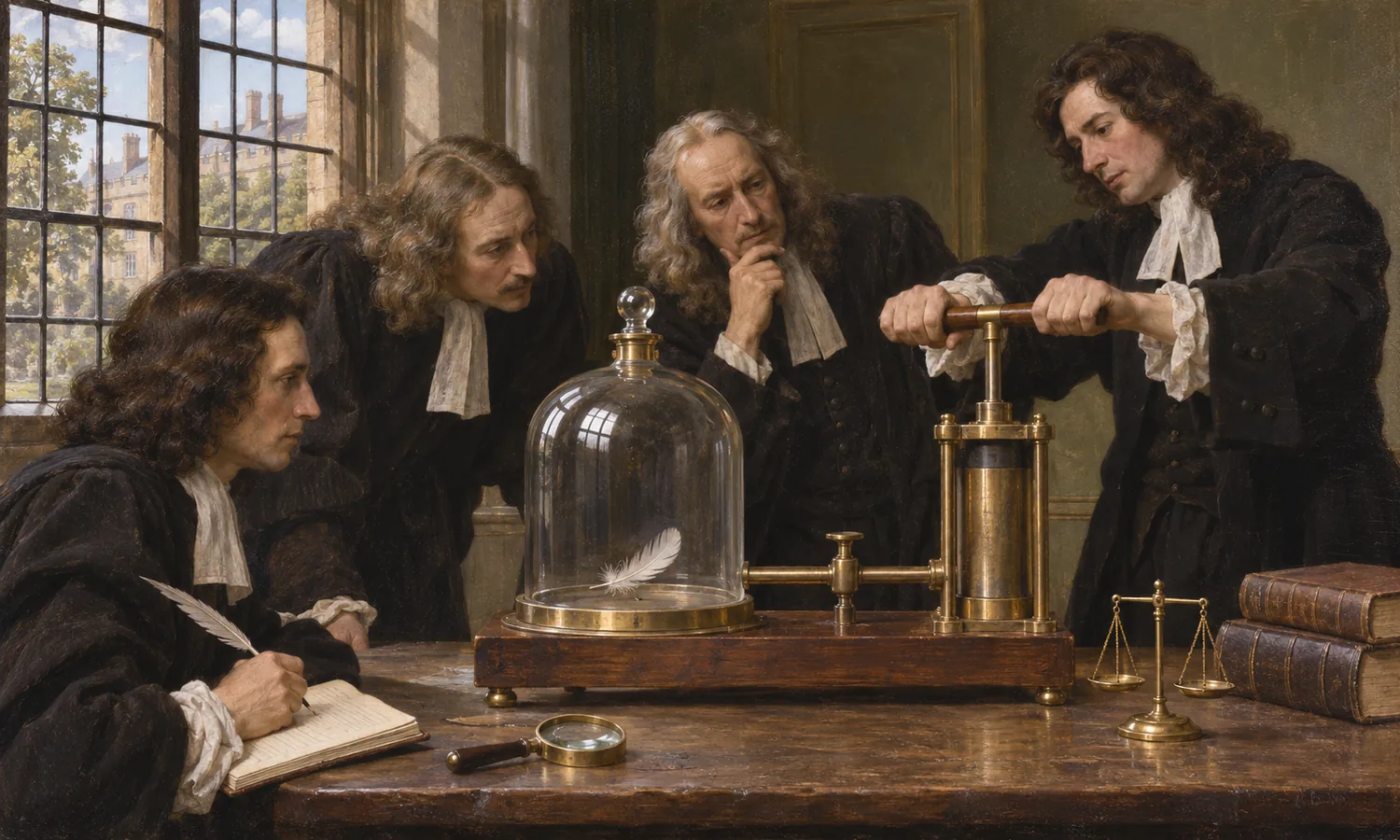
The new science helped this mood. The Royal Society, a club of people who loved experiment, met in London and received royal charters in 1662 and 1663. Its early members included scientists such as Robert Boyle and Robert Hooke, the architect Christopher Wren, and the writers John Evelyn, Edmund Waller and John Dryden. In 1667 Thomas Sprat published a History of the Royal Society, in which he praised careful experiment as the opposite of the angry passions of the war years. Writers close to the Society preferred a plain, clear style.
The French example added to the change. Charles's followers had lived in France and admired its tidy rules for plays and poems, and English writers began to value order, balance and good sense. In verse this meant the heroic couplet, two rhyming lines of ten syllables each. Sir John Denham's poem Cooper's Hill, first printed in 1642, was taken as a model. Dryden thought it set the exact standard of good writing, and he would make the couplet his own.
Drama and its audience
The biggest change in literature came in the theatre. Parliament had closed all playhouses in 1642 and passed a further order against acting in 1647. For eighteen years plays could be read but not properly performed. One clever man found a way round the ban. In 1656 the playwright William Davenant staged The Siege of Rhodes, a story sung to music, as an "entertainment" in the manner of the ancients. It was an early English opera.
When Charles returned, he gave two men the sole right to stage plays in London. Davenant received one royal patent, and the playwright Thomas Killigrew received the other. Killigrew's King's Company opened in November 1660 in a converted tennis court with Shakespeare's Henry IV, Part 1. Davenant's company had the Duke of York as its patron and was called the Duke's Company.
The new theatres were nothing like the Globe. They were built for the purpose, roofed and well lit, with names such as Lincoln's Inn Fields, Dorset Garden and Drury Lane. A proscenium arch framed the stage, and painted scenery could be changed in front of the audience. The actors played on an apron stage that reached out into the room. Seats cost between one and four shillings, so the audience was mostly courtiers and well-off townspeople. The king and his brother often attended.
Women now acted on the public stage. During the closure no boys had been trained to play female parts, and actresses were already common on the continent. Pepys, who loved the theatre, noticed the handsome women on the stage with pleasure in 1662. Thomas Betterton became the leading actor of the age and learned the part of Hamlet from Davenant.
Comedy was the great success of the age. The court and the town liked plays that laughed at love, money and fashion, and that turned the grand ideas of the heroic plays upside down. A comedy of manners is a play about fashionable people in a polished society, driven by wit and by tricks of love. Its setting was London. Its people were young gallants, jealous husbands, country wives and foolish fops, and its chief sport was seduction and the hypocrisy around it. Names told the audience what to expect: Courtall, Lady Cockwood, Sir Fopling Flutter.
Poetry and satire
The central figure of the age was John Dryden. Born in 1631, he had written verses on Cromwell's death in 1659, and in 1660 he welcomed the returning king in Astraea Redux. He then became the voice of the restored monarchy. Annus Mirabilis (1667) praised London and the king for surviving the Dutch war and the Great Fire. In 1668 he became Poet Laureate. For the next fourteen years or so he wrote mainly for the stage, which taught him to handle character and quick speech.
Then the Exclusion Crisis gave him a great subject. Absalom and Achitophel (1681) retells the Bible story of Absalom's revolt against his father David. In the poem David stands for Charles II, Absalom for the Duke of Monmouth, and Achitophel for Shaftesbury, who tempts Absalom to rebel. The Duke of Buckingham appears as Zimri. A poem in which real people hide behind other names is called a histoire à clef. Dryden used the heroic couplet to praise and to wound in the same line.
His rival in the theatre, Thomas Shadwell, became the target of MacFlecknoe, begun in the late 1670s and printed in 1682. It is a mock-heroic poem, which treats a small subject in the grand style of epic to make it look foolish. Shadwell is crowned the heir of the dull poet Flecknoe, holding a mug of ale instead of a royal orb. Dryden also wrote Religio Laici (1682), in defence of the Church of England, and The Hind and the Panther (1687), written after he joined the Roman Catholic Church under James II.
Prose and ideas
John Bunyan, a tinker's son from Bedfordshire, wrote from the other side of the Restoration world. Much of his finest work was written in prison. In Grace Abounding (1666) he told the story of his own religious struggles. Then he turned his experience into a story for everyone. The Pilgrim's Progress (Part I, 1678; Part II, 1684) is an allegory, a tale whose people and places stand for ideas. A man named Christian leaves the City of Destruction and travels through the Slough of Despond, Vanity Fair and the Valley of the Shadow of Death to reach the Heavenly City. The people he meets have names such as Mr Worldly-Wiseman and Talkative, so the reader knows at once what each one stands for. In the second part his wife Christiana makes the same journey. Bunyan's language is plain, vivid and full of the Bible, and the book was read in ordinary homes for generations.
Aphra Behn wrote prose as well. Her short novel Oroonoko (1688) tells of an African prince who is tricked into slavery in Surinam, the colony where she had once lived. He rises in revolt against his masters, and the story presents him as a noble man and his oppressors as the ones who fail the test of honour.
New ideas also found their way into prose. Isaac Newton's Principia (1687) set out the laws of motion and gravity, and John Locke's Essay Concerning Human Understanding (1690) argued that knowledge comes from experience. Dryden wrote the best critical prose of the age, mostly in the prefaces to his own plays and poems.
Criticism
Criticism began inside the age itself. Dryden's Of Dramatic Poesie (1668), written in 1665 when the plague had shut the theatres, is a conversation between four speakers who argue about ancient and modern drama and about French and English practice. It is the best critical essay of the age. Thomas Rymer, a stricter critic, judged English tragedy by classical rules, and his A Short View of Tragedy (1693) attacked Shakespeare's Othello. In 1698 Jeremy Collier's A Short View of the Immorality and Profaneness of the English Stage attacked the playwrights from the side of religion.
Literature in focus
A broad period and its shorter ages
The Neoclassical period on this timeline runs from 1660 to 1785. It contains the Restoration, the Augustan age and the Age of Sensibility. These are overlapping levels of description. Neoclassical points to the influence of classical models and habits of critical judgement; Restoration points first to a political event.
From Dryden to Pope
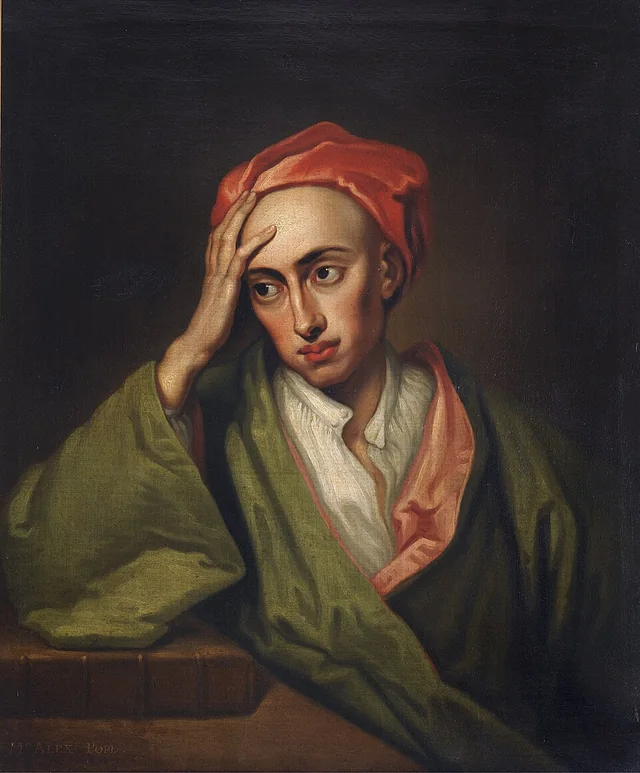
Dryden's political satire and dramatic criticism helped establish a public language of judgement. Pope developed the heroic couplet into a remarkably flexible instrument of argument, praise and attack. In The Rape of the Lock, epic machinery is applied to a social quarrel. The difference in scale creates mock-heroic comedy: the form asks readers to reconsider the importance assigned to fashionable behaviour.
Essays, satire and the novel
Addison and Steele's periodical essays brought a speaking, observant prose voice to a recurring readership. Swift's Gulliver's Travels makes imaginary journeys expose failures in human conduct. Defoe, Richardson and Fielding developed different kinds of prose fiction. It is therefore misleading to describe the whole period as poetry governed by rules.
Johnson and the later century
Johnson's Dictionary appeared in 1755, his edition of Shakespeare in 1765, and his Lives of the Poets in 1779–1781. These works belong to a later moment than Pope's early satire. They connect language, textual judgement and the writer's working life. The later century also gave increasing attention to sympathy, memory, landscape and the Gothic.
What changes within the period?
The broad label does not require every writer to sound alike. Put a Dryden satire, a Pope mock-epic and a Gray elegy beside one another and ask about speaker, audience and purpose. Classical models can be present in each without producing the same emotional effect. The separate Restoration, Augustan and Sensibility chapters provide the narrower historical settings.
Why return to classical writers?
A classical model gives a writer more than an old subject. It offers examples of form, judgement and public purpose. A poet can learn from an earlier poem without describing the same world, just as an essayist can adapt an inherited kind of argument to a new audience. The interesting question is what happens in the adaptation. A model becomes part of a living disagreement about the present.
This helps explain why imitation is not necessarily the opposite of originality. A familiar form can make a new subject visible. It may allow a reader to compare a public claim with an older ideal, or make a small event look absurdly grand. The writer's choice of what to borrow and what to change carries meaning. Classical learning becomes a resource rather than a rule that prevents invention.
The term Neoclassical is therefore most useful when it leads to a question about a particular work. Which model matters here? What effect does the borrowed form create? Does the new work honour the earlier example, alter it or use it to expose a difference? Those questions are more precise than saying every writer valued reason.
The couplet can make a thought feel complete
A heroic couplet joins two rhyming lines of iambic pentameter. Its pairing can give an argument a clear shape: an assertion meets an answer, a claim meets a qualification, or two balanced phrases bring a difference into view. The sound helps a reader hear a relation between ideas. Form is doing part of the intellectual work.
Yet not every couplet closes the thought in the same way. A sentence may continue beyond the pair, or a neat verbal balance may expose something that is not balanced in life. Reading aloud helps make those choices audible. Notice where a pause feels expected and whether the sentence confirms or resists it. The pattern supplies possibilities, not an automatic effect.
This is useful when comparing Dryden and Pope. Both can make verse think, but an account should explain the movement of the particular passage. Does the wit depend on a sudden change of scale, a carefully placed name or an apparently obvious judgement? The answer connects a technique with a purpose instead of leaving heroic couplet as an isolated definition.
Mock-heroic writing changes the size of an event
The Rape of the Lock provides a memorable example of a small social event treated with the resources of epic. That change of scale is the point. The elevated machinery makes a fashionable world look both brilliant and absurd, inviting a reader to ask how much importance its members give to their concerns. The poem's pleasure and its criticism are closely connected.
Mock-heroic does not simply mean making fun of a hero. It concerns the relation between form and subject. A reader recognises the grand manner and notices the disproportion. To explain the effect, identify the kind of elevation involved and the event being elevated. A general statement that the poem is funny misses the mechanism that produces the humour.
The same habit of comparing claims with their actual scale helps connect satire across the period. Writers ask what happens when pride, power or reputation grows beyond reasonable limits. Their targets differ, and so do their forms. The connection lies in an act of judgement, not in the assumption that satire must always sound angry.
An essay can create a companion for the reader
The periodical essay offers a different relation to an audience. It returns regularly, often through an observing voice that seems familiar over time. That voice can comment on a custom, introduce a character or turn a small encounter into a question about conduct. The form makes literary discussion part of a reader's recurring life.
Ask how the speaking persona builds trust. Does it claim modesty, learning, good sense or access to a particular social world? Such features are part of the writing rather than neutral qualities floating outside it. A reader can enjoy the voice and still examine its assumptions. The apparent ease of the prose may rest on careful organisation.
The connection with the coffeehouse is useful because both involve discussion among people receiving news and opinions. But the printed essay can reach someone absent from the actual room. It helps create a public conversation through reading. The audience is larger than the people whom the writer can address face to face.
The novel changes the scale of moral judgement
A brief satire can expose a fault quickly; a novel can follow a choice through time. A reader sees what a character expects, what the surrounding world permits and how the result differs from the intention. This gives prose fiction a distinct part in the century's interest in conduct. The form can test a judgement by making a life develop around it.
The rise of the novel should not be described as a single invention completed by one writer. Defoe, Richardson and Fielding offer different methods, while women writers help shape the field. Letter form, narrative commentary and the account of everyday experience create different relations between character and reader. Those differences are the substance of literary history, not details to be removed from a simple timeline.
Compare a judgement made by a narrator with one you form from an action. Do they agree? If not, the reader has work to do. Fiction can encourage sympathy while leaving conduct open to criticism. This makes the later interest in sensibility easier to understand as part of the century's development rather than an entirely foreign subject arriving from nowhere.
Johnson and the need to examine the evidence
A dictionary, an edition and a critical life have different immediate tasks. Together, Johnson's work shows the importance of looking closely at language, texts and the circumstances of writing. Literary judgement is not only a matter of announcing taste. It can depend on the meaning of a word, the choice between readings or the relation between a writer's work and working life.
This part of the century also makes a useful bridge to modern study. We still need definitions, reliable texts and accounts of literary careers. The tools have changed, but the underlying questions remain: what does the passage say, what evidence supports the reading, and how far should a conclusion be taken? The Neoclassical period includes that work of careful examination as well as its memorable wit.
A connection worth keeping
The period's interest in judgement links the stage, the essay, the poem and the novel. Each form gives a reader or audience a different position from which to assess conduct. That variety is the reason to study the broad frame alongside its narrower ages, rather than use one label to make every work sound alike.
Key terms
- Heroic couplet - two rhyming lines of ten syllables each, the main verse form of the age.
- Satire - writing that attacks vice or folly through ridicule.
- Mock-heroic - a poem that treats a small or silly subject in the grand style of an epic.
Writers and works
| Writer | Works | What to remember |
|---|---|---|
| Alexander Pope | The Rape of the Lock | Mock-heroic satire |
| Joseph Addison and Richard Steele | The Spectator | Periodical essay |
| Samuel Johnson | A Dictionary of the English Language (1755) | Language and literary judgement |
Important points to remember
- The timeline uses 1660–1785 for this chapter. Literary boundaries are approximate.
- Check the date of a work separately from its writer's lifetime.
- Read this chapter alongside the wider period guide when comparing neighbouring ages.
Quick revision - 14 points
Open the 14 pointsClose the list
- Charles II — Charles II rode into London on 29 May 1660 and began the Restoration.
- Davenant and Killigrew — Each of the two men received a patent giving his company the sole right to stage plays.
- To accept the Book of Common Prayer — About 2,000 ministers who refused were driven from their churches, by Baxter's estimate.
- Samuel Pepys — Pepys kept his diary until 1669 and recorded the plague and the Great Fire.
- The Pilgrim's Progress — Grace Abounding is his own life story, while The Pilgrim's Progress turns it into an allegory.
- MacFlecknoe — MacFlecknoe crowns Shadwell the heir of the dull poet Flecknoe.
- Keeping the Catholic Duke of York from the throne — The struggle ran from 1679 to 1681 and produced the Whigs and the Tories.
- Heroic plays — It copied the grand speeches of heroic plays until they sounded silly.
- Bombay — Catherine of Braganza's dowry included Bombay, which Charles handed to the East India Company in 1668.
- All for Love — Dryden wrote it in 1677 and claimed to follow Shakespeare while tidying the plot.
- The Earl of Rochester — Rochester attacked the idea that human reason can be trusted.
- The Glorious Revolution — James II fled, and William and Mary were crowned together in 1689.
- The Man of Mode — Etherege wrote it in 1676.
- His wine and a Parmesan cheese — Pepys and Sir William Penn dug a pit and put the wine and cheese in it.
Quick quiz - 19 questions
Tap an answer to see at once if it is right. You do not need to log in.
Open the 19 questionsClose the quiz
1Which king came back to England in 1660?
Answer: B. Charles II rode into London on 29 May 1660 and began the Restoration.
2Who held the two royal patents to stage plays in London after 1660?
Answer: A. Each of the two men received a patent giving his company the sole right to stage plays.
3What did the Act of Uniformity of 1662 require of ministers?
Answer: D. About 2,000 ministers who refused were driven from their churches, by Baxter's estimate.
4Which writer began a famous diary in January 1660?
Answer: C. Pepys kept his diary until 1669 and recorded the plague and the Great Fire.
5Which work by Bunyan is an allegory in which Christian travels to the Heavenly City?
Answer: A. Grace Abounding is his own life story, while The Pilgrim's Progress turns it into an allegory.
6Which poem by Dryden mocks Thomas Shadwell?
Answer: A. MacFlecknoe crowns Shadwell the heir of the dull poet Flecknoe.
7What was the Exclusion Crisis about?
Answer: D. The struggle ran from 1679 to 1681 and produced the Whigs and the Tories.
8What did Buckingham's The Rehearsal (1671) make fun of?
Answer: C. It copied the grand speeches of heroic plays until they sounded silly.
9Which Indian port city came to Charles II in his wife's dowry?
Answer: B. Catherine of Braganza's dowry included Bombay, which Charles handed to the East India Company in 1668.
10Which play by Dryden retells the story of Antony and Cleopatra in blank verse?
Answer: D. Dryden wrote it in 1677 and claimed to follow Shakespeare while tidying the plot.
11Who wrote A Satyr against Mankind (1675)?
Answer: A. Rochester attacked the idea that human reason can be trusted.
12Which event of 1688 brought William III and Mary II to the throne?
Answer: D. James II fled, and William and Mary were crowned together in 1689.
13Which comedy of manners features Dorimant and Sir Fopling Flutter?
Answer: A. Etherege wrote it in 1676.
14What did Pepys bury in his garden to save it from the Great Fire?
Answer: D. Pepys and Sir William Penn dug a pit and put the wine and cheese in it.
15What creates the mock-heroic effect in The Rape of the Lock?
Answer: C. The disproportion between form and subject produces humour and criticism.
16What can a regular periodical essay create for its audience?
Answer: D. Repeated publication can make commentary part of a reader's habits.
17Why can imitation be creative?
Answer: A. The choice of what to retain and alter can carry new meaning.
18What can a novel do differently from a brief satire?
Answer: B. Long narrative gives moral judgement another scale.
19Which three stages fit inside this timeline's broad Neoclassical frame?
Answer: C. The umbrella period includes several narrower phases.
Frequently asked questions
Does this chapter use exact historical boundaries?
The dates are the timeline's study convention. Language, literary forms and writers' careers can cross them. Use the date of the particular work when a question asks about a narrower age.
Where can I read the wider historical context?
The full period guide contains the longer background. This chapter concentrates on the age named above and keeps its own revision and practice sections.
Are these pictures historical documents?
The artwork is illustrative. Captions identify representative or imagined scenes and modern painted interpretations; those images are not evidence that the pictured scene happened exactly as shown.
How should I use the quiz?
Read the explanations after answering. Questions about earlier events or later criticism are background questions, not claims that every named date falls inside the chapter's boundaries.
Sources and further reading
The relevant background, text references and public practice material are retained from the original restoration age guide. Publication dates, authorship and period boundaries should be checked against the source editions listed there.
Afsar Khan, Ph.D. English
Test your knowledge
Check what you have learned with quizzes and MCQs.