

On this page
- The world of this age
- The language
- How writing reached readers
- Drama and the masque
- Poetry
- Criticism and scholarship
- Literature in focus
- A courtly poem does not make time disappear
- Herbert: faith as a developing conversation
- Milton's early poetry and the work of judgement
- Public argument reaches the printed page
- What passes into the Commonwealth?
- Reading the contrast without forcing a conclusion
- Key terms
- Writers and works
- Important points to remember
- Quick revision - 10 points
- Quick quiz - 15 questions
- Frequently asked questions
- Sources and further reading
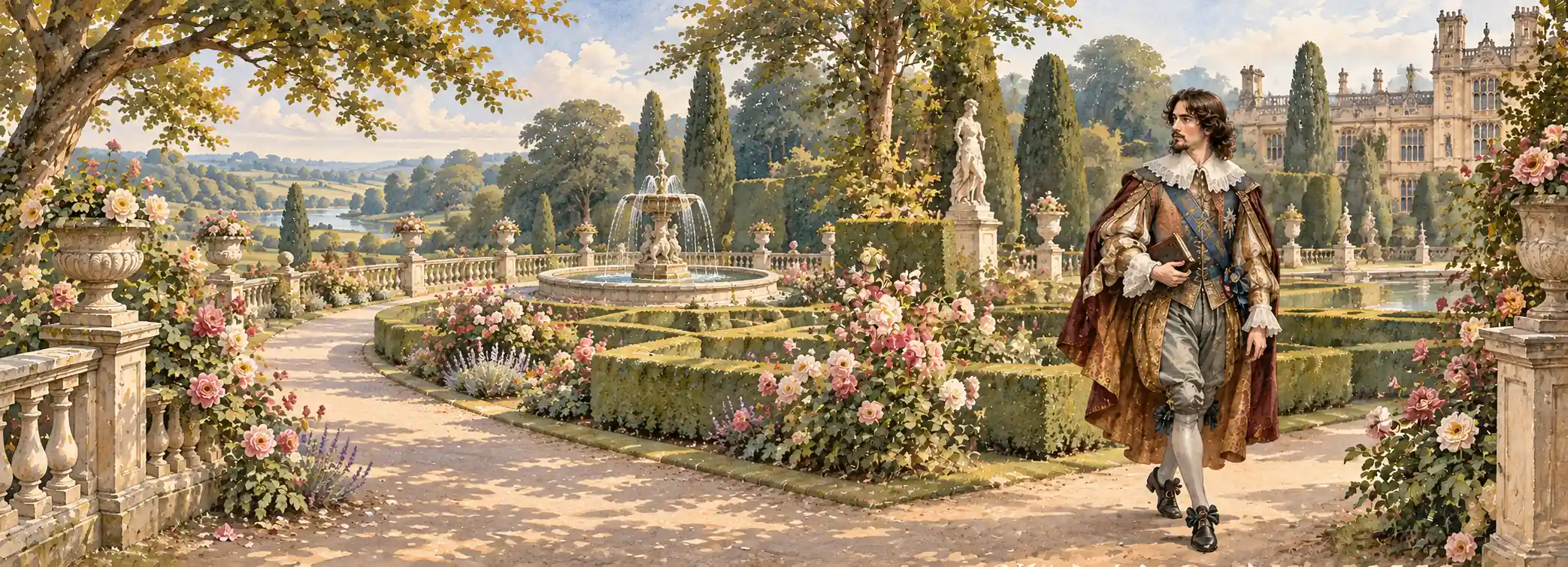
The Caroline age inherits the theatres, court entertainments and poetic arguments of the Jacobean years. Yet the setting grows more divided. Charles I's court presents images of order while political and religious disagreements put that order under pressure. The literature cannot be reduced to a single mood. A Cavalier lyric may urge a lover to enjoy the present; Herbert turns inward to examine faith; Milton gives an apparently private poem a wider moral force. Keep the contrast between public order and private doubt in view. The Civil War changes the conditions in which writers work, but it does not stop them writing. It makes their choices of form, audience and loyalty harder to separate.
The Caroline age takes its name from Charles I, whose reign ended with his execution in 1649. Courtly verse remained important, while conflict between king and Parliament grew toward civil war. The date label describes a political reign; writers and styles did not all begin or end with it.
The world of this age
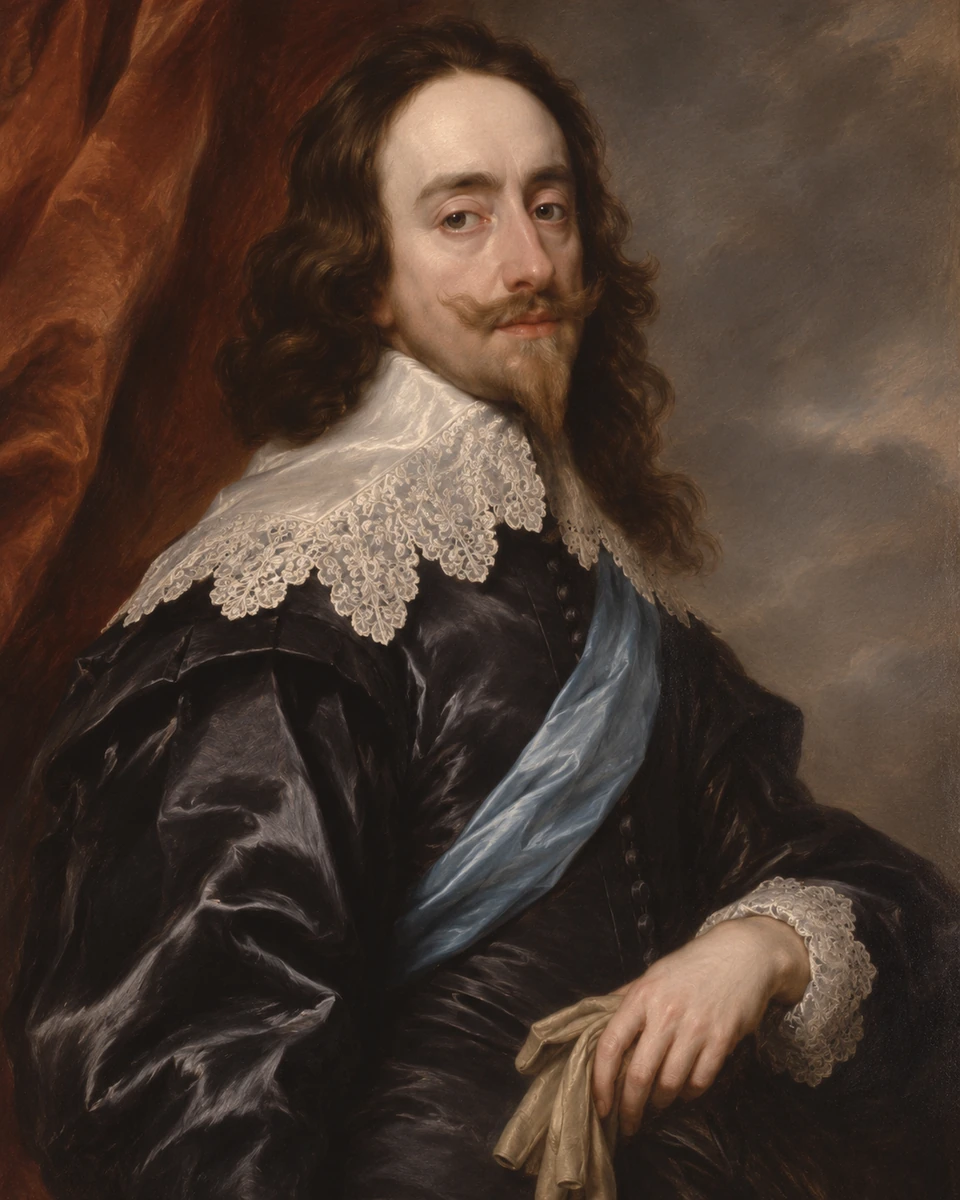
Charles I became king in 1625. He was shy, serious and a fine judge of paintings. He shared his father's belief in royal power, but he lacked his father's skill at avoiding open quarrels. In the same year he married Henrietta Maria, a French Catholic princess, which made many Protestants uneasy. His favourite minister, the Duke of Buckingham, led military expeditions that failed, and Parliament hated him. In 1628 Buckingham was stabbed to death by a discontented officer, and in the same year Parliament forced Charles to accept the Petition of Right, which said that the king could not tax without consent or jail people without cause. A year later Charles sent Parliament home and ruled alone for eleven years. To find money he revived old taxes. The most hated was Ship Money, once paid only by port towns to keep the navy ready, which from 1635 he demanded from inland counties as well.
The crisis came from Scotland. In 1637 Charles and his Archbishop of Canterbury, William Laud, tried to force a new Prayer Book on the Scottish church. To Scottish Presbyterians it looked too close to Catholic worship. They signed the National Covenant in 1638 and raised an army. Charles needed money to answer them, so in 1640 he had to call Parliament again. The first, the Short Parliament, refused to help and was dismissed in three weeks. The second, the Long Parliament, met in November 1640 and attacked the king's advisers. His chief minister, the Earl of Strafford, was executed in 1641. In January 1642 Charles walked into the House of Commons with armed men to arrest five members, but they had already escaped. After that, neither side trusted the other. In August 1642 Charles raised his royal flag at Nottingham, and the Civil War began.
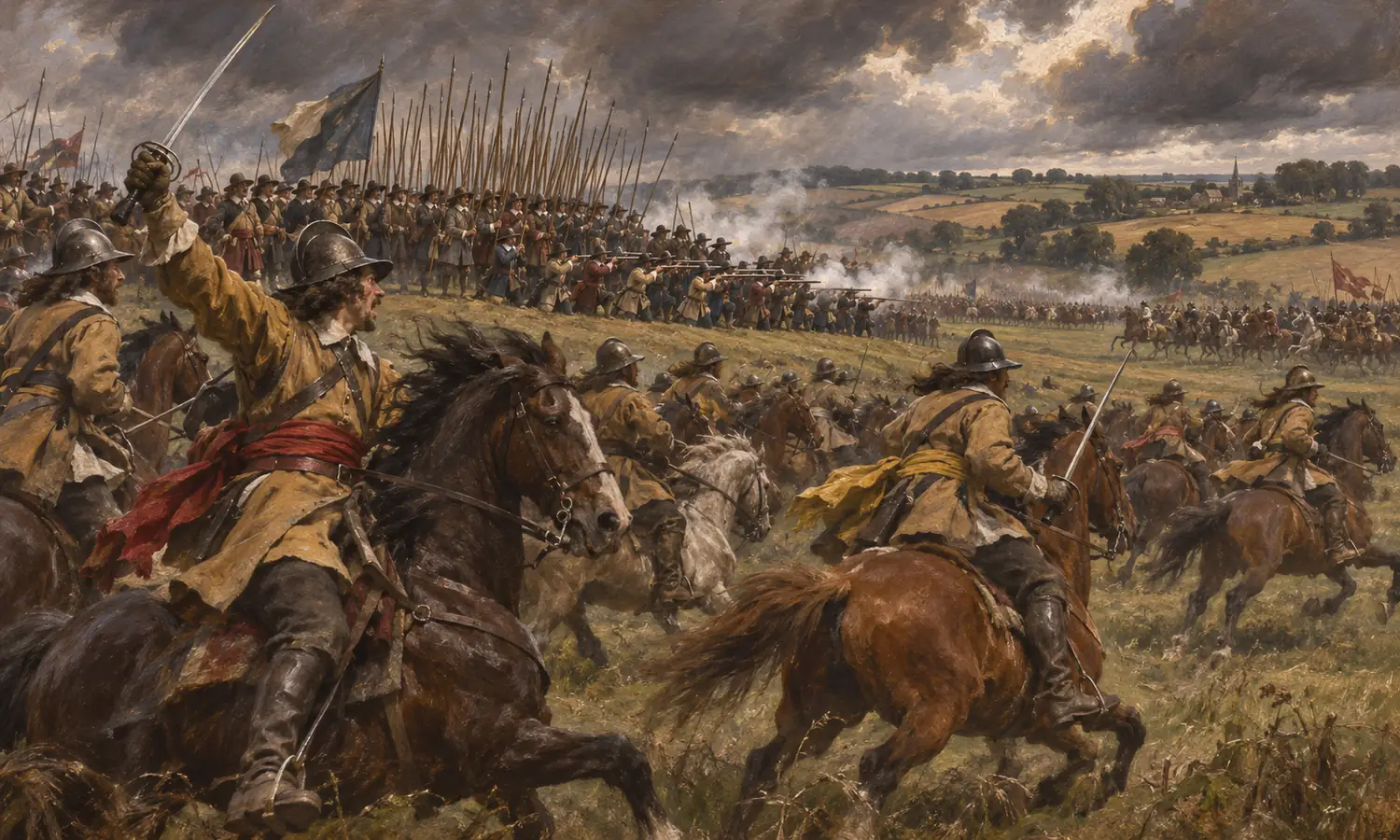
Supporters of the king were called Cavaliers, and supporters of Parliament were nicknamed Roundheads. Parliament built a disciplined force, the New Model Army, which crushed the royal army at Naseby in June 1645. Charles surrendered in 1646 but kept making secret deals, and a second war broke out in 1648. The army then removed the members of Parliament who wanted peace with him, and the rest set up a court. On 30 January 1649 Charles was beheaded outside the Banqueting House at Whitehall.
London was by far the largest city in England, and it was growing fast as people left their villages to look for work. Streets were crowded, and disease spread easily. When James came to the throne, plague was killing thousands of Londoners, his coronation was held with little ceremony, and the theatres stayed closed for many months. Plague returned in 1625 and again in the 1630s, and each time the playhouses shut their doors.
Society was divided into clear ranks. At the top stood the king and the great lords. Below them came the gentry, who owned land and ran the counties, then merchants, craftsmen and farmers, and a large body of labourers and servants. Rank decided a person's clothes, schooling and manners. Girls were mostly taught at home to run a household, few learned Latin, and a married woman had very few rights under the law. Even so, a small number of women found ways to write and publish.
A young gentleman's education followed a clear path. First came grammar school, then Oxford or Cambridge, and then the Inns of Court in London, where law was studied. The Inns were also clubs for young wits. Students went there to learn manners, make friends, watch plays and write verse. John Donne, Francis Beaumont and John Ford all spent time at them.
Under Charles, the Church changed again. Archbishop Laud wanted churches to be orderly and beautiful, with railed altars and rich ceremony. Puritans saw this as a step back toward Rome. Many left, and in 1630 a large group sailed to found the Massachusetts Bay Colony. Those who stayed won power in Parliament, and in the 1640s they set out to change the Church and everyday life.
The language
The English of these years is called Early Modern English. It is the language of Shakespeare and the King James Bible. It is close enough to read today, but spelling had no fixed rules, and people still used "thou" and "thee" for close friends, for inferiors and for God. The language was also growing fast. It had borrowed words from Latin, Greek, French and Italian, and many readers felt lost among them. In 1604 a schoolmaster named Robert Cawdrey published A Table Alphabeticall, a small list of hard English words with plain meanings. It is regarded as the first English dictionary.
Writers chose their styles with care. Jonson and Bacon liked short, firm sentences. Donne wrote as if arguing aloud, with sudden starts. Thomas Browne preferred long, rolling sentences full of Latin words, and Milton shaped English as if it were Latin, with long, balanced sentences.
How writing reached readers
Poems were handled differently. Gentleman poets often thought it undignified to print their verse, so poems were copied by hand and passed among friends. Many of Donne's poems were read this way for years, and they were printed only in 1633, two years after his death.
Drama and the masque
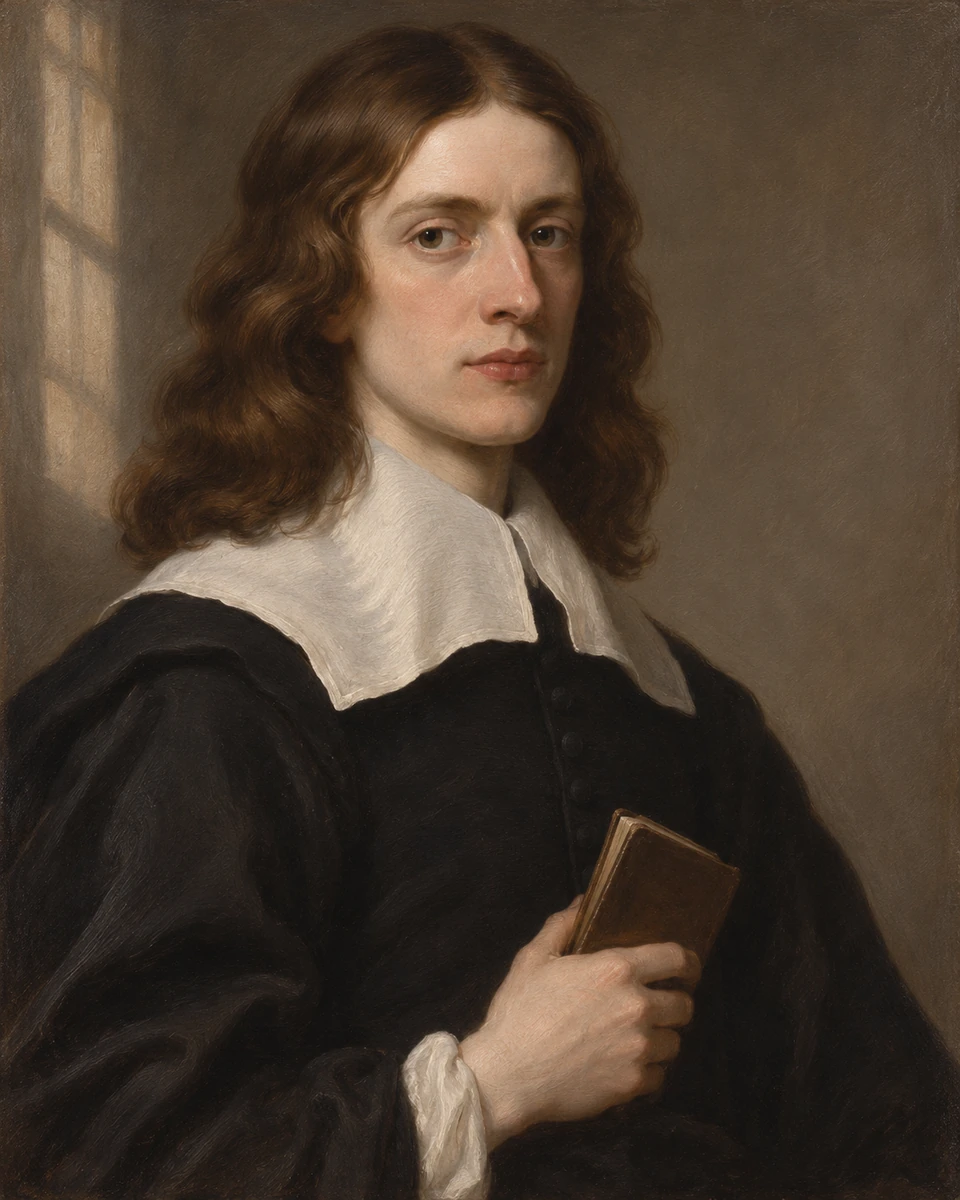
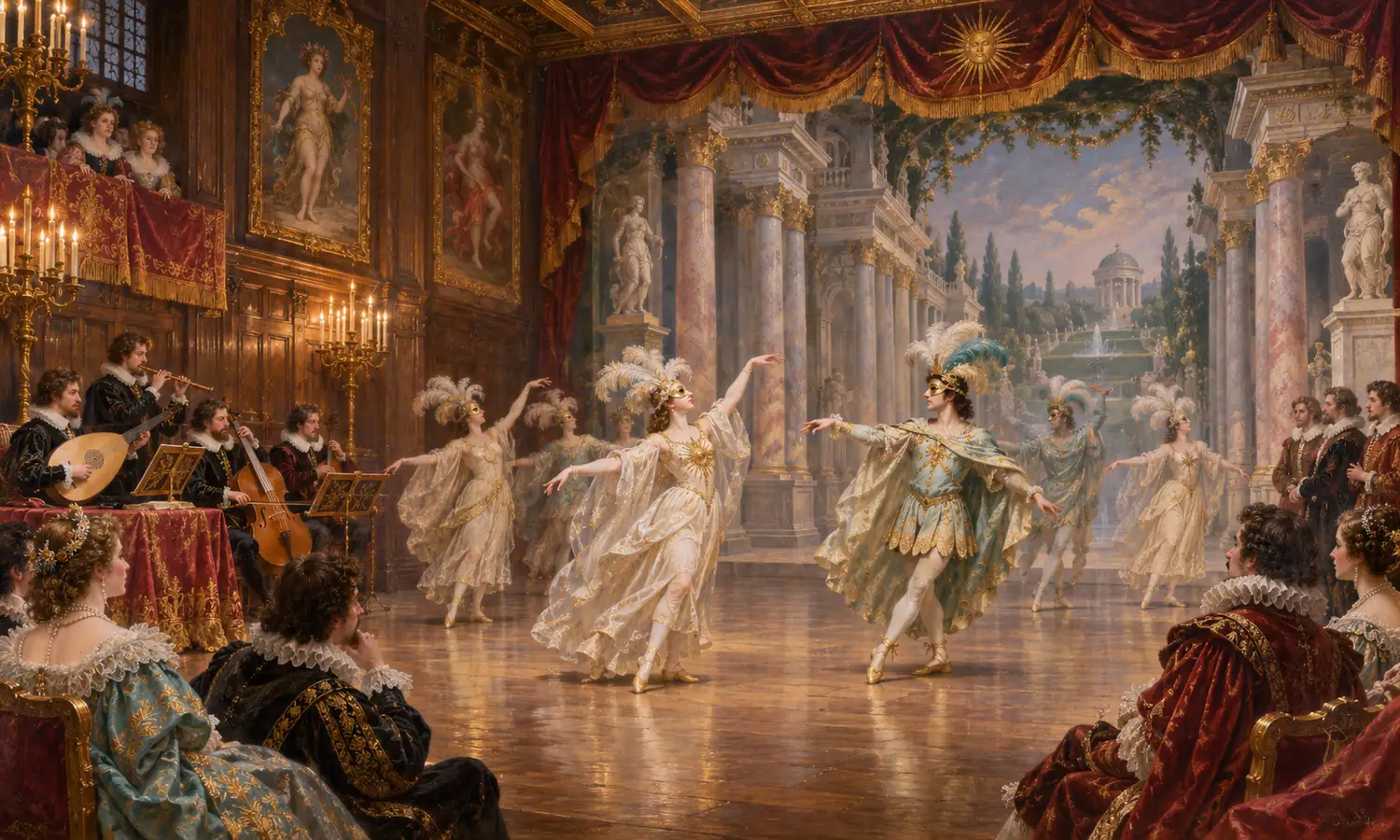
When Charles I became king, the stage grew more polished and more tied to the court. Charles and Henrietta Maria liked graceful plays about love and honour. Philip Massinger wrote A New Way to Pay Old Debts (about 1625), whose greedy villain, Sir Giles Overreach, became a favourite role. John Ford wrote tragedies of forbidden love, such as 'Tis Pity She's a Whore, and James Shirley wrote comedies about fashionable London life. Meanwhile, Puritan dislike of the stage was growing. William Prynne's huge book Histriomastix (1633) attacked plays and actors. Since the queen herself liked to act in court shows, the book was taken as an insult to her, and Prynne was severely punished. Nine years later, Parliament ordered public plays to stop.
Poetry
George Herbert wrote with the same wit but a quieter voice. He came from a noble family, studied at Cambridge, and hoped for a career at court. When those hopes faded, he became a priest and served the small parish of Bemerton, near Salisbury, from 1630 until his death in 1633. His poems describe a private quarrel and friendship with God. Many are plain and tender, and some, such as "Easter Wings", are shaped on the page like the wings they describe. According to his friend Izaak Walton, Herbert sent his poems from his deathbed to his friend Nicholas Ferrar, saying that they could be published if they might help any poor soul, and otherwise burned. Ferrar published them as The Temple in 1633.
Another group of poets belonged to the court. The Cavalier poets, Thomas Carew, Sir John Suckling, Richard Lovelace and Robert Herrick, were gentlemen who served or admired Charles I. They were followers of Ben Jonson, and were sometimes called the "sons of Ben". Their verse was short, polished and light, and its themes were love, wine, loyalty and the fast passing of time. Herrick's famous advice, "Gather ye rosebuds while ye may", is an example of carpe diem, Latin for "seize the day". Suckling teased a pale lover with "Why so pale and wan, fond lover?" When war came, their loyalty was tested. In 1642 Lovelace was jailed for presenting a petition to Parliament in favour of the king, and in prison he wrote "To Althea, from Prison", which says that stone walls cannot make a prison for a free and loving mind. Herrick's Hesperides was published in 1648, in the middle of the war.
John Milton belonged to neither group. He studied at Cambridge and spent years in quiet study, planning to become a great poet. He wrote "On the Morning of Christ's Nativity" in 1629, a masque called Comus (1634) for the family of the Earl of Bridgewater at Ludlow Castle, and in 1637 "Lycidas", a poem of grief for a Cambridge friend, Edward King, who drowned in the Irish Sea. "Lycidas" is also an attack on corrupt clergy, a sign of the political storm to come. Then war came, and Milton put his great poem aside and wrote mostly prose for the Puritan cause. Paradise Lost (1667) belongs to the next age.
Criticism and scholarship
The name "metaphysical" began as a complaint. In 1693 John Dryden said that Donne showed off his learning and filled the minds of ladies with hard ideas when he should have been winning their hearts. In 1779, in his Life of Cowley, Samuel Johnson used the word metaphysical for a whole group of poets. He admired their learning but disliked their conceits, saying that in them "the most heterogeneous ideas are yoked by violence together".
For about two centuries Donne was little read. Then in 1921 H. J. C. Grierson published an anthology, Metaphysical Lyrics and Poems of the Seventeenth Century, and T. S. Eliot reviewed it in an essay, "The Metaphysical Poets". Eliot argued that these poets could feel a thought as directly as the smell of a rose, and that this power was lost after the seventeenth century, a change he called a "dissociation of sensibility". He blamed Milton and Dryden in part. His essay made Donne a favourite of modern poets and readers.
Later critics deepened the study. William Empson's Seven Types of Ambiguity (1930) showed how many meanings a line of Donne or Herbert could hold. Cleanth Brooks, in The Well Wrought Urn (1947), read Donne's "The Canonization" as a lesson in paradox. Rosemond Tuve's A Reading of George Herbert (1952) placed Herbert's images within Christian tradition. Helen Gardner's Penguin anthology The Metaphysical Poets (1957) introduced many students to the group.
Literature in focus
A reign divided by war
The Caroline period follows Charles I from 1625 to 1649. Court entertainment, religious disagreement and political conflict belong to the same setting, but they should not be collapsed into one mood. A court masque presents order through music, costume and performance; a civil-war pamphlet is addressed to a world in which that order is fiercely disputed.
Poetry beyond a single school
The Cavalier poets are associated with courtly wit and royalist loyalties. Herbert's devotional poetry has a different purpose, while Milton's early poems do not fit neatly into either group. The headings are useful for comparison, but the poem itself should decide an interpretation. Carpe diem, for example, is an invitation to act before time passes; it is a theme rather than a complete description of every Cavalier poem.
Prose and the freedom to argue
Milton's Areopagitica appeared in 1644, during the Civil War and before the Commonwealth. It answered the system of licensing books before publication. It therefore belongs in this period's prose discussion even though Milton later served the republican government. Moving all of his prose into 1649–1660 would lose that important sequence.
The boundary at 1642
The order against public stage plays came in 1642, not in 1649. It separates the theatrical conditions of the early reign from the years of war. The end of a public performance system did not end poetry, reading or religious prose. The subsequent Commonwealth chapter examines those continuing forms under a different government.
A courtly poem does not make time disappear
The shortness of a Cavalier lyric can be misleading. A brief invitation to enjoy life may rest on an urgent awareness that pleasure will pass. Carpe diem is powerful because the present cannot be kept. The poem's graceful surface can therefore carry a serious pressure underneath it. Love, beauty and celebration become more intense when time makes them uncertain.
A good reading separates the speaker's wish from the poem's whole effect. The speaker may ask someone to act now, but a reader can still question the argument. Is the appeal generous, anxious or self-interested? Does the reminder of time open freedom or create pressure? The lyric becomes more interesting when those possibilities are allowed to coexist.
Courtly polish also does not prove that the surrounding world was calm. The Caroline years contain deep political conflict. A poem's chosen setting may offer a temporary order that is valuable precisely because life outside it is unstable. This is a connection to consider, not a rule that every flower or feast must secretly stand for the Civil War. Begin with what the text actually gives you.
Herbert: faith as a developing conversation
Herbert's devotional poetry often makes belief feel like an encounter. A speaker may resist, complain, hesitate or discover that a confident argument has reached its limit. The resulting poem does not simply announce a settled doctrine. It allows a reader to experience a movement of feeling and understanding. That movement gives the writing a dramatic quality even when there is only one visible speaker.
Look at the relation between simplicity and difficulty. A plain word can carry a large emotional demand, while a small image can organise a difficult spiritual question. A poem need not use obscure vocabulary to be intellectually serious. Herbert is especially useful for seeing how everyday language and a carefully shaped form can work together.
The appearance of a poem on the page can matter too. In a shaped poem, the visible arrangement helps direct attention toward the relation between bodily form and spiritual experience. Do not stop with the observation that the poem looks like something. Explain how the reader moves through the lines and how that movement supports the thought.
Milton's early poetry and the work of judgement
A masque is made for performance, but its moral questions can extend beyond the occasion. Comus places choices about desire and self-command within a dramatic situation. To understand such a work, ask what kind of temptation is being presented and how the language tries to make it persuasive. A wrong choice is more dramatically interesting when the argument for it has force.
Lycidas gives another form to the relation between a particular occasion and a wider judgement. The death of Edward King provides the occasion for grief, while the poem also considers poetic work and religious responsibility. A pastoral elegy does not simply report a death in disguised language. It uses an inherited form to explore what that loss makes the writer question.
Keep these early works distinct from Milton's later epic. A writer's career can link several political periods, but the works do not all belong to the same moment. The difference between the Caroline poems, the prose of the Civil War and the later publication of Paradise Lost helps us see development without turning the author's entire life into one undivided age.
Public argument reaches the printed page
Areopagitica belongs to the world of licensing and print. Its importance comes partly from asking what a society loses when books must be approved before they can appear. Read its argument through the relation between truth and encounter. A belief protected from every challenge may not have been tested in the same way as a belief examined through disagreement.
The historical setting must remain visible. Milton's work is not a simple copy of a modern statement of unrestricted rights. A serious account should explain the particular system he addresses and then consider the argument he makes against it. Keeping that context protects us from praising the work through claims it does not actually make.
The connection with the earlier Jacobean world is clear: prose, poetry and performance remain ways of testing a position. The political pressure changes who can speak, where work circulates and what a writer risks. Form is not separate from that life, yet a poem or pamphlet still needs to be understood through its particular language and purpose.
What passes into the Commonwealth?
The end of Charles I's reign changes government, but writers carry earlier forms and arguments forward. Devotional verse continues, Milton continues to write prose, and readers still encounter work produced before the war. The closure of public theatres creates a break in one institution rather than the disappearance of every literary activity.
This prepares a useful comparison with the following chapter. Ask which conditions have changed and which resources remain available. That question makes the movement between ages concrete. It also prevents the misleading idea that a change of political label requires poets, readers and the English language to begin again from nothing.
Reading the contrast without forcing a conclusion
Place a short Cavalier lyric beside a devotional poem by Herbert. Both may be carefully made and direct in address, yet the desired response can be very different. One speaker may seek another person's agreement; the other may struggle to understand an obligation within faith. Compare the movement of the argument before applying the school names.
The result is a fuller account of the Caroline age. Political pressure surrounds the writing, but it does not produce only one poetic voice. The poems ask readers to move between pleasure, loss, conscience and hope. Their shared historical setting becomes meaningful because it contains those differences.
Key terms
- Cavalier - a supporter of Charles I in the Civil War, and the name for the court poets of his time.
- Masque - a court entertainment of music, dance, costume and scenery.
- Conceit - a surprising comparison that is stretched far and worked out with logic.
- Carpe diem - Latin for "seize the day", a theme urging people to enjoy life while it lasts.
Writers and works
| Writer | Works | What to remember |
|---|---|---|
| Thomas Carew | Poems | Courtly lyric |
| Richard Lovelace | To Althea, from Prison | Liberty, loyalty and confinement |
Important points to remember
- The timeline uses 1625–1649 for this chapter. Literary boundaries are approximate.
- Check the date of a work separately from its writer's lifetime.
- Read this chapter alongside the wider period guide when comparing neighbouring ages.
Quick revision - 10 points
Open the 10 pointsClose the list
- Charles I — Caroline comes from Carolus, the Latin form of Charles.
- Public stage plays must stop — The order said plays should cease while the "sad causes" of the war lasted.
- A surprising comparison worked out at length — Donne's comparison of lovers to the legs of a pair of compasses is a famous example.
- George Herbert — Herbert's friend Nicholas Ferrar published the poems after his death.
- "To Althea, from Prison" — Lovelace had been jailed for presenting a petition in favour of the king.
- Robert Herrick — Herrick also wrote "Gather ye rosebuds while ye may".
- A Cambridge friend, Edward King — Edward King drowned in the Irish Sea.
- 1644 — Milton’s licensing argument belongs to the Civil War before the Commonwealth.
- Seize the day — The phrase expresses an invitation to act before time passes.
- The Commonwealth — Charles I’s execution in 1649 marks the political boundary.
Quick quiz - 15 questions
Tap an answer to see at once if it is right. You do not need to log in.
Open the 15 questionsClose the quiz
1The word "Caroline" in this age refers to the reign of which king?
Answer: A. Caroline comes from Carolus, the Latin form of Charles.
2What did Parliament order on 2 September 1642?
Answer: A. The order said plays should cease while the "sad causes" of the war lasted.
3What is a conceit?
Answer: D. Donne's comparison of lovers to the legs of a pair of compasses is a famous example.
4Which poet wrote The Temple, printed in 1633?
Answer: B. Herbert's friend Nicholas Ferrar published the poems after his death.
5Which poem was written by Richard Lovelace while he was in prison in 1642?
Answer: A. Lovelace had been jailed for presenting a petition in favour of the king.
6Which Cavalier poet wrote Hesperides, published in 1648?
Answer: C. Herrick also wrote "Gather ye rosebuds while ye may".
7Milton's "Lycidas" (1637) mourns the death of whom?
Answer: D. Edward King drowned in the Irish Sea.
8When was Areopagitica published?
Answer: D. Milton’s licensing argument belongs to the Civil War before the Commonwealth.
9What does carpe diem mean?
Answer: A. The phrase expresses an invitation to act before time passes.
10Which period follows the Caroline reign on this timeline?
Answer: B. Charles I’s execution in 1649 marks the political boundary.
11Why can carpe diem poetry carry urgency beneath its polish?
Answer: C. The invitation to enjoy the present depends on its not lasting forever.
12What is useful to follow in Herbert's devotional poetry?
Answer: D. The speaker can question, resist and change within a poem.
13Who is mourned in Milton's Lycidas?
Answer: A. The death supplies the occasion for a pastoral elegy.
14Which question helps explain a masque's moral action?
Answer: B. The argument offered within the action is part of its dramatic force.
15What did the theatre closure interrupt most directly?
Answer: C. Literary work continued in other forms and settings.
Frequently asked questions
Does this chapter use exact historical boundaries?
The dates are the timeline's study convention. Language, literary forms and writers' careers can cross them. Use the date of the particular work when a question asks about a narrower age.
Where can I read the wider historical context?
The full period guide contains the longer background. This chapter concentrates on the age named above and keeps its own revision and practice sections.
Are these pictures historical documents?
The artwork is illustrative. Captions identify representative or imagined scenes and modern painted interpretations; those images are not evidence that the pictured scene happened exactly as shown.
How should I use the quiz?
Read the explanations after answering. Questions about earlier events or later criticism are background questions, not claims that every named date falls inside the chapter's boundaries.
Sources and further reading
The relevant background, text references and public practice material are retained from the original jacobean and caroline age guide. Publication dates, authorship and period boundaries should be checked against the source editions listed there.
Afsar Khan, Ph.D. English
Test your knowledge
Check what you have learned with quizzes and MCQs.