


On this page
Imagine a student returning from college on a crowded bus. Every day, she passes the same railway crossing without paying much attention to it. One afternoon, she reads a story in which the closed gate seems to divide the town into two impatient worlds. The author describes the crossing without naming it at first. For a moment, the student sees a familiar place as if she had never seen it before.
Why does the story make the crossing interesting when the crossing itself has not changed? The author could simply have reported that the traffic stopped. Instead, the choice of words and the order of information change the student's experience. These are questions about the way a literary work is made. They lead to a different kind of criticism from one that begins with the author's life.
Russian Formalism is an approach to literature that studies the devices and arrangements that give literary works their particular character. This is the second article in the series on literary theory and cultural studies. It explains how the Russian Formalists studied language, narrative and literary change. It also briefly compares their approach with New Criticism, another tradition of close attention to literary texts.
Where Russian Formalism came from
A new kind of literary study
At the beginning of the twentieth century, young Russian writers were experimenting with language. They wanted poetry to sound different from the writing their readers already knew. Some broke familiar patterns of rhythm and grammar, while others experimented with the sounds of words. These experiments formed part of Russian Futurism, an artistic movement that challenged established forms of art.
Peter Steiner, in his chapter on Russian Formalism in The Cambridge History of Literary Criticism (1995), connects the Formalists with this experimental spirit. Their work developed during the First World War and around the Russian Revolution of 1917. They did not all hold the same opinions. What brought them together was the desire to study literary art through its own distinctive features.
Literary critics had long explained poems through the experiences of their authors. Another approach treated novels as records of society, while some critics looked for philosophical or spiritual truths in literature. The Formalists challenged the idea that any of these explanations could replace the study of literary construction. A novel might describe poverty, for example, but a newspaper article could describe poverty too.
Two centres of the movement
The first major group was the Moscow Linguistic Circle, established in 1915. Roman Jakobson was one of its leading members. Its work brought the study of language into contact with the study of poetry. Its members were interested in how literary expression could be examined using the methods of linguistics, the systematic study of language.
The second group was formed in Petrograd in 1916. It was called the Society for the Study of Poetic Language, commonly known as OPOYAZ. The name comes from its Russian title. Viktor Shklovsky, Boris Eichenbaum and Yuri Tynianov were important figures associated with this group. Its studies often began with the particular methods by which literary works achieve their effects.
The Moscow group stressed linguistic systems, while OPOYAZ concentrated on artistic construction.
In his history of criticism, M. A. R. Habib explains that the Formalists sought a general account of literary techniques. They also wanted to understand how those techniques changed across literary history. This gives their project a wider purpose than the detailed interpretation of a single poem. They hoped to establish a distinct field of literary research with concepts that could be examined and tested.
Art in a changing society
The Russian Revolution brought arguments about the future of art into public life. Questions about literature became closely connected with questions about social change. Habib describes how the Formalists and Futurists shared a platform in the journal LEF, the Left Front of Art. Their attacks on older artistic conventions brought them into contact with revolutionary culture.
Marxist critics challenged the separation of artistic methods from the social conditions that produced them.
By the end of the 1920s, official attitudes towards Formalism had become increasingly hostile. The movement lost its earlier institutional position around 1930. Its ideas did not disappear with its organisations. Some continued in the study of language outside Russia, and others were developed into new accounts of literary history.
Did you know?
The Moscow Linguistic Circle and OPOYAZ were established before the Russian Revolution of 1917. Russian Formalism was therefore already developing when the revolutionary debates about art began.
Important points to remember
- Russian Formalism developed in Russia during the 1910s.
- It was closely connected with the experimental spirit of Russian Futurism.
- The Moscow Linguistic Circle was established in 1915.
- OPOYAZ was founded in Petrograd in 1916.
- Jakobson was a leading member of the Moscow group.
- Shklovsky, Eichenbaum and Tynianov were associated with OPOYAZ.
- Formalism lost its earlier institutional position around 1930.
The core ideas of Russian Formalism
Literariness and the literary device
Roman Jakobson argued that literary study needs an object of inquiry that is specifically literary. He called this quality literariness, the feature that makes a work a work of literature. He used the term in his study of recent Russian poetry, published in 1921. Instead of collecting information about a writer, the critic asks what turns verbal material into literary art.
Consider a simple notice at a railway station. It tells passengers that the train has been delayed. The words have a practical task, and passengers usually stop thinking about them once they understand the message. A poet could take the same situation and arrange words so that their sounds suggest a train's repeated movement. Here the verbal arrangement becomes something to notice in its own right.
A literary device is a method used in constructing a work. Repetition, rhyme, a change of viewpoint and the deliberate withholding of information are examples. The Formalists examine the function of a device rather than simply giving it a name.
This approach also changes the usual distinction between form and content. Form is sometimes treated as a decorative cover around an idea that exists independently of it. For the Formalists, the way material is organised helps create the work itself. Changing that organisation can change the reader's understanding, even when the events or subject remain the same.
Defamiliarization and habitual perception
Shklovsky developed his best-known idea in his essay "Art as Technique" (1917), also translated as "Art as Device". The Russian word ostranenie is usually translated as defamiliarization or making strange. It describes the way art can interrupt ordinary habits of perception. Familiar things are presented in a manner that makes a person attend to them again.
Shklovsky begins from a problem of daily life. An action performed many times can become automatic. A person may walk through a market each morning without noticing the shapes or colours of the things on display. Shklovsky calls attention to the way habit reduces the effort involved in perceiving familiar objects. This process is called automatization.
Art can interrupt this process. A story may describe a ceiling fan from the viewpoint of a child who has never seen one. Its blades might resemble three arms that cannot stop turning. The familiar name of the object is withheld for a time, so readers must work to recognise it. They pay attention to its movement instead of passing quickly over the word fan.
Unexpected expression can slow perception. Difficulty matters when it renews attention, not simply because it is difficult.
Defamiliarization is broader than the use of unusual words. An ordinary sentence can become strange when spoken by an unexpected narrator. Familiar social customs may appear odd when they are described from the viewpoint of someone outside that society. A writer can even make a familiar literary convention strange by deliberately breaking it.
- Habit lets readers pass quickly over the word fan
- A child sees three arms that cannot stop turning
- Readers slow down and notice the movement again
Practical language and the poetic function
An early Formalist distinction is that between practical language, used primarily to communicate information, and poetic language, which draws special attention to its own organisation. This distinction concerns the way language is used. It does not mean that poetry and ordinary speech have entirely separate dictionaries.
Jakobson later developed the idea of the poetic function in "Linguistics and Poetics", published in 1960. In his account, this function directs attention towards the message itself. The reader notices how the words have been chosen and put together. Sound patterns and repeated sentence forms become especially significant when they help organise the message.
Imagine a shopkeeper advertising fresh fruit with a short phrase whose two parts rhyme. The rhyme makes the words easier to remember. Such a phrase has a practical purpose, yet it also displays a poetic function. Jakobson's account allows this function to appear outside literature. In poetry, it generally occupies a dominant position among the functions of language.
Jakobson explains verbal patterns through two activities. Selection means choosing one word from alternatives that could occupy its place. Combination means joining chosen words into a sequence. A poet might choose night rather than evening because night forms a sound pattern with light. A relationship between alternative words now helps organise words appearing together in a line.
Fabula and syuzhet
The Formalists also made a useful distinction between the events of a story and their presentation. The Russian term fabula refers to the underlying sequence of events as reconstructed in their chronological and causal order. Syuzhet refers to the arrangement of those events in the narrative as readers encounter them. English discussions often call these story and plot, though translations can vary.
Imagine a story about a farmer who loses a bag of money. First he visits a bank, then he takes a bus, and finally he notices that his bag is missing. This is the basic order of the events. But a writer could begin with the farmer searching for the bag and describe the earlier journey afterwards. The events remain the same, but the order in which readers learn about them has changed.
A flashback presents an earlier event after a later one. Delaying information can create suspense.
The distinction helps a critic explain why a summary is not a substitute for a story. A summary can remove the delays that make a story interesting. The narrative's method of presenting events is itself part of what needs to be studied.
- Visits the bank
- Takes a bus
- Notices the bag is missing
- Searches for the bag
- The story flashes back to the bank
- The earlier bus ride is shown
Literary change and the dominant
A device may become less striking as readers grow accustomed to it. What once appeared unusual can eventually become a convention, an established way of writing. A later writer may renew an old form by using it differently. This is one way to understand why literary forms change across time.
The later Formalists gave increasing attention to the relations between devices. The idea of the dominant identifies a leading feature that organises other features within a work or a literary system. A strongly patterned rhythm might shape the choice of words in a poem, for example. The dominant is therefore a matter of how parts relate to each other rather than simply which device occurs most often.
Important points to remember
- Literariness is the distinctive quality that makes a verbal work literary.
- A literary device is a method of constructing a work.
- Shklovsky's "Art as Technique" appeared in 1917.
- Defamiliarization interrupts habitual perception.
- Automatization is the process by which familiar perception becomes automatic.
- Jakobson's poetic function directs attention towards the message itself.
- Fabula is the underlying chronological and causal sequence of events.
- Syuzhet is the arrangement of events as presented in a narrative.
- The dominant organises other features within a work or system.
Thinkers and texts
Viktor Shklovsky (1893-1984)
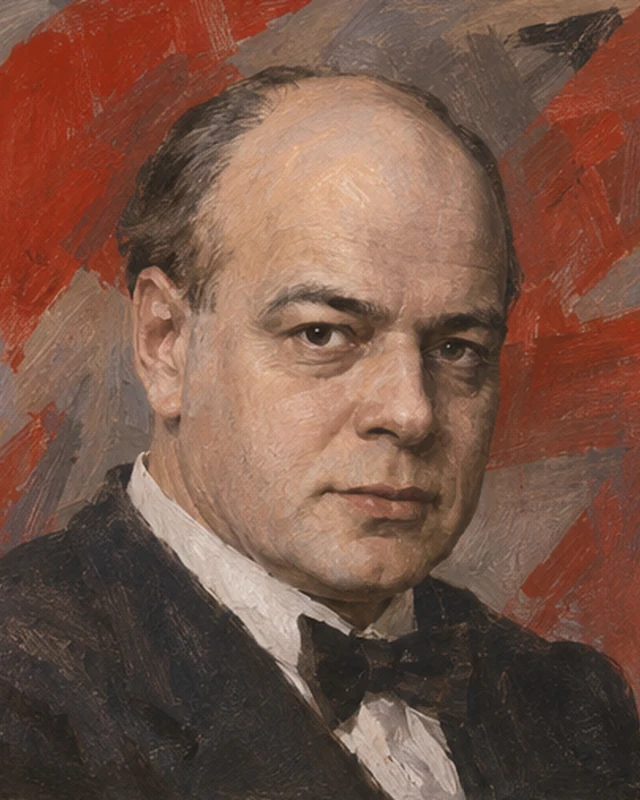
Shklovsky helped establish the Formalist study of artistic devices. In "Art as Technique", he considers the ways writers remove objects from familiar habits of perception. His examples include the work of the Russian novelist Leo Tolstoy. Instead of treating artistic expression simply as a means of expressing ideas, Shklovsky studies the experience produced by its construction.
His book Theory of Prose first appeared in Russian in 1925. It extends the study of artistic devices into narrative fiction. Shklovsky examines how writers arrange incidents and use interruptions or repetitions in their stories.
Roman Jakobson (1896-1982)
Jakobson's research extended beyond Russian Formalism into linguistics and structuralism. His study of recent Russian poetry examined the distinctive organisation of poetic language. Later, he developed a more general account of the different functions of verbal communication. The poetic function was one part of that account.
In "Linguistics and Poetics", Jakobson connects six factors in communication with six functions. The referential function concentrates on the context, while the emotive function concentrates on the speaker. The conative function concerns the person addressed. The phatic function maintains contact, and the metalingual function deals with the code or language being used. The poetic function concentrates on the message itself.
An announcement about the weather may chiefly perform a referential function. A person asking whether a telephone connection is still working mainly checks the channel of communication. A poem may have several of these functions at once. Jakobson's account asks which function governs the organisation of the message.
Boris Eichenbaum (1886-1959)
Eichenbaum set out the changing aims of the movement in "The Theory of the Formal Method" (collected in 1927). He explains how the Formalists began by distinguishing poetic from practical language. Their work then expanded into questions of verse, narrative structure and literary history. His account is useful because it presents Formalism as an evolving investigation rather than a fixed collection of rules.
In his essay "How Gogol's 'Overcoat' Is Made" (1919), Eichenbaum examines Nikolai Gogol's short story about a poor government clerk. He pays special attention to the narrator's verbal performance and the movement between comic and pathetic effects. The Russian term skaz describes narration that imitates the manner of oral storytelling. Such narration makes a reader notice the voice through which the events are presented.
Yuri Tynianov (1894-1943)
Tynianov's essay "On Literary Evolution" (1927) asks how literature changes as a system. A literary work contains elements whose functions depend on their relations to other elements. A similar principle applies to genres and movements within a literary period. New forms can alter the importance and function of older forms.
A letter, for example, may ordinarily belong to personal communication. Within a novel, a series of letters can become the principle by which a story is organised. The literary status and function of a form depend partly on where and how it is used. Tynianov's approach therefore gives literary history more room than a theory concerned only with isolated techniques.
In 1928, Tynianov and Jakobson jointly formulated theses on the study of literature and language. They argued for the study of literary systems and their relationship to historical change. The development of literature cannot be understood merely by counting devices or collecting unrelated facts about literary influences.
Vladimir Propp (1895-1970)
Propp was a Russian folklorist whose methods are closely related to Formalist narrative studies. His Morphology of the Folktale appeared in Russian in 1928. Its first English translation was published in 1958. Morphology here means the study of the structure of the tale and the relations between its parts.
Propp examined Russian wondertales collected by Alexander Afanasyev. He identified 31 possible narrative functions, or actions defined by their role in the progress of the story. A villain might take away something valuable, for instance, and a hero might set out to recover it. Different characters can carry out the same function in different stories.
Not every tale contains all 31 functions. Propp's important claim concerns their relative order when they occur in the kind of tale he studied. His work also distinguishes seven spheres of action, associated with roles such as the villain, donor, helper, dispatcher, hero, false hero and sought-for person with her father. One character may perform more than one role.
Propp's method does not establish a rule that every novel or tale must follow. It describes a particular group of folktales and offers a model for comparison. His work later became an important influence on structuralist studies of narrative.
The Prague Linguistic Circle and Jan Mukařovský (1891-1975)
The Prague Linguistic Circle was founded in 1926. Jakobson took part in its work, alongside Czech scholars including Vilém Mathesius and Jan Mukařovský. It drew on Russian Formalism while developing its own ideas about language and literature. Its work helped connect formal analysis with structuralism, the study of systems of relations.
Mukařovský developed an account of foregrounding, in which a feature of language becomes especially noticeable against familiar usage. In his work on standard language and poetic language, he examines how poetic expression departs from ordinary linguistic expectations. Repetition and parallel patterns can also make expression noticeable. He was interested in the relationship between such features and changing aesthetic norms, or accepted standards of artistic expression.
An interesting story
In December 1928, Yuri Tynianov travelled to Prague, where Roman Jakobson was active in linguistic research. He presented his ideas about literary evolution to the Prague Linguistic Circle on 16 December. Their discussions led towards a joint statement on the problems of studying literature and language. Their joint theses date from 1928 and mark a change in the movement's direction. The two scholars insisted that researchers should investigate systems and historical relationships rather than merely collect examples of techniques. This meeting shows how ideas developed in Russia entered a wider conversation in Central Europe and helped prepare the way for structuralism.
Key terms
- Literariness - the distinctive literary quality of a verbal work.
- Literary device - a method of constructing a literary work.
- Defamiliarization - making the familiar appear strange so it can be perceived afresh.
- Ostranenie - Shklovsky's Russian term for defamiliarization.
- Automatization - the process by which habitual perception becomes automatic.
- Practical language - language used chiefly for practical communication.
- Poetic language - language whose artistic organisation draws attention to itself.
- Poetic function - the function of language that focuses attention on the message itself.
- Selection - choosing a word from possible alternatives.
- Combination - putting selected words together in a sequence.
- Fabula - events reconstructed in chronological and causal order.
- Syuzhet - the arrangement of events in a narrative.
- Flashback - the presentation of an earlier event after a later one.
- Dominant - a leading feature that organises other features within a system.
- Skaz - narration that imitates oral storytelling.
- Morphology - the study of structure and the relations among its parts.
- Narrative function - an action defined by its role in the progress of a story.
- Foregrounding - making language or another artistic feature stand out against expectations.
Important points to remember
- Shklovsky's Theory of Prose first appeared in 1925.
- Jakobson described six functions of language.
- Eichenbaum examined the oral style of Gogol's narration.
- Tynianov published "On Literary Evolution" in 1927.
- Jakobson and Tynianov wrote joint theses in 1928.
- Propp's Morphology of the Folktale appeared in 1928.
- Propp identified 31 functions in his study of Russian wondertales.
- The Prague Linguistic Circle was founded in 1926.
- Mukařovský developed the account of foregrounding.
Reading with Russian Formalism
The crossing seen again
Return to the student on the bus. The story makes a railway crossing look different by describing the waiting people on both sides. It presents the gate as a division between two worlds rather than merely naming it. A Formalist reading begins by identifying how the passage changes perception.

The first device is a metaphor, or a comparison made through the language of one thing applied to another. By making the gate a boundary between worlds, the writer draws attention to something ordinarily ignored. The second device is the delay in naming the object. Readers must make sense of the scene before they discover precisely where the people are standing.
Suppose the story opens with the traffic already stopped. Only later does it describe the approaching train that caused the gate to close. The critic can then distinguish the fabula from the syuzhet. The order of the actual events differs from the order in which the story gives readers information.
Delayed information strengthens the metaphor by presenting the division before explaining its ordinary cause.
Tolstoy's horse
In "Art as Technique", Shklovsky discusses Tolstoy's story Kholstomer, also known in English as Strider. The story gives a horse a perspective from which to observe human conduct. Human beings speak of things and animals as belonging to particular owners. From the horse's position, the practice of claiming ownership appears difficult to understand.
The horse's viewpoint changes the presentation of familiar customs. Readers who ordinarily accept the language of ownership may begin to examine its assumptions. Its central device is the change of perspective through which an ordinary human institution is seen.
A historical reading could connect this device with nineteenth-century attitudes towards property.
Important points to remember
- A Formalist reading begins with the construction of the text.
- Metaphor can change the perception of a familiar object.
- Delayed naming can produce defamiliarization.
- Changes in narrative order can create curiosity.
- Shklovsky discusses Tolstoy's Kholstomer in "Art as Technique".
- The horse's viewpoint makes human ideas about ownership appear strange.
Criticisms and legacy
The case against Russian Formalism
Leon Trotsky devoted a chapter of Literature and Revolution (1924) to the Formalist school. He accepted that the detailed study of literary technique could be valuable. His objection was to treating it as a sufficient explanation of artistic production. He argued that forms of art need to be understood through their connections with social life.
A critic could explain how a poem about factory workers uses repetition to suggest the rhythm of labour. This would tell readers something about the poem's construction. Trotsky's approach would also ask what kinds of labour existed and how the poet understood the workers' position. These questions cannot all be answered by counting sounds or examining patterns in isolation.
Habib, in A History of Literary Criticism (2005), also examines the difficulty of separating artistic perception from the meaning of what is perceived. A device may make an ordinary practice seem strange, but the significance of that change depends on what the practice is. Tolstoy's horse makes ownership strange precisely because ownership is a meaningful social arrangement. A formal explanation can therefore be strengthened by attention to meaning and context.
A comparison with New Criticism
New Criticism developed mainly in the English-speaking world and became especially influential in the United States during the 1940s and 1950s. Its name comes from John Crowe Ransom's book The New Criticism (1941). It shared the Formalists' insistence that the actual words of the work deserve serious attention. Its characteristic method was close reading, detailed examination of the language and structure of a particular text.
Cleanth Brooks's The Well Wrought Urn (1947) treats the relationships among the elements of poetry. His idea of the heresy of paraphrase challenges the belief that a poem's meaning can be adequately replaced by a prose summary. Wimsatt and Beardsley describe two critical errors. The intentional fallacy treats the author's private intention as the standard for judging the work. The affective fallacy judges the work by its emotional effects on readers. Their essays appeared in 1946 and 1949 respectively.
Habib distinguishes the schools by their main interests. The Russian Formalists were particularly concerned with general principles of literary construction and the evolution of techniques. The New Critics concentrated more on interpreting individual works, especially poems, and examining how their parts form a whole. Both approaches attend closely to form, but they are not two names for the same movement.
- Russian FormalismStudies how devices produce literary effects and how those devices change over time.
- New CriticismUses close reading to see how the parts of an individual work, especially a poem, form a whole.
What lasted and what came next
Russian Formalism helped prepare the way for structuralism and the systematic study of narrative, often called narratology. Propp's account of narrative functions offered a model for comparing stories. Jakobson's research into the organisation of language supported a wider study of relationships within systems. Tynianov's work made it possible to think about literary forms as changing historical relationships.
Structuralism later extended the study of patterns into myths, signs and cultural practices.
How to read these thinkers
A reader can identify a device and ask what changes when it is replaced.
The strength of Formalism is that it asks critics to explain how literary effects are produced. Its limitations become apparent when the discussion of a device replaces the study of everything else in a work. Literary construction and the social world are different objects of inquiry. A careful critic can study their relationship without confusing the questions that each approach asks.
Important points to remember
- Trotsky criticised Formalism in Literature and Revolution (1924).
- He accepted the value of studying technique but rejected its sufficiency.
- Ransom's The New Criticism appeared in 1941.
- Brooks discussed the heresy of paraphrase in The Well Wrought Urn (1947).
- Wimsatt and Beardsley distinguished intention from the emotional effects of reading.
- Russian Formalism helped prepare the way for structuralism and narratology.
Critics and works
| Thinker | Dates | Key work | Known for |
|---|---|---|---|
| Viktor Shklovsky | 1893-1984 | "Art as Technique" (1917); Theory of Prose (1925) | Defamiliarization and artistic devices |
| Roman Jakobson | 1896-1982 | "Linguistics and Poetics" (1960) | Literariness and the poetic function |
| Boris Eichenbaum | 1886-1959 | "The Theory of the Formal Method" (collected in 1927) | Development of Formalist methods |
| Yuri Tynianov | 1894-1943 | "On Literary Evolution" (1927) | Literature as an evolving system |
| Vladimir Propp | 1895-1970 | Morphology of the Folktale (1928) | Narrative functions |
| Jan Mukařovský | 1891-1975 | "Standard Language and Poetic Language" | Foregrounding and poetic language |
| John Crowe Ransom | 1888-1974 | The New Criticism (1941) | New Criticism |
| Cleanth Brooks | 1906-1994 | The Well Wrought Urn (1947) | Close reading and heresy of paraphrase |
| W. K. Wimsatt and Monroe C. Beardsley | 1907-1975; 1915-1985 | "The Intentional Fallacy" (1946); "The Affective Fallacy" (1949) | Two critical fallacies |
Quick revision - 50 points
Open the 50 pointsClose the list
- Russian Formalism studies the devices and arrangements that give literature its distinctive character.
- Russian Futurism challenged established artistic forms.
- The Formalists developed their work during the First World War and around the Russian Revolution.
- The Moscow Linguistic Circle was established in 1915.
- OPOYAZ was founded in Petrograd in 1916.
- OPOYAZ stands for the Society for the Study of Poetic Language.
- Roman Jakobson was a leading member of the Moscow Linguistic Circle.
- Shklovsky, Eichenbaum and Tynianov were associated with OPOYAZ.
- The Formalists and Futurists shared a platform in the journal LEF.
- Russian Formalism lost its institutional position around 1930.
- Literariness refers to the qualities that make a work literary.
- Jakobson used the term literariness in his 1921 study of recent Russian poetry.
- A literary device is a method used to construct a work.
- The intentional fallacy treats private authorial intention as the standard for judging a text.
- Shklovsky's "Art as Technique" appeared in 1917.
- "Art as Device" is another English title of Shklovsky's essay.
- Ostranenie is the Russian term usually translated as defamiliarization.
- Automatization makes habitual perception automatic.
- The affective fallacy judges a work by its emotional effects on readers.
- Practical language chiefly communicates information.
- Poetic language draws attention to its own organisation.
- Jakobson's "Linguistics and Poetics" was published in 1960.
- The poetic function directs attention towards the message itself.
- The poetic function may also occur outside literature.
- Selection means choosing a word from possible alternatives.
- Combination means placing selected words in a sequence.
- Fabula refers to events in their chronological and causal order.
- Syuzhet refers to the presentation of events in a narrative.
- A flashback presents an earlier event after a later one.
- The dominant organises other features within a literary work or system.
- Shklovsky's Theory of Prose first appeared in 1925.
- Jakobson's referential function focuses on the context.
- Jakobson's emotive function focuses on the speaker.
- Jakobson's conative function focuses on the person addressed.
- The phatic function maintains contact in communication.
- The metalingual function concerns the language or code itself.
- Eichenbaum examined Gogol's The Overcoat in a 1919 essay.
- Skaz is narration that imitates oral storytelling.
- Tynianov published "On Literary Evolution" in 1927.
- Tynianov and Jakobson formulated joint theses in 1928.
- Propp's Morphology of the Folktale appeared in Russian in 1928.
- The first English translation of Propp's book appeared in 1958.
- Propp identified 31 possible narrative functions in Russian wondertales.
- Propp distinguished seven spheres of action.
- The Prague Linguistic Circle was founded in 1926.
- Jan Mukařovský developed an account of foregrounding.
- Shklovsky used Tolstoy's Kholstomer to illustrate defamiliarization.
- Trotsky criticised the Formalist school in Literature and Revolution (1924).
- Ransom's The New Criticism appeared in 1941.
- Brooks discussed the heresy of paraphrase in The Well Wrought Urn (1947).
Quick quiz - 25 questions
Tap an answer to see at once if it is right. You do not need to log in.
Open the 25 questionsClose the quiz
1What is the main subject of Russian Formalist criticism?
Answer: B. Russian Formalism examines the distinctive construction of literary works.
2When was the Moscow Linguistic Circle established?
Answer: A. The Moscow Linguistic Circle was established in 1915.
3What was OPOYAZ?
Answer: C. OPOYAZ was the Society for the Study of Poetic Language, founded in Petrograd in 1916.
4Which artistic movement was closely connected with early Russian Formalism?
Answer: D. Russian Futurism and Formalism shared an interest in experimental artistic language.
5Which term means the quality that makes a work literary?
Answer: B. Jakobson identified literariness as the distinctive quality of literary art.
6Who wrote "Art as Technique"?
Answer: A. Shklovsky published the essay in 1917.
7What does the Russian term ostranenie mean?
Answer: C. Ostranenie is the Russian term for making the familiar appear strange.
8What happens during automatization?
Answer: D. Shklovsky uses the idea of habitual perception to explain the effects of defamiliarization.
9Which of Jakobson's functions directs attention towards the message itself?
Answer: B. The poetic function focuses on the organisation of the message.
10What does selection mean in Jakobson's account of language?
Answer: A. Selection is the choice of a word from alternatives that could occupy its place.
11What is the fabula of a narrative?
Answer: C. Fabula refers to the underlying sequence of events reconstructed by the reader.
12A story begins with an arrest and later reveals the crime. Which term refers to this arrangement?
Answer: D. Syuzhet concerns the narrative order in which the reader encounters events.
13What is the dominant in Formalist theory?
Answer: B. The dominant helps explain the relations among the elements of a literary system.
14Which work by Shklovsky first appeared in Russian in 1925?
Answer: A. Theory of Prose extends the study of devices into narrative fiction.
15Which of Jakobson's functions is associated with maintaining contact?
Answer: C. The phatic function maintains the channel of communication.
16Who wrote the 1919 essay examining how Gogol's The Overcoat is made?
Answer: D. Eichenbaum examines the story's narration and verbal performance.
17What is skaz?
Answer: B. Skaz makes the manner and voice of the storyteller especially noticeable.
18Who published "On Literary Evolution" in 1927?
Answer: A. Tynianov studied literature as an evolving system of relationships.
19How many possible narrative functions did Propp identify in Russian wondertales?
Answer: C. Propp identified 31 functions, although individual tales need not contain all of them.
20In Propp's analysis, what determines a narrative function?
Answer: D. Different characters may perform the same function in different tales.
21Which circle, founded in 1926, helped develop Formalist ideas into structuralism?
Answer: A. The Prague Linguistic Circle developed Formalist insights alongside its own linguistic research.
22Which thinker is especially associated with foregrounding?
Answer: B. Mukařovský examined how poetic expression becomes noticeable against linguistic expectations.
23What does Shklovsky illustrate through Tolstoy's horse in Kholstomer?
Answer: C. The horse's perspective makes familiar human ideas about ownership appear strange.
24What was Trotsky's main objection to Russian Formalism?
Answer: D. Trotsky accepted the usefulness of technical analysis but stressed art's relations with social life.
25Which distinction best describes Russian Formalism and New Criticism?
Answer: A. The approaches share an interest in form but differ in their central research goals.
Frequently asked questions
What is Russian Formalism in simple words?
Russian Formalism is a way of studying literature through the devices that shape its language and construction. It asks how a literary work produces its effects.
Who were the main Russian Formalists?
Viktor Shklovsky, Roman Jakobson, Boris Eichenbaum and Yuri Tynianov were major figures. Vladimir Propp's study of folktales is closely related to their narrative research.
What is defamiliarization in literary theory?
Defamiliarization means presenting something familiar in an unfamiliar way so that readers notice it afresh. Shklovsky explained the idea in "Art as Technique" (1917).
What is the difference between fabula and syuzhet?
Fabula is the underlying sequence of events in chronological and causal order. Syuzhet is the order and arrangement in which the narrative presents those events.
How many functions did Vladimir Propp identify?
Propp identified 31 possible narrative functions in the Russian wondertales he studied. He did not claim that each individual tale contains every function.
What is the difference between Russian Formalism and New Criticism?
Both give attention to literary form. Russian Formalism examines general devices, poetic language and literary evolution, while New Criticism emphasises close reading and the unity of individual literary texts.
Sources
- Habib, M. A. R. A History of Literary Criticism: From Plato to the Present. Blackwell, 2005.
- Steiner, Peter. "Russian Formalism." The Cambridge History of Literary Criticism, vol. 8, Cambridge University Press, 1995.
- Shklovsky, Viktor. "Art as Technique." In Russian Formalist Criticism: Four Essays, translated by Lee T. Lemon and Marion J. Reis, University of Nebraska Press, 1965.
- Eichenbaum, Boris. "The Theory of the Formal Method." In Russian Formalist Criticism: Four Essays, translated by Lee T. Lemon and Marion J. Reis, University of Nebraska Press, 1965.
- Jakobson, Roman. "Linguistics and Poetics." In Style in Language, edited by Thomas A. Sebeok, MIT Press, 1960.
- Tynianov, Yuri. Permanent Evolution: Selected Essays on Literature, Theory and Film. Academic Studies Press, 2019.
- Propp, Vladimir. Morphology of the Folktale. 2nd English ed., University of Texas Press, 1968.
- Mukařovský, Jan. "Standard Language and Poetic Language." In A Prague School Reader on Esthetics, Literary Structure, and Style, edited by Paul L. Garvin, Georgetown University Press, 1964.
- Trotsky, Leon. Literature and Revolution. 1924.
- Ransom, John Crowe. The New Criticism. New Directions, 1941.
- Brooks, Cleanth. The Well Wrought Urn: Studies in the Structure of Poetry. Harcourt, Brace, 1947.
- Wimsatt, William K., and Monroe C. Beardsley. "The Intentional Fallacy." The Sewanee Review, 1946.
- Wimsatt, William K., and Monroe C. Beardsley. "The Affective Fallacy." The Sewanee Review, 1949.
Afsar Khan, Ph.D. English
Test your knowledge
Check what you have learned with quizzes and MCQs.