


On this page
Imagine a student named Meera standing outside a railway station in Lucknow. She has just missed her train to Delhi and cannot find her phone. Her brother tells this story later, beginning with her return home that evening. Meera herself begins with the moment when she realised that her phone was missing. A newspaper report starts with the delay at the station.
The events are connected, yet each telling gives the reader a different experience. One version creates suspense about whether Meera will reach Delhi. Another makes the reader wonder how the phone disappeared. A third treats the incident as an example of a public problem. What changes when events are moved around, and when the reader knows less than a character?
Narratology is the systematic study of narratives and the ways in which they are constructed and communicated. It distinguishes what happens from how those happenings are presented. This article in the series on literary theory and cultural studies examines the origins of narratology. It explains the work of Gérard Genette, Mieke Bal, Gerald Prince and Seymour Chatman, with examples from literature and ordinary storytelling.
Where narratology came from
From the study of plot to the study of narrative
An early account of plot appears in Aristotle's Poetics. Aristotle gives particular attention to the arrangement of actions in tragedy. The importance of a dramatic incident depends partly on its relation to other incidents. A death, for instance, may have a different meaning at the beginning of a tragedy than at its conclusion.
In the twentieth century, Russian Formalism gave a new direction to such questions. The Formalists distinguished fabula, the events reconstructed in their temporal and causal sequence, from syuzhet, their artistic arrangement in a work. A detective novel may begin with a discovery and reveal the events that caused it much later. The order in which those events occurred is different from their order of presentation.
Vladimir Propp published Morphology of the Folktale in Russian in 1928. He studied recurrent actions in a selected body of Russian wonder tales. Instead of treating every prince or helper as entirely different, he considered the role that an action performs. His work suggested that apparently different tales might share features of organisation.
The structuralist background
M. A. R. Habib traces the linguistic foundations of structuralism to Ferdinand de Saussure. Saussure's distinction between the shared language system and individual acts of speech suggested a new approach to cultural activities. A theorist could ask which conventions allow a particular story to make sense. A narrative is then understood in relation to possibilities that exist beyond that single text.
Consider a familiar detective story in which someone finds a clue. The reader expects that the clue may eventually help explain an earlier event. A writer may fulfil the expectation or deliberately disappoint it. Either way, the writer makes use of conventions that a reader can recognise. These conventions are not simply rules of correct grammar.
French structuralism provided the immediate setting for classical narratology. Gérard Genette, Roland Barthes and Tzvetan Todorov approached stories as objects that could be studied through systematic distinctions. Gerald Prince explains in his chapter on narratology in The Cambridge History of Literary Criticism that the field investigates general features of narrative. It asks how stories can resemble one another and how they can differ as narratives.
This direction differs from a critical approach that begins with the biography of a novelist. A narratologist may study the sequence of revelations in a novel without first investigating its author's childhood. Such a method does not prove that biography is irrelevant. It identifies a different problem that can be examined with its own tools.
Did you know?
The name of the discipline is much younger than the activity it studies. In 1969, Tzvetan Todorov introduced the French term narratologie in Grammaire du Décaméron, a study of Boccaccio's tales. Gerald Prince identifies this as the source of the English term narratology.
Important points to remember
- Aristotle studied the organisation of action in tragedy.
- Russian Formalism distinguished fabula from syuzhet.
- Propp's Morphology of the Folktale first appeared in Russian in 1928.
- Saussure's language model helped shape structuralist thought.
- Classical narratology developed in the setting of French structuralism.
- Todorov introduced the term narratologie in 1969.
- Narratology studies the general features and variations of narratives.
The core ideas of narratology
Story, discourse and the act of telling
A reader often uses the word story for everything contained in a novel. Narratology needs a more exact vocabulary. In Narrative Discourse, Genette separates the content narrated, its presentation and the activity of narrating it. The French terms associated with these distinctions are histoire, récit and narration.
Imagine a grandmother telling her grandchildren how she travelled to college many years ago. Her journey belongs to the narrated events. The words and arrangement through which she presents the journey belong to the narrative discourse. Her telling of it to her grandchildren on a particular evening is the act of narration.
The distinctions help readers understand a work that contains several acts of telling. A character in a novel can recount an earlier adventure to another character. The adventure and the occasion of telling it have different positions in the structure. The occasion may itself be one event within the larger narrative.
Narrative order
Genette studies narrative time under three headings: order, duration and frequency. Order compares the sequence of happenings in the narrated world with their sequence in the discourse. The difference between these sequences is called an anachrony. The reader may need to rearrange information received across several chapters to reconstruct a chronology.
An analepsis presents something that occurred earlier than the point reached in the main narrative. It is often called a flashback. When Meera remembers leaving her phone on a shop counter, the account moves back in time. This backward movement can explain something that previously seemed mysterious.
A prolepsis presents or announces an event later than the point reached in the narrative. It is often called a flash-forward. Suppose a narrator reveals that Meera will eventually become a railway engineer. The information makes the reader look at her present difficulties with knowledge of her future. A suggestion of danger alone need not amount to an actual flash-forward.
Narrative duration
Duration concerns the relation between the time occupied by happenings and the space devoted to their presentation. A novel may give twenty years of a person's life in a single sentence. It may give several pages to a conversation lasting a few minutes. Narrative pace therefore cannot be measured simply by counting the years covered in a book.
Genette distinguishes four basic relations of duration. A scene presents an event at a relatively similar pace to its occurrence, as in extended dialogue. This similarity is a convention rather than an exact equality between reading time and event time. A summary compresses a longer period into a shorter presentation.
An ellipsis omits a stretch of story time. A narrator might move directly from a student's first day at university to graduation without presenting the intervening years. A descriptive pause may stop the progress of events while the discourse continues. These variations can direct attention towards a turning point or away from ordinary activities.
Narrative frequency
Frequency compares how often something happens with how often it is narrated. Singulative narration reports one occurrence once, or corresponding occurrences on separate occasions. A report of Monday's journey followed by a report of Tuesday's separate journey can therefore be singulative. The usual example is a single occurrence told a single time.
Repetitive narration presents the same occurrence more than once. Three passengers might give different accounts of the same delay. Their accounts could reveal disagreements about what happened. Repetition in a narrative can therefore alter the reader's understanding even when the event remains unchanged.
Iterative narration presents repeated occurrences together in a single account. A narrator who says that Meera took the early train every Monday describes a habit. The discourse refers once to a series of similar actions. Genette gives sustained attention to iterative narration in his study of Marcel Proust.
- OrderWhen is the loss of the phone revealed compared with when it happened?
- DurationHow much space does the text spend on a few minutes of waiting?
- FrequencyDoes the narrator tell one event twice, or describe a recurring event once?
Voice and narrative levels
Voice concerns the activity and position of the narrator. The person who writes a novel is its actual author, while its narrator is a role within the narrative. An author can invent a narrator whose knowledge and judgements differ from the author's own. A first-person statement in fiction is therefore not automatically a statement about the novelist's life.
Genette calls a narrator homodiegetic when that narrator is a participant in the story being told. An autodiegetic narrator is a special case who recounts a story centred on the narrator as protagonist. A heterodiegetic narrator does not participate as a character in the story being narrated. These categories concern participation rather than simply the grammatical pronouns used.
Genette also distinguishes levels of narration. An extradiegetic narrator tells a first-level narrative, while an intradiegetic narrator tells a story from within that narrative. The resulting embedded story may be called metadiegetic. A person recounting a childhood incident within a novel can occupy the second position. A narrator's level and participation must be considered separately.
Focalization and the distribution of knowledge
The person speaking is not necessarily the person whose experience shapes a passage. Genette uses focalization to examine the selection and restriction of narrative information. A narrator may report events in the third person while limiting the account to what Meera knows. Readers then encounter the station through her limited understanding.
In Genette's scheme, zero focalization places no consistent restriction on the account through a particular character's knowledge. Internal focalization limits the information to a character's perspective or knowledge. External focalization restricts the account largely to observable actions and appearances. In the last case, the narrative may withhold thoughts and motives even when characters are present.
Internal focalization may remain fixed on one character or move between several. Multiple internal focalization can present the same event through different characters. The loss of a phone may appear first through Meera and then through a passenger. A shift of focalization can occur without a change in narrator.
- Voice · who speaks?A narrator outside the action tells Meera’s story.
- Focalization · whose knowledge shapes the account?The reader knows only what Meera knows about her missing phone.
Important points to remember
- Genette distinguishes story, narrative discourse and narrating.
- Analepsis moves backwards and prolepsis moves forwards in narrative order.
- Scene, summary, ellipsis and pause are relations of narrative duration.
- Narrative frequency compares occurrences with their presentations.
- A homodiegetic narrator participates in the story narrated.
- An extradiegetic narrator tells a first-level narrative.
- Voice and focalization answer different questions.
- Genette distinguishes zero, internal and external focalization.
Thinkers and texts
Gérard Genette and Narrative Discourse
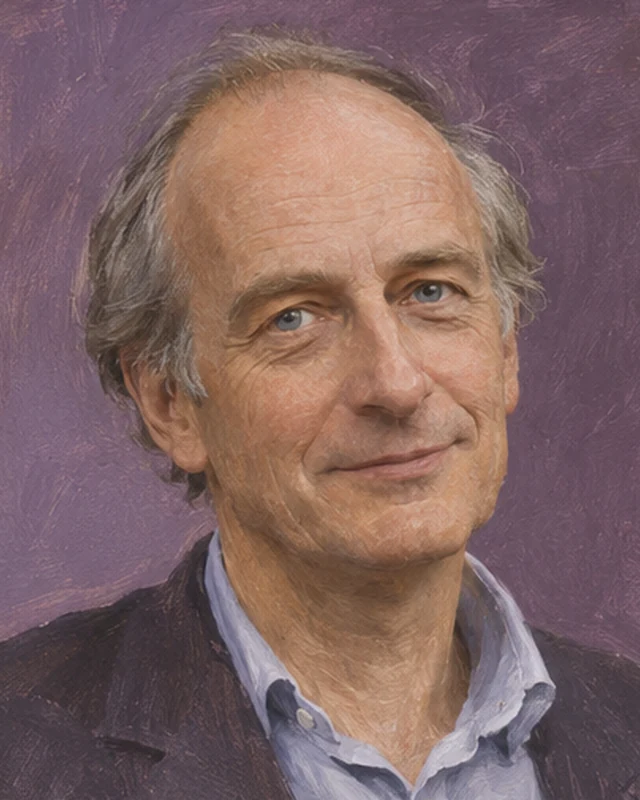
Gérard Genette (1930-2018) developed a detailed vocabulary for analysing narrative presentation. His study of narrative discourse first appeared in French as part of Figures III in 1972. Jane E. Lewin translated it into English as Narrative Discourse: An Essay in Method in 1980. The English edition was published by Cornell University Press.
The book draws extensively on Marcel Proust's long novel sequence, often called In Search of Lost Time. Proust's treatment of memory and recurring experience makes it difficult to describe the work through a simple chronological summary. Genette's categories help explain how a narrator moves between periods of life. They also show how repeated experience becomes material for storytelling.
Genette organises his discussion around time, mood and voice. The time categories include order, duration and frequency. Mood includes questions of distance and perspective, such as the amount of information available to the reader. Voice includes the relations between the narrator, the narrated events and the situation of telling.
The distinctions prevent several common errors in reading. A narrator who appears in the story need not know everything about the past. A narrator who tells a story from outside its action may still limit the information available. Neither the presence of a narrator nor the grammatical person alone determines the perspective.
Mieke Bal and the three levels of narrative
Mieke Bal was born in 1946. Her Narratology: Introduction to the Theory of Narrative first appeared in English in 1985. The fourth English edition appeared in 2017 through the University of Toronto Press. Its treatment extends beyond literary fiction to other narrative texts and forms.
Bal distinguishes the fabula, the logically and chronologically related events experienced or caused by actors, from the story, their particular presentation. A narrative text is the concrete telling that communicates that story. The reader works from the text towards an understanding of the arranged story and reconstructed fabula. Bal's terminology must be distinguished from Chatman's different use of the word story.
Bal also separates an actor at the level of the fabula from a character as developed in the story. An actor can be identified through the events in which it participates. The presentation may then give that figure particular traits, appearances or relationships. An abstract account of an action cannot capture everything readers learn about a character.
Bal develops the concept of the focalizer, the agent through whose perspective a presentation is organised, and the focalized object. Her distinction between character-bound and external focalizers differs from Genette's three-part division. A reader should therefore state whose model is being used. The same technical word can have different implications in different theories.
Gerald Prince and the reader within the narrative
Gerald Prince (1942-2026) helped establish narratology as a systematic field of study in English. His A Grammar of Stories: An Introduction appeared in 1973. He published Narratology: The Form and Functioning of Narrative in 1982. His A Dictionary of Narratology followed in 1987. Both books organise concepts for studying narratives and their communication.
Prince gives particular attention to the narratee, the addressee to whom a narrator directs the telling. A narrator may address an individual, a group or a receiver whose identity remains largely unstated. The narratee belongs to the narrative situation and is distinct from the actual reader. The actual reader can recognise the address without occupying that fictional position.
Imagine a mother recounting an incident to her child within a novel. The child is the narratee of that particular account, although thousands of people may read the novel. The narrator may explain details unfamiliar to the child. Such explanations help readers understand the relationship between teller and addressee.
Prince also studies narrativity, the quality or degree to which something is narrative. A timetable gives information about several trains, but it may not present a connected sequence of happenings. A report explaining why a traveller missed a train presents a change and its circumstances. The boundary between narrative and non-narrative communication is a theoretical question rather than a matter of length.
Seymour Chatman and the structure of fiction and film
Seymour Chatman (1928-2015) published Story and Discourse: Narrative Structure in Fiction and Film in 1978. He distinguishes the content of a narrative from its means and manner of expression. His story level contains events and existents, such as characters and settings. His discourse level concerns how this material is presented.
Chatman distinguishes kernels, major events that determine the direction of the plot, from satellites, subsidiary events that develop or enrich it. Meera's decision to return home instead of taking a later train may be a kernel. Her purchase of tea while waiting may be a satellite, provided it has no decisive consequence. An apparently minor event can become a kernel if the plot depends on it.
A satellite is not necessarily artistically unimportant. Removing a description of the station may leave the main chain of actions intact. Yet the story could lose its atmosphere or social detail. Chatman's distinction identifies a structural function rather than measuring the worth of a passage.
Chatman's account also makes room for the difference between actual authors and readers and their textual counterparts. The implied author is the organising conception of the author inferred from a work. The implied reader is a reading position invited by the work. Neither should be confused with a speaking narrator or that narrator's particular narratee.
An interesting story
In 1978, Cornell University Press published Seymour Chatman's Story and Discourse. The book placed fiction and film within the same investigation of narrative structure. Chatman was teaching rhetoric at the University of California, Berkeley, and his work brought European narrative theory into wider English-language discussion. In 2012, the International Society for the Study of Narrative gave him its Lifetime Achievement Award. The university's memorial records that the award recognised the importance of his contributions to narrative theory, with particular attention to his 1978 book. The history illustrates how a study that began with literary structures became a field extending across different media.
Key terms
- Narratology - systematic study of narrative structures and communication.
- Fabula - logically and chronologically connected events.
- Syuzhet - arrangement of events in a literary work.
- Discourse - presentation of narrative content.
- Narration - act of telling a narrative.
- Anachrony - difference between story order and presentation order.
- Analepsis - presentation of an earlier event.
- Prolepsis - presentation or announcement of a later event.
- Duration - relation between time in the story and its presentation.
- Frequency - relation between occurrences and their narration.
- Ellipsis - omission of a period of story time.
- Voice - position and activity of a narrator.
- Focalization - selection and restriction of narrative information.
- Focalizer - agent of perspective in Bal's account.
- Narratee - addressee of the narrator.
- Narrativity - quality or degree of being narrative.
- Existents - characters and settings in Chatman's model.
- Kernel - event that determines a direction in the plot.
- Satellite - subsidiary event that elaborates the narrative.
- Implied author - organising conception of the author inferred from the work.
Important points to remember
- Genette's French study appeared in 1972 and its English translation in 1980.
- Genette develops his account through an analysis of Proust.
- Bal's three levels are fabula, story and text.
- Bal's focalizer is not identical to Genette's account of focalization.
- Prince studies the narratee and narrativity.
- Prince's dictionary first appeared in 1987.
- Chatman's Story and Discourse appeared in 1978.
- Chatman distinguishes kernels from satellites.
Reading with narratology
Meera's missed train
The station incident can be arranged into a simple chain of events. Meera visits a shop, loses her phone, misses her train and decides to go home. This is one reconstruction of the fabula, assuming that the facts are known. A storyteller may select only part of the chain or alter its order.

If the account begins at the platform, a later memory of the shop can provide an analepsis. If a narrator reports the future consequences early, that passage can provide a prolepsis. Several minutes of waiting may be given in extended dialogue. The journey home may then be omitted through an ellipsis.
A version in the third person can limit the reader to Meera's experience. Her ignorance of the phone's location becomes the reader's ignorance. An account that reports only her movements and words would create a different restriction. Another version could disclose what a shopkeeper knows while Meera remains unaware.
Prince's approach directs attention to who receives each version. A brother speaking to a parent may emphasise reassurance. A journalist addressing a public audience may stress the station delay. Chatman's model helps identify which event changes the chain of actions and which details merely enrich that telling. These are different questions about the same incident.
- Visits the shop
- Loses her phone
- Misses the train
- Decides to go home
- Misses the train
- Recalls the shop
- Recalls leaving the phone
- Decides to go home
Pip in Great Expectations
Charles Dickens's Great Expectations (1860-1861) begins with Pip recalling his childhood visit to the churchyard. The adult Pip narrates events experienced by the younger Pip. Because the protagonist tells his own story, the narrator is autodiegetic. The adult teller and the child experiencing the incident occupy different temporal positions.
Pip's childhood understanding of his family is shaped by what he can discover from their gravestones. His encounter with the escaped convict introduces fear and uncertainty. A reader encounters much of the episode through the child's experience, but the adult narrator's language also shapes the account. The two positions cannot always be separated neatly.
Later information changes the meaning of Pip's expectations and his relationships. The reader's earlier assumptions may need revision when important facts become known. A narratological analysis can therefore explain how withheld knowledge affects a reading. It does not require the critic to ignore the novel's treatment of class or moral growth.
Important points to remember
- The same fabula can receive several different presentations.
- A backward movement can supply information missing from an earlier passage.
- Different focalizations can produce different degrees of knowledge.
- A narratee can influence what a narrator explains.
- Pip narrates his own life in Great Expectations.
- The experiencing child and the adult teller occupy different temporal positions.
- Narrative analysis can be combined with social interpretation.
Criticisms and legacy
The case against narratology
A classification can explain the way information is distributed without explaining every reason for that distribution. Susan Sniader Lanser challenged the separation of narrative form from gender in her 1986 essay "Toward a Feminist Narratology". She proposed an approach that brings feminist questions into the study of narrative form. The authority to speak and the ways in which speech is received may have social significance.
Consider two novels that use a first-person narrator. The grammatical person may be the same in both. Yet one narrator may be able to speak publicly, while another must hide an account from family members. An analysis of gender and authority asks why the same formal category may have different consequences. It extends narrative analysis rather than merely changing its labels.
The scope of narrative categories can also become a matter of debate. Burkhard Niederhoff, in his account of focalization for The Living Handbook of Narratology (2013), questions whether a single focalizer can always be assigned. He discusses the opening of Great Expectations, where the child's experience and adult perspective overlap. His discussion warns against forcing a passage into a rigid classification.
The disagreement between Bal and Genette is itself instructive. Their systems differ in the questions they ask about the selection of information and the agent of perception. Neither vocabulary should be used as though its terms were independent of these theoretical choices. A critic must explain why a distinction helps illuminate a particular passage.
From classical to postclassical narratology
The structuralist foundations of narratology did not limit the field to one method forever. In later work, narratologists paid greater attention to readers, social contexts and the kinds of knowledge that narratives create. Such developments are often grouped under the broad name postclassical narratology. They retain some structural distinctions while investigating problems that those distinctions alone do not resolve.
Feminist narratology, for instance, studies the relations between narrative practices and gender. Cognitive approaches consider how readers construct an understanding of a narrated world. The study of film investigates how images and sound organise information. Different media may present related events by quite different means.
Chatman's comparison of fiction and film helps explain the importance of such differences. A written text can give a character's thought directly through words. A film may communicate a related experience through a close view, a gesture or sound. The content may be comparable even though its expression uses another medium.
How to read these thinkers
Genette's distinctions are particularly useful when the order, pace or perspective of a narrative seems difficult. Bal gives readers another method of separating the event structure, its arrangement and its expression. Prince directs attention to the principles of narrative communication. Chatman brings the analysis of events and their presentation across the boundary between literature and film.
These methods work best when the reader begins with a specific difficulty in a text. Identifying an analepsis is useful if it explains why an earlier event has been withheld. Identifying a narratee matters if it reveals something about the situation of telling. The term should help explain an effect that can be demonstrated from the work.
Narratology gives readers a language for discussing the construction of narratives. It does not replace other kinds of criticism. Instead, it makes the forms of stories available for closer examination and comparison. A reader can then ask how those forms are connected with the lives and histories they represent.
Important points to remember
- Lanser proposed a feminist narratology in 1986.
- Narrative forms may have different social consequences in different contexts.
- Niederhoff questions the assignment of a single focalizer in some passages.
- Bal and Genette do not use focalization in identical ways.
- Postclassical narratology extends the field's questions.
- Narratives can be studied across different media.
- Technical terms should explain textual effects rather than replace interpretation.
Critics and works
| Thinker | Dates | Key work | Known for |
|---|---|---|---|
| Gérard Genette | 1930-2018 | Narrative Discourse: An Essay in Method (1980 English edition) | Time, mood, voice and focalization |
| Mieke Bal | Born 1946 | Narratology: Introduction to the Theory of Narrative (1985 English edition) | Fabula, story, text and focalizer |
| Gerald Prince | 1942-2026 | Narratology: The Form and Functioning of Narrative (1982); A Dictionary of Narratology (1987) | Narrative communication, narratee and narrativity |
| Seymour Chatman | 1928-2015 | Story and Discourse: Narrative Structure in Fiction and Film (1978) | Story and discourse, kernels and satellites |
Quick revision - 50 points
Open the 50 pointsClose the list
- Narratology studies the structures and communication of narratives.
- Aristotle studies the organisation of actions in Poetics.
- Russian Formalism distinguishes fabula from syuzhet.
- Propp's Morphology of the Folktale first appeared in Russian in 1928.
- Saussure's linguistic theory helped provide the foundations of structuralism.
- Classical narratology developed in the setting of French structuralism.
- Todorov introduced the French term narratologie in 1969.
- Todorov introduced the term in Grammaire du Décaméron.
- Genette distinguishes histoire, récit and narration.
- Narrative order compares the sequence of events with their presentation.
- An anachrony is a departure from the chronological sequence in presentation.
- Analepsis presents an earlier event.
- Prolepsis presents or announces a later event.
- Duration concerns the relation between story time and the amount of presentation.
- A scene presents an event at a relatively similar pace to its occurrence.
- Summary compresses a longer stretch of story time.
- Ellipsis omits a period of story time.
- A descriptive pause can suspend the progress of events.
- Frequency compares the number of occurrences with the number of presentations.
- Singulative narration can present one occurrence once.
- Repetitive narration presents the same occurrence more than once.
- Iterative narration presents repeated occurrences together in one account.
- Voice concerns the activity and position of the narrator.
- A narrator is distinct from the actual author.
- A homodiegetic narrator participates in the story being told.
- An autodiegetic narrator recounts a story centred on that narrator as protagonist.
- A heterodiegetic narrator does not participate in the story being told.
- An extradiegetic narrator tells a first-level narrative.
- An intradiegetic narrator tells a story from within another narrative.
- A metadiegetic narrative is an embedded story.
- Zero focalization does not consistently limit information to a particular character's knowledge.
- Internal focalization limits information to a character's perspective or knowledge.
- External focalization restricts information largely to observable behaviour and appearances.
- Fixed internal focalization remains with one character.
- Multiple internal focalization can present the same occurrence through several characters.
- Genette's study of narrative discourse first appeared in Figures III in 1972.
- Jane E. Lewin translated Genette's Narrative Discourse into English in 1980.
- Genette analyses Proust's narrative methods in Narrative Discourse.
- Bal's Narratology first appeared in English in 1985.
- Bal distinguishes fabula, story and narrative text.
- Bal develops the concepts of focalizer and focalized object.
- Prince's Narratology: The Form and Functioning of Narrative appeared in 1982.
- Prince's A Dictionary of Narratology appeared in 1987.
- The narratee is the addressee within the narrative situation.
- Narrativity concerns the quality or degree of being narrative.
- Chatman's Story and Discourse appeared in 1978.
- Chatman's story level includes events and existents.
- Kernels determine directions in the plot, while satellites elaborate the narrative.
- Pip is an autodiegetic narrator in Great Expectations.
- Lanser proposed a feminist narratology in 1986.
Quick quiz - 25 questions
Tap an answer to see at once if it is right. You do not need to log in.
Open the 25 questionsClose the quiz
1What does narratology principally study?
Answer: A. Narratology examines the construction and communication of narratives.
2Who introduced the French term narratologie in 1969?
Answer: B. Todorov introduced the term in Grammaire du Décaméron.
3Which work first appeared in Russian in 1928?
Answer: C. Vladimir Propp's book examines recurrent actions in Russian wonder tales.
4Which term names the artistic arrangement of events in Russian Formalism?
Answer: D. Syuzhet concerns the presentation of events rather than their reconstructed chronology.
5In which French volume did Genette's study of narrative discourse appear in 1972?
Answer: A. Genette's French study formed part of Figures III.
6Which novelist's work provides the main literary material for Genette's Narrative Discourse?
Answer: B. Genette examines Proust's methods of presenting memory and recurring experience.
7A narrator returns to an incident that occurred before the present point in the narrative. What is this called?
Answer: C. Analepsis presents an earlier incident and is often called a flashback.
8What is the term for a presentation of an event later than the point reached in the narrative?
Answer: D. Prolepsis is the forward movement commonly called a flash-forward.
9Which relation of duration omits a stretch of story time?
Answer: A. Ellipsis leaves a period of story time unpresented.
10Which category applies when several years are presented in a single sentence?
Answer: B. Summary compresses a longer period into a shorter account.
11Three witnesses give separate accounts of the same accident. Which frequency relation applies?
Answer: C. One occurrence is presented more than once.
12A narrator describes a journey made every Monday in one account. Which category applies?
Answer: D. Iterative narration presents recurring events collectively.
13What is a narrator who participates in the story being told called?
Answer: A. A homodiegetic narrator appears as a participant in the narrated events.
14What does the term extradiegetic describe in Genette's account?
Answer: B. Extradiegetic refers to the level of narration, not participation in the events.
15Which focalization restricts information largely to observable behaviour and appearances?
Answer: C. Genette's external focalization withholds direct access to thoughts and motives.
16A third-person narrative gives access only to one character's thoughts and knowledge. Which distinction is most relevant?
Answer: D. Internal focalization can occur in a third-person narrative.
17Who distinguishes fabula, story and text in her three-level model?
Answer: A. Bal distinguishes events, their arrangement and their concrete expression.
18In which year did Bal's Narratology first appear in English?
Answer: B. The first English edition appeared in 1985; the fourth appeared in 2017.
19Who wrote A Dictionary of Narratology (1987)?
Answer: C. Prince's dictionary appeared five years after his 1982 book on narratology.
20What is the addressee of a narrator within the narrative situation called?
Answer: D. The narratee is the receiver addressed by the narrator, distinct from the actual reader.
21Which book studies narrative structure in both fiction and film?
Answer: A. Chatman's 1978 book examines the two media through a common framework.
22What does Chatman call a major event that determines the direction of the plot?
Answer: B. A kernel has a decisive role in the causal organisation of the plot.
23Which term describes the organising conception of the author inferred from a work?
Answer: C. The implied author is inferred from the work and is not its speaking narrator.
24How can Pip's narration in Great Expectations be classified in terms of participation?
Answer: D. Pip narrates a story in which he himself is the protagonist.
25Who published the essay "Toward a Feminist Narratology" in 1986?
Answer: A. Lanser argues for studying narrative form in relation to feminist questions.
Frequently asked questions
What is narratology in simple words?
Narratology studies how stories are built and told. It examines the relations between events, their presentation, the narrator and the distribution of information.
Who coined the term narratology?
Tzvetan Todorov introduced the French term narratologie in Grammaire du Décaméron in 1969. The systematic study of narrative had begun earlier.
What are Genette's three categories of narrative time?
They are order, duration and frequency. Order compares sequences, duration compares the time of events with their presentation, and frequency compares occurrences with presentations.
What is the difference between narrator and focalization?
The narrator is the agent of telling. Focalization concerns the perspective or informational restriction of a passage. The narrator can present events through a character's limited knowledge.
What is Mieke Bal's model of narrative?
Bal distinguishes fabula, story and text. Fabula concerns the related events, story is their particular presentation, and text is the concrete expression communicating the story.
What is the difference between kernels and satellites in Chatman's theory?
Kernels are major events that determine the direction of the plot. Satellites elaborate that plot without necessarily changing its basic causal structure. Satellites can still be important to the artistic effect of a work.
Sources
- Bal, Mieke. Narratology: Introduction to the Theory of Narrative. University of Toronto Press, 1985; 4th ed., 2017.
- Chatman, Seymour. Story and Discourse: Narrative Structure in Fiction and Film. Cornell University Press, 1978.
- Genette, Gérard. Narrative Discourse: An Essay in Method. Translated by Jane E. Lewin, Cornell University Press, 1980.
- Habib, M. A. R. A History of Literary Criticism: From Plato to the Present. Blackwell, 2005.
- Lanser, Susan Sniader. "Toward a Feminist Narratology." Style, 1986.
- Meister, Jan Christoph. "Narratology." The Living Handbook of Narratology, University of Hamburg, 2014.
- Niederhoff, Burkhard. "Focalization." The Living Handbook of Narratology, University of Hamburg, 2013.
- Prince, Gerald. A Grammar of Stories: An Introduction. Mouton, 1973.
- Prince, Gerald. Narratology: The Form and Functioning of Narrative. Mouton, 1982.
- Prince, Gerald. A Dictionary of Narratology. University of Nebraska Press, 1987.
- Prince, Gerald. "Narratology." The Cambridge History of Literary Criticism, Cambridge University Press.
- "Seymour Chatman." University of California Academic Senate, In Memoriam.
- "Gerald J. Prince, French and Francophone Studies." University of Pennsylvania Almanac, 24 November 2026.
Afsar Khan, Ph.D. English
Test your knowledge
Check what you have learned with quizzes and MCQs.