

On this page
- The world of Victorian criticism
- Matthew Arnold: culture and the touchstone
- John Ruskin: morality, nature and craft
- Walter Pater: the Aesthetic turn
- Oscar Wilde: the critic as artist
- How Victorian criticism shaped what came after
- Critics and works
- Quick revision - 50 points
- Quick quiz - 25 questions
- Frequently asked questions
- Sources
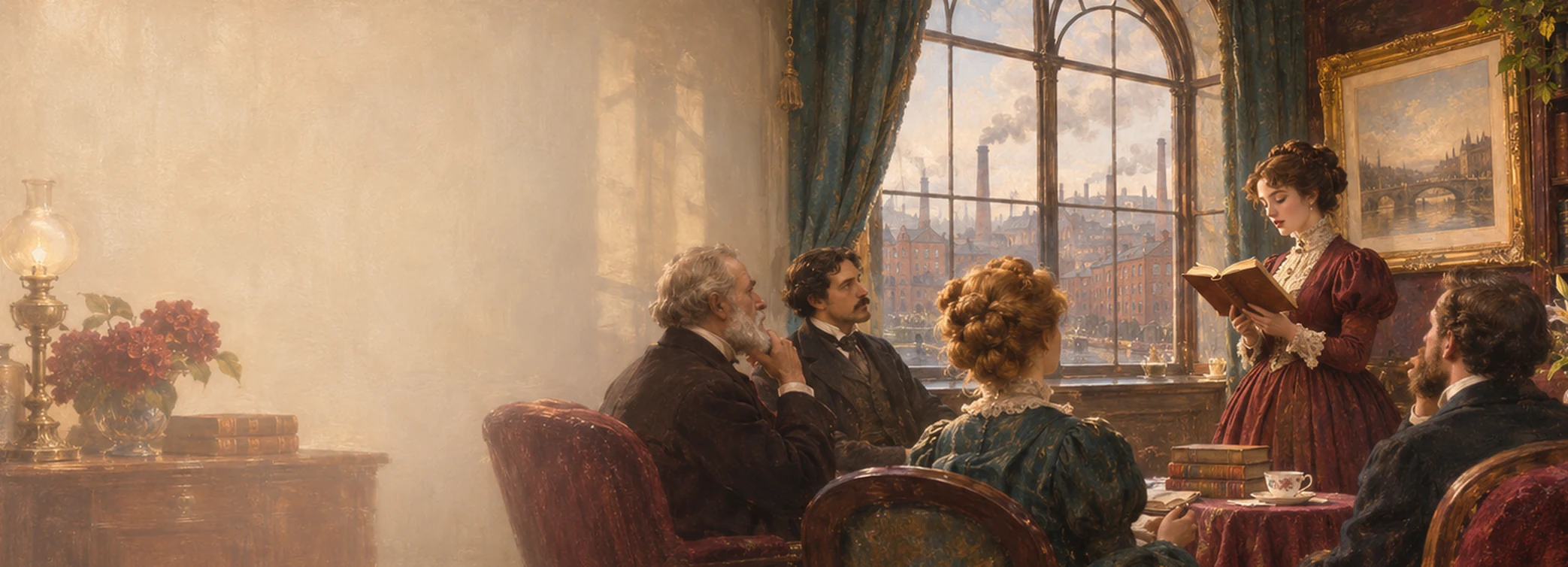
Picture Victorian Britain in the nineteenth century. Factory chimneys darken the sky, railways cut across quiet valleys, and new scientific discoveries unsettle old religious certainties. Amid this rapid change, critics ask an urgent question: what is art for in an industrial world? Their answers divide the age into two great camps. One camp insists that literature and art must serve morality, truth and social health. The other answers that art owes nothing to sermons or factories—it exists purely for the sake of beauty.
Four names stand for this debate. Matthew Arnold called poetry "a criticism of life" and looked to high culture to steady a restless society. John Ruskin tied great art to moral truthfulness and the free, imperfect hand of the craftsman. Walter Pater shifted criticism toward Aestheticism, urging readers to savour intense beauty and live with a "hard, gem-like flame". Oscar Wilde pushed Aestheticism to its wittiest extreme, declaring that "All art is quite useless" and that the critic himself is an artist.
This is the sixth article in the series on the history of English literary criticism. In the previous article, we saw Wordsworth, Coleridge, Shelley and Hazlitt place imagination and feeling at the centre of poetry. Victorian critics kept the Romantic reverence for art, yet argued fiercely over whether art's true home is public duty or private beauty—a quarrel that leads straight into twentieth-century Modernism.
The world of Victorian criticism
Moral duty versus art for art's sake
Across Queen Victoria's long reign (1837-1901), English criticism swung like a pendulum between two poles. In the early and mid-Victorian years, critics like Matthew Arnold and John Ruskin felt a heavy sense of public responsibility. They wanted literature and art to educate the growing middle class, elevate taste and resist the ugliness of industrial capitalism.
By the 1870s and 1890s, a younger generation grew weary of earnest Victorian moralising. Influenced by French writers such as Théophile Gautier and the slogan l'art pour l'art ("art for art's sake"), Walter Pater and Oscar Wilde championed the Aesthetic Movement. They argued that judging a poem or painting by its moral lesson is a mistake: art has its own laws, and beauty is its own justification.
Science, industry and the crisis of faith
Victorian criticism cannot be separated from the anxieties of its time. Works such as Charles Darwin's On the Origin of Species (1859) shook traditional religious belief, while rapid urbanisation and mass journalism flooded the market with cheap, hurried writing. Arnold feared that as formal religion weakened, society would lose its moral anchor unless poetry and culture stepped forward to "interpret life for us, to console us, to sustain us".
A map of the age
In Abrams's map of critical theories, Victorian criticism splits cleanly down the middle. Arnold and Ruskin lean toward the pragmatic and moral view, measuring art by its civilising power and truthfulness to life. Pater and Wilde lean toward impressionistic and aesthetic criticism, treating the artwork as an autonomous world of beauty—a stance that helped prepare the ground for twentieth-century Formalism and New Criticism.
Did you know?
Walter Pater was so unsettled when conservative Oxford critics accused the famous Conclusion of Studies in the History of the Renaissance (1873) of promoting selfish pleasure-seeking that he quietly removed the entire Conclusion from the second edition of 1877. He only restored it in the third edition of 1888, with a brief note explaining his true meaning.
Important points to remember
- Victorian criticism (1837-1901) was shaped by a central debate between moral/social responsibility and "art for art's sake".
- Matthew Arnold and John Ruskin represent the moral and cultural tradition; Walter Pater and Oscar Wilde represent the Aesthetic Movement.
- Industrialisation, mass journalism and the crisis of religious faith gave Victorian criticism an urgent public tone.
- In Abrams's map, Arnold and Ruskin lean toward the pragmatic view, while Pater and Wilde move toward aesthetic autonomy and impressionism.
- Walter Pater omitted the famous Conclusion from the 1877 second edition of The Renaissance out of fear it might mislead young readers, restoring it in 1888.
Matthew Arnold: culture and the touchstone
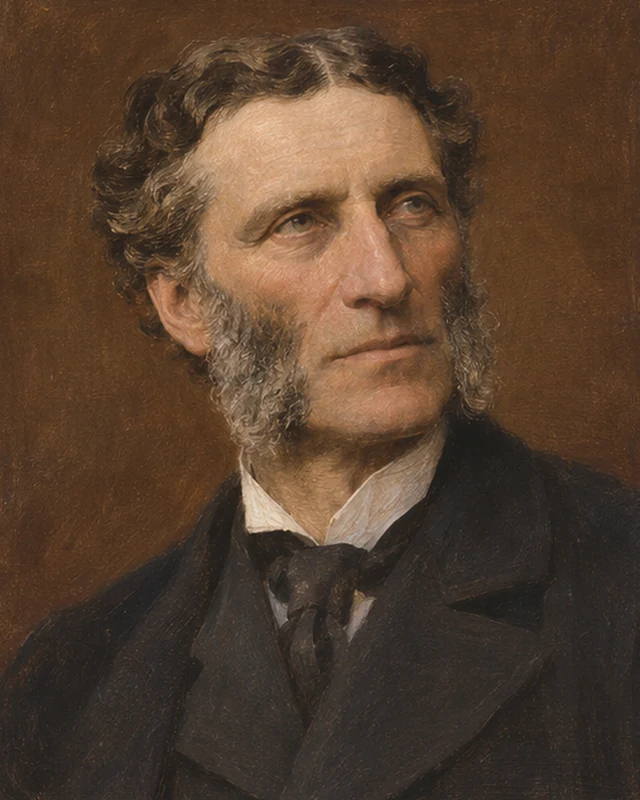
Matthew Arnold (1822-1888)—poet, inspector of schools and Professor of Poetry at Oxford—was the dominant literary critic of the Victorian era. His most influential critical writings include the Preface to Poems (1853), Essays in Criticism (First Series, 1865; Second Series, 1888), Culture and Anarchy (1869), and his landmark essay "The Study of Poetry" (1880).
Disinterestedness and the function of criticism
In "The Function of Criticism at the Present Time" (published in Essays in Criticism, 1865), Arnold gave criticism an ambitious cultural mission. He defined criticism as:
"A disinterested endeavour to learn and propagate the best that is known and thought in the world."
By disinterestedness, Arnold did not mean indifference or boredom. He meant keeping the mind free from party politics, personal vanity and narrow commercial interests so that the critic can "see the object as in itself it really is". Only by circulating fresh, European ideas—not merely provincial English ones—could criticism prepare the soil for great creative literature.
In Culture and Anarchy (1869), Arnold widened this critique to society at large. Borrowing a phrase from Jonathan Swift, he described culture as "sweetness and light" (beauty and intelligence). He famously divided Victorian society into three classes—the Barbarians (aristocracy), the Philistines (materialistic middle class) and the Populace (working class)—and argued that England suffered from too much narrow moral strictness (Hebraism) and too little open-minded curiosity (Hellenism).
Poetry as "a criticism of life"
In "The Study of Poetry" (written in 1880 as the general introduction to T. H. Ward's anthology The English Poets, and reprinted in Essays in Criticism, Second Series, 1888), Arnold set out his mature view of poetry. Poetry, he declared, is "a criticism of life under the conditions fixed for such a criticism by the laws of poetic truth and poetic beauty".
Great poetry, Arnold argued, does not merely entertain; it illuminates how to live. To reach the highest rank, a poem must unite superior style—what Arnold called the grand style—with high seriousness, an idea he adapted from Aristotle's Poetics (spoudaiotes).
The touchstone method and the three estimates
How should a reader recognise truly great poetry? In "The Study of Poetry", Arnold warned against two common traps:
- The historical estimate: overrating a poem simply because it is old or played an important role in the development of the language.
- The personal estimate: overrating a poem because of private affections, memories or personal affinities.
Both traps distort judgment. Critics must strive instead for the real estimate. To achieve it, Arnold proposed his famous touchstone method: keep in mind a few short lines and passages from supreme masters—Homer, Dante, Shakespeare and Milton—and hold other poems beside them, just as a jeweller tests gold against a touchstone.
Applying this strict standard, Arnold delivered famous—and fiercely debated—verdicts. He loved Geoffrey Chaucer's lively humanity, yet denied him the highest rank because he lacked "high seriousness". Even more provocatively, he declared that John Dryden and Alexander Pope were not classics of English poetry at all: "they are classics of our prose".
- Historical estimateThe poem’s age or place in literary history may bias the reader.
- Personal estimatePrivate memories or preferences may bias the reader.
- Real estimateCompare the poem with passages from acknowledged masters.
Important points to remember
- Matthew Arnold (1822-1888) was Professor of Poetry at Oxford and the central Victorian literary critic.
- In "The Function of Criticism at the Present Time" (Essays in Criticism, 1865), he defined criticism as "a disinterested endeavour to learn and propagate the best that is known and thought in the world".
- Disinterestedness means seeing "the object as in itself it really is", free from political or practical bias.
- In Culture and Anarchy (1869), Arnold defined culture as "sweetness and light" and divided society into Barbarians, Philistines and Populace.
- In "The Study of Poetry" (1880), Arnold called poetry "a criticism of life" marked by "high seriousness" and the "grand style".
- Arnold warned against the historical estimate and the personal estimate, urging critics to seek the real estimate.
- His touchstone method tests poems against short passages from Homer, Dante, Shakespeare and Milton.
- Arnold said Chaucer lacked "high seriousness" and called Dryden and Pope "classics of our prose".
John Ruskin: morality, nature and craft
John Ruskin (1819-1900) was the most influential art and social critic of Victorian Britain. Although he began by defending the painter J. M. W. Turner, his passionate prose reshaped how Victorians thought about painting, architecture, labour and literature alike. His major works include Modern Painters (five volumes, 1843-1860), The Seven Lamps of Architecture (1849), The Stones of Venice (three volumes, 1851-1853), and Unto This Last (1860; book form 1862).
Art as a moral force
For Ruskin, art and morality are inseparable. Great art is never a shallow decorative trick; it is the expression of a truthful, reverent mind and a just society. He hated the soulless uniformity of industrial factories, which turned human workers into mere machines.
In his celebrated chapter "The Nature of Gothic" (The Stones of Venice, Volume 2, 1853), Ruskin praised medieval Gothic cathedrals precisely because their carved stone showed the free, irregular touch of individual craftsmen. As he declared, "neither architecture nor any other noble work of man can be good unless it be imperfect", for imperfection is the sign of living human effort rather than mechanical slavery.
The pathetic fallacy
Ruskin's most famous contribution to literary criticism appears in Volume 3, Part 4, Chapter 12 of Modern Painters (1856), in a chapter titled "Of the Pathetic Fallacy". Ruskin coined the term pathetic fallacy for the poetic habit of attributing human emotions to inanimate objects in nature.
His famous example comes from Charles Kingsley's poem in Alton Locke, which describes the sea as "the cruel, crawling foam". Foam, Ruskin points out, is not cruel, nor does it crawl; it is only the speaker's violent grief that projects human feeling onto water. Ruskin distinguished between two orders of poets: the highest, like Homer, see the natural world clearly and steadily even in moments of deep feeling; the second order, swept away by emotion, fall into the pathetic fallacy. Today, critics use the term neutrally as a descriptive label for personified nature, yet its origin lies in Ruskin's fierce devotion to truth.
Important points to remember
- John Ruskin (1819-1900) was the leading Victorian art and social critic, linking great art directly to moral truth and human dignity.
- His major works include Modern Painters (1843-1860), The Seven Lamps of Architecture (1849), The Stones of Venice (1851-1853) and Unto This Last (1860/1862).
- In "The Nature of Gothic" (The Stones of Venice), Ruskin praised medieval imperfection as the mark of human freedom over industrial monotony.
- In Modern Painters, Volume 3 (1856), Ruskin coined the term pathetic fallacy for attributing human feelings to inanimate nature (e.g., "the cruel, crawling foam").
- Ruskin ranked calm, truthful observation of nature above emotional distortion.
Walter Pater: the Aesthetic turn
Walter Pater (1839-1894), a quiet, scholarly fellow of Brasenose College, Oxford, gently dismantled the moral certainty of mid-Victorian criticism. His slim, exquisite book Studies in the History of the Renaissance (1873; revised as The Renaissance: Studies in Art and Poetry in 1877) and his later collection Appreciations, with an Essay on Style (1889) became the guiding texts of the English Aesthetic Movement.
Impressionistic criticism
In the Preface to The Renaissance, Pater quoted Matthew Arnold's famous rule—to see the object "as in itself it really is"—and quietly turned it inside out. In aesthetic criticism, Pater replied, "the first step towards seeing one's object as it really is, is to know one's own impression as it really is".
Instead of asking whether a poem teaches virtue or matches a classical touchstone, Pater's aesthetic critic asks personal, sensory questions: "What is this song or picture, this engaging personality presented in life or in a book, to me? What effect does it really produce on me?" Criticism, in Pater's hands, becomes subtle, personal appreciation—an effort to catch and describe the unique flavour of each work of art.
The "hard, gem-like flame" and the condition of music
In the famous Conclusion to The Renaissance (1873), Pater meditated on the fleetingness of human life. Every moment slips away like water, leaving us only a brief interval of conscious awareness. The wisest response, Pater argued, is to sharpen our senses and live as intensely as possible through art and beauty:
"To burn always with this hard, gem-like flame, to maintain this ecstasy, is success in life."
Because art comes to us "proposing frankly to give nothing but the highest quality to your moments as they pass, and simply for those moments' sake", Pater closed the book by praising the love of "art for its own sake".
In his essay "The School of Giorgione" (added in 1877), Pater offered another enduring maxim: "All art constantly aspires towards the condition of music." Why music? Because in music, form and content cannot be separated—you cannot summarise a symphony's "message" apart from its notes. Great poetry and painting strive for that same perfect fusion of form and meaning.
Important points to remember
- Walter Pater (1839-1894) was an Oxford scholar and the intellectual leader of the English Aesthetic Movement.
- His key critical books are Studies in the History of the Renaissance (1873; revised 1877) and Appreciations, with an Essay on Style (1889).
- Reversing Arnold, Pater argued that the aesthetic critic must first "know one's own impression as it really is".
- In the Conclusion to The Renaissance, Pater wrote: "To burn always with this hard, gem-like flame, to maintain this ecstasy, is success in life."
- Pater championed "art for its own sake", valuing art for the intensity it gives to passing moments.
- In "The School of Giorgione" (1877), he declared: "All art constantly aspires towards the condition of music."
Oscar Wilde: the critic as artist
Oscar Wilde (1854-1900)—dramatist, novelist and dazzling conversationalist—studied at Oxford under both Ruskin and Pater, and turned Pater's quiet aestheticism into bold, provocative paradox. His major critical essays were gathered in Intentions (1891), alongside his famous epigrammatic Preface to The Picture of Dorian Gray (1891).
The Decay of Lying and the reversal of imitation
First published in 1889 and collected in Intentions (1891), "The Decay of Lying" is a sparkling dialogue between Vivian and Cyril. With playful seriousness, Wilde attacks realistic fiction and turns two thousand years of Aristotelian mimesis upside down.
Art, Vivian argues, is not a dull photograph of everyday facts; "Lying, the telling of beautiful untrue things, is the proper aim of Art." Even more famously, Wilde reverses the ancient mirror metaphor altogether: "Life imitates Art far more than Art imitates Life." People only began noticing the strange beauty of London fogs, Vivian jokes, after Impressionist painters taught them how to look at fog. Nature itself is shaped by the artistic images through which we learn to see it.
The Critic as Artist
In "The Critic as Artist" (published 1890; collected in Intentions, 1891)—a two-part dialogue between Gilbert and Ernest—Wilde makes the boldest claim for literary criticism in the nineteenth century. Earlier ages treated the critic as a modest judge or servant of the poet. Wilde argues that criticism is itself an independent, creative art.
Mocking Arnold directly, Gilbert declares that the critic's aim is not to see the object as in itself it really is, but to see it as it really is not—using a poem or painting as raw material to create a new work of beauty. "The highest Criticism," Gilbert says, "is the record of one's own soul."
The Preface to The Picture of Dorian Gray (1891)
When Victorian reviewers attacked The Picture of Dorian Gray as immoral, Wilde added a razor-sharp preface of twenty-five epigrams defending artistic freedom:
- "The artist is the creator of beautiful things."
- "There is no such thing as a moral or an immoral book. Books are well written, or badly written. That is all."
- "Vice and virtue are to the artist materials for an art."
- "All art is quite useless."
With that final line, Wilde sealed the break with Victorian moralism: art is not a tool, a sermon or a useful machine—its very uselessness is what makes it free.
An interesting story
While an undergraduate at Oxford in 1874, the young Oscar Wilde was so inspired by John Ruskin's lectures on the dignity of manual labour that he joined Ruskin's famous "Hinksey Road" dig—rolling a wheelbarrow and swinging a pickaxe alongside other students to repair a muddy country road for local villagers. Yet at the very same university, Wilde discovered Walter Pater's The Renaissance, which he later called his "golden book". Wilde's glittering career as a critic was born in the tension between those two Oxford teachers, with Pater's cult of beauty winning out over Ruskin's gospel of toil.
Key terms
- Victorian criticism - literary and cultural criticism of Queen Victoria's reign (1837-1901), divided between moral seriousness (Arnold, Ruskin) and Aestheticism (Pater, Wilde).
- Disinterestedness - Arnold's ideal of a critic standing free of political, practical or personal bias to see "the object as in itself it really is".
- Sweetness and light - Arnold's phrase (adapted from Swift) in Culture and Anarchy for beauty and intelligence.
- Barbarians, Philistines and Populace - Arnold's three labels for the Victorian aristocracy, middle class and working class.
- Hebraism and Hellenism - Arnold's contrast between strict moral conduct (Hebraism) and open-minded intellectual beauty (Hellenism).
- Criticism of life - Arnold's famous definition of poetry in "The Study of Poetry" (1880).
- High seriousness - Arnold's standard for supreme poetry (adapted from Aristotle's spoudaiotes), combining deep moral truth with the "grand style".
- Touchstone method - Arnold's method of testing poems by holding them beside short passages from Homer, Dante, Shakespeare and Milton.
- Historical and personal estimates - Arnold's two critical fallacies, contrasted with the real estimate.
- Pathetic fallacy - Ruskin's term (Modern Painters, Vol. 3, 1856) for attributing human emotions to inanimate nature.
- The Nature of Gothic - Ruskin's famous chapter in The Stones of Venice (1853) praising imperfect, free human craftsmanship over industrial perfection.
- Aestheticism / Art for art's sake - the late-Victorian movement (Pater, Wilde) asserting that art exists solely for beauty, independent of morality or utility.
- Impressionistic criticism - Pater's approach of asking what personal impression a work of art produces on the critic.
- Hard, gem-like flame - Pater's metaphor in the Conclusion to The Renaissance for living with intense aesthetic awareness.
- Condition of music - Pater's ideal of art in which form and content are completely inseparable.
- Life imitates Art - Wilde's witty reversal of Aristotelian imitation in "The Decay of Lying" (1891).
- The Critic as Artist - Wilde's 1891 dialogue arguing that criticism is an independent, creative art rather than a secondary service.
Important points to remember
- Oscar Wilde (1854-1900) studied under both Ruskin and Pater at Oxford and became the most famous voice of Aestheticism.
- His major critical collection is Intentions (1891), containing "The Decay of Lying" and "The Critic as Artist".
- In "The Decay of Lying" (speakers: Vivian and Cyril), Wilde declares that "Life imitates Art far more than Art imitates Life."
- In "The Critic as Artist" (speakers: Gilbert and Ernest), Wilde argues that criticism is itself a creative art and "the record of one's own soul".
- In the Preface to The Picture of Dorian Gray (1891), Wilde writes: "There is no such thing as a moral or an immoral book. Books are well written, or badly written. That is all."
- Wilde closes that preface with the famous slogan: "All art is quite useless."
How Victorian criticism shaped what came after
Ideas that stayed
Victorian criticism left two lasting legacies that still shape how we read today. From Arnold and Ruskin came the conviction that literature matters deeply to culture, society and human dignity—and that critics must hold high standards rather than bow to passing fashion. From Pater and Wilde came the insistence that a work of art must be judged first as art—for its form, style and beauty—rather than reduced to a moral sermon or a history lesson.
From the Victorians to Modernism
Twentieth-century criticism grew directly out of this Victorian tension. When T. S. Eliot wrote The Sacred Wood (1920) and defended "impersonality" and literary tradition, he was arguing both with and against Matthew Arnold. When Formalists and New Critics insisted on reading the poem itself rather than hunting for moral messages, they echoed Pater's fusion of form and content and Wilde's defence of artistic autonomy. Even modern cultural studies and Marxist criticism owe a quiet debt to Arnold's Culture and Anarchy and Ruskin's critique of industrial labour.
How to read the Victorian critics
When you read these four critics, ask three questions of each. What is the relationship between art and morality? What is the critic's job—a judge, a moral prophet, a sensitive receiver of impressions, or an independent artist? And how does each writer respond to modern industrial society? Arnold offers culture; Ruskin offers moral craft; Pater offers intense aesthetic moments; Wilde offers witty liberation. Together, they turn the Victorian era into one of the most dramatic chapters in the history of criticism.
Important points to remember
- Arnold and Ruskin established the tradition of cultural and social criticism in English.
- Pater and Wilde defended the autonomy of art and the inseparable unity of form and content.
- T. S. Eliot and twentieth-century Modernist critics built directly upon—and argued against—Matthew Arnold.
- Pater's and Wilde's focus on form and aesthetic independence helped prepare the ground for New Criticism.
Critics and works
| Critic | Dates | Key work | Known for |
|---|---|---|---|
| Matthew Arnold | 1822-1888 | Essays in Criticism (1865, 1888), Culture and Anarchy (1869), "The Study of Poetry" (1880) | Disinterestedness; "sweetness and light"; "criticism of life"; high seriousness; touchstone method |
| John Ruskin | 1819-1900 | Modern Painters (1843-1860), The Stones of Venice (1851-1853), Unto This Last (1860/1862) | Moral theory of art; "The Nature of Gothic"; coining the pathetic fallacy (1856) |
| Walter Pater | 1839-1894 | Studies in the History of the Renaissance (1873), Appreciations (1889) | Aestheticism; impressionistic criticism; "hard, gem-like flame"; "condition of music" |
| Oscar Wilde | 1854-1900 | Intentions (1891), Preface to The Picture of Dorian Gray (1891) | "Life imitates Art"; "The Critic as Artist"; "All art is quite useless" |
Quick revision - 50 points
Open the 50 pointsClose the list
- Victorian literary criticism spans Queen Victoria's reign (1837-1901).
- The four major critics covered here are Matthew Arnold, John Ruskin, Walter Pater and Oscar Wilde.
- Victorian criticism was shaped by a debate between moral/cultural duty and "art for art's sake".
- Arnold and Ruskin represent the moral-cultural tradition; Pater and Wilde represent the Aesthetic Movement.
- Matthew Arnold lived from 1822 to 1888 and served as Professor of Poetry at Oxford.
- Arnold's Essays in Criticism appeared in two series: 1865 (First Series) and 1888 (Second Series).
- In "The Function of Criticism at the Present Time" (1865), Arnold defined criticism as "a disinterested endeavour to learn and propagate the best that is known and thought in the world".
- Arnold's ideal of "disinterestedness" means seeing "the object as in itself it really is", free from party or practical bias.
- Arnold published Culture and Anarchy in 1869.
- In Culture and Anarchy, Arnold described culture as "sweetness and light" (a phrase borrowed from Swift).
- Arnold divided Victorian society into Barbarians (aristocracy), Philistines (middle class) and Populace (working class).
- Arnold contrasted Hebraism (strict moral conduct) with Hellenism (open-minded intellectual beauty).
- "The Study of Poetry" was first published in 1880 as the introduction to T. H. Ward's The English Poets.
- Arnold defined poetry as "a criticism of life" governed by poetic truth and poetic beauty.
- Arnold demanded "high seriousness" (adapted from Aristotle) and the "grand style" in supreme poetry.
- Arnold warned against two critical fallacies: the historical estimate and the personal estimate.
- Arnold urged critics to aim for the "real estimate" using the touchstone method.
- Arnold's four main touchstone poets are Homer, Dante, Shakespeare and Milton.
- Arnold praised Chaucer yet said he lacked "high seriousness".
- Arnold famously called Dryden and Pope "classics of our prose" rather than true poets.
- John Ruskin lived from 1819 to 1900 and was the leading Victorian art and social critic.
- Ruskin's Modern Painters appeared in five volumes between 1843 and 1860.
- Ruskin published The Seven Lamps of Architecture in 1849 and The Stones of Venice in 1851-1853.
- In "The Nature of Gothic" (The Stones of Venice), Ruskin praised medieval imperfection as a sign of human freedom.
- Ruskin published Unto This Last, his social and economic critique, in 1860 (book form 1862).
- In Volume 3 of Modern Painters (1856), Ruskin coined the term "pathetic fallacy".
- Pathetic fallacy means attributing human emotions to inanimate objects in nature.
- Ruskin's famous example of the pathetic fallacy is "the cruel, crawling foam" (from Charles Kingsley).
- Ruskin insisted that great art cannot be separated from morality and truthfulness.
- Walter Pater lived from 1839 to 1894 and was an Oxford scholar and leader of Aestheticism.
- Pater published Studies in the History of the Renaissance in 1873 (revised as The Renaissance in 1877).
- Pater omitted the famous Conclusion in the 1877 second edition and restored it in 1888.
- Reversing Arnold, Pater said the aesthetic critic must first "know one's own impression as it really is".
- Pater's impressionistic critic asks: "What is this song or picture... to me?"
- In the Conclusion to The Renaissance, Pater wrote: "To burn always with this hard, gem-like flame, to maintain this ecstasy, is success in life."
- Pater closed The Renaissance by praising the love of "art for its own sake".
- In "The School of Giorgione" (1877), Pater wrote: "All art constantly aspires towards the condition of music."
- Pater published Appreciations, with an Essay on Style in 1889.
- Oscar Wilde lived from 1854 to 1900 and studied at Oxford under both Ruskin and Pater.
- Wilde called Pater's The Renaissance his "golden book".
- Wilde published his major critical essay collection Intentions in 1891.
- "The Decay of Lying" (in Intentions) is a dialogue between Vivian and Cyril.
- In "The Decay of Lying", Wilde argues that "Life imitates Art far more than Art imitates Life."
- Wilde also writes that "Lying, the telling of beautiful untrue things, is the proper aim of Art."
- "The Critic as Artist" (in Intentions) is a two-part dialogue between Gilbert and Ernest.
- In "The Critic as Artist", Wilde argues that criticism is an independent, creative art and "the record of one's own soul".
- Mocking Arnold, Wilde says the critic aims to see the object as in itself it really is not.
- Wilde published the epigrammatic Preface to The Picture of Dorian Gray in 1891.
- In that preface, Wilde wrote: "There is no such thing as a moral or an immoral book. Books are well written, or badly written. That is all."
- Wilde ended the Preface to The Picture of Dorian Gray with: "All art is quite useless."
Quick quiz - 25 questions
Tap an answer to see at once if it is right. You do not need to log in.
Open the 25 questionsClose the quiz
1In which essay did Matthew Arnold define criticism as "a disinterested endeavour to learn and propagate the best that is known and thought in the world"?
Answer: B. That famous definition appears in "The Function of Criticism at the Present Time" (Essays in Criticism, 1865).
2In Culture and Anarchy (1869), what name did Arnold give to the materialistic Victorian middle class?
Answer: B. Arnold called the aristocracy Barbarians, the middle class Philistines, and the working class the Populace.
3What two-word phrase did Arnold borrow from Jonathan Swift to describe culture?
Answer: B. Arnold defined culture as "sweetness and light" (beauty and intelligence) in Culture and Anarchy.
4In what year was Matthew Arnold's "The Study of Poetry" first published?
Answer: C. It first appeared in 1880 as the general introduction to T. H. Ward's anthology The English Poets.
5How did Matthew Arnold famously define poetry in "The Study of Poetry"?
Answer: B. Arnold defined poetry as "a criticism of life under the conditions fixed... by the laws of poetic truth and poetic beauty".
6What are the two critical fallacies Arnold warns against in "The Study of Poetry"?
Answer: C. Arnold warns that both the historical estimate and the personal estimate distort the "real estimate".
7Which four poets supply Arnold's main examples for the "touchstone method"?
Answer: B. Arnold uses short passages from Homer, Dante, Shakespeare and Milton as touchstones of supreme poetry.
8What controversial judgment did Arnold pass on Dryden and Pope in "The Study of Poetry"?
Answer: B. Arnold judged that Dryden and Pope lacked true poetic high seriousness and called them "classics of our prose".
9Why did Arnold say Geoffrey Chaucer fell just short of the very highest rank of poets?
Answer: B. Arnold praised Chaucer's richness and liquid diction, yet felt he lacked Aristotle's "high seriousness".
10In which work did John Ruskin coin the term "pathetic fallacy"?
Answer: C. Ruskin introduced the term in Volume 3, Part 4, Chapter 12 of Modern Painters (1856).
11What does Ruskin's term "pathetic fallacy" describe?
Answer: B. It refers to projecting human feelings onto inanimate nature, as in "the cruel, crawling foam".
12In which famous chapter of The Stones of Venice (1853) did Ruskin praise medieval imperfection as a sign of human freedom?
Answer: B. In "The Nature of Gothic", Ruskin argued that no noble human work can be good unless it is imperfect.
13Which book by Walter Pater (1873) became the foundational text of the English Aesthetic Movement?
Answer: B. Studies in the History of the Renaissance (1873; revised as The Renaissance, 1877) launched English Aestheticism.
14How did Walter Pater reverse Matthew Arnold's rule to "see the object as in itself it really is"?
Answer: B. In the Preface to The Renaissance, Pater shifted criticism from objective standards to personal aesthetic impression.
15Complete Walter Pater's famous line from the Conclusion to The Renaissance: "To burn always with this ..., to maintain this ecstasy, is success in life."
Answer: B. Pater urged readers to burn always with a "hard, gem-like flame" of intense aesthetic awareness.
16Why did Walter Pater omit the Conclusion from the 1877 second edition of The Renaissance?
Answer: B. Alarmed by conservative criticism at Oxford, Pater removed the Conclusion in 1877 and restored it in 1888.
17According to Pater's "The School of Giorgione" (1877), all art constantly aspires towards the condition of what?
Answer: C. Pater chose music because in music, form and subject matter are completely fused and inseparable.
18What is the title of Oscar Wilde's 1891 collection of critical essays?
Answer: B. Intentions (1891) gathers "The Decay of Lying", "Pen, Pencil and Poison", "The Critic as Artist" and "The Truth of Masks".
19Who are the two speakers in Oscar Wilde's dialogue "The Decay of Lying"?
Answer: C. Vivian (Wilde's mouthpiece) and Cyril converse in "The Decay of Lying".
20How does Oscar Wilde reverse Aristotle's theory of imitation in "The Decay of Lying"?
Answer: B. Vivian argues that Art shapes how we see the world, so Life imitates Art far more than Art imitates Life.
21Who are the two speakers in Oscar Wilde's "The Critic as Artist"?
Answer: B. Gilbert (speaking for Wilde) and Ernest debate the creative role of criticism in "The Critic as Artist".
22According to Gilbert in "The Critic as Artist", what is "the highest Criticism"?
Answer: C. Wilde elevates criticism into an independent, creative autobiography: "the record of one's own soul".
23In which work does Wilde write: "There is no such thing as a moral or an immoral book. Books are well written, or badly written. That is all"?
Answer: C. That famous epigram appears in the 1891 Preface to The Picture of Dorian Gray.
24What is the final epigram of Wilde's Preface to The Picture of Dorian Gray?
Answer: B. Wilde closes the preface with the bold Aesthetic slogan: "All art is quite useless."
25Which two Oxford teachers shaped the contrasting sides of Oscar Wilde's early aesthetic education?
Answer: B. Wilde worked on Ruskin's Hinksey Road dig while also calling Pater's The Renaissance his "golden book".
Frequently asked questions
What is Victorian literary criticism?
It is the literary and cultural criticism written during Queen Victoria's reign (1837-1901). Its four leading figures—Matthew Arnold, John Ruskin, Walter Pater and Oscar Wilde—debated whether art exists to serve moral and social truth or purely for the sake of beauty.
What did Matthew Arnold mean by the "touchstone method"?
In "The Study of Poetry" (1880), Arnold advised critics to keep short passages from supreme poets—Homer, Dante, Shakespeare and Milton—in mind and compare other poems against them to judge their real poetic value, avoiding historical or personal bias.
What is John Ruskin's "pathetic fallacy"?
Coined in Volume 3 of Modern Painters (1856), the pathetic fallacy is the poetic habit of attributing human emotions to inanimate nature—such as calling sea-spray "the cruel, crawling foam"—when strong feeling distorts calm observation.
Why did Walter Pater say all art aspires towards the condition of music?
In "The School of Giorgione" (1877), Pater praised music because its form and content are completely fused into one indivisible whole. Great poetry and painting strive to achieve that same seamless unity rather than carrying a detachable moral message.
What did Oscar Wilde mean by "Life imitates Art"?
In "The Decay of Lying" (1891), Wilde reversed Aristotle's theory of imitation by arguing that art teaches us how to see and feel. Rather than art passively copying nature, our perception of life and nature is shaped by the artistic images we absorb.
How did Victorian criticism prepare the way for twentieth-century criticism?
Arnold's insistence on literary tradition and high standards directly shaped T. S. Eliot, while Pater's and Wilde's defence of artistic autonomy and unified form helped pave the way for Formalism and New Criticism.
Sources
- Abrams, M. H., and Geoffrey Galt Harpham. A Glossary of Literary Terms. 11th ed., Cengage Learning, 2015.
- Abrams, M. H. The Mirror and the Lamp: Romantic Theory and the Critical Tradition. Oxford University Press, 1953.
- Drabble, Margaret, editor. The Oxford Companion to English Literature. 6th ed., Oxford University Press, 2000.
- Arnold, Matthew. Essays in Criticism (First Series, 1865; Second Series, 1888).
- Arnold, Matthew. Culture and Anarchy. 1869.
- Arnold, Matthew. "The Study of Poetry." 1880.
- Ruskin, John. The Stones of Venice. 3 vols., 1851-1853.
- Ruskin, John. Modern Painters, Vol. 3. 1856.
- Pater, Walter. Studies in the History of the Renaissance. 1873; revised as The Renaissance: Studies in Art and Poetry, 1877.
- Pater, Walter. Appreciations, with an Essay on Style. 1889.
- Wilde, Oscar. Intentions ("The Decay of Lying" and "The Critic as Artist"). 1891.
- Wilde, Oscar. Preface to The Picture of Dorian Gray. 1891.
Afsar Khan, Ph.D. English
Test your knowledge
Check what you have learned with quizzes and MCQs.