

On this page
- The world of Romantic criticism
- William Wordsworth: Preface to Lyrical Ballads
- Samuel Taylor Coleridge: Biographia Literaria
- Percy Bysshe Shelley: A Defence of Poetry
- William Hazlitt: sympathy and gusto
- How Romantic criticism shaped what came after
- Critics and works
- Quick revision - 50 points
- Quick quiz - 25 questions
- Frequently asked questions
- Sources
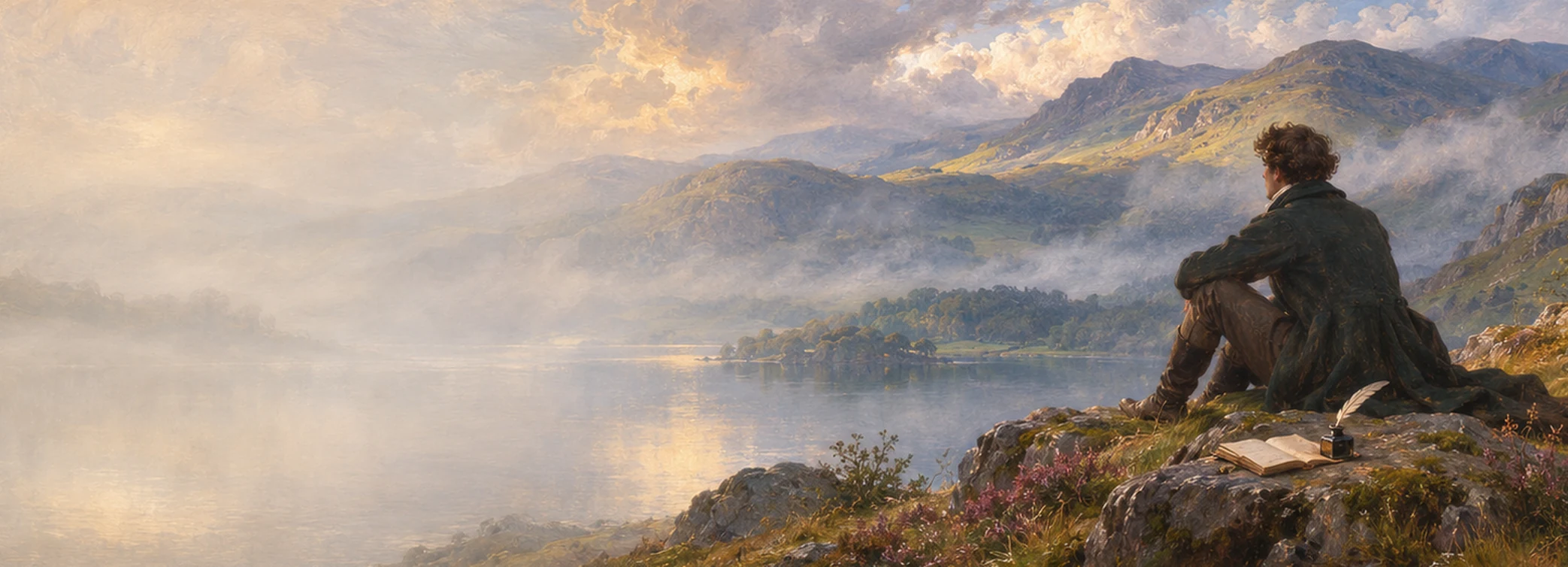
Picture a quiet revolution in how people talk about poetry around the year 1800. For more than two thousand years, critics had compared a poem to a mirror held up to the outer world. Now a new generation of English writers compared the poet's mind to a lamp—a living source of light that pours its own feeling and vision onto the world. That image, made famous by M. H. Abrams in The Mirror and the Lamp, captures the turning point of Romantic criticism.
Four names stand for this age. William Wordsworth argued for common life, plain speech and deep feeling in his Preface to Lyrical Ballads. Samuel Taylor Coleridge built the richest philosophical theory of imagination in English in Biographia Literaria. Percy Bysshe Shelley answered a playful attack on poetry by naming poets "the unacknowledged legislators of the world". William Hazlitt brought a painter's eye and fiery sympathy to English essays, judging art by its vital intensity, or "gusto".
This is the fifth article in the series on the history of English literary criticism. In the previous article, we saw Dryden, Pope, Addison and Samuel Johnson weigh literature against reason, nature and common sense. Romantic critics broke away from neoclassical rules and artificial diction, asking a new set of questions about the poet's mind, emotion and creative power.
The world of Romantic criticism
From the mirror to the lamp
Earlier critics—from Aristotle and Sidney to Dryden and Johnson—had looked mainly at the world a poem imitates or the effect it has on an audience. Romantic critics shifted the spotlight to the poet. In Abrams's map of critical theories, this is the expressive view: poetry is no longer chiefly a mirror of manners or a polite tool for moral instruction, but the outward expression of an inner life.
Along with this shift came a new idea of form. Neoclassical critics often treated poetic form as something applied from outside, like pouring liquid into a fixed mould. Romantic critics—especially Coleridge—championed organic form: a poem should grow naturally from within, like a living plant, taking its own unique shape from the feeling and idea that give it life.
Revolutions and reactions
Romantic criticism did not appear out of thin air. It grew in the shadow of the French Revolution (1789), which awakened hopes of liberty and equality, and the Industrial Revolution, which made poets fearful that cold machinery and narrow utilitarian calculation were crowding out beauty and feeling. At the same time, German thinkers such as Immanuel Kant, Friedrich Schelling and August Wilhelm Schlegel were writing deeply about imagination and organic unity, and Coleridge carried many of their insights into English criticism.
A map of the age
Although Romantic critics rejected rigid classical rules, they did not think poetry was lawless or trivial. On the contrary, they claimed a higher truth for it than ever before. For Wordsworth, poetry reveals the permanent passions of the human heart. For Coleridge, imagination reconciles opposites into a living whole. For Shelley, imagination is the root of moral sympathy itself. For Hazlitt, great art awakens our fullest human vitality.
Did you know?
When Wordsworth and Coleridge first published Lyrical Ballads in 1798, the book appeared anonymously and had no Preface at all—only a short "Advertisement" of a few paragraphs. The famous Preface to Lyrical Ballads was added to the second edition in 1800, and expanded further in 1802.
Important points to remember
- Romantic criticism flourished in England from the publication of Lyrical Ballads (1798) through the 1830s.
- M. H. Abrams described the Romantic shift as moving from the mirror (imitation) to the lamp (expression).
- In Abrams's map, Romantic criticism represents the expressive view, centring on the poet's mind, feeling and imagination.
- Romantic critics favoured organic form (growing from within) over mechanical rules imposed from outside.
- The French Revolution, the Industrial Revolution and German Idealist philosophy all shaped Romantic critical thought.
- Lyrical Ballads (1798) had only a short "Advertisement"; Wordsworth added the famous Preface in 1800 and expanded it in 1802.
William Wordsworth: Preface to Lyrical Ballads
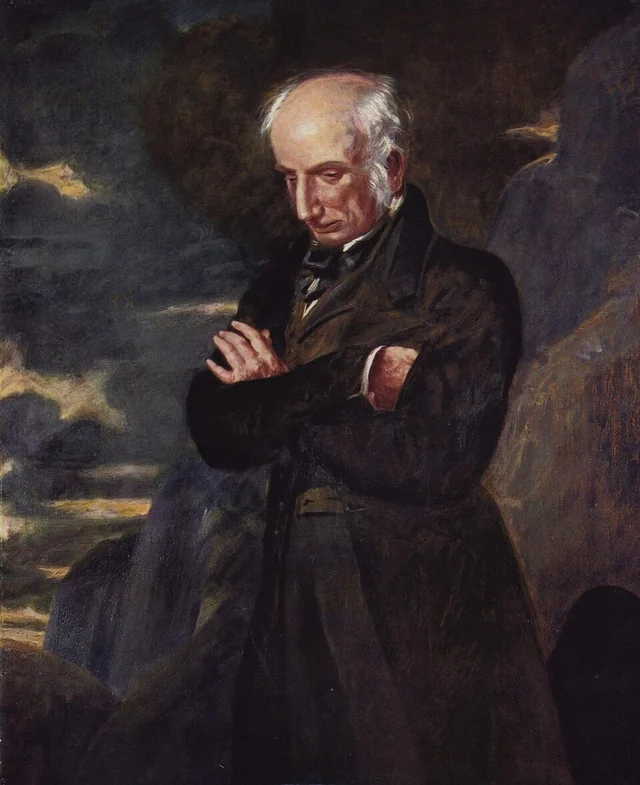
William Wordsworth (1770-1850) wrote the Preface to Lyrical Ballads for the second edition of 1800 and revised and enlarged it in 1802 (adding the famous passage "What is a Poet?" and an Appendix on poetic diction). He intended it to defend the unusual simplicity of his poems against hostile reviewers, yet it quickly became the informal manifesto of English Romanticism.
Ordinary life and plain language
Wordsworth begins by explaining the experiment behind his poems. His chief object was "to choose incidents and situations from common life", to relate them in "a selection of language really used by men", and at the same time to throw over them "a certain colouring of imagination" so that ordinary things would appear fresh and unusual.
Why did Wordsworth prefer "humble and rustic life"? Because in the countryside, he argued, the essential passions of the heart are less under restraint, speak a plainer language, and are bound up with the permanent forms of nature. He attacked eighteenth-century "poetic diction"—stock artificial phrases and personifications that separated poetry from living speech. Going even further, he declared that "there neither is, nor can be, any essential difference between the language of prose and metrical composition".
Emotion recollected in tranquillity
Wordsworth's most famous definition of poetry appears in two linked sentences that must always be read together:
"For all good poetry is the spontaneous overflow of powerful feelings: it takes its origin from emotion recollected in tranquillity."
Students often quote only the first half and mistake Wordsworth for a critic who wants raw, uncontrolled emotion on the page. In fact, Wordsworth stresses reflection and craft. The original emotion is remembered later in a calm state of mind, contemplated until tranquillity gradually disappears and a kindred emotion takes its place—and only then does composition begin. As Wordsworth adds, valuable poems are written only by a person who, along with "more than usual organic sensibility", has also "thought long and deeply".
What is a poet?
In the 1802 edition, Wordsworth asks directly: "What is a Poet?" His answer is warm and democratic: a poet is "a man speaking to men". He does not differ from other people in kind, only in degree—having more lively sensibility, more enthusiasm and tenderness, a greater knowledge of human nature, and a more comprehensive soul.
Wordsworth also turns Aristotle's Poetics upside down. Where Aristotle had called plot the soul of tragedy, Wordsworth insists that in his poems "the feeling therein developed gives importance to the action and situation, and not the action and situation to the feeling".
Important points to remember
- William Wordsworth (1770-1850) added the Preface to Lyrical Ballads in 1800 and expanded it in 1802.
- He chose "incidents and situations from common life" written in "a selection of language really used by men".
- He preferred humble and rustic life because human passions there are simpler, plainer and closer to nature.
- He attacked artificial eighteenth-century "poetic diction" and claimed there is no essential difference between the language of prose and metrical composition.
- Wordsworth defined poetry as "the spontaneous overflow of powerful feelings" taking its origin from "emotion recollected in tranquillity".
- In 1802, he defined the poet as "a man speaking to men", differing from others in degree rather than in kind.
- Reversing Aristotle, Wordsworth argued that feeling gives importance to action and situation, not the other way around.
Samuel Taylor Coleridge: Biographia Literaria
Samuel Taylor Coleridge (1772-1834) was Wordsworth's closest collaborator on Lyrical Ballads and the deepest philosophical critic of the English tradition. Published in two volumes in 1817, his Biographia Literaria ("literary biography") blends personal memoir, German philosophy and penetrating practical criticism. Though famously uneven in structure, its chapters on imagination and on Wordsworth's poetic theory remain cornerstones of modern criticism.
Primary imagination, secondary imagination and fancy
In Chapter 13 of Biographia Literaria, Coleridge makes the most famous distinction in Romantic criticism—separating Imagination (which he divides into Primary and Secondary) from Fancy:
- Primary Imagination is "the living Power and prime Agent of all human Perception". It is the involuntary, universal creative act by which every human mind perceives and orders the world—a repetition in the finite mind of the eternal act of creation.
- Secondary Imagination is an echo of the primary, co-existing with the conscious will. It is the true poetic power: it "dissolves, diffuses, dissipates, in order to recreate", unifying scattered images and ideas into a fresh, living whole. Earlier in the book, Coleridge coined the word esemplastic (meaning "to shape into one") for this unifying force.
- Fancy, by contrast, is merely a mechanical mode of memory. It has "no other counters to play with, but fixities and definites". Fancy can place two ready-made images side by side, yet it never melts or transforms them into a new creation.
- Primary imaginationThe mind perceives and orders the world.
- Secondary imaginationThe poet reshapes what the mind perceives.
- FancyMemory rearranges images without changing them.
Poetic faith and the nature of a poem
In Chapter 14, Coleridge recalls how he and Wordsworth divided the work of Lyrical Ballads. Wordsworth was to give the charm of novelty to everyday things, while Coleridge was to treat supernatural characters and incidents with enough human truth to win from the reader "that willing suspension of disbelief for the moment, which constitutes poetic faith".
In the same chapter, Coleridge defines a poem carefully: it is a species of composition opposed to works of science by proposing pleasure, not truth, as its immediate object, and each part must mutually support and explain the whole. He also distinguishes a poem (the formal composition in metre) from poetry (a broader creative spirit that can exist even in prose, as in Plato or the Bible).
Answering Wordsworth on poetic diction
In Chapters 17 to 22, Coleridge offers a respectful yet devastating critique of Wordsworth's Preface. He agrees with Wordsworth's attack on stale poetic diction, yet rejects three of Wordsworth's main claims:
- Rustic language is not naturally superior. Education and wide reflection enrich language; isolated rural speech is often narrow rather than universal.
- "Selection" undoes the rustic claim. Once a poet selects and purifies rustic speech of its local defects, what remains is simply the common language of educated men everywhere—not specifically rustic language.
- Metre makes a real difference. Prose and poetry cannot share the exact same language without change, because metre heightens emotional excitement and naturally calls for more vivid, concentrated phrasing. Even Wordsworth's own finest poems, Coleridge points out, rise far above his narrow theory.
Important points to remember
- Samuel Taylor Coleridge (1772-1834) published Biographia Literaria in two volumes in 1817.
- In Chapter 13, he divides Imagination into Primary (universal human perception) and Secondary (conscious poetic creation that "dissolves, diffuses, dissipates, in order to recreate").
- Coleridge coined the word esemplastic ("to shape into one") for the unifying power of imagination.
- Fancy is mechanical and deals only with "fixities and definites", rearranging images without transforming them.
- In Chapter 14, Coleridge introduced the phrase "willing suspension of disbelief for the moment, which constitutes poetic faith".
- Coleridge defines a poem as having pleasure, not truth, as its immediate object, and distinguishes between a poem and poetry.
- In Chapters 17-22, Coleridge refuted Wordsworth's claims about rustic language and argued that metre creates a real difference between poetry and prose.
Percy Bysshe Shelley: A Defence of Poetry
Percy Bysshe Shelley (1792-1822) wrote A Defence of Poetry in February and March 1821 while living in Italy, though it remained unpublished until 1840. Written in soaring, musical prose, it stands alongside Sir Philip Sidney's An Apology for Poetry as one of the two great English defences of the poetic art.
Peacock's challenge: The Four Ages of Poetry
Just as Sidney had answered Stephen Gosson, Shelley wrote in reply to an attack—this time a witty, ironic one by his own close friend, the novelist Thomas Love Peacock. In 1820, Peacock published The Four Ages of Poetry, arguing playfully that poetry moves through four stages: Iron, Gold, Silver and Brass. In an age of modern science, reason and political economy, Peacock joked, a poet is "a semi-barbarian in a civilized community" whose work is a waste of adult intelligence. Shelley was amused yet genuinely provoked, and sat down to defend poetry's deepest value.
Reason, imagination and the fading coal
Shelley begins by contrasting two faculties of the mind: Reason (to logizein), which analyses, counts and compares things already known, and Imagination (to poiein), which synthesises, creates and perceives the hidden harmony of the universe. Reason is to Imagination, Shelley says, "as the instrument to the agent, as the body to the spirit, as the shadow to the substance".
In a broad sense, Shelley defines poetry as "the expression of the imagination", and argues that poetry is born with humanity itself. Like Plato in the Ion, Shelley insists that true poetic creation cannot be switched on by willpower alone: "the mind in creation is as a fading coal, which some invisible influence, like an inconstant wind, awakens to transitory brightness." By the time composition begins, inspiration is already fading, so even the greatest poem is only a feeble shadow of the poet's original vision.

Moral empathy and "unacknowledged legislators"
How does poetry improve society? Shelley hates direct moral preaching ("Didactic poetry is my abhorrence"). Instead, poetry works morally by enlarging human sympathy. "The great secret of morals is Love; or a going out of our own nature," Shelley writes, and "A man, to be greatly good, must imagine intensely and comprehensively; he must put himself in the place of another and of many others."
Because imagination creates the ideals, metaphors and sympathies by which societies live and reform themselves, poets quietly shape human civilization far more deeply than politicians do. Shelley ends his essay with one of the most famous sentences in literary criticism:
"Poets are the unacknowledged legislators of the world."
Important points to remember
- Percy Bysshe Shelley (1792-1822) wrote A Defence of Poetry in 1821; it was published posthumously in 1840.
- It was written in reply to Thomas Love Peacock's satirical essay The Four Ages of Poetry (1820), which divided poetry into Iron, Gold, Silver and Brass ages.
- Shelley contrasts Reason (analytical, the instrument) with Imagination (synthetic and creative, the agent).
- Shelley defines poetry broadly as "the expression of the imagination".
- He compares the inspired mind to "a fading coal, which some invisible influence, like an inconstant wind, awakens to transitory brightness".
- Poetry improves morals not by preaching, but by expanding sympathy ("The great secret of morals is Love").
- Shelley concludes with the famous line: "Poets are the unacknowledged legislators of the world."
William Hazlitt: sympathy and gusto
William Hazlitt (1778-1830) was the finest practical critic and essayist of the Romantic age. Trained first as a portrait painter before turning to journalism and literary lecturing, he wrote with energy, candour and vivid concrete detail. His major critical books include The Round Table (1817), Characters of Shakespear's Plays (1817), Lectures on the English Poets (1818), Lectures on the English Comic Writers (1819), and The Spirit of the Age (1825).
Poetry as passion and "gusto"
Unlike Coleridge, Hazlitt did not build elaborate philosophical systems. He trusted immediate, passionate responsiveness to a work of art—what is often called impressionistic or sympathetic criticism. In his famous opening lecture, "On Poetry in General" (Lectures on the English Poets, 1818), he declared: "Poetry is the language of the imagination and the passions." Poetry, he argued, is not locked inside rhymed books; it is the natural language of human desire, fear and wonder whenever the mind is deeply stirred.
Hazlitt's signature critical term is gusto, explained in his essay "On Gusto" (The Round Table, 1817). He defines gusto in art as "power or passion defining any object". A painter or poet has gusto when his work is so charged with living sensory energy that the viewer or reader almost feels, touches and tastes the subject. In literature, Hazlitt found supreme gusto in Chaucer, Spenser, Shakespeare and Milton.
Shakespeare and sympathetic imagination
In Characters of Shakespear's Plays (1817), Hazlitt helped turn Shakespeare criticism away from eighteenth-century rules and moral checklists toward deep psychological insight into character. What amazed Hazlitt most about Shakespeare was his sympathetic imagination—his power to disappear from himself and enter completely into every kind of human being, from Hamlet and Othello to Falstaff and Iago.
Shakespeare, Hazlitt wrote, "was nothing in himself; but he was all that others were, or that they could become." This insight had a famous ripple effect: the young poet John Keats attended Hazlitt's lectures, read his essays eagerly, and drew directly on Hazlitt's view of Shakespeare when formulating his own celebrated concept of Negative Capability.
The Spirit of the Age (1825)
In The Spirit of the Age (1825), Hazlitt turned his sharp eye on his own contemporaries—Wordsworth, Coleridge, Byron, Scott, Lamb, Bentham and others. His portraits are vivid, fearless and famously mixed: he could praise Wordsworth's poetic genius in one sentence and lash him for political conservatism in the next.
An interesting story
Shelley's A Defence of Poetry almost vanished before anyone could read it. Shelley wrote the essay in early 1821 for a new periodical called The Literary Miscellany, which had printed Peacock's The Four Ages of Poetry. Before Shelley's reply could appear, the magazine collapsed after its very first issue. The next year, in July 1822, Shelley drowned in a storm off the coast of Italy at the age of twenty-nine. His unfinished manuscript lay untouched for nearly nineteen years until his widow, Mary Shelley, edited it—trimming out the direct personal references to Peacock—and published it in 1840. Without her care, one of the great manifestos of English criticism might never have reached print.
Key terms
- Romantic criticism - literary criticism of the late eighteenth and early nineteenth centuries (1798-1830s), centring on imagination, emotion, organic form and the poet's inner vision.
- The Mirror and the Lamp - M. H. Abrams's famous metaphor contrasting classical/neoclassical imitation (the mirror) with Romantic expression (the lamp).
- Expressive theory - the Romantic view that poetry is primarily the outward expression of the poet's inner feelings and imagination.
- Organic form - the idea (championed by Coleridge) that a poem grows naturally from within like a living organism, rather than obeying mechanical rules.
- Poetic diction - the artificial, ornate vocabulary of eighteenth-century verse, attacked by Wordsworth in his Preface.
- Emotion recollected in tranquillity - Wordsworth's account of how powerful feeling is remembered and refined calmly before being shaped into poetry.
- A man speaking to men - Wordsworth's democratic definition of the poet in the 1802 Preface.
- Primary Imagination - Coleridge's term for the universal, unconscious creative power of human perception.
- Secondary Imagination - Coleridge's term for the conscious poetic power that dissolves and recreates experience into a new unity.
- Fancy - Coleridge's term for the lower, mechanical faculty that merely rearranges fixed memories without transforming them.
- Esemplastic - a word coined by Coleridge in Biographia Literaria meaning "to shape into one".
- Willing suspension of disbelief - Coleridge's phrase for the reader's voluntary acceptance of supernatural or fictional elements ("poetic faith").
- The Four Ages of Poetry - Thomas Love Peacock's 1820 satirical essay (Iron, Gold, Silver, Brass) that provoked Shelley's A Defence of Poetry.
- Fading coal - Shelley's metaphor for the inspired mind in creation, briefly brightened by an unseen wind.
- Unacknowledged legislators - Shelley's closing description of poets as the hidden moral and imaginative shapers of human civilization.
- Gusto - Hazlitt's critical term for "power or passion defining any object" with vivid sensory life.
- Sympathetic imagination - the power to step outside oneself and enter into the feelings of other people, praised by both Shelley and Hazlitt.
- Impressionistic criticism - criticism grounded in the critic's personal, passionate, concrete response to a work, mastered by Hazlitt.
Important points to remember
- William Hazlitt (1778-1830) was trained as a painter and became the leading practical and impressionistic critic of the Romantic age.
- His major critical books include The Round Table (1817), Characters of Shakespear's Plays (1817), Lectures on the English Poets (1818) and The Spirit of the Age (1825).
- In "On Poetry in General" (1818), Hazlitt defined poetry as "the language of the imagination and the passions".
- In "On Gusto" (The Round Table, 1817), he defined gusto as "power or passion defining any object".
- In Characters of Shakespear's Plays (1817), he praised Shakespeare's sympathetic imagination ("nothing in himself; but he was all that others were").
- Hazlitt's view of Shakespeare deeply influenced John Keats's concept of Negative Capability.
- The Spirit of the Age (1825) contains vivid, candid critical portraits of Hazlitt's contemporaries.
How Romantic criticism shaped what came after
Ideas that stayed
Romantic critics permanently changed the language of literary criticism. Wordsworth made everyday life and sincere feeling worthy of the highest poetry. Coleridge gave modern criticism its core vocabulary—organic form, imagination versus fancy, and willing suspension of disbelief—which later shaped I. A. Richards and the New Critics of the twentieth century. Shelley forged an unforgettable link between poetic imagination and moral empathy. Hazlitt showed that great criticism can itself be vivid, passionate literature.
From the Romantics to the Victorians
Yet the Romantic triumph also raised fresh worries for the next generation. If poetry depends wholly on personal feeling and flashes of inspiration, how can a critic tell great art from self-indulgent daydreaming? In the Victorian age that followed—led by Matthew Arnold and Walter Pater—critics kept the Romantic reverence for poetry's high calling, yet tried to restore balance, cultural standards and "disinterestedness".
How to read the Romantic critics
When you read these four critics, ask three questions of each. How does he define imagination? What does he think poetry does to human feeling? And what eighteenth-century habit is he pushing against? Wordsworth pushes against artificial poetic diction. Coleridge pushes against mechanical psychology and narrow theories of metre. Shelley pushes against cold utilitarianism. Hazlitt pushes against dry, rule-bound reading. Seen together, their essays form one of the richest debates in the history of English literature.
Important points to remember
- Wordsworth democratised poetic subject matter and language.
- Coleridge's ideas of organic form and imagination deeply influenced twentieth-century New Criticism.
- Shelley linked poetic imagination directly to moral empathy and social renewal.
- Hazlitt pioneered vivid, character-centred and impressionistic criticism in English.
- Victorian critics such as Matthew Arnold later sought to balance Romantic feeling with classical standards and cultural order.
Critics and works
| Critic | Dates | Key work | Known for |
|---|---|---|---|
| William Wordsworth | 1770-1850 | Preface to Lyrical Ballads (1800, 1802) | Common life and plain language; "emotion recollected in tranquillity"; "a man speaking to men" |
| Samuel Taylor Coleridge | 1772-1834 | Biographia Literaria (1817) | Primary and Secondary Imagination vs. Fancy; "willing suspension of disbelief"; critique of Wordsworth |
| Percy Bysshe Shelley | 1792-1822 | A Defence of Poetry (written 1821, pub. 1840) | Reply to Peacock; Reason vs. Imagination; "fading coal"; "unacknowledged legislators of the world" |
| William Hazlitt | 1778-1830 | Characters of Shakespear's Plays (1817), Lectures on the English Poets (1818), The Spirit of the Age (1825) | Gusto; sympathetic imagination; Shakespeare's characters; passionate impressionistic criticism |
Quick revision - 50 points
Open the 50 pointsClose the list
- Romantic criticism flourished in England from 1798 through the 1830s.
- The four major critics covered here are William Wordsworth, Samuel Taylor Coleridge, Percy Bysshe Shelley and William Hazlitt.
- M. H. Abrams described the Romantic shift as moving from the "mirror" (imitation) to the "lamp" (expression).
- In Abrams's map, Romantic criticism represents the expressive theory of literature.
- Romantic critics favoured organic form over mechanical neoclassical rules.
- Lyrical Ballads was first published anonymously in 1798 with only a short "Advertisement".
- Wordsworth added the famous Preface to Lyrical Ballads to the second edition in 1800.
- Wordsworth expanded the Preface in 1802, adding "What is a Poet?" and an Appendix on poetic diction.
- Wordsworth chose "incidents and situations from common life" as his subject matter.
- Wordsworth aimed to use "a selection of language really used by men".
- He preferred humble and rustic life because passions there are plainer and closer to nature.
- Wordsworth attacked artificial eighteenth-century "poetic diction".
- He claimed there is no essential difference between the language of prose and metrical composition.
- Wordsworth defined poetry as "the spontaneous overflow of powerful feelings".
- He added that poetry "takes its origin from emotion recollected in tranquillity".
- Wordsworth defined the poet as "a man speaking to men", differing from others in degree, not kind.
- Reversing Aristotle, Wordsworth said feeling gives importance to action and situation.
- Samuel Taylor Coleridge published Biographia Literaria in two volumes in 1817.
- In Chapter 13, Coleridge distinguished Primary Imagination, Secondary Imagination and Fancy.
- Primary Imagination is "the living Power and prime Agent of all human Perception".
- Secondary Imagination co-exists with the conscious will and "dissolves, diffuses, dissipates, in order to recreate".
- Coleridge coined the word "esemplastic" ("to shape into one") for the unifying power of imagination.
- Fancy is mechanical and has "no other counters to play with, but fixities and definites".
- In Chapter 14, Coleridge introduced "willing suspension of disbelief for the moment, which constitutes poetic faith".
- Coleridge defined a poem as having pleasure, not truth, as its immediate object.
- Coleridge distinguished between a poem (in metre) and poetry (a broader creative spirit).
- In Chapters 17-22, Coleridge refuted Wordsworth's theory of rustic language and poetic diction.
- Coleridge argued that metre creates a real, organic difference between poetry and prose.
- Percy Bysshe Shelley wrote A Defence of Poetry in February-March 1821.
- Shelley's essay was published posthumously in 1840 by Mary Shelley.
- Shelley wrote A Defence of Poetry in reply to Thomas Love Peacock's The Four Ages of Poetry (1820).
- Peacock divided poetry into four ages: Iron, Gold, Silver and Brass.
- Peacock joked that a modern poet is "a semi-barbarian in a civilized community".
- Shelley contrasted Reason (to logizein, analytical) with Imagination (to poiein, synthetic and creative).
- Shelley defined poetry broadly as "the expression of the imagination".
- Shelley compared the mind in creation to "a fading coal" awakened briefly by an inconstant wind.
- Shelley disliked didactic poetry, declaring "Didactic poetry is my abhorrence."
- Shelley argued that "The great secret of morals is Love", powered by imaginative sympathy.
- Shelley ended his essay with: "Poets are the unacknowledged legislators of the world."
- William Hazlitt (1778-1830) trained first as a painter before becoming a major critic and essayist.
- Hazlitt published The Round Table and Characters of Shakespear's Plays in 1817.
- Hazlitt published Lectures on the English Poets in 1818.
- In "On Poetry in General" (1818), Hazlitt defined poetry as "the language of the imagination and the passions".
- In "On Gusto" (The Round Table, 1817), Hazlitt defined gusto as "power or passion defining any object".
- Hazlitt praised Shakespeare's sympathetic imagination, saying he was "nothing in himself; but he was all that others were".
- Hazlitt's view of Shakespeare deeply influenced John Keats's idea of Negative Capability.
- Hazlitt published The Spirit of the Age in 1825, profiling contemporary writers and thinkers.
- Hazlitt is remembered as the master of vivid, passionate impressionistic criticism.
- Coleridge's ideas of organic form and imagination strongly influenced twentieth-century New Criticism.
- Romantic criticism paved the way for Victorian debates led by Matthew Arnold and Walter Pater.
Quick quiz - 25 questions
Tap an answer to see at once if it is right. You do not need to log in.
Open the 25 questionsClose the quiz
1Which book by M. H. Abrams uses the image of "the mirror and the lamp" to contrast neoclassical and Romantic criticism?
Answer: B. Abrams's The Mirror and the Lamp (1953) contrasts mimetic imitation (mirror) with Romantic expression (lamp).
2In what year was Wordsworth's Preface to Lyrical Ballads first added to the collection?
Answer: B. The 1798 first edition had only a brief "Advertisement"; the Preface appeared in 1800 and was expanded in 1802.
3According to Wordsworth's Preface, poetry is "the spontaneous overflow of powerful feelings" taking its origin from what?
Answer: B. Wordsworth emphasizes calm reflection: "emotion recollected in tranquillity".
4Why did Wordsworth prefer "humble and rustic life" as the subject of poetry?
Answer: B. Wordsworth believed rural life showed essential human passions in a plainer, more durable form.
5How did Wordsworth define the poet in the 1802 Preface?
Answer: B. Wordsworth called the poet "a man speaking to men", differing from others in degree rather than kind.
6How does Wordsworth reverse Aristotle's emphasis on plot?
Answer: B. Wordsworth stresses that the feeling developed in a poem gives importance to the action and situation.
7In what year was Coleridge's Biographia Literaria published?
Answer: C. Coleridge published Biographia Literaria in two volumes in 1817.
8Which chapter of Biographia Literaria contains Coleridge's famous distinction between Primary Imagination, Secondary Imagination and Fancy?
Answer: B. Chapter 13 sets out the definitions of Primary Imagination, Secondary Imagination and Fancy.
9Which faculty, according to Coleridge, "dissolves, diffuses, dissipates, in order to recreate"?
Answer: C. Secondary Imagination is the conscious poetic power that dissolves and reshapes experience into a new unity.
10What does the word "esemplastic", coined by Coleridge, mean?
Answer: B. Coleridge coined "esemplastic" to describe the unifying, shaping power of the imagination.
11According to Coleridge, which faculty has "no other counters to play with, but fixities and definites"?
Answer: A. Fancy is mechanical and merely rearranges fixed memories without transforming them.
12In which chapter of Biographia Literaria does Coleridge introduce "willing suspension of disbelief"?
Answer: C. Chapter 14 recalls the plan of Lyrical Ballads and defines "willing suspension of disbelief" as poetic faith.
13According to Coleridge in Chapter 14, what is the immediate object of a poem (as opposed to science)?
Answer: B. Coleridge distinguishes a poem from works of science by stating that its immediate object is pleasure, not truth.
14On what major point did Coleridge disagree with Wordsworth in Chapters 17-22 of Biographia Literaria?
Answer: B. Coleridge argued against Wordsworth's claims about rustic speech and insisted that metre creates a real difference between prose and poetry.
15Whose satirical essay The Four Ages of Poetry (1820) provoked Shelley to write A Defence of Poetry?
Answer: B. Shelley's friend Thomas Love Peacock wrote The Four Ages of Poetry in 1820.
16What are Peacock's four ages of poetry in order?
Answer: B. Peacock mischievously ordered them as Iron, Gold, Silver and Brass.
17In what year was Shelley's A Defence of Poetry first published?
Answer: D. Written in 1821, the essay was published posthumously by Mary Shelley in 1840.
18To what does Shelley compare the mind in creation?
Answer: B. Shelley writes that "the mind in creation is as a fading coal", awakened briefly by an inconstant wind.
19How does Shelley distinguish Reason from Imagination?
Answer: B. Shelley treats Reason (to logizein) as analytical and Imagination (to poiein) as synthetic and creative.
20Complete Shelley's famous closing sentence: "Poets are the ... of the world."
Answer: B. Shelley closes A Defence of Poetry with: "Poets are the unacknowledged legislators of the world."
21How did William Hazlitt define poetry in "On Poetry in General" (Lectures on the English Poets, 1818)?
Answer: C. Hazlitt defined poetry as "the language of the imagination and the passions".
22What does Hazlitt's critical term "gusto" mean?
Answer: B. In "On Gusto" (The Round Table, 1817), Hazlitt defines gusto as "power or passion defining any object".
23Which younger Romantic poet was deeply influenced by Hazlitt's view of Shakespeare's sympathetic imagination when developing "Negative Capability"?
Answer: C. John Keats attended Hazlitt's lectures and drew directly on Hazlitt's account of Shakespeare's self-effacing sympathy.
24Which 1817 book by Hazlitt shifted Shakespeare criticism toward vivid psychological portraits of characters?
Answer: B. Hazlitt published Characters of Shakespear's Plays in 1817.
25Which 1825 book by Hazlitt offers sharp critical portraits of his own contemporaries, including Wordsworth, Coleridge and Byron?
Answer: C. The Spirit of the Age (1825) gathers Hazlitt's candid portraits of leading thinkers and writers of his day.
Frequently asked questions
What is Romantic literary criticism?
It is the literary criticism of the Romantic age (roughly 1798 to the 1830s), led in England by Wordsworth, Coleridge, Shelley and Hazlitt. It shifted attention from classical rules and imitation to the poet's imagination, emotion and organic form.
Did Wordsworth think poetry is just raw, uncontrolled emotion?
No. While he called poetry "the spontaneous overflow of powerful feelings", he immediately added that it "takes its origin from emotion recollected in tranquillity" and requires a poet who has "thought long and deeply".
What is the difference between Imagination and Fancy in Coleridge?
In Chapter 13 of Biographia Literaria, Secondary Imagination is a living, creative power that dissolves and reshapes experience into a new unity. Fancy is a mechanical faculty that merely rearranges fixed memories without transforming them.
Why did Shelley write A Defence of Poetry?
Shelley wrote it in 1821 to answer his friend Thomas Love Peacock's witty 1820 essay The Four Ages of Poetry, which had joked that poets were outdated "semi-barbarians" in an age of modern science.
What did Shelley mean by "unacknowledged legislators of the world"?
Shelley meant that poets shape human civilization at its deepest level by creating the ideals, metaphors and moral sympathy that inspire laws and social change—even when society fails to recognise their influence.
What did William Hazlitt mean by "gusto"?
In his 1817 essay "On Gusto", Hazlitt defined gusto as "power or passion defining any object"—the vivid sensory intensity that makes a painting or poem feel fully alive to the reader's senses and emotions.
Sources
- Abrams, M. H., and Geoffrey Galt Harpham. A Glossary of Literary Terms. 11th ed., Cengage Learning, 2015.
- Abrams, M. H. The Mirror and the Lamp: Romantic Theory and the Critical Tradition. Oxford University Press, 1953.
- Drabble, Margaret, editor. The Oxford Companion to English Literature. 6th ed., Oxford University Press, 2000.
- Wordsworth, William. Preface to Lyrical Ballads. 1800; revised 1802.
- Coleridge, Samuel Taylor. Biographia Literaria. 1817.
- Peacock, Thomas Love. The Four Ages of Poetry. 1820.
- Shelley, Percy Bysshe. A Defence of Poetry. Written 1821; published 1840.
- Hazlitt, William. The Round Table and Characters of Shakespear's Plays. 1817.
- Hazlitt, William. Lectures on the English Poets. 1818.
- Hazlitt, William. The Spirit of the Age. 1825.
Afsar Khan, Ph.D. English
Test your knowledge
Check what you have learned with quizzes and MCQs.