

On this page
- The world of neoclassical criticism
- John Dryden: the father of English criticism
- Alexander Pope: An Essay on Criticism
- Joseph Addison: taste and the imagination
- Samuel Johnson: common sense and human nature
- How neoclassical criticism shaped what came after
- Critics and works
- Quick revision - 50 points
- Quick quiz - 25 questions
- Frequently asked questions
- Sources
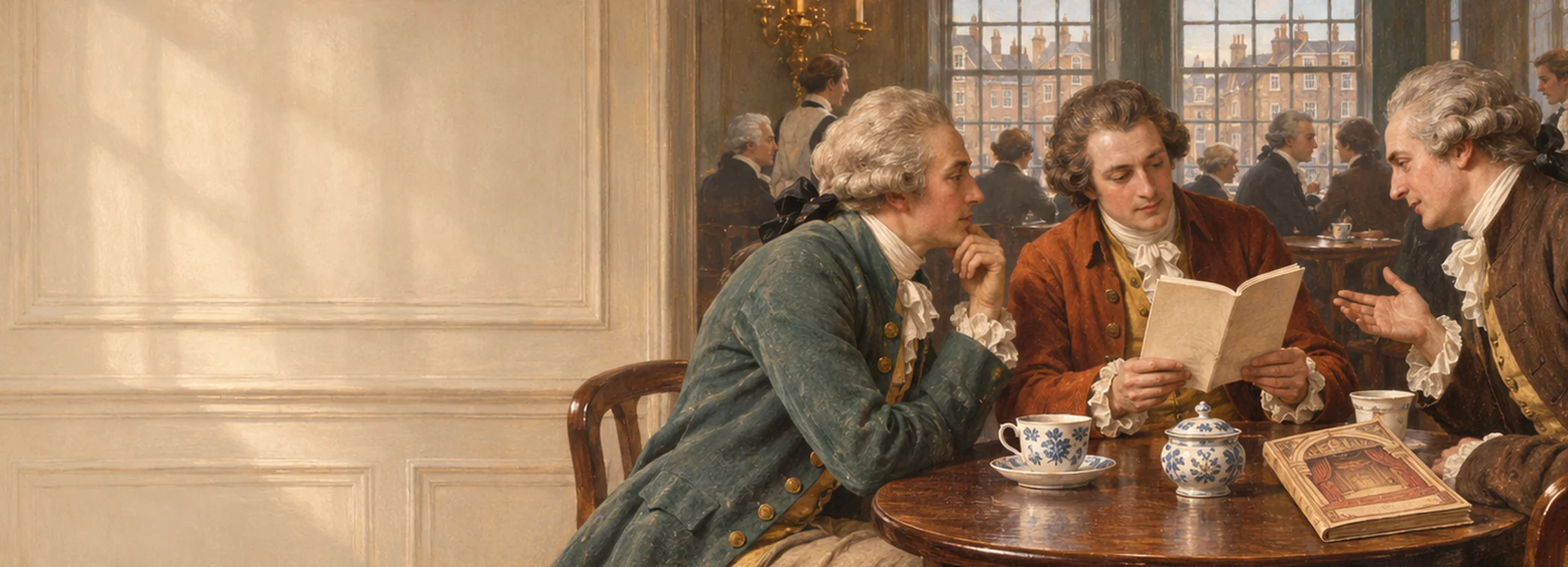
Picture a London coffee-house around the year 1700. Men sit at long wooden tables over cups of coffee, passing around a newly printed play or the latest issue of a daily paper. They argue about plot, wit, taste and the rules of the ancient Greeks. By this time, nobody needs to defend poetry's right to exist, as Sir Philip Sidney had to do a century earlier. Instead, criticism has become a lively public art—a way of testing books by reason, judgment and common sense.
Four names stand for this age. John Dryden turned English criticism into a flexible, generous craft and earned the title "the father of English criticism". Alexander Pope summed up the neoclassical creed in unforgettable heroic couplets. Joseph Addison carried literary taste to the middle-class breakfast table and opened a fresh inquiry into the imagination. Samuel Johnson brought the age to its summit, weighing Shakespeare and fifty-two English poets against the steady measure of human nature.
This is the fourth article in the series on the history of English literary criticism. In the previous articles, we met the ancient critics of Greece and Rome and the Elizabethan defenders who brought classical ideas into English. Neoclassical critics inherited that tradition, refined it under French influence, and yet—especially in Dryden, Addison and Johnson—refused to let rigid rules crush living literature.
The world of neoclassical criticism
Reason, nature and the ancients
Neoclassical criticism flourished in England from the Restoration of Charles II in 1660 to the death of Samuel Johnson in 1784. After the turmoil of the English Civil War, writers longed for order, clarity and balance. Many English courtiers had spent their exile in France, where dramatists such as Pierre Corneille and Jean Racine—and the critic Nicolas Boileau, whose L'Art poétique appeared in 1674—admired classical restraint and strict rules.
When neoclassical critics told poets to "follow Nature", they did not mean wild mountains or lonely woods. By Nature they meant universal human nature, the permanent truths of human life, and the orderly laws of reason. The ancient rules of Aristotle and Horace mattered not because they were old, but because the ancients had discovered what naturally pleases human beings across all ages. As Pope later put it, those rules were simply "Nature methodized".
The rise of coffee-houses and periodicals
Criticism also changed because its audience changed. In the Renaissance, critics wrote mostly for noble patrons and fellow scholars. In the Restoration and eighteenth century, a growing middle-class public bought books, filled theatres, and gathered in London coffee-houses—such as Will's Coffee-House, where Dryden held court. Daily periodicals like The Tatler (1709-1711) and The Spectator (1711-1712) turned literary criticism into polite, everyday conversation.
A map of the age
In Abrams's map of critical theories, neoclassical criticism remains grounded in the mimetic view (art as a mirror of general human nature) and the pragmatic view (art aiming to instruct and delight an audience). Yet the age was never as stiff or mechanical as later critics sometimes claimed. Dryden defended English freedom against French regularity, Addison explored the psychological pleasures of the imagination, and Johnson demolished the unities of time and place. Inside the neoclassical house, the windows toward Romanticism were already being unlocked.
Did you know?
Joseph Addison signed each of his essays in The Spectator with a single capital letter at the end—either C, L, I, or O. Read together, those four letters spell Clio, the name of the Greek Muse of History.
Important points to remember
- English neoclassical criticism spans roughly from the Restoration (1660) to the death of Samuel Johnson (1784).
- French neoclassicism—especially Corneille, Racine and Boileau (L'Art poétique, 1674)—strongly influenced English debates.
- By "Nature", neoclassical critics meant universal human nature and rational order, not wild scenery.
- Classical rules were valued as "Nature methodized", not merely as ancient commands.
- London coffee-houses and periodicals like The Spectator widened the audience for literary criticism.
- In Abrams's map, neoclassical criticism stays mainly mimetic and pragmatic, while Addison and Johnson begin to point beyond strict rules.
- Addison signed his Spectator papers with the letters C, L, I, or O, spelling Clio.
John Dryden: the father of English criticism
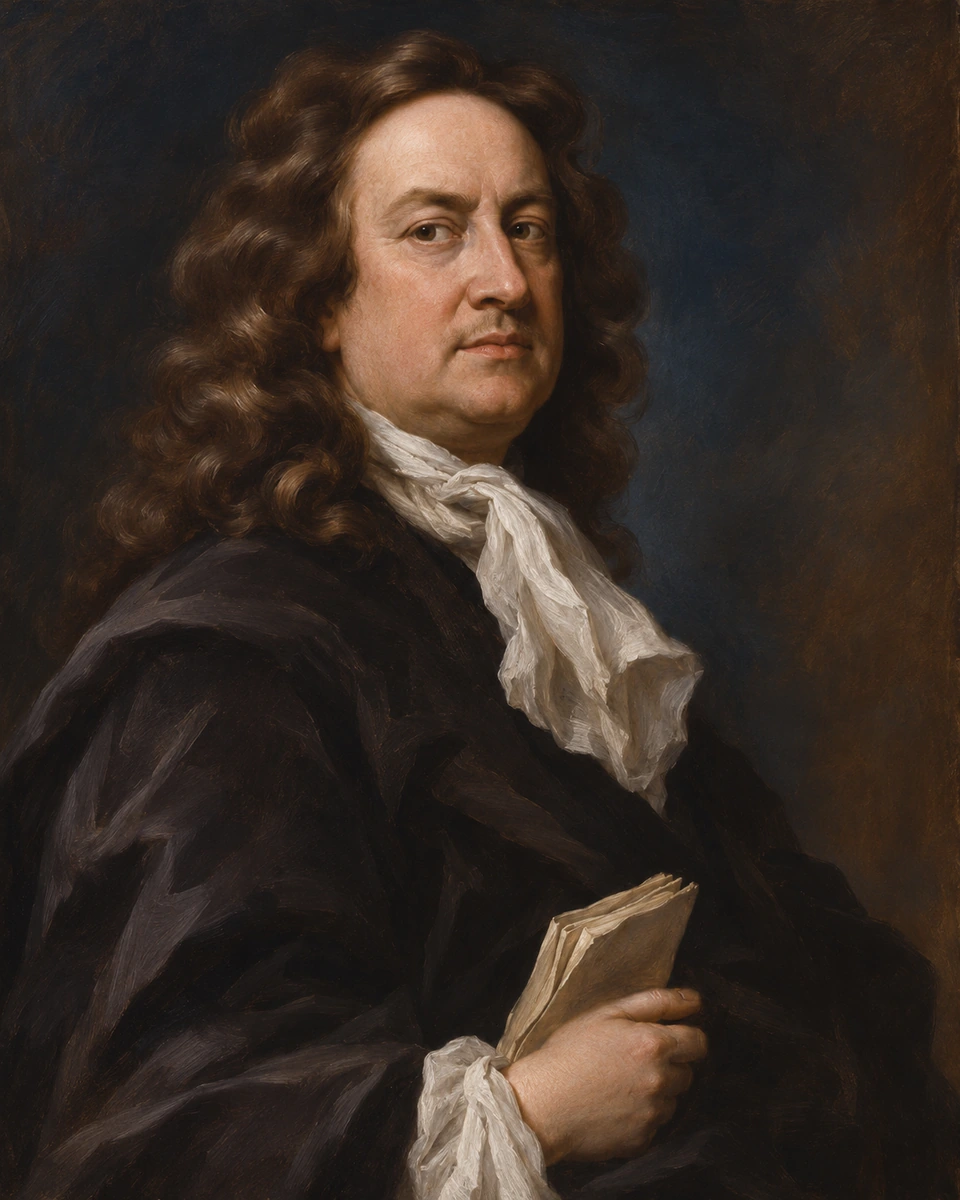
John Dryden (1631-1700) was the dominant poet, playwright and translator of the Restoration, and in 1668 he became England's first official Poet Laureate. Samuel Johnson later called him "the father of English criticism". Dryden earned that title because he wrote the first body of sustained, practical criticism in clear, modern English prose. Most of his criticism appeared in prefaces and dedications to his plays and translations, alongside his single most famous critical work, An Essay of Dramatic Poesy.
An Essay of Dramatic Poesy (1668)
Written around 1665-1666 while London was shut down by the Great Plague and published in 1668, An Essay of Dramatic Poesy is not a lecture at all—it is a dramatic dialogue. Four cultivated gentlemen take a barge down the River Thames on 3 June 1665 to listen to the distant thunder of cannons from the Battle of Lowestoft, where the English fleet is fighting the Dutch. As the gunfire fades and victory seems assured, they fall into a friendly debate about the art of drama.
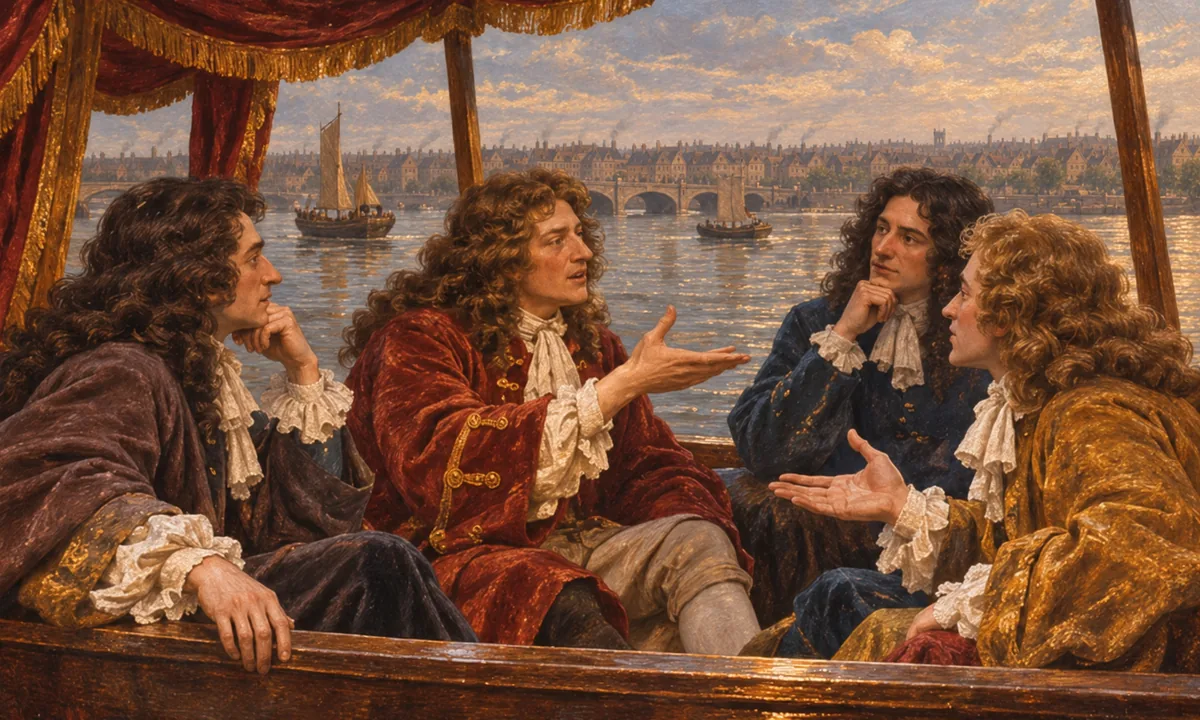
Each of the four speakers represents a major critical position of the age (and is traditionally linked to a real contemporary):
- Crites (Sir Robert Howard, Dryden's brother-in-law) defends the Ancients (Greek and Roman dramatists) and argues against rhyme in plays.
- Eugenius (Charles Sackville, Lord Buckhurst) defends the Moderns, arguing that modern playwrights have learned from the ancients and improved upon them.
- Lisideius (Sir Charles Sedley) defends French drama, praising its strict observance of the three unities, its single plots and its avoidance of violence on stage.
- Neander (whose name means "new man", representing Dryden himself) defends English drama, tragicomedy, lively subplots and the use of rhymed verse in serious plays.
- CritesAncient drama
- EugeniusModern drama
- LisideiusFrench drama
- NeanderEnglish drama
Defining a play and defending English drama
Early in the dialogue, Lisideius offers a working definition of a play that all four friends accept:
"A just and lively image of human nature, representing its passions and humours, and the changes of fortune to which it is subject, for the delight and instruction of mankind."
Notice the shift from Sidney and Horace. Here, "delight" comes before "instruction". Dryden believed that the chief end of poetry is delight, and that instruction follows naturally from it.
Through Neander, Dryden answers French neoclassicism with common sense. French plays, Neander says, are regular and neat, yet they have only the cold "beauties of a statue", not the warm, breathing motion of life. English drama—especially tragicomedy, which mingles mirth and seriousness, and subplots that weave variety into the action—gives a fuller, livelier image of human life. As for rhyme, Neander defends heroic couplets in serious plays as a heightening of noble speech, though in later years (as in All for Love, 1677) Dryden himself returned to blank verse.
Dryden on Shakespeare, Jonson and Chaucer
Dryden is at his very best in comparative criticism—measuring one great writer against another. In An Essay of Dramatic Poesy, Neander contrasts Shakespeare and Ben Jonson in lines that every student of English literature knows. Shakespeare, he says, "was the man who of all modern, and perhaps ancient poets, had the largest and most comprehensive soul". He was "naturally learned; he needed not the spectacles of books to read nature". Ben Jonson, by contrast, was "the most learned and judicious writer which any theatre ever had". Neander sums up the difference in one crisp line: "I admire him, but I love Shakespeare."
In the final year of his life, Dryden wrote the Preface to the Fables (1700), which contains his warm, generous appreciation of Geoffrey Chaucer. Comparing Chaucer with Ovid, Dryden praises the vivid gallery of pilgrims in The Canterbury Tales and declares, according to the proverb, that "here is God's plenty".
Important points to remember
- John Dryden (1631-1700) was England's first official Poet Laureate (1668) and was called "the father of English criticism" by Samuel Johnson.
- An Essay of Dramatic Poesy (1668) is a dialogue among four speakers on a boat on the Thames during the Battle of Lowestoft (3 June 1665).
- Crites defends the Ancients and blank verse; Eugenius defends the Moderns; Lisideius defends French drama; Neander (Dryden) defends English drama and rhymed verse.
- A play is defined as "a just and lively image of human nature... for the delight and instruction of mankind".
- Dryden puts delight before instruction as the primary end of poetry.
- Neander compares strict French plays to "the beauties of a statue" and defends English tragicomedy and subplots.
- Dryden says Shakespeare had "the largest and most comprehensive soul" and contrasts him with Jonson: "I admire him, but I love Shakespeare."
- In Preface to the Fables (1700), Dryden praises Chaucer with the phrase "Here is God's plenty."
Alexander Pope: An Essay on Criticism
Alexander Pope (1688-1744) was the supreme poet of the Augustan age, and his An Essay on Criticism (1711) is the manifesto of English neoclassicism. Written when Pope was only twenty-three and composed in polished heroic couplets, the poem belongs to the verse-treatise tradition of Horace's Ars Poetica and Boileau's L'Art poétique. Its lines are so tight and memorable that many have passed into everyday English speech.
The three parts of the poem
Pope divides his poem into three clear parts:
- Part 1 (lines 1-200) sets out the general principles of taste and judgment. Good taste is as rare as true poetic genius. Critics must first study Nature, learn from the ancient masters—especially Homer and Virgil—and understand that the classical rules are "Nature methodized", not arbitrary laws. Yet Pope also allows for a "nameless grace" beyond rules when a great poet achieves an effect that no rule can teach.
- Part 2 (lines 201-559) diagnoses the causes of bad criticism. The chief enemy is pride, followed by imperfect learning ("A little learning is a dang'rous thing"), judging a poem by isolated lines instead of the whole, worshipping flashy ornaments or mere verbal tricks, and blindly favouring either the ancients or the moderns.
- Part 3 (lines 560-744) sketches the moral character of the ideal critic—modest, candid, polite and fearless—and closes with a short history of great critics, praising Aristotle, Horace, Dionysius, Petronius, Quintilian, Longinus, Erasmus, Vida, Boileau and Pope's own mentor William Walsh.
Nature, rules and "True Wit"
Pope's most famous critical couplet appears in Part 2:
"True wit is nature to advantage dressed, What oft was thought, but ne'er so well expressed."
For Pope, wit does not mean mere joking or clever wordplay. It means imaginative intelligence joined with clear judgment. The poet does not try to shock readers with private eccentricities; instead, he takes universal human truths that everyone recognises and gives them their clearest, sharpest form.
In Part 1, Pope gives his central command: "First follow Nature, and your judgment frame / By her just standard, which is still the same." Because the great ancient poets copied Nature so faithfully, studying Homer and Virgil is the same as studying Nature itself.
Craft, sound and the generous critic
Pope insists that a good critic must look at the whole design of a work, not peck at minor slips: "To err is human; to forgive, divine." He also demonstrates technical craft in action. In a famous passage on poetic rhythm, he declares that "The sound must seem an echo to the sense"—making his own lines move softly when describing gentle breezes, and lumber slowly when describing Ajax lifting a heavy rock.
Notably, Pope also admires Longinus, praising him as an ardent critic "whose own example strengthens all his laws". Even at the height of neoclassicism, Pope knew that rules without fire and greatness of mind are lifeless.
Important points to remember
- Alexander Pope (1688-1744) published An Essay on Criticism in 1711, at the age of twenty-three.
- The poem is written in heroic couplets and follows the tradition of Horace's Ars Poetica and Boileau's L'Art poétique.
- It is divided into three parts: principles of criticism, causes of false judgment, and the character and history of good critics.
- Pope defines classical rules as "Nature methodized".
- Pope's famous definition of wit: "True wit is nature to advantage dressed, / What oft was thought, but ne'er so well expressed."
- Pride and "a little learning" are among the chief causes of bad criticism.
- Pope demonstrates "The sound must seem an echo to the sense" through his own verse rhythms.
- Pope calls for generous, whole-work judgment ("To err is human; to forgive, divine") and praises Longinus alongside Aristotle and Horace.
Joseph Addison: taste and the imagination
Joseph Addison (1672-1719) brought literary criticism out of the study and into the parlour. Together with Richard Steele, he produced The Spectator (1711-1712), a daily paper read across London. Addison wrote in an easy, graceful "middle style" designed to make good taste accessible to ordinary readers—men and women alike.
True wit, Paradise Lost and Chevy Chase
Addison's criticism in The Spectator covered three famous series of papers before his essays on the imagination:
- On Wit (Spectator Nos. 58-63, May 1711): Drawing on John Locke's distinction between wit and judgment, Addison separated True Wit (the resemblance of ideas that gives delight and surprise) from False Wit (mere resemblance of letters or words, such as puns, anagrams and acrostics) and Mixed Wit (a blend of both, which he found in Abraham Cowley).
- On Chevy Chase (Spectator Nos. 70 and 74, May 1711): In a bold break with aristocratic snobbery, Addison praised the old English folk ballad Chevy Chase and compared its simplicity and nobility with Homer and Virgil.
- On Paradise Lost (18 Saturday essays, January-May 1712): Addison guided readers systematically through John Milton's epic—first examining its fable, characters, sentiments and language by Aristotelian standards, and then walking through each of its twelve books. These essays helped secure Milton's place as a national classic.
The Pleasures of the Imagination (1712)
Addison's most original contribution to critical theory is his series of eleven essays on The Pleasures of the Imagination (Spectator Nos. 411-421, published from 21 June to 3 July 1712). It is one of the earliest systematic works of aesthetics in English.
Influenced by John Locke's empirical psychology, Addison begins with the senses. Sight, he says, is the most perfect and delightful of all our senses, and it is sight that furnishes the imagination with its ideas. He divides the pleasures of the imagination into two kinds:
- Primary pleasures arise from objects that are actually present before our eyes (a vast landscape, a grand building, a blooming garden).
- Secondary pleasures arise from ideas of visible objects that are not present before us, but are called up by memory, painting, sculpture or—above all—words in poetry.
Addison names three qualities in objects that trigger these pleasures: the Great (vastness, wild oceans, mountains—linking closely to Longinus's sublime), the Uncommon (novelty and surprise), and the Beautiful (symmetry, colour and grace).
Why Addison matters
While Addison respected Aristotle and Horace, his essays shifted attention away from rigid rules and toward the reader's psychological experience. In Spectator No. 419, he even defended what Dryden called "the fairy way of writing"—poems about ghosts, fairies and imaginary worlds, where Shakespeare excelled. By making imagination and the sublime central to literary pleasure, Addison helped prepare the road for Edmund Burke, the pre-Romantics and the Romantic poets.
Important points to remember
- Joseph Addison (1672-1719) co-founded The Spectator (1711-1712) with Richard Steele and wrote in an accessible "middle style".
- In Spectator Nos. 58-63, Addison distinguished True Wit (resemblance of ideas), False Wit (wordplay and puns) and Mixed Wit.
- In Spectator Nos. 70 and 74, he praised the folk ballad Chevy Chase alongside Homer and Virgil.
- In 18 Saturday essays (1712), he popularised Milton's Paradise Lost using Aristotelian standards.
- The Pleasures of the Imagination appeared in Spectator Nos. 411-421 (June-July 1712).
- Addison divided imaginative pleasures into primary (from objects before our eyes) and secondary (from absent objects recalled by art or words).
- He named three sources of imaginative pleasure: the Great, the Uncommon and the Beautiful.
- Addison shifted criticism toward the reader's mind and praised "the fairy way of writing".
Samuel Johnson: common sense and human nature
Samuel Johnson (1709-1784)—lexicographer, essayist, poet and towering talker of eighteenth-century London—was the greatest English critic of his age. He is often called the last great neoclassicist, yet he never worshipped rules blindly. Johnson judged every book by two firm tests: truth to general human nature, and moral usefulness. His chief critical works are his essays in The Rambler (1750-1752), his Preface to Shakespeare (1765), and his Lives of the Most Eminent English Poets (1779-1781).
The Preface to Shakespeare (1765)
Johnson's Preface to his eight-volume edition of Shakespeare is one of the finest pieces of literary criticism ever written in English. He begins by asking why Shakespeare has survived the test of time—the "length of duration and continuance of esteem". His answer states the core principle of neoclassical criticism:
"Nothing can please many, and please long, but just representations of general nature."
Shakespeare, Johnson declares, is "above all writers, at least above all modern writers, the poet of nature", and his drama is "the mirror of life". His characters are not freakish individuals tied to one narrow custom or place; they are "the genuine progeny of common humanity", acting and speaking as real men and women act and speak across all ages.
On this same ground, Johnson boldly defends Shakespeare's tragicomedy against strict neoclassical critics. Real life, Johnson observes, is neither pure tragedy nor pure comedy; it is a mingled state where the reveller is hastening to his wine while the mourner is burying his friend. By mixing sorrow and mirth, Shakespeare is simply closer to truth, and "there is always an appeal open from criticism to nature".
Breaking the three unities
The most famous section of the Preface is Johnson's demolition of the unities of time and place. Critics from Castelvetro to Voltaire had faulted Shakespeare for letting a play span years and leap between countries. Johnson agrees that unity of action is necessary, because a story needs a coherent beginning, middle and end. But he sweeps aside the unities of time and place with blunt common sense:
"The truth is, that the spectators are always in their senses, and know, from the first act to the last, that the stage is only a stage, and that the players are only players."
Nobody in a London theatre truly believes he is in ancient Alexandria. If the audience's imagination can accept that the wooden stage represents Alexandria in Act I, it has no trouble accepting that the same stage represents Rome in Act II. Dramatic pleasure, Johnson adds, does not come from mistaking a play for reality; "imitations produce pain or pleasure, not because they are mistaken for realities, but because they bring realities to mind".
Faults of Shakespeare and the Lives of the Poets
Johnson was too honest a critic to offer blind praise. In the Preface, he lists Shakespeare's faults plainly: he sometimes sacrifices virtue to convenience, writes without clear moral purpose, leaves his endings hurried, and cannot resist a pun. A quibble (pun), Johnson famously says, was "the fatal Cleopatra for which he lost the world, and was content to lose it". He also remarks that Shakespeare's tragedy "seems to be skill", while his comedy seems "to be instinct".
In his final masterpiece, Lives of the Most Eminent English Poets (1779-1781), Johnson wrote biographical and critical studies of 52 poets, from Abraham Cowley to Thomas Gray. Two essays are especially famous for students:
- In Life of Cowley, Johnson gave the Metaphysical poets (such as John Donne and Abraham Cowley) their lasting critical label. He admired their learning and sharp intellect, yet faulted their far-fetched conceits, writing that in their poetry "the most heterogeneous ideas are yoked by violence together".
- In Life of Dryden, Johnson traced Dryden's career and famously named him "the father of English criticism".
Across the Lives, Johnson also showed his preference for clear, natural expression and his impatience with artificial pastoral conventions—famously criticising Milton's Lycidas for lacking genuine personal grief.
An interesting story
Johnson's great edition of Shakespeare almost became an embarrassment before it became a triumph. In 1756, Johnson published his Proposals for editing Shakespeare and promised the finished volumes by Christmas 1757, taking advance subscription money from readers. Years rolled by while Johnson put off the work. In 1762, the satirist Charles Churchill mocked him openly in his poem The Ghost, accusing him of pocketing subscribers' money without producing a page. Stung by the public jibe, Johnson buckled down and finally published his eight-volume edition—with its monumental Preface—in October 1765, nine years after his promise.
Key terms
- Neoclassical criticism - literary criticism of the Restoration and eighteenth century (1660-1784), guided by reason, order, decorum and classical models.
- Nature (neoclassical) - universal human nature and rational order, rather than wild external scenery.
- Nature methodized - Alexander Pope's phrase explaining that classical rules are not arbitrary laws, but nature reduced to orderly principles.
- Heroic couplet - rhymed pairs of iambic pentameter lines, perfected by Dryden and Pope.
- An Essay of Dramatic Poesy - Dryden's 1668 critical dialogue among Crites, Eugenius, Lisideius and Neander on the Thames.
- Comparative criticism - judging writers by placing them side by side, a method pioneered in English by Dryden.
- True Wit - for Pope, "nature to advantage dressed"; for Addison, the pleasing resemblance of ideas rather than mere wordplay.
- False Wit - Addison's term for mechanical wordplay such as puns, anagrams and acrostics.
- Primary pleasures of the imagination - Addison's term for imaginative pleasures arising from objects directly before our eyes.
- Secondary pleasures of the imagination - Addison's term for pleasures arising from absent objects recalled by memory, art or poetry.
- The Great, the Uncommon and the Beautiful - Addison's three sources of imaginative pleasure.
- The fairy way of writing - Dryden's phrase, praised by Addison, for imaginative poetry dealing with ghosts, fairies and supernatural worlds.
- General nature - Johnson's test of lasting literature: universal human truth rather than local eccentricity.
- Appeal from criticism to nature - Johnson's principle that truth to life overrides rigid critical rules.
- Test of time - Johnson's standard ("length of duration and continuance of esteem") for judging classic authors.
- Fatal Cleopatra - Johnson's witty image for Shakespeare's irresistible love of puns (quibbles).
- Metaphysical poets - the group of seventeenth-century poets (Donne, Cowley and others) defined by Johnson in Life of Cowley, where "heterogeneous ideas are yoked by violence together".
- Critical biography - the blend of a writer's life story and literary judgment perfected by Johnson in Lives of the Poets.
Important points to remember
- Samuel Johnson (1709-1784) is the towering critic of the late eighteenth century, judging literature by general human nature and moral truth.
- His Preface to Shakespeare appeared in 1765, nine years after his 1756 Proposals.
- Johnson wrote that "Nothing can please many, and please long, but just representations of general nature."
- He called Shakespeare "the poet of nature" and his drama "the mirror of life".
- Johnson defended tragicomedy as faithful to real life ("an appeal open from criticism to nature").
- He rejected the unities of time and place because "the spectators are always in their senses" and know the stage is only a stage.
- Johnson called a quibble (pun) Shakespeare's "fatal Cleopatra".
- Lives of the Most Eminent English Poets (1779-1781) covers 52 poets and perfected critical biography.
- In Life of Cowley, Johnson defined Metaphysical poetry as a style where "the most heterogeneous ideas are yoked by violence together".
- In Life of Dryden, Johnson called Dryden "the father of English criticism".
How neoclassical criticism shaped what came after
Ideas that stayed
Neoclassical critics gave English criticism its modern voice and its sharpest tools. Dryden showed how to compare writers generously and write criticism in clear, conversational prose. Pope gave readers memorable standards of proportion, craftsmanship and whole-work judgment. Addison built a bridge between literature and the psychology of the reader, making taste and imagination public concerns. Johnson proved that common sense and lived human experience outrank mechanical rules, and he set the model for critical biography.
The bridge to the Romantics
It is tempting to imagine a sharp wall between the Neoclassical age and the Romantic age that followed. In reality, the neoclassicists built much of the bridge themselves. When Addison celebrated the pleasures of the imagination, the sublime vastness of nature, and the humble ballad Chevy Chase, he anticipated Romantic tastes. When Johnson shattered the unities of time and place and placed Shakespeare above classical rules, he cleared the stage for Romantic freedom. Even when Wordsworth and Coleridge later rebelled against eighteenth-century poetic diction, they were arguing directly with the standards Dryden, Pope and Johnson had made famous.
How to read the neoclassical critics
When you read these four critics, ask three questions of each. What does he mean by "Nature"? How strictly does he treat the classical rules? And whom is he writing for? Dryden writes for Restoration playgoers and fellow wits. Pope writes for poets and aspiring critics. Addison writes for the everyday middle-class reader of The Spectator. Johnson writes for the "common reader" whose steady judgment outlasts literary fashion. Asked this way, the neoclassical age appears not as a cold museum of rules, but as a century of vigorous, humane argument.
Important points to remember
- Dryden established modern English critical prose and comparative criticism.
- Pope condensed neoclassical craft, wit and judgment into memorable verse.
- Addison introduced psychological aesthetics and made taste a middle-class concern.
- Johnson championed the "common reader", general human nature and critical biography.
- Addison's focus on imagination and Johnson's rejection of the unities of time and place prepared the way for Romantic criticism.
- Romantic critics like Wordsworth and Coleridge built their theories partly in reaction against neoclassical standards.
Critics and works
| Critic | Dates | Key work | Known for |
|---|---|---|---|
| John Dryden | 1631-1700 | An Essay of Dramatic Poesy (1668), Preface to the Fables (1700) | Father of English criticism; four-speaker dialogue; defence of English drama and Chaucer |
| Alexander Pope | 1688-1744 | An Essay on Criticism (1711) | "Nature methodized"; "True wit is nature to advantage dressed"; sound echoing sense |
| Joseph Addison | 1672-1719 | The Spectator (1711-1712), The Pleasures of the Imagination (1712) | True vs. False Wit; Paradise Lost and Chevy Chase essays; primary and secondary pleasures |
| Samuel Johnson | 1709-1784 | Preface to Shakespeare (1765), Lives of the Poets (1779-1781) | General nature; defence of tragicomedy; rejection of unities of time and place; Metaphysical poets |
Quick revision - 50 points
Open the 50 pointsClose the list
- English neoclassical criticism spans roughly from the Restoration (1660) to Samuel Johnson's death (1784).
- The four major English neoclassical critics are John Dryden, Alexander Pope, Joseph Addison and Samuel Johnson.
- French neoclassicism, including Nicolas Boileau's L'Art poétique (1674), strongly shaped English critical debate.
- By "Nature", neoclassical critics meant universal human nature and rational order.
- London coffee-houses and periodicals like The Spectator created a wider middle-class audience for criticism.
- John Dryden lived from 1631 to 1700 and became England's first official Poet Laureate in 1668.
- Samuel Johnson called Dryden "the father of English criticism" in Life of Dryden.
- Dryden's An Essay of Dramatic Poesy was published in 1668.
- The essay is written as a dialogue among four gentlemen on a boat on the Thames on 3 June 1665.
- The distant gunfire in the essay comes from the Battle of Lowestoft between the English and Dutch fleets.
- Crites (Sir Robert Howard) defends the Ancients and blank verse.
- Eugenius (Lord Buckhurst) defends the Moderns over the Ancients.
- Lisideius (Sir Charles Sedley) defends French drama and the three unities.
- Neander (John Dryden) defends English drama, tragicomedy, subplots and rhymed verse in serious plays.
- In the essay, a play is defined as "a just and lively image of human nature... for the delight and instruction of mankind".
- Dryden placed delight before instruction as the primary aim of poetry.
- Neander compared rigid French plays to "the beauties of a statue".
- Dryden wrote that Shakespeare had "the largest and most comprehensive soul".
- Comparing Ben Jonson and Shakespeare, Dryden said: "I admire him, but I love Shakespeare."
- In Preface to the Fables (1700), Dryden praised Chaucer with the phrase "Here is God's plenty."
- Alexander Pope lived from 1688 to 1744 and published An Essay on Criticism in 1711.
- Pope was only twenty-three years old when An Essay on Criticism appeared.
- An Essay on Criticism is written in heroic couplets and divided into three parts.
- Pope called the classical rules "Nature methodized".
- Pope's famous definition of wit is: "True wit is nature to advantage dressed, / What oft was thought, but ne'er so well expressed."
- Pope warned that pride and "a little learning" are major causes of bad criticism.
- Pope demonstrated that "The sound must seem an echo to the sense."
- Pope urged generous judgment with the line "To err is human; to forgive, divine."
- Joseph Addison lived from 1672 to 1719 and co-founded The Spectator (1711-1712) with Richard Steele.
- Addison signed his Spectator essays with the letters C, L, I, or O, spelling Clio.
- In Spectator Nos. 58-63, Addison distinguished True Wit, False Wit and Mixed Wit.
- True Wit, for Addison, lies in the resemblance of ideas; False Wit lies in mere wordplay such as puns.
- In Spectator Nos. 70 and 74, Addison praised the folk ballad Chevy Chase.
- Addison wrote 18 Saturday essays in 1712 examining Milton's Paradise Lost.
- Addison's The Pleasures of the Imagination appeared in Spectator Nos. 411-421 (June-July 1712).
- Addison traced imaginative pleasures originally to the sense of sight.
- Primary pleasures come from objects before our eyes; secondary pleasures come from absent objects recalled by art or words.
- Addison named three sources of imaginative pleasure: the Great, the Uncommon and the Beautiful.
- Addison praised "the fairy way of writing" in Spectator No. 419.
- Samuel Johnson lived from 1709 to 1784 and wrote The Rambler (1750-1752), Preface to Shakespeare (1765) and Lives of the Poets (1779-1781).
- Johnson wrote that "Nothing can please many, and please long, but just representations of general nature."
- Johnson called Shakespeare "the poet of nature" and his drama "the mirror of life".
- Johnson defended tragicomedy as faithful to real human life.
- Johnson upheld unity of action but rejected the unities of time and place.
- Johnson argued that "the spectators are always in their senses" and know the stage is only a stage.
- Johnson called a quibble (pun) Shakespeare's "fatal Cleopatra".
- Johnson remarked that Shakespeare's tragedy "seems to be skill", while his comedy seems "to be instinct".
- Lives of the Most Eminent English Poets (1779-1781) covers 52 English poets.
- In Life of Cowley, Johnson gave the Metaphysical poets their lasting critical description.
- Johnson wrote that in Metaphysical poetry "the most heterogeneous ideas are yoked by violence together".
Quick quiz - 25 questions
Tap an answer to see at once if it is right. You do not need to log in.
Open the 25 questionsClose the quiz
1Who called John Dryden "the father of English criticism"?
Answer: C. Samuel Johnson gave Dryden that famous title in his Life of Dryden.
2In what literary form is John Dryden's An Essay of Dramatic Poesy (1668) written?
Answer: B. It is a dialogue among Crites, Eugenius, Lisideius and Neander on a boat on the Thames.
3Which speaker in An Essay of Dramatic Poesy represents Dryden himself?
Answer: D. Neander ("new man") speaks for Dryden, defending English drama, tragicomedy and rhymed verse.
4Which speaker in An Essay of Dramatic Poesy defends French drama and the three unities?
Answer: A. Lisideius (representing Sir Charles Sedley) praises French regularity and strict adherence to the unities.
5Which real-life naval battle booms in the background of An Essay of Dramatic Poesy?
Answer: B. The dialogue is set on 3 June 1665 during the Battle of Lowestoft between the English and Dutch fleets.
6To what does Neander compare strict French plays?
Answer: A. Neander says French plays are regular but lifeless, like "the beauties of a statue".
7Of which poet did Dryden say, "Here is God's plenty"?
Answer: C. Dryden used that famous phrase for Chaucer in his Preface to the Fables (1700).
8How did Dryden sum up his comparison of Ben Jonson and Shakespeare?
Answer: B. Neander admires Jonson's learning and judgment, but declares: "I admire him, but I love Shakespeare."
9In what year was Alexander Pope's An Essay on Criticism published?
Answer: C. Pope published An Essay on Criticism in 1711, when he was twenty-three years old.
10In what verse form is Pope's An Essay on Criticism written?
Answer: C. The entire poem is written in polished heroic couplets (rhymed iambic pentameter).
11How does Pope describe the classical rules in An Essay on Criticism?
Answer: B. Pope explains that the ancient rules were discovered, not devised, and are simply "Nature methodized".
12Complete Pope's famous couplet: "True wit is nature to advantage dressed, / ..."
Answer: B. For Pope, true wit gives universal human truth its clearest, finest expression.
13According to Part 2 of An Essay on Criticism, what is the chief cause of bad judgment?
Answer: B. Pope identifies pride—alongside "a little learning" and judging by parts—as the chief enemy of good criticism.
14What name is spelled by the four letters (C, L, I, O) that Joseph Addison used to sign his Spectator essays?
Answer: A. The four letters spell Clio, the Greek Muse of History.
15In Spectator Nos. 58-63, how does Addison define True Wit?
Answer: B. True Wit consists in the resemblance of ideas, whereas False Wit relies on mere wordplay like puns and anagrams.
16Which old English folk ballad did Addison praise alongside Homer and Virgil in The Spectator?
Answer: B. In Spectator Nos. 70 and 74, Addison praised the simplicity and nobility of Chevy Chase.
17Which Spectator issues contain Addison's famous series The Pleasures of the Imagination?
Answer: D. Addison published the eleven essays on The Pleasures of the Imagination in Spectator Nos. 411-421 (June-July 1712).
18Which three qualities are Addison's sources of imaginative pleasure?
Answer: B. Addison traces imaginative pleasure to the Great (vastness), the Uncommon (novelty) and the Beautiful.
19In what year was Samuel Johnson's Preface to Shakespeare published?
Answer: C. Johnson published his eight-volume edition of Shakespeare and its Preface in October 1765.
20According to Johnson's Preface to Shakespeare, what alone can "please many, and please long"?
Answer: C. Johnson's touchstone is universal human truth: "just representations of general nature".
21Which of the three unities did Samuel Johnson accept as genuinely necessary?
Answer: C. Johnson accepted unity of action, while rejecting the unities of time and place as unnecessary.
22Why does Johnson say the unities of time and place are unnecessary?
Answer: B. Johnson argues that audiences never mistake a theatre for reality, so the imagination easily crosses time and space.
23What did Samuel Johnson call Shakespeare's "fatal Cleopatra"?
Answer: C. Johnson wrote that a quibble was "the fatal Cleopatra for which he lost the world, and was content to lose it".
24How many poets are covered in Samuel Johnson's Lives of the Most Eminent English Poets (1779-1781)?
Answer: C. Johnson wrote biographical and critical accounts of 52 English poets.
25In which essay did Samuel Johnson write that "the most heterogeneous ideas are yoked by violence together"?
Answer: B. Johnson used this famous phrase in Life of Cowley to describe the conceits of the Metaphysical poets.
Frequently asked questions
What is neoclassical literary criticism?
It is the literary criticism of the Restoration and eighteenth century (roughly 1660-1784), shaped by classical models, reason, order and truth to universal human nature. Its four leading English figures are John Dryden, Alexander Pope, Joseph Addison and Samuel Johnson.
Why is John Dryden called the father of English criticism?
Samuel Johnson gave Dryden that title because Dryden was the first English writer to produce a large, flexible body of practical and comparative criticism in clear modern prose, judging plays and poems by reasoned principles rather than rigid dogma.
What did Alexander Pope mean by "Nature methodized"?
Pope meant that the classical rules of Aristotle and Horace were not arbitrary laws invented to restrict poets. Instead, they were observations of what naturally works in human art, organised into clear principles.
What is the difference between Addison's primary and secondary pleasures of the imagination?
Primary pleasures come from visible objects directly before our eyes, such as a mountain or a garden. Secondary pleasures come from ideas of absent objects called up in the mind by memory, painting or the words of a poem.
How did Samuel Johnson defend Shakespeare against the three unities?
Johnson accepted unity of action, but rejected the unities of time and place. He argued that audiences are always in their senses and know the stage is only a stage, so their imagination has no difficulty following changes of time or location.
What did Samuel Johnson say about the Metaphysical poets?
In his Life of Cowley (from Lives of the Poets), Johnson admired the learning and wit of poets like Donne and Cowley, but criticised their strained conceits, remarking that in their verse "the most heterogeneous ideas are yoked by violence together".
Sources
- Abrams, M. H., and Geoffrey Galt Harpham. A Glossary of Literary Terms. 11th ed., Cengage Learning, 2015.
- Abrams, M. H. The Mirror and the Lamp: Romantic Theory and the Critical Tradition. Oxford University Press, 1953.
- Drabble, Margaret, editor. The Oxford Companion to English Literature. 6th ed., Oxford University Press, 2000.
- Dryden, John. An Essay of Dramatic Poesy. 1668.
- Dryden, John. Preface to the Fables. 1700.
- Pope, Alexander. An Essay on Criticism. 1711.
- Addison, Joseph. The Spectator (Nos. 58-63, 70, 74, 267-369 and 411-421). 1711-1712.
- Johnson, Samuel. Preface to Shakespeare. 1765.
- Johnson, Samuel. Lives of the Most Eminent English Poets. 1779-1781.
Afsar Khan, Ph.D. English
Test your knowledge
Check what you have learned with quizzes and MCQs.