


On this page
- The world of early twentieth-century criticism
- A. C. Bradley: tragic character and poetic autonomy
- T. S. Eliot: tradition and impersonality
- I. A. Richards: psychology and practical criticism
- How early twentieth-century criticism shaped what came after
- Critics and works
- Quick revision - 50 points
- Quick quiz - 25 questions
- Frequently asked questions
- Sources
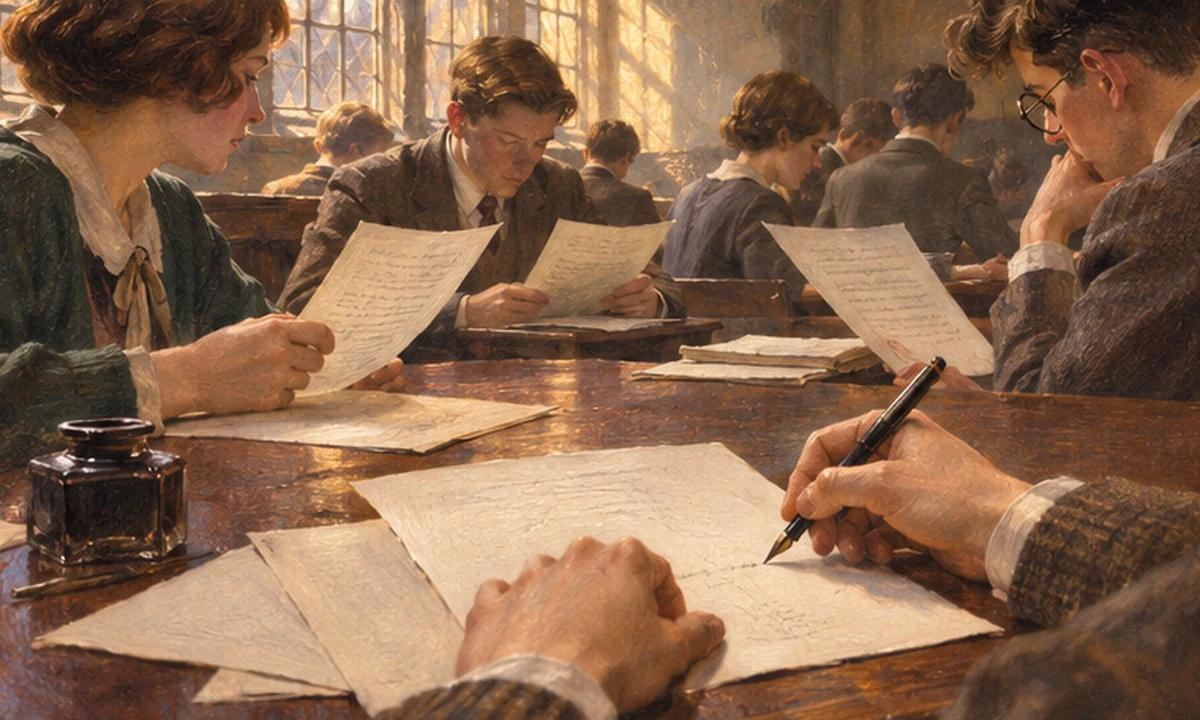
Picture a Cambridge lecture hall in the 1920s. A young teacher hands out sheets printed with thirteen short poems—with the authors' names, titles and dates stripped away—and asks his students to write down what they genuinely think. When the papers come back, even bright undergraduates have praised weak sentimental verse and ridiculed masterpieces. That famous classroom experiment by I. A. Richards marks the moment literary criticism turned away from biographical gossip and vague praise, and fixed its eyes firmly on the words on the page.
Three names stand for this turning point in the early twentieth century. A. C. Bradley stood at the summit of nineteenth-century character criticism, bringing Shakespeare's tragic heroes to vivid psychological life while defending poetry as an autonomous world of its own. T. S. Eliot broke sharply with Romantic self-expression, championing literary tradition, impersonality and the "objective correlative". I. A. Richards brought psychology, semantics and "practical criticism" into the university, laying the groundwork for modern close reading.
This is the seventh article in the series on the history of English literary criticism. In the previous article, we saw Victorian critics divide between moral duty and art for art's sake. Early twentieth-century critics moved beyond both Victorian sermons and aesthetic daydreaming, turning literary criticism into a disciplined modern craft.
The world of early twentieth-century criticism
From the poet to the poem
In M. H. Abrams's map of critical theories, the early twentieth century marks the decisive move toward the objective view. Romantic critics had asked what a poem reveals about the poet's soul. Victorian critics had asked whether a poem makes society better or gives the reader exquisite pleasure. Now critics began asking a sharper question: how does the poem itself work as a structure of language, imagery and form?
English enters the university
Criticism also changed because its home changed. Throughout most of the nineteenth century, English literature was barely studied as an independent university subject—Oxford and Cambridge focused on Greek and Latin classics. In the early twentieth century, English became a formal degree discipline (the famous Cambridge English Tripos was established in 1917). University teachers needed clear, teachable methods of reading, rather than polite coffee-house chat or vague personal impressions.
A map of the age
These three critics represent three distinct stages of that transition. A. C. Bradley forms the bridge: deeply rooted in Victorian humanism and character psychology, yet insisting in "Poetry for Poetry's Sake" on the organic unity of form and content. T. S. Eliot speaks as a modernist poet-critic, redirecting attention from the poet's biography to the living tradition of literature. I. A. Richards speaks as a scientific analyst of language and the reader's mind, inventing the classroom method of close reading.
Did you know?
In the Cambridge classroom experiment behind Practical Criticism (1929), I. A. Richards mixed poems by celebrated masters—such as John Donne, Christina Rossetti and Gerard Manley Hopkins—with sentimental minor verse, removing all authors' names. Stripped of famous reputations, many students mocked Donne and Hopkins while showering praise on mediocre, cliché-ridden poems.
Important points to remember
- Early twentieth-century criticism (1900-1930s) shifted attention from the poet's biography to the text itself.
- In Abrams's map, this period marks the rise of the objective view of literature.
- The establishment of English as a university degree subject (such as the Cambridge English Tripos in 1917) created a demand for systematic methods of reading.
- A. C. Bradley bridged nineteenth-century character criticism and modern ideas of poetic autonomy.
- T. S. Eliot redirected criticism toward tradition, craft and impersonality.
- I. A. Richards pioneered close reading by testing how students actually read unidentified poems.
A. C. Bradley: tragic character and poetic autonomy
Andrew Cecil Bradley (1851-1935) served as Professor of Poetry at Oxford from 1901 to 1906. His two landmark books—Shakespearean Tragedy (1904) and Oxford Lectures on Poetry (1909)—were both delivered first as university lectures. For decades, Bradley was the single most influential Shakespeare critic in the English-speaking world.
Shakespearean Tragedy (1904)
Shakespearean Tragedy consists of ten lectures, focusing closely on Shakespeare's four great tragedies: Hamlet, Othello, King Lear and Macbeth. Bradley famously viewed Shakespearean tragedy as primarily a drama of character—summed up in the idea that "character is destiny". The calamities of a tragedy do not simply fall from the sky; they grow out of the deeds of an exceptional human being.
In Bradley's account, the Shakespearean tragic hero is a person of high rank and noble stature who possesses a marked one-sidedness or fatal tendency (such as Hamlet's melancholy reflection, Othello's trusting passion, or Macbeth's ambition). Under extraordinary circumstances, this trait leads to catastrophe and leaves the audience with a profound sense of tragic waste. Influenced by the German philosopher Hegel, Bradley also saw tragedy as a convulsion within a moral order: the moral world expels evil, yet only at the terrible cost of destroying what is noble alongside it.
"Poetry for Poetry's Sake" (1901/1909)
Bradley was far more than a character analyst. In his 1901 inaugural Oxford lecture, "Poetry for Poetry's Sake" (collected in Oxford Lectures on Poetry, 1909), he gave one of the clearest modern defences of poetic autonomy. Poetry, he wrote, may have "ulterior values"—it can serve religion, morality or culture—yet its poetic worth is never decided by those outside uses. Instead, "its nature is to be not a part, nor yet a copy, of the real world... but to be a world by itself, independent, complete, autonomous".
Crucially, Bradley insisted on the organic unity of form and substance. You cannot boil a poem down to a prose summary and keep the poem alive; in true poetry, meaning and wording are inseparable.
The backlash against Bradley
Because Bradley examined Hamlet, Iago and Lady Macbeth with the psychological thoroughness of a nineteenth-century novelist—even adding scholarly endnotes discussing Hamlet's exact age or whether Lady Macbeth had children—younger twentieth-century critics accused him of forgetting that Shakespeare's characters are dramatic creations made of poetry, not real people with off-stage biographies. In 1933, the Cambridge critic L. C. Knights famously attacked this approach in his essay "How Many Children Had Lady Macbeth?", urging readers to treat a Shakespeare play as a dramatic poem rather than a real-life case history.
Important points to remember
- A. C. Bradley (1851-1935) was Professor of Poetry at Oxford and published Shakespearean Tragedy (1904) and Oxford Lectures on Poetry (1909).
- Shakespearean Tragedy focuses on the four great tragedies: Hamlet, Othello, King Lear and Macbeth.
- Bradley emphasised character ("character is destiny"), tragic waste and a Hegelian conflict within a moral order.
- In "Poetry for Poetry's Sake" (1901/1909), Bradley defended poetry as an autonomous world and stressed the organic unity of form and substance.
- In 1933, L. C. Knights famously criticised Bradley's character-centred approach in "How Many Children Had Lady Macbeth?".
T. S. Eliot: tradition and impersonality
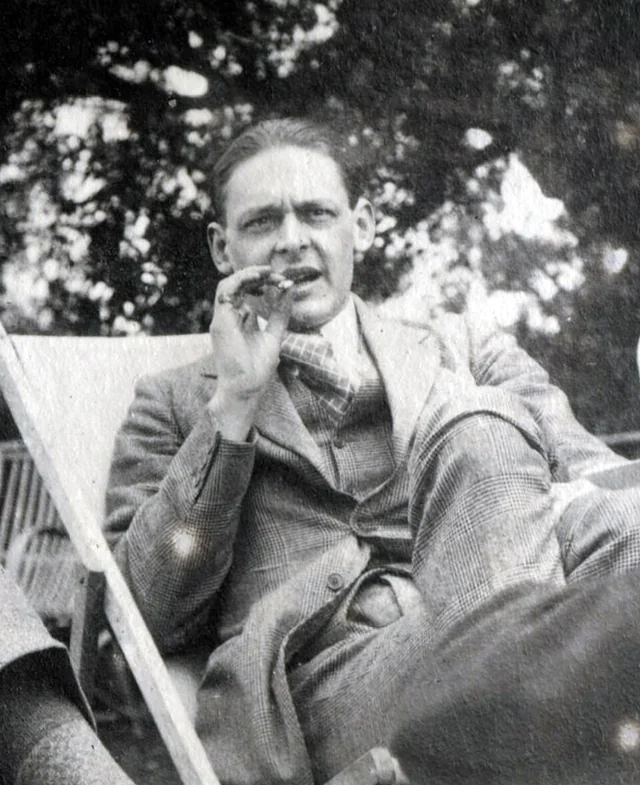
Thomas Stearns Eliot (1888-1965)—American-born poet, dramatist and Nobel laureate—was the towering literary critic of the twentieth century. Like Dryden, Johnson and Arnold before him, Eliot was a poet-critic whose essays reshaped literary history and taste across the English-speaking world. His most famous early critical essays appeared in The Sacred Wood (1920) and Homage to John Dryden (1924), later collected in Selected Essays (1932).
"Tradition and the Individual Talent" (1919)
First published in two parts in The Egoist in 1919 and included in The Sacred Wood (1920), "Tradition and the Individual Talent" is the manifesto of modernist criticism. Eliot begins by challenging the Romantic habit of praising a poet solely for being "original" or unlike anyone else. On the contrary, Eliot argues, "not only the best, but the most individual parts of his work may be those in which the dead poets, his ancestors, assert their immortality most vigorously".
Tradition, for Eliot, does not mean blindly copying the past. It "cannot be inherited, and if you want it you must obtain it by great labour". It demands what Eliot calls the historical sense—a perception "not only of the pastness of the past, but of its presence". A traditional writer feels that the whole of European literature from Homer onward forms a living, simultaneous order. Whenever a genuinely new work of art enters that order, the whole existing order shifts slightly, so that "the past should be altered by the present as much as the present is directed by the past".
The impersonal theory of poetry
In the second part of the essay, Eliot directly attacks Wordsworth's Romantic formula of "emotion recollected in tranquillity". In its place, he offers his famous catalyst analogy from chemistry. When oxygen and sulphur dioxide are mixed in a chamber containing a filament of platinum, they combine to form sulphurous acid—yet the platinum itself remains untouched and unchanged.
The poet's mind, Eliot says, is that shred of platinum: a catalyst that fuses feelings, images and experiences into a poem without leaving raw personal biography inside the work. "The more perfect the artist, the more completely separate in him will be the man who suffers and the mind which creates." Eliot sums up his impersonal creed in one of the most quoted sentences in modern criticism:
"Poetry is not a turning loose of emotion, but an escape from emotion; it is not the expression of personality, but an escape from personality."
Because "the progress of an artist is a continual self-sacrifice, a continual extinction of personality", Eliot concludes that "honest criticism and sensitive appreciation is directed not upon the poet but upon the poetry".
Objective correlative and dissociation of sensibility
Two more critical concepts coined or popularised by Eliot became permanent fixtures of twentieth-century criticism:
- Objective correlative — introduced in "Hamlet and His Problems" (1919; collected in The Sacred Wood, 1920). A poet cannot simply pour raw emotion onto the page; the only way of expressing emotion in art is by finding an "objective correlative"—that is, "a set of objects, a situation, a chain of events which shall be the formula of that particular emotion". When those external facts are given, the emotion is immediately evoked. Provocatively, Eliot called Shakespeare's Hamlet "most certainly an artistic failure" because Hamlet's intense disgust seemed in excess of the dramatic facts presented on stage.
- Dissociation of sensibility — introduced in "The Metaphysical Poets" (1921; collected in Homage to John Dryden, 1924). Reversing Samuel Johnson's dismissal of John Donne and his followers, Eliot praised the seventeenth-century Metaphysical poets for their unified sensibility: they could "feel their thought as immediately as the odour of a rose". Later in the seventeenth century, Eliot claimed, a "dissociation of sensibility" set in—aggravated by John Milton and John Dryden—splitting thought from feeling, a divide from which English poetry never fully recovered.
Important points to remember
- T. S. Eliot (1888-1965) published The Sacred Wood in 1920 and Homage to John Dryden in 1924.
- "Tradition and the Individual Talent" (1919) argues that tradition is earned by "great labour" and requires the historical sense ("not only of the pastness of the past, but of its presence").
- A genuinely new work alters the existing order of past literature as much as the past directs the present.
- Eliot's impersonal theory compares the poet's mind to a filament of platinum (a catalyst) that remains unchanged while fusing elements into art.
- Eliot wrote: "Poetry is not a turning loose of emotion, but an escape from emotion; it is not the expression of personality, but an escape from personality."
- In "Hamlet and His Problems" (1919), Eliot introduced the objective correlative and famously called Hamlet "an artistic failure".
- In "The Metaphysical Poets" (1921), Eliot praised Donne's unified sensibility and argued that a dissociation of sensibility (splitting thought and feeling) set in during the seventeenth century.
I. A. Richards: psychology and practical criticism
Ivor Armstrong Richards (1893-1979) taught at Cambridge and later at Harvard, and did more than anyone else to turn literary criticism into a systematic, text-centred discipline. Together with his brilliant student William Empson (author of Seven Types of Ambiguity, 1930) and his Cambridge colleague F. R. Leavis, Richards pioneered close reading and became the intellectual grandfather of American New Criticism. His landmark books include The Meaning of Meaning (1923, with C. K. Ogden), Principles of Literary Criticism (1924), Science and Poetry (1926), Practical Criticism (1929), and The Philosophy of Rhetoric (1936).
Two uses of language and pseudo-statements
In Principles of Literary Criticism (1924) and Science and Poetry (1926), Richards tackled a pressing modern question: if science tells us what is true about the world, what use is poetry? His answer drew a sharp line between two uses of language:
- Referential (scientific) language points to external facts and aims to make statements that can be tested as true or false.
- Emotive language (the language of poetry) is used to evoke, organise and harmonise human feelings and attitudes.
Because poetry uses emotive language, its claims are what Richards calls pseudo-statements—not "lies", but utterances whose value lies in ordering our emotions rather than passing a scientific test. When a great poem resolves conflicting human impulses into a poised, active balance, it creates a deeply valuable psychological state that Richards called synaesthesis.
Practical Criticism (1929) and the Four Kinds of Meaning
Richards's most famous book, Practical Criticism: A Study of Literary Judgment (1929), grew directly out of his Cambridge classroom experiment. He gave undergraduates thirteen unidentified poems and collected their candid written comments, which he called protocols. Studying these protocols, Richards catalogued ten main difficulties that make readers misread poetry—including stock responses (ready-made clichés and habitual prejudices), mnemonic irrelevances (stray personal memories triggered by a word), sentimentality (excessive, unearned emotion), and doctrinal adhesions (judging a poem solely by whether you agree with its religious or political beliefs).
To train readers to read carefully, Richards divided total poetic meaning into Four Kinds of Meaning:
- Sense: the plain literal content—what the speaker is saying.
- Feeling: the speaker's emotional attitude toward the subject.
- Tone: the speaker's attitude toward the listener or reader.
- Intention: the speaker's underlying aim—the effect he is trying to produce.
A skilled reader, Richards insisted, must listen to all four strands working together in the words on the page.
- SenseWhat is said
- FeelingThe speaker’s attitude to the subject
- ToneThe speaker’s attitude to the listener
- IntentionThe effect the speaker aims to produce
An interesting story
When L. C. Knights published his famous 1933 essay "How Many Children Had Lady Macbeth?", the witty title sounded so much like a direct quotation from A. C. Bradley that generations of students have assumed Bradley actually asked that exact question. In reality, Bradley never wrote those words. What Bradley did include in the back of Shakespearean Tragedy were detailed endnotes—such as "Note EE" on the duration of the action in Macbeth and notes debating Hamlet's age and whereabouts when his father died—that treated the plays almost like historical puzzles. Knights's catchy title became one of the most memorable caricatures in literary criticism, even though Bradley's book remains a classic.
Key terms
- Early twentieth-century criticism - the shift (1900-1930s) from Victorian character and biographical criticism toward impersonality, tradition and close textual reading.
- Character is destiny - the central idea associated with A. C. Bradley's Shakespearean Tragedy (1904), viewing tragic catastrophe as growing out of the hero's character.
- Tragic waste - Bradley's phrase for the painful destruction of noble human potential alongside evil in Shakespearean tragedy.
- Poetry for Poetry's Sake - Bradley's 1901 Oxford lecture defending poetry as an autonomous world where form and substance are inseparable.
- How Many Children Had Lady Macbeth? - L. C. Knights's 1933 essay attacking Bradley's character-centred approach in favour of reading plays as dramatic poems.
- Historical sense - T. S. Eliot's perception "not only of the pastness of the past, but of its presence", essential to literary tradition.
- Impersonal theory of poetry - Eliot's claim that poetry is an escape from emotion and personality, not an expression of them.
- Catalyst / filament of platinum - Eliot's chemical analogy for the poet's mind, which combines feelings into art while remaining itself unchanged.
- Objective correlative - Eliot's term ("Hamlet and His Problems", 1919) for a set of objects, situation or chain of events that serves as the formula for a particular emotion.
- Dissociation of sensibility - Eliot's term ("The Metaphysical Poets", 1921) for the seventeenth-century split between thought and feeling, contrasted with Donne's unified sensibility.
- Referential vs. emotive language - I. A. Richards's distinction between factual scientific language and attitude-shaping poetic language.
- Pseudo-statements - Richards's term for poetic statements that organise human emotions without needing scientific verification.
- Synaesthesis - Richards's term for the harmonious, poised equilibrium of conflicting psychological impulses produced by great art.
- Practical criticism / close reading - Richards's method of analysing the words on the page without relying on author biography or historical reputation.
- Protocols - the written student responses to thirteen unidentified poems collected by Richards in Practical Criticism (1929).
- Four Kinds of Meaning - Richards's four strands of total meaning: Sense, Feeling, Tone and Intention.
- Stock responses - ready-made, habitual emotional clichés that prevent readers from responding freshly to a poem.
Important points to remember
- I. A. Richards (1893-1979) published The Meaning of Meaning (1923, with C. K. Ogden), Principles of Literary Criticism (1924), Science and Poetry (1926) and Practical Criticism (1929).
- Richards separated referential (scientific) language from emotive (poetic) language.
- He called poetic utterances pseudo-statements and described the psychological balance of great art as synaesthesis.
- In Practical Criticism (1929), he analysed student protocols on thirteen unidentified poems and identified ten reading difficulties, including stock responses.
- Richards defined Four Kinds of Meaning: Sense, Feeling, Tone and Intention.
- Richards's method of close reading laid the foundation for William Empson, F. R. Leavis and American New Criticism.
How early twentieth-century criticism shaped what came after
Ideas that stayed
These three critics reshaped how literature is taught and read in classrooms around the world. Bradley showed how deeply psychological insight and organic unity can illuminate Shakespeare. Eliot gave modern readers a permanent vocabulary—tradition, impersonality, objective correlative and dissociation of sensibility—and rescued the Metaphysical poets from two centuries of neglect. Richards proved that reading poetry is a skill that can be tested, diagnosed and trained by attending closely to sense, feeling, tone and intention.
The road to New Criticism and Theory
From Eliot's focus on the poem rather than the poet, and Richards's method of close reading, sprang the dominant school of mid-twentieth-century criticism: New Criticism in America (led by John Crowe Ransom, Cleanth Brooks, Allen Tate and W. K. Wimsatt) and the Cambridge school in Britain (William Empson and F. R. Leavis). Even later waves of twentieth-century literary theory—Structuralism, Deconstruction and Reader-Response theory—defined themselves by pushing off from the foundations Eliot and Richards laid in the 1920s.
How to read these three critics
When you read Bradley, Eliot and Richards, ask three simple questions of each. Where does he locate the heart of a literary work—in character, in tradition and poetic craft, or in language and the reader's mind? How does he react to the Romantics and Victorians? And what practical tool does he hand the reader? Bradley hands you psychological depth; Eliot hands you the historical sense and objective correlative; Richards hands you the Four Kinds of Meaning.
Important points to remember
- Bradley's Shakespearean Tragedy remains a landmark of psychological and structural Shakespeare criticism.
- Eliot rehabilitated the Metaphysical poets and redirected attention from the poet to the poem.
- Richards made close reading and semantic analysis the core of modern English studies.
- Eliot and Richards together laid the direct foundation for New Criticism (Brooks, Ransom, Wimsatt) and Cambridge criticism (Empson, Leavis).
Critics and works
| Critic | Dates | Key work | Known for |
|---|---|---|---|
| A. C. Bradley | 1851-1935 | Shakespearean Tragedy (1904), Oxford Lectures on Poetry (1909) | Character-centred Shakespeare criticism; tragic waste; "Poetry for Poetry's Sake" |
| T. S. Eliot | 1888-1965 | The Sacred Wood (1920), Homage to John Dryden (1924), Selected Essays (1932) | Historical sense; impersonal theory (platinum catalyst); objective correlative; dissociation of sensibility |
| I. A. Richards | 1893-1979 | Principles of Literary Criticism (1924), Science and Poetry (1926), Practical Criticism (1929) | Emotive vs. referential language; pseudo-statements; close reading; Four Kinds of Meaning |
Quick revision - 50 points
Open the 50 pointsClose the list
- Early twentieth-century criticism (1900-1930s) shifted focus from the poet's biography to the poem itself.
- In Abrams's map, this era marks the rise of the objective view of literature.
- The Cambridge English Tripos was established in 1917, helping turn literary criticism into a university discipline.
- The three central figures covered here are A. C. Bradley, T. S. Eliot and I. A. Richards.
- A. C. Bradley lived from 1851 to 1935 and was Professor of Poetry at Oxford (1901-1906).
- Bradley published Shakespearean Tragedy in 1904 and Oxford Lectures on Poetry in 1909.
- Shakespearean Tragedy examines four plays: Hamlet, Othello, King Lear and Macbeth.
- Bradley's tragic view is often summed up as "character is destiny".
- Bradley emphasised the sense of "tragic waste" and drew on Hegel's theory of tragic conflict.
- Bradley delivered his inaugural Oxford lecture "Poetry for Poetry's Sake" in 1901.
- In "Poetry for Poetry's Sake", Bradley called poetry "a world by itself, independent, complete, autonomous".
- Bradley insisted on the organic unity of form and substance in poetry.
- In 1933, L. C. Knights attacked Bradley's character-centred method in "How Many Children Had Lady Macbeth?".
- T. S. Eliot lived from 1888 to 1965 and was the most influential poet-critic of the twentieth century.
- Eliot's "Tradition and the Individual Talent" first appeared in The Egoist in 1919.
- Eliot collected his landmark early essays in The Sacred Wood (1920).
- Eliot argued that tradition cannot be inherited; it must be obtained "by great labour".
- Eliot's "historical sense" is a perception "not only of the pastness of the past, but of its presence".
- For Eliot, all European literature from Homer onward forms a simultaneous order.
- A genuinely new work slightly alters the existing order of all past literature.
- Eliot's impersonal theory directly challenged Wordsworth's "emotion recollected in tranquillity".
- Eliot compared the poet's mind to a "filament of platinum"—a catalyst that remains unchanged while creating art.
- Eliot wrote: "The progress of an artist is a continual self-sacrifice, a continual extinction of personality."
- Eliot declared: "Poetry is not a turning loose of emotion, but an escape from emotion; it is not the expression of personality, but an escape from personality."
- Eliot urged that honest criticism be directed "not upon the poet but upon the poetry".
- In "Hamlet and His Problems" (1919), Eliot introduced the term "objective correlative".
- An objective correlative is "a set of objects, a situation, a chain of events which shall be the formula of that particular emotion".
- Eliot famously called Shakespeare's Hamlet "most certainly an artistic failure".
- In "The Metaphysical Poets" (1921), Eliot introduced the concept of "dissociation of sensibility".
- Eliot praised Donne and the Metaphysical poets for their "unified sensibility"—feeling their thought "as immediately as the odour of a rose".
- Eliot argued that the dissociation of sensibility set in during the seventeenth century and was aggravated by Milton and Dryden.
- Eliot's essay helped rehabilitate John Donne and the Metaphysical poets in twentieth-century taste.
- I. A. Richards lived from 1893 to 1979 and taught at Cambridge and Harvard.
- With C. K. Ogden, Richards co-authored The Meaning of Meaning (1923).
- Richards published Principles of Literary Criticism in 1924.
- Richards published Science and Poetry in 1926 and Practical Criticism in 1929.
- Richards distinguished between two uses of language: referential (scientific) and emotive (poetic).
- Referential language states verifiable facts; emotive language organises human attitudes and feelings.
- Richards called poetic utterances "pseudo-statements" because they do not require scientific verification.
- Richards used the term "synaesthesis" for the harmonious balance of conflicting impulses produced by great art.
- In Practical Criticism (1929), Richards gave students thirteen unidentified poems without authors' names or dates.
- Richards called the students' written responses "protocols".
- Richards identified ten main difficulties of reading, including "stock responses", "mnemonic irrelevances" and "doctrinal adhesions".
- Stock responses are ready-made emotional clichés that block fresh reading.
- Richards defined Four Kinds of Meaning: Sense, Feeling, Tone and Intention.
- Sense is literal content; Feeling is attitude toward the subject; Tone is attitude toward the listener; Intention is the speaker's aim.
- Richards's student William Empson developed close reading further in Seven Types of Ambiguity (1930).
- Richards's Cambridge colleague F. R. Leavis also championed rigorous close reading.
- Together, Eliot and Richards laid the direct foundation for American New Criticism.
- Modern literary theory in the later twentieth century grew partly in response to the methods Eliot and Richards pioneered.
Quick quiz - 25 questions
Tap an answer to see at once if it is right. You do not need to log in.
Open the 25 questionsClose the quiz
1Which four plays are the main focus of A. C. Bradley's Shakespearean Tragedy (1904)?
Answer: B. Bradley's landmark 1904 lectures focus on Shakespeare's four great tragedies: Hamlet, Othello, King Lear and Macbeth.
2Which German philosopher strongly influenced Bradley's theory of tragic conflict?
Answer: C. Bradley drew on Hegel's view of tragedy as a collision within a moral order (and included a lecture on "Hegel's Theory of Tragedy" in Oxford Lectures on Poetry).
3In which 1901 inaugural Oxford lecture did Bradley describe poetry as "a world by itself, independent, complete, autonomous"?
Answer: B. Bradley delivered "Poetry for Poetry's Sake" in 1901 and collected it in Oxford Lectures on Poetry (1909).
4Who famously criticised A. C. Bradley's character-centred approach in the 1933 essay "How Many Children Had Lady Macbeth?"?
Answer: C. L. C. Knights used that witty title in 1933 to argue that Shakespeare's plays should be read as dramatic poems rather than real-life biographies.
5In which magazine was T. S. Eliot's "Tradition and the Individual Talent" first published in 1919?
Answer: B. It appeared in two parts in The Egoist in 1919 before being collected in The Sacred Wood (1920).
6What is the title of T. S. Eliot's landmark 1920 collection of critical essays?
Answer: B. The Sacred Wood (1920) included "Tradition and the Individual Talent" and "Hamlet and His Problems".
7According to T. S. Eliot, how must a writer obtain "tradition"?
Answer: B. Eliot wrote that tradition "cannot be inherited, and if you want it you must obtain it by great labour".
8How does Eliot define the "historical sense" in "Tradition and the Individual Talent"?
Answer: B. The historical sense feels all of European literature from Homer onward as a living, simultaneous order.
9What chemical analogy does T. S. Eliot use for the poet's mind in his impersonal theory of poetry?
Answer: C. Like a filament of platinum that causes oxygen and sulphur dioxide to combine while remaining unchanged itself, the poet's mind acts as a catalyst.
10Complete Eliot's famous statement: "Poetry is not a turning loose of emotion, but an escape from emotion; it is not the expression of personality, but ..."
Answer: B. Eliot directly rejected Romantic self-expression in favour of impersonality.
11According to Eliot, honest criticism and sensitive appreciation should be directed upon what?
Answer: B. Eliot wrote that honest criticism is directed "not upon the poet but upon the poetry".
12In which essay did T. S. Eliot introduce the concept of the "objective correlative"?
Answer: C. Eliot introduced the term in "Hamlet and His Problems" (1919; collected in The Sacred Wood, 1920).
13What controversial judgment did T. S. Eliot pass on Shakespeare's Hamlet?
Answer: B. Eliot argued that Hamlet's disgust lacked an adequate objective correlative and called the play "an artistic failure".
14In which 1921 essay did Eliot coin the phrase "dissociation of sensibility"?
Answer: B. Eliot introduced the phrase in "The Metaphysical Poets" (1921), praising John Donne's unified sensibility.
15Which two seventeenth-century poets did Eliot say aggravated the "dissociation of sensibility"?
Answer: C. Eliot argued that the split between thought and feeling was aggravated by the influence of Milton and Dryden.
16With whom did I. A. Richards co-author The Meaning of Meaning (1923)?
Answer: C. I. A. Richards and C. K. Ogden co-authored The Meaning of Meaning in 1923.
17In what year was I. A. Richards's Principles of Literary Criticism published?
Answer: C. Principles of Literary Criticism appeared in 1924, followed by Science and Poetry (1926) and Practical Criticism (1929).
18What are the "two uses of language" distinguished by I. A. Richards?
Answer: B. Richards separated factual, verifiable referential language from attitude-shaping emotive language.
19What term did I. A. Richards use for poetic statements that organise human emotions without needing scientific verification?
Answer: B. Richards called poetic utterances "pseudo-statements", defending their psychological value in an age of science.
20What does Richards's term "synaesthesis" describe?
Answer: B. Synaesthesis is the poised, balanced organisation of conflicting impulses achieved through great art.
21How many unidentified poems did I. A. Richards give to Cambridge students in his Practical Criticism (1929) experiment?
Answer: C. Richards distributed 13 poems without authors' names or dates and analysed the students' written responses ("protocols").
22What did Richards call the written student responses collected in Practical Criticism?
Answer: B. Richards named the students' candid written judgments "protocols".
23Which of these is NOT one of I. A. Richards's Four Kinds of Meaning?
Answer: D. The Four Kinds of Meaning are Sense, Feeling, Tone and Intention.
24In Richards's Four Kinds of Meaning, what does "Tone" refer to?
Answer: B. Feeling is the speaker's attitude toward the subject, while Tone is the speaker's attitude toward the listener or reader.
25Which famous student of I. A. Richards carried close reading forward in Seven Types of Ambiguity (1930)?
Answer: B. William Empson studied under Richards at Cambridge and published Seven Types of Ambiguity in 1930.
Frequently asked questions
What changed in early twentieth-century literary criticism?
Criticism shifted from nineteenth-century character studies, moralising and biographical chat toward the text itself. A. C. Bradley defended poetic autonomy, T. S. Eliot championed impersonality and tradition, and I. A. Richards pioneered close reading in the university classroom.
Why was A. C. Bradley criticised by later critics like L. C. Knights?
Bradley analysed Shakespeare's heroes with such deep psychological detail that later critics—famously L. C. Knights in "How Many Children Had Lady Macbeth?" (1933)—felt he treated dramatic characters like real-life people rather than parts of a poetic play.
What did T. S. Eliot mean by the "objective correlative"?
In "Hamlet and His Problems" (1919), Eliot defined it as "a set of objects, a situation, a chain of events which shall be the formula of that particular emotion", so that emotion is evoked through concrete artistic details rather than stated rawly.
What is Eliot's "dissociation of sensibility"?
Introduced in "The Metaphysical Poets" (1921), it is Eliot's term for a seventeenth-century split between intellect and emotion, contrasting with the "unified sensibility" of John Donne and his contemporaries, who felt their thoughts directly.
What did I. A. Richards prove in Practical Criticism (1929)?
By giving Cambridge students thirteen poems without authors' names or dates, Richards showed how easily readers fall into "stock responses", personal irrelevances and ideological bias—proving the need for disciplined close reading.
What are Richards's Four Kinds of Meaning?
They are Sense (what is literally said), Feeling (attitude toward the subject), Tone (attitude toward the listener/reader) and Intention (the speaker's underlying aim).
Sources
- Abrams, M. H., and Geoffrey Galt Harpham. A Glossary of Literary Terms. 11th ed., Cengage Learning, 2015.
- Abrams, M. H. The Mirror and the Lamp: Romantic Theory and the Critical Tradition. Oxford University Press, 1953.
- Drabble, Margaret, editor. The Oxford Companion to English Literature. 6th ed., Oxford University Press, 2000.
- Bradley, A. C. Shakespearean Tragedy. Macmillan, 1904.
- Bradley, A. C. Oxford Lectures on Poetry ("Poetry for Poetry's Sake"). Macmillan, 1909.
- Knights, L. C. How Many Children Had Lady Macbeth? An Essay in the Theory and Practice of Shakespeare Criticism. Minority Press, 1933.
- Eliot, T. S. The Sacred Wood: Essays on Poetry and Criticism. Methuen, 1920.
- Eliot, T. S. Selected Essays. Faber and Faber, 1932.
- Richards, I. A. Principles of Literary Criticism. Kegan Paul, 1924.
- Richards, I. A. Science and Poetry. Kegan Paul, 1926.
- Richards, I. A. Practical Criticism: A Study of Literary Judgment. Kegan Paul, 1929.
Afsar Khan, Ph.D. English
Test your knowledge
Check what you have learned with quizzes and MCQs.