

On this page
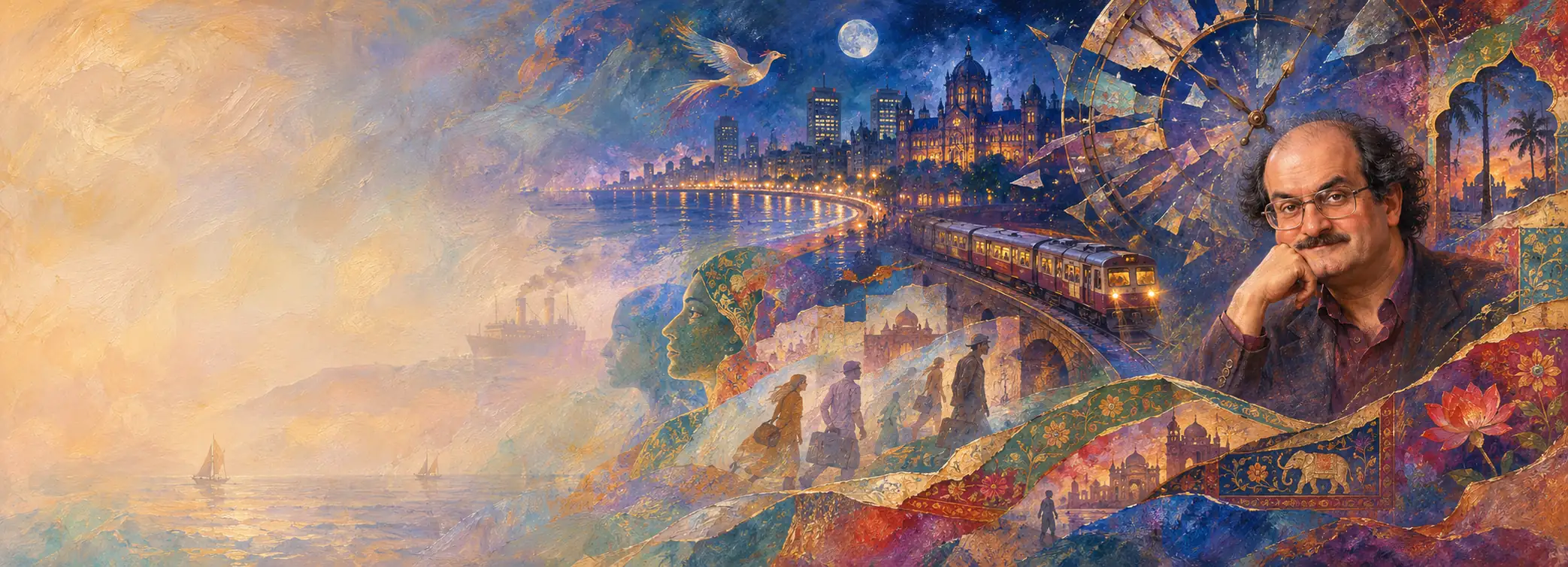
In 1981, a novel about a child born at the moment of Indian independence won the Booker Prize. The novel was Salman Rushdie's Midnight's Children. It connected one person's life with the history of a nation and used fantasy, humour and unusual storytelling methods. Its success helped bring Indian English fiction to greater international attention. Yet Indian writing in English had a long history before Rushdie, and many important writers continued working outside his particular style.
The years from 1980 to 2000 marked a major change in Indian English literature. India experienced political conflict, economic reform, growing migration and closer contact with the wider world. Indian English fiction gained new readers and publishers, while writers examined history, caste, gender, family and cultural identity. The novel became especially prominent, but drama and other literary forms also developed. The dates of this article are working boundaries rather than strict limits on literary careers.
We will first study the world in which these writers lived. Then we will examine their literary works and the ideas that shaped them. The article will explain unfamiliar terms as they appear and distinguish books published during 1980-2000 from later works by the same writers.
The world of this period
Political life
India entered the 1980s as an independent democratic republic. Its political institutions had developed since independence in 1947, but public life remained affected by social inequality, regional demands and disagreements about the role of the central government.
The Indian National Congress continued to play a major part in national politics. Indira Gandhi returned to power as prime minister in 1980. The decade witnessed serious political tensions, particularly in Punjab and other regions. On 31 October 1984, Indira Gandhi was assassinated by two of her Sikh bodyguards. In the days that followed, Sikhs were attacked in Delhi and other places. Thousands were killed, and many families suffered lasting losses.
These events raised important questions about communal violence, which means violence directed against people because of their religious community. They also showed the difficulty of protecting citizens' rights during political crises. The events of 1984 became an important subject in public memory, historical writing and later literature.
Rajiv Gandhi became prime minister after Indira Gandhi's death. His government promoted technological development and administrative changes. However, disputes about political authority, corruption and regional demands continued. During the late 1980s and 1990s, Indian politics became more closely associated with coalition governments. A coalition government is formed when two or more political parties cooperate to exercise power. Regional parties also gained influence. This development showed that political concerns differed across India's states and communities.
One of the most important debates of the period concerned caste and social justice. The Mandal Commission, formally the Second Backward Classes Commission, submitted its report in 1980. It recommended measures to improve the representation of socially and educationally disadvantaged communities. In August 1990, the National Front government announced its decision to implement a major recommendation concerning reservations for Other Backward Classes in central government employment.
Reservation in this context means setting aside a proportion of opportunities for groups recognised under public policy. The announcement produced strong political reactions. Supporters viewed it as an important step towards social justice. Opponents raised different objections, and protests took place in several parts of India. The debate revealed that political independence had not ended questions about caste, privilege or unequal opportunity. For literature, such developments mattered because novels and plays increasingly examined the relationship between individuals and social structures.
The politics of the 1990s also brought renewed attention to religion and national identity. On 6 December 1992, the Babri Masjid in Ayodhya was demolished. The event was followed by communal violence in different parts of the country. It became part of a larger national debate about religion, history, constitutional values and the rights of communities.
In May 1998, India conducted a series of nuclear tests at Pokhran. The tests attracted considerable international attention and intensified debates about national security and India's position in the world. These political changes formed the background against which writers explored identity, belonging, conflict and the meaning of the nation.
Indian English fiction did not simply reproduce newspaper accounts of political events. Writers often used family stories, personal memories and fictional characters to investigate their deeper effects. A novel might move between different historical periods to show how the past continues to shape the present. This approach became especially important in the fiction of Salman Rushdie and Amitav Ghosh.
Social life
Indian society changed in several important ways between 1980 and 2000. Cities expanded, educational opportunities grew and new kinds of employment appeared. More Indians travelled abroad for study and work. Nevertheless, social change was uneven, and opportunities continued to differ according to class, caste, gender and location.
One important development was the growing visibility of the Indian diaspora. A diaspora is a community of people living outside their country of origin while maintaining real or imagined connections with it. Indian communities had existed overseas for generations. During the late twentieth century, migration for education, professional work and family settlement added new dimensions to these communities.
This experience created new literary questions. Could a person belong to more than one culture? How does migration change language, memory and family relationships? What happens when the customs of an older generation differ from the expectations of children growing up abroad? Such questions became central to the fiction of Bharati Mukherjee and other writers concerned with migration.
The relationship between language and identity also grew more important. English was used in higher education, administration, business and some forms of public communication. Yet it was not equally available to every Indian. Many people continued to use regional languages in daily life and literary expression. India's linguistic diversity remained central to its cultural life.
Indian English writers therefore worked within a society where several languages often existed side by side. Some novelists brought Indian expressions, speech rhythms and cultural references into English. Others explored the problems of translation and communication between communities. Their writing challenged the assumption that English must always follow British literary habits.
The position of women was another major subject of public discussion. Women's organisations and social movements drew attention to violence, discrimination, education, employment and family authority. More women entered higher education and professional employment, although access differed greatly across communities. These changes did not remove traditional expectations about marriage, motherhood or domestic responsibility.
As a result, many women experienced tension between personal wishes and social obligations. Indian English fiction increasingly examined this conflict. Feminist writing studies women's experiences and questions unequal relationships between genders. It may explore family life, social rules, education, employment and personal independence. Writers such as Shashi Deshpande and Manju Kapur explored women's lives through the experiences of families and individuals rather than treating gender inequality as an abstract idea.
Caste also remained a major social concern. The debates surrounding the Mandal Commission revealed continuing inequalities in education and employment. Discrimination could influence access to resources, social relationships and opportunities for advancement. Literature could examine these differences through characters whose lives were shaped by structures beyond their personal control.
A further development concerned the idea of identity. Identity refers to how a person understands themselves and how others define them. It can involve language, religion, caste, gender, family, nationality and personal experience. In a changing society, identity was not always simple or fixed.
A character might feel attached to a family tradition while questioning its restrictions. Someone living abroad might feel connected to India while also becoming part of another society. Late twentieth-century Indian English literature gave increasing attention to such complex experiences.
Economic life
The Indian economy experienced major changes during the 1980s and 1990s. At the beginning of the period, the government continued to play an important role in economic planning and industrial regulation. Many industries operated under systems of government permission and control. Public-sector enterprises remained important in several areas of the economy.
During the 1980s, some restrictions were gradually reduced. However, serious economic difficulties emerged towards the end of the decade. In 1991, India faced a severe balance-of-payments crisis. This meant that the country had great difficulty meeting its international payment obligations. The government introduced major economic reforms under Prime Minister P. V. Narasimha Rao and Finance Minister Manmohan Singh.
These reforms became associated with economic liberalisation. Liberalisation means reducing certain government restrictions and allowing greater competition and private economic activity. The reforms affected trade, investment, industry and financial institutions. They also increased India's engagement with international markets.
The wider process of growing economic connections between countries is called globalisation. Globalisation involves the movement of goods, capital, information, ideas and people across national borders. The changes of the 1990s encouraged the growth of new businesses and expanded opportunities in some professional sectors. Telecommunications, media and other services also developed, helping create new patterns of urban life.
However, the benefits were not shared equally. Many people continued to depend on agriculture, informal employment and low-paid work. Economic insecurity remained a serious problem. The contrast between wealth and poverty became increasingly visible in cities and smaller towns.
This changing economic environment provided important material for fiction. Writers could explore the experiences of middle-class professionals, migrants, business families and people struggling for economic security. The relationship between money and personal freedom also became an important concern.
Economic independence could offer new choices, particularly to women and younger people. At the same time, financial pressure could strengthen dependence within families. These tensions appeared in novels about marriage, work and changing social expectations.
The economic changes of the period also affected publishing. Indian English books gained greater visibility in international literary markets. Publishers in India and abroad developed interest in new Indian writers. A successful novel could reach readers in several countries through different editions. Yet international success did not mean that every Indian writer received equal attention.
Writers working in regional languages often faced different publishing conditions. English-language literature also remained more accessible to educated readers. This difference is important when studying the development of Indian English literature.
Schools, colleges and the press
Education continued to play a major role in the growth of Indian English literature. Universities and colleges introduced readers to English literature, literary criticism and writing from different parts of the world. Students encountered British, American and other literary traditions alongside the growing study of Indian writing in English. The university classroom helped create an audience for Indian English poetry, fiction and drama.
Literary journals, newspapers and magazines also provided spaces for discussion. Reviews and essays helped readers discover new writers. Academic criticism examined how Indian authors used language, represented history and addressed social problems. The expansion of publishing and communication created new opportunities for literary debate.
However, education remained unequal across regions and social groups. Not every student had the same access to English-medium education, libraries or published books. This difference influenced both the production of literature and the kinds of readers it reached.
The study of Indian English literature also encouraged questions about the literary canon. A canon is a group of works commonly treated as especially important in a literary tradition. Critics and teachers began to debate which writers should receive attention and how Indian writing should be studied. The increasing prominence of fiction raised further questions about the place of poetry, drama and writing in Indian languages. These debates helped shape the academic study of Indian English literature.
Religion
Religion continued to influence Indian public life during the final decades of the twentieth century. India was home to many religious traditions, including Hinduism, Islam, Sikhism, Christianity, Buddhism and Jainism. Religious identities often formed part of family and community life. They could also become connected with political disagreements.
The Indian Constitution established a framework of secularism, in which the state is not meant to favour one religion over others. In practice, debates about the relationship between religion and politics remained important. The violence against Sikhs in 1984 and the conflicts following the demolition of the Babri Masjid in 1992 revealed serious threats to religious coexistence. These events affected public discussion about citizenship, constitutional protection and collective responsibility.
They also encouraged reflection on communalism. In Indian political discussion, communalism often means treating religious communities as opposing political groups and using religious identity to deepen division. Literature could explore the consequences of such division through personal relationships and family histories. It could show how political events affected people who had previously lived together as neighbours.
At the same time, Indian writers did not treat religion only as a cause of conflict. Religious customs, beliefs, ceremonies and stories remained important parts of everyday life. Literature also explored the tension between tradition and individual choice.
A character might value religious belonging while questioning an unfair social custom. Another might discover that family expectations were connected with religion, caste and gender. These tensions gave Indian English fiction new opportunities to examine social relationships.
Writers also questioned simple divisions between the modern and the traditional. Modern education or professional employment did not necessarily remove religious belief. Similarly, religious commitment did not always prevent people from supporting social reform. The relationship between religion, history and identity was therefore complex. Understanding this complexity helps readers approach the literature of the period without reducing Indian society to a single political or religious experience.
Did you know?
Salman Rushdie won the Booker Prize in 1981 for Midnight's Children. Sixteen years later, Arundhati Roy won the same prize for her first novel, The God of Small Things (1997). These international successes brought considerable attention to Indian fiction in English, although the tradition itself had developed over many earlier generations.
Important points to remember
- India experienced major political and social changes between 1980 and 2000.
- Indira Gandhi was assassinated on 31 October 1984.
- Anti-Sikh violence followed her assassination in several Indian cities.
- The Mandal Commission submitted its recommendations in 1980.
- The government announced OBC reservation measures in August 1990.
- India introduced major economic liberalisation reforms in 1991.
- The Babri Masjid was demolished in Ayodhya on 6 December 1992.
- The Indian diaspora became an important subject of literary discussion.
- Salman Rushdie won the Booker Prize for Midnight's Children in 1981.
- Arundhati Roy won the Booker Prize for The God of Small Things in 1997.
Literature in this period
The changing Indian English novel
During the 1980s and 1990s, the Indian English novel gained a much wider readership. More novels reached international publishers, reviewers and literary prize committees. Indian English fiction had existed long before this period, but the range of subjects and storytelling methods continued to expand.
One important influence was postcolonial writing. Postcolonial writing examines the effects of colonial rule and the experiences of societies after colonialism. It often asks how political freedom changes national identity, language and cultural life.
Writers increasingly questioned the idea that history could be told through one complete and neutral account. They examined the difference between official history and personal memory.
Some novelists used non-linear narrative, a method in which events are presented outside their usual time order. The story might move between childhood and adulthood or between the colonial past and the independent present.
Others used magic realism. This method places fantastic or impossible events within an otherwise recognisable world. The fantastic elements may help a writer explore history, belief or political power.
Not every Indian novelist followed these experimental methods. Some preferred detailed realism, while others combined humour, fantasy and ordinary social experience.
The period therefore produced several distinct approaches to fiction. It would be misleading to treat every novelist as a follower of Salman Rushdie.
Salman Rushdie: history and imagination

Salman Rushdie became one of the most widely discussed Indian-born novelists of the period. His Midnight's Children (1981) follows Saleem Sinai, who is born at midnight as India becomes independent on 15 August 1947. Saleem's life is connected with events in the history of modern India.
The novel does not present national history as a simple sequence of facts. Saleem tells his story through memory, family events, unusual powers and shifting accounts of the past.
Saleem's narration raises questions about the reliability of memory. An unreliable narrator is a storyteller whose account may contain mistakes, distortions or limited knowledge.
This does not mean that every statement made by Saleem is false. Rather, the reader must consider how personal experience shapes the version of history being told.
The novel also uses magic realism. Saleem's extraordinary abilities connect private experience with a much larger national story.
Another important feature is metafiction. Metafiction is writing that draws attention to the process of telling or constructing a story.
Saleem frequently reflects on his own narration. His account reminds the reader that history and fiction are both shaped through language and selection.
Midnight's Children won the Booker Prize in 1981. Its success increased international attention to Indian English fiction, although it did not create the tradition.
Rushdie's Shame (1983) turns to the political and social world of Pakistan through a partly imaginary setting. The novel uses satire, fantasy and family relationships to examine power, public honour and shame.
Satire uses humour, irony or exaggeration to criticise human behaviour and social institutions. In Shame, private experiences become connected with political authority.
His The Satanic Verses (1988) follows, among other characters, Gibreel Farishta and Saladin Chamcha. Its narrative combines migration, transformation, dreams and questions of belief.
The novel provoked intense controversy and protests. Discussion of the work requires a distinction between its literary methods and the religious objections raised against it.
Taken together, these novels show Rushdie's interest in history, identity and the power of storytelling. They also demonstrate how an English-language novel can draw upon several cultural and literary traditions.
Amitav Ghosh: memory, borders and history
Amitav Ghosh developed a different approach to history and fiction. His first novel, The Circle of Reason (1986), follows Alu, a young man whose experiences take him beyond his original home. The novel combines ideas about reason, work, travel and personal identity.
Its story crosses geographical boundaries. Travel is not merely a change of setting. It allows the novel to examine how people form connections in unfamiliar places.
Ghosh's The Shadow Lines (1988) is especially important for its treatment of borders and memory. The narrator remembers family relationships and stories linking places such as Calcutta, Dhaka and London. Different periods of history enter the narrative through personal recollections. The novel explores how political boundaries can divide places that remain connected through memory, language and family life.
Partition memory refers to the personal and collective recollection of the division of British India in 1947 and its consequences. Such memories may continue to shape later generations. The Shadow Lines also considers communal violence and the limits of national boundaries. The novel questions whether a political border can fully separate people's lives and histories.
Its structure is non-linear. Events are not always presented in the order in which they occurred. This technique requires the reader to connect memories gradually. The resulting understanding of history remains shaped by human relationships.
Ghosh's later novel The Hungry Tide was published in 2004, outside the period covered by this article. It is included in Ghosh's larger career because of its importance in discussions of environment, language and human communities. It is set in the Sundarbans and explores relationships between people and the natural world. The date must be kept clear: The Hungry Tide belongs to Ghosh's later work, not to the publications of 1980-2000.
Vikram Seth: realism and literary form
Vikram Seth is notable for the variety of forms he uses. His The Golden Gate (1986) is a verse novel, meaning a novel written in poetry rather than ordinary prose. The book is set in San Francisco and follows relationships among modern urban characters. It uses a patterned stanza form associated with Alexander Pushkin's Eugene Onegin. This makes the work unusual within Indian English fiction. Seth uses an inherited poetic structure to tell a modern story.
His much longer novel A Suitable Boy appeared in 1993. The novel is set in India during the early years after independence. It follows several families and includes the story of Lata Mehra, whose mother wants her to marry a suitable man. Marriage is one subject among many. The novel also explores education, politics, religion, class and social change.
Seth generally uses detailed domestic realism, a method that presents everyday life through families, relationships and familiar social situations. The novel creates a broad picture of society by following characters whose personal decisions are affected by public events. It therefore offers an important contrast with Rushdie's more fantastic style. A novel does not need magical events or a fragmented structure to explore national history. Seth demonstrates how detailed social observation can also connect private life with public change.
Rohinton Mistry: ordinary lives and political power
Rohinton Mistry was born in Bombay and later settled in Canada. His fiction frequently returns to Indian social and political life. Such a Long Journey (1991) follows Gustad Noble, a middle-class Parsi man living in Bombay.
A Parsi is a member of an Indian community historically associated with Zoroastrian religious traditions. The novel explores Gustad's family problems against a background of political tension and the 1971 war. Personal responsibilities, financial difficulties and political events become connected within the story.
Mistry's A Fine Balance (1995) is set largely during the Indian Emergency of the 1970s. The novel brings together Dina Dalal, Ishvar Darji, Omprakash Darji and Maneck Kohlah. Their experiences reveal differences of caste, class, age and economic opportunity.
Ishvar and Omprakash are tailors who have faced serious hardship. Dina struggles to maintain her independence, while Maneck attempts to find his place in a changing society. Their relationships show how people from different backgrounds can become dependent on one another.
The Emergency provides the political background, but the novel concentrates on its consequences for ordinary people. Mistry uses social realism to connect individual suffering with larger structures of power. His novels are important because they make public history understandable through particular lives rather than political speeches.
Vikram Chandra and Upamanyu Chatterjee
Two other writers helped broaden the subjects and methods of Indian English fiction. Vikram Chandra's Red Earth and Pouring Rain was first published in 1995. The novel moves between different times and places, combining stories of Indian history with modern experiences. It draws upon forms of oral storytelling, in which a narrative is passed on through the voice of a storyteller.
Its structure brings several stories into contact with one another. This method shows how the past can be retold from different positions. Chandra's Love and Longing in Bombay (1997) is a collection of connected short stories. These works explore the possibilities of storytelling and the lives of people in changing social settings.
Upamanyu Chatterjee's English, August: An Indian Story (1988) follows Agastya Sen, a young Indian civil servant. Agastya's experiences in a small town reveal his uncertainty about work, identity and the social world around him. The novel uses irony and comedy to examine the distance between urban education and everyday administrative life.
It can also be read as a kind of bildungsroman, a story about a young person's education and development. However, Agastya's development is not presented as a simple journey towards maturity. His confusion is part of the novel's central interest. Chatterjee's humour differs from the large historical experiments of Rushdie and Ghosh. It pays close attention to the discomforts and contradictions of ordinary life.
Shashi Tharoor and the retelling of history
Shashi Tharoor's The Great Indian Novel (1989) uses the structure and characters of the Mahabharata to retell aspects of modern Indian political history. The Mahabharata is an ancient Indian epic, a long narrative involving families, conflicts, political power and moral questions. Tharoor adapts this familiar framework to the history of colonial rule, the independence movement and later political developments.
This technique is called intertextuality. Intertextuality occurs when one literary work refers to or reshapes another work. The novel depends on the reader recognising connections between the ancient epic and modern political figures or events. It also uses satire to question political authority and public behaviour.
Tharoor's approach differs from a conventional historical novel. His purpose is not simply to reproduce events in chronological order. Instead, he invites readers to reconsider familiar political stories through an older narrative form. The result shows how literary traditions from India can be used to create modern fiction in English.
Shashi Deshpande and women's inner lives
Shashi Deshpande's fiction explores marriage, family expectations and women's search for personal identity. Her That Long Silence (1988) centres on Jaya, a married woman who examines her life and relationships. The narrative focuses on the pressures created by family roles and the difficulty of speaking openly about personal unhappiness.
Deshpande uses psychological realism, a method that pays particular attention to a character's thoughts, feelings and inner conflicts. Jaya's reflections reveal how silence can become part of an unequal relationship.
The novel does not treat every woman as having the same experience. It examines one woman's attempt to understand the choices and expectations that have shaped her life. Deshpande's approach is important to the development of feminist writing in Indian English fiction. It shows that a novel about everyday domestic life can examine large questions about social power.
Manju Kapur and difficult choices
Manju Kapur's first novel, Difficult Daughters (1998), is set against the historical background of the years leading towards Partition. Its central character, Virmati, struggles between family expectations, education and personal relationships. Education offers her a possible path towards independence. However, her decisions are also shaped by marriage, social rules and family authority.
The novel places a woman's personal story beside the wider changes occurring in India before independence. This connection does not make Virmati a simple symbol of the nation. Her experiences remain shaped by particular family relationships and difficult choices.
The novel explores gender discrimination, meaning unequal treatment based on gender. Kapur shows how women may be encouraged to seek education while still being expected to accept restrictions in personal life. Difficult Daughters is important for its presentation of female education, family conflict and the relationship between private and national histories.
Bharati Mukherjee and the migrant experience
Bharati Mukherjee was born in India and developed a major writing career in North America. Her novel Jasmine (1989) examines migration and changing personal identity. The central character, originally named Jyoti, moves from India to the United States and experiences major changes in her life. The names used for her at different stages suggest changing relationships with people, places and expectations.
The novel explores the difficulties and possibilities of migration. It also raises questions about hybridity, the mixing or interaction of cultural influences in a person's life. A migrant may adopt new customs without entirely losing memories of an earlier home.
Mukherjee presents such changes through a character facing both opportunity and danger. Her treatment of migration complicates the idea that belonging must be fixed permanently to one country. This is an important example of diasporic fiction, writing that explores the lives of people living away from their country or community of origin.
Arundhati Roy and The God of Small Things
Arundhati Roy's first novel, The God of Small Things (1997), became an international literary success. Set in Kerala, the novel centres on a family whose relationships are shaped by caste, gender, social expectations and personal loss. The twins Estha and Rahel occupy an important place in the narrative.
The novel moves between different moments in their lives. Its non-linear structure gradually reveals events that have affected the family. Roy pays close attention to childhood perception and the way children understand adult language and behaviour. The novel's style is highly patterned, and recurring details help connect different parts of the story.
Its treatment of caste discrimination is particularly significant. The relationship between personal affection and social prohibition reveals how private choices may be controlled by larger social rules. The novel also examines unequal expectations placed upon women.
Roy's achievement was recognised when The God of Small Things won the Booker Prize in 1997. The award brought new attention to her writing, but the novel's importance also lies in its treatment of social divisions and narrative form.
Mahesh Dattani and Indian English drama
Although fiction attracted much international attention, drama remained an important part of Indian English literature. Mahesh Dattani wrote plays originally in English and became an important figure in modern Indian theatre. His play Tara (1990) examines gender discrimination through the experiences of conjoined twins who were separated by surgery.
The twins, Tara and Chandan, face the consequences of decisions made by adults. The play explores unequal treatment within the family and the social preference given to sons. Dattani uses personal relationships to expose a wider pattern of inequality.
His Final Solutions (1993) examines communal prejudice and tensions between religious communities. The play connects present events with memories of earlier conflicts. A dramatic chorus is a group of performers who comment on or contribute to the action. In Final Solutions, the chorus and its masks help express collective attitudes and communal identities.
Dattani uses theatrical form to show how prejudice can be repeated across generations. His work demonstrates that Indian English drama could address social questions through performance, dialogue and stage imagery.
Poetry and other prose
The novel was especially prominent during these two decades, but poetry and non-fiction remained significant. Vikram Seth's The Golden Gate showed that poetry could be used to tell a long fictional story. Its formal structure offered a striking alternative to prose fiction.
Literary essays and criticism also helped define the growing field of Indian writing in English. Reviewers debated whether international recognition encouraged creative freedom or placed new expectations upon writers. Questions about audience were especially important.
A writer in English might address readers in India and abroad. These readers could have different levels of knowledge about Indian languages, customs or history. Some writers explained cultural references directly, while others allowed readers to understand unfamiliar material through the story itself.
The growing importance of English-language fiction did not make Indian-language literatures less significant. Indian literature continued to develop in Bengali, Hindi, Malayalam, Marathi, Tamil, Urdu and many other languages. Translation also helped works cross linguistic boundaries. The study of Indian English literature therefore requires attention to the wider literary culture of India.
An interesting story
On 23 October 1990, Mahesh Dattani's play Twinkle Tara, later known as Tara, was performed in Bangalore. The play examined the unequal treatment of a brother and sister through the story of conjoined twins. Dattani returned to difficult questions about family and society in later plays.
On 10 July 1993, Final Solutions was first performed at Guru Nanak Bhavan in Bangalore. It brought communal prejudice into the theatre through the experiences of a Hindu family and two Muslim youths. The play used a masked chorus to represent changing group attitudes. These performances demonstrated how contemporary Indian English drama could address social conflict through characters, dialogue and stage action.
Key terms
- Postcolonial writing - literature that examines colonial rule and its continuing effects.
- Non-linear narrative - storytelling that does not follow events in ordinary time order.
- Magic realism - a method that places fantastic events within a recognisable world.
- Unreliable narrator - a storyteller whose account may be mistaken, limited or distorted.
- Metafiction - fiction that draws attention to its own storytelling process.
- Satire - writing that uses humour or irony to criticise behaviour or institutions.
- Partition memory - recollections of the division of British India and its consequences.
- Verse novel - a novel written in verse rather than ordinary prose.
- Domestic realism - writing that closely presents family and everyday social life.
- Parsi - a member of an Indian community historically linked with Zoroastrianism.
- Oral storytelling - the passing of stories through spoken narration.
- Bildungsroman - a story concerned with a young person's education and development.
- Intertextuality - the connection created when one work refers to or reshapes another.
- Psychological realism - writing that closely examines characters' thoughts and feelings.
- Gender discrimination - unequal treatment of people because of their gender.
- Hybridity - the interaction or mixing of different cultural influences.
- Diasporic fiction - fiction concerned with life away from a country or community of origin.
- Dramatic chorus - a group of performers who contribute to or comment on stage action.
Criticism and scholarship
The growing international attention to Indian English fiction encouraged new critical debates during this period. Meenakshi Mukherjee's The Twice Born Fiction: Themes and Techniques of the Indian Novel in English (1971) belongs to an earlier stage of scholarship. It examined the development and literary methods of Indian English fiction. Her later book The Perishable Empire: Essays on Indian Writing in English (2000) explored the development of Indian writing in English in relation to the larger literary culture of India, including writing in Indian languages. This distinction is important because English-language books form only one part of Indian literary activity.
M. K. Naik's A History of Indian English Literature (1982) offered a major historical survey of the tradition. Its importance lies in its attempt to organise the development of Indian writing in English across different literary forms. Naik and Shyamala A. Narayan later prepared Indian English Literature, 1980-2000: A Critical Survey (2001), extending historical coverage to the decades discussed in this article. The title and dates of this later study show that the final decades of the century had become a recognised field of literary scholarship.
The criticism of the period examined questions of language, history, cultural identity and international readership. Critics also debated the relationship between Indian English fiction and writing produced in Indian languages. These questions remain important because literary success abroad does not automatically represent the full range of writing within India.
Important points to remember
- Salman Rushdie's Midnight's Children appeared in 1981 and won the Booker Prize.
- Rushdie published Shame in 1983 and The Satanic Verses in 1988.
- Amitav Ghosh published The Circle of Reason in 1986 and The Shadow Lines in 1988.
- Vikram Seth's The Golden Gate (1986) is a verse novel.
- Seth's A Suitable Boy appeared in 1993.
- Rohinton Mistry published Such a Long Journey in 1991 and A Fine Balance in 1995.
- Arundhati Roy's The God of Small Things won the Booker Prize in 1997.
- Manju Kapur's Difficult Daughters was published in 1998.
- Mahesh Dattani's Tara dates from 1990 and Final Solutions from 1993.
- Amitav Ghosh's The Hungry Tide appeared later, in 2004.
How the period ends
The year 2000 is a useful boundary for this survey, but the careers discussed here did not end with it. Indian English fiction continued to attract international readers, and its subjects expanded further. The growing use of digital communication and international publishing created new conditions for literary circulation.
Several works by writers already discussed appeared after the end of the period. Amitav Ghosh's The Hungry Tide was published in 2004. Such later publications show why literary careers must not be restricted to artificial historical boundaries. The date of a book should always be distinguished from the period in which its author first became prominent.
The following period, from 2000 onwards, brought another generation of widely read Indian English writers. Yet it also continued many earlier concerns, including migration, family, social inequality, historical memory and the relationship between local experiences and the wider world.
Important points to remember
- The period 1980-2000 is a historical division, not a fixed limit on literary careers.
- Indian English fiction gained wider international recognition during these decades.
- Magic realism and non-linear narration were important methods in some major novels.
- Realist novels continued to examine family life and social institutions.
- Migration and cultural identity became major literary concerns.
- Women's writing explored education, marriage, inequality and personal independence.
- Mahesh Dattani contributed significantly to modern Indian drama in English.
- Literature in Indian languages remained an essential part of India's wider literary culture.
- Ghosh's The Hungry Tide (2004) belongs to the next period chronologically.
- The literature after 2000 continued to examine history, identity and global connections.
Writers and works
| Writer | Dates | Main works | Remembered for |
|---|---|---|---|
| Salman Rushdie | 1947-present | Midnight's Children (1981); Shame (1983); The Satanic Verses (1988) | Historical fiction, magic realism and unusual narrative methods |
| Amitav Ghosh | 1956-present | The Circle of Reason (1986); The Shadow Lines (1988); The Hungry Tide (2004) | Memory, borders, migration and historical connections |
| Vikram Chandra | 1961-present | Red Earth and Pouring Rain (1995); Love and Longing in Bombay (1997) | Layered storytelling and historical imagination |
| Upamanyu Chatterjee | 1959-present | English, August: An Indian Story (1988); The Last Burden (1993) | Comic fiction about administration, family and modern life |
| Shashi Tharoor | 1956-present | The Great Indian Novel (1989) | Satirical retelling of Indian political history through the Mahabharata |
| Rohinton Mistry | 1952-present | Such a Long Journey (1991); A Fine Balance (1995) | Social realism and ordinary lives under political pressure |
| Arundhati Roy | 1961-present | The God of Small Things (1997) | Non-linear fiction about family, caste and social restrictions |
| Bharati Mukherjee | 1940-2017 | Jasmine (1989) | Migration, identity and cultural change |
| Manju Kapur | 1948-present | Difficult Daughters (1998) | Women's education, marriage and family conflict |
| Shashi Deshpande | 1938-present | That Long Silence (1988) | Women's inner lives and psychological realism |
| Vikram Seth | 1952-present | The Golden Gate (1986); A Suitable Boy (1993) | Verse fiction, domestic realism and social observation |
| Mahesh Dattani | 1958-present | Tara (1990); Final Solutions (1993) | English-language drama exploring gender and communal prejudice |
Quick revision - 50 points
Open the 50 pointsClose the list
- The years 1980-2000 form a useful period in the study of late twentieth-century Indian English literature.
- Indira Gandhi was assassinated on 31 October 1984.
- Anti-Sikh violence followed her assassination in Delhi and other places.
- The Mandal Commission submitted its report in 1980.
- The government announced measures to implement OBC reservations in central employment in August 1990.
- India introduced major economic liberalisation reforms in 1991.
- P. V. Narasimha Rao and Manmohan Singh led the government that introduced the 1991 economic reforms.
- The Babri Masjid was demolished in Ayodhya on 6 December 1992.
- India conducted nuclear tests at Pokhran in May 1998.
- The Indian diaspora became an important subject of late twentieth-century fiction.
- Feminist writing examined women's experiences and unequal gender relationships.
- Indian English books gained greater visibility in international publishing during the 1980s and 1990s.
- Salman Rushdie published Midnight's Children in 1981.
- Saleem Sinai, the narrator of Midnight's Children, was born at the moment of Indian independence.
- Midnight's Children uses magic realism to connect personal experience with national history.
- Midnight's Children won the Booker Prize in 1981.
- Rushdie published Shame, a novel concerned with Pakistan, in 1983.
- Rushdie's The Satanic Verses appeared in 1988.
- Amitav Ghosh published The Circle of Reason in 1986.
- Ghosh's The Shadow Lines appeared in 1988.
- The Shadow Lines connects family memories with places including Calcutta, Dhaka and London.
- Ghosh's The Hungry Tide was published in 2004, outside this article's period.
- Vikram Seth's The Golden Gate (1986) is a verse novel.
- The Golden Gate is set in San Francisco and uses a stanza form associated with Pushkin's Eugene Onegin.
- Seth's A Suitable Boy (1993) follows several families, including Lata Mehra's.
- Rohinton Mistry's Such a Long Journey (1991) centres on Gustad Noble.
- Mistry's A Fine Balance (1995) is set largely during the Indian Emergency of the 1970s.
- Dina Dalal, Ishvar Darji, Omprakash Darji and Maneck Kohlah are important characters in A Fine Balance.
- Vikram Chandra published Red Earth and Pouring Rain in 1995.
- Chandra's Love and Longing in Bombay appeared in 1997.
- Upamanyu Chatterjee's English, August (1988) follows the civil servant Agastya Sen.
- Shashi Tharoor's The Great Indian Novel (1989) uses the Mahabharata to retell modern Indian political history.
- Shashi Deshpande's That Long Silence (1988) examines the experiences of a married woman named Jaya.
- Manju Kapur's Difficult Daughters (1998) follows Virmati's struggle with family expectations and personal choices.
- Bharati Mukherjee's Jasmine (1989) follows a woman originally named Jyoti.
- Arundhati Roy published The God of Small Things in 1997.
- Estha and Rahel are the twins at the centre of The God of Small Things.
- The God of Small Things won the Booker Prize in 1997.
- Mahesh Dattani's Tara (1990) explores gender discrimination through the experiences of conjoined twins.
- Dattani's Final Solutions (1993) examines communal prejudice and uses a masked chorus.
- Magic realism places fantastic events within a recognisable fictional world.
- Non-linear narrative presents events outside their ordinary chronological order.
- A verse novel tells an extended fictional story through poetry.
- An unreliable narrator gives an account that may be mistaken, limited or distorted.
- Metafiction draws attention to the process of constructing and telling a story.
- Intertextuality connects literary works through reference, adaptation or the reshaping of an earlier text.
- Diasporic fiction explores experiences of migration and life away from a country or community of origin.
- M. K. Naik published A History of Indian English Literature in 1982.
- Meenakshi Mukherjee published The Perishable Empire: Essays on Indian Writing in English in 2000.
- M. K. Naik and Shyamala A. Narayan published Indian English Literature, 1980-2000: A Critical Survey in 2001.
Quick quiz - 25 questions
Tap an answer to see at once if it is right. You do not need to log in.
Open the 25 questionsClose the quiz
1In which year did the Indian government announce measures to implement the Mandal Commission's reservation recommendation for OBCs in central government employment?
Answer: A. The National Front government announced the reservation measures in August 1990.
2Which political leaders were associated with India's major economic reforms of 1991?
Answer: B. Narasimha Rao was prime minister and Manmohan Singh was finance minister when the reforms began.
3In which year was the Babri Masjid demolished in Ayodhya?
Answer: C. The Babri Masjid was demolished on 6 December 1992.
4What is the term for fiction that explores migration and life away from a country or community of origin?
Answer: D. Diasporic fiction explores migration, cultural belonging and experiences of communities living away from their places of origin.
5Who wrote Midnight's Children (1981)?
Answer: A. Salman Rushdie published Midnight's Children in 1981.
6Who narrates the main story of Midnight's Children?
Answer: B. Saleem Sinai narrates the novel through his memories and personal experiences.
7Which Salman Rushdie novel, published in 1983, explores the political and social world of Pakistan?
Answer: C. Rushdie published Shame in 1983, using satire and fantasy to explore political power and social attitudes.
8Which literary method places fantastic events within an otherwise recognisable fictional world?
Answer: D. Magic realism brings fantastic or impossible events into a world that otherwise resembles ordinary reality.
9Who wrote The Circle of Reason (1986)?
Answer: A. The Circle of Reason was Amitav Ghosh's first novel.
10Which group of cities is closely connected through family memory in The Shadow Lines?
Answer: B. Ghosh connects Calcutta, Dhaka and London through memories, family relationships and history.
11Which Amitav Ghosh novel was published in 2004?
Answer: C. The Hungry Tide appeared in 2004, after the period covered by this article.
12Which novel, published in 1986, was written in verse?
Answer: D. Vikram Seth wrote The Golden Gate as a verse novel using a patterned stanza form.
13Who is an important central character in Vikram Seth's A Suitable Boy?
Answer: A. Lata Mehra's family and marriage prospects form an important part of A Suitable Boy.
14Who is the central character of Rohinton Mistry's Such a Long Journey?
Answer: B. Gustad Noble is the middle-class Parsi protagonist of Such a Long Journey.
15Which historical period forms the main political background of A Fine Balance?
Answer: C. A Fine Balance is set largely during the Indian Emergency of the 1970s.
16Who wrote Red Earth and Pouring Rain (1995)?
Answer: D. Vikram Chandra published Red Earth and Pouring Rain in 1995.
17Which character is the young civil servant in English, August?
Answer: A. Agastya Sen is the central character in Upamanyu Chatterjee's English, August.
18Which Indian epic provides the main narrative framework for Shashi Tharoor's The Great Indian Novel?
Answer: B. Tharoor reshapes the Mahabharata to satirise aspects of modern Indian political history.
19Which novel centres on the married woman Jaya?
Answer: C. Jaya examines her marriage and personal identity in Shashi Deshpande's That Long Silence.
20In which novel does Virmati struggle with education, family expectations and personal relationships?
Answer: D. Virmati is the central character of Manju Kapur's Difficult Daughters.
21Which novel follows a migrant woman originally named Jyoti?
Answer: A. Bharati Mukherjee's Jasmine follows Jyoti through changes in place, name and personal identity.
22In which novel do the twins Estha and Rahel appear?
Answer: B. Estha and Rahel are central characters in Arundhati Roy's The God of Small Things.
23Which Indian author won the Booker Prize in 1997?
Answer: C. Arundhati Roy won the Booker Prize for The God of Small Things in 1997.
24What central family issue does Mahesh Dattani explore in Tara?
Answer: D. Tara examines gender discrimination through the lives of conjoined twins and their family.
25Which theatrical device helps express collective prejudice in Mahesh Dattani's Final Solutions?
Answer: A. Dattani uses a masked chorus to express changing collective attitudes towards religious communities.
Frequently asked questions
What are the main features of Indian English literature from 1980 to 2000?
This period saw growing international recognition for Indian English fiction. Writers explored history, migration, caste, gender and national identity. Their methods included magic realism, satire, non-linear narrative, domestic realism and psychological realism.
Why is Salman Rushdie important in Indian English literature?
Rushdie's Midnight's Children (1981) connected personal experience with Indian national history through unusual storytelling methods. The novel won the Booker Prize in 1981. His fiction also influenced discussions about memory, history, language and the relationship between reality and imagination.
What is the difference between magic realism and ordinary realism?
Magic realism includes fantastic events within a world that otherwise resembles ordinary reality. Ordinary realism generally presents events and social relationships without such impossible elements. Rushdie often uses magic realism, while Vikram Seth's A Suitable Boy is an example of detailed social and domestic realism.
How do Amitav Ghosh and Vikram Seth differ as novelists?
Amitav Ghosh often explores memory, migration, borders and the relationship between personal experience and history. Vikram Seth is known for his use of varied literary forms and detailed social observation. The Shadow Lines uses a non-linear narrative, while A Suitable Boy examines Indian society through several families.
Why is The Hungry Tide discussed in an article covering 1980-2000?
The Hungry Tide was published in 2004, so it does not belong to the period chronologically. It is mentioned briefly because Amitav Ghosh is primarily discussed in this article, and his career continued beyond 2000. Its correct publication date must be preserved.
What is Mahesh Dattani's contribution to Indian English drama?
Mahesh Dattani helped develop modern Indian drama written originally in English. His Tara (1990) examines gender discrimination within a family. Final Solutions (1993) explores communal prejudice through dramatic conflict and a masked chorus.
Sources
- M. K. Naik, A History of Indian English Literature, Sahitya Akademi, 1982.
- M. K. Naik and Shyamala A. Narayan, Indian English Literature, 1980-2000: A Critical Survey, Pencraft International, 2001.
- Meenakshi Mukherjee, The Perishable Empire: Essays on Indian Writing in English, Oxford University Press, 2000.
- Salman Rushdie, Midnight's Children, Jonathan Cape, 1981.
- Amitav Ghosh, The Shadow Lines, Ravi Dayal Publisher, 1988.
- Rohinton Mistry, A Fine Balance, McClelland & Stewart, 1995.
- Arundhati Roy, The God of Small Things, IndiaInk, 1997.
- Mahesh Dattani, Collected Plays, Penguin Books, 2000.
Afsar Khan, Ph.D. English
Test your knowledge
Check what you have learned with quizzes and MCQs.