

On this page
In 1794 a travel book called The Travels of Dean Mahomet was printed in Cork, in Ireland. Its author had spent his youth in Bihar and then served in the army of the East India Company from 1769 to 1784. The University of California Press describes the book as the first one written in English by an Indian. It is a good place to begin a long story.
That story is now more than two hundred years old. Indians have written poems, novels, plays, essays, histories and life stories in a language that came to India with traders and later became the language of government schools. This article does not cover one period. It looks at the background from the Company's charter of 1600 to the decision on education in 1835. It then explains the names and arguments that surround the subject. Last, it shows how the next six articles divide the history.
The article first describes the world that made English writing by Indians possible. It then asks what the subject is called, who belongs to it, and why the language itself has caused argument. Every hard term is explained where it first appears.
The world behind Indian English literature
Traders who became rulers
The East India Company was an English trading company. It received its charter, a royal document that gave a group of merchants the right to trade in the East, on 31 December 1600. K. R. Srinivasa Iyengar, who wrote one of the first wide surveys of Indian writing in English in 1945, begins his story with British expansion in the sixteenth century. He says that wherever the Briton went, he took "his language and his literature" along with the tools of trade.
Iyengar describes how the traders became rulers. The English reached India while the Mughals were still strong. They traded, prospered and stayed. By the end of the eighteenth century, in his words, "the incredible transformation had been all but completed", and a people from Britain governed a vast subcontinent.
The Company's own role changed more slowly. From 1834 it acted as a managing agency for the British government in India. After the revolt of 1857, which British writers called the Mutiny, it lost even that role.
The first scholars and the first newspaper
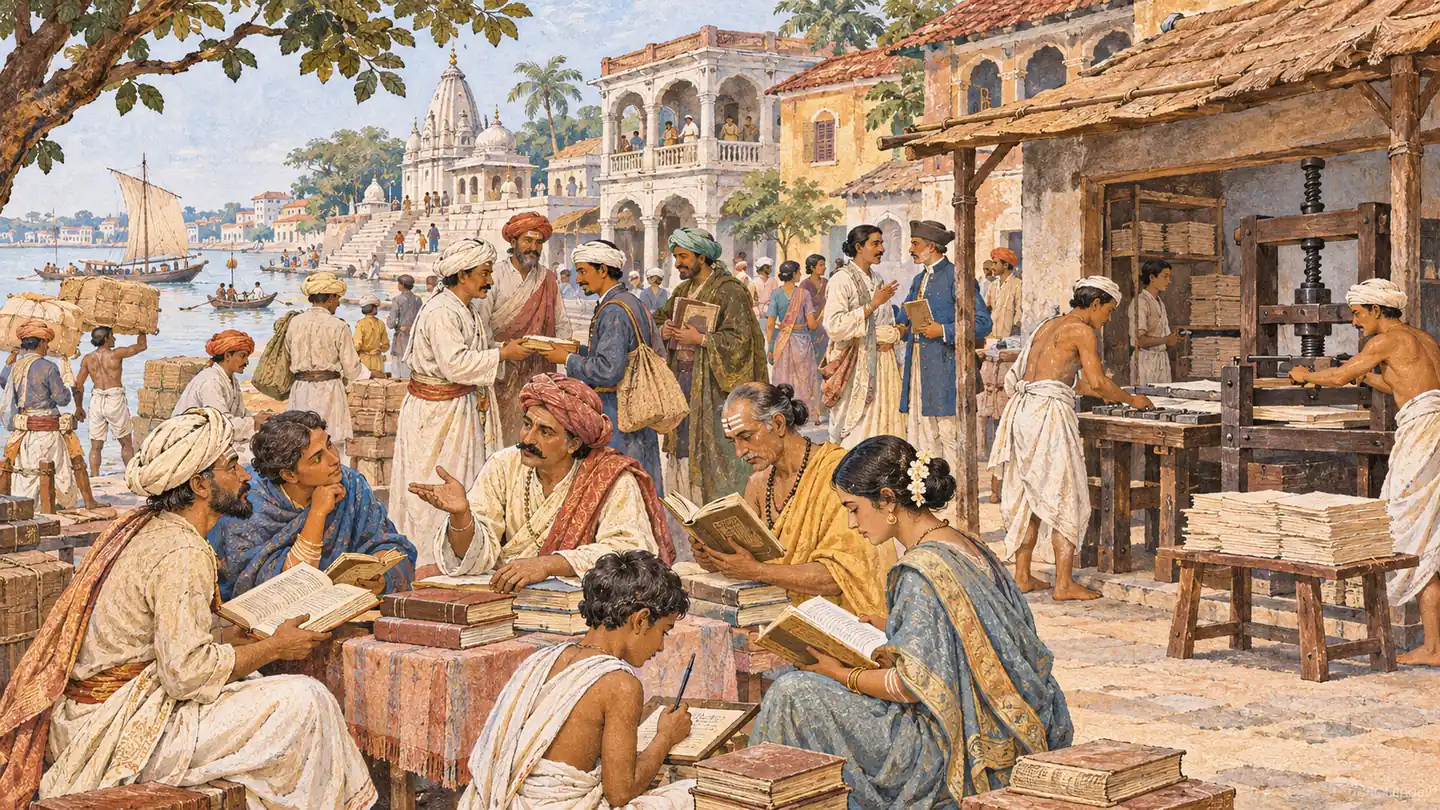
Education was not at first a concern of the Company. Iyengar writes that the early British administrators, even when they meant well, had no spontaneous interest in Hindu culture and Oriental learning. Warren Hastings founded the Calcutta Madrassa, a school of Islamic learning, in 1781. A year earlier, in 1780, James Augustus Hicky had started Hicky's Bengal Gazette at Calcutta. Iyengar calls it India's first newspaper.
The arrival of Sir William Jones, an English scholar, "ushered in a new era in the education of India", in Iyengar's view. Jones founded the Bengal Asiatic Society, a body for the study of Asian history and literature. He published English versions of Sakuntala and Hitopadesa, wrote odes to Hindu gods, and composed a long verse tale, The Enchanted Fruit, based on an episode of the Mahabharata. Jones was an Englishman, so his own writing is not Indian writing in English. Iyengar still gives him credit for inspiring both Englishmen and Indians to study Indian sacred writing with respect.
Other steps followed. Jonathan Duncan started the Sanskrit College at Benares, and a Committee of Public Instruction was formed in 1823. Yet one question divided opinion. Should India adopt a wholly Western system of education, with English as the medium of instruction, the language in which lessons are taught? Or should it revive the study of Sanskrit and Persian and teach in the various languages of the people, their mother tongue in each region? Iyengar says that opinion was sharply divided and that things drifted for two or three decades.
Three forces settle the question
Then, Iyengar says, three forces arrived together and made the course clear. The first was the new energy among educated Indians, shown best in Raja Rammohan Roy. The second was the work of Christian missionaries, people who travel to spread their religion. The third was the persuasive English prose of Macaulay.
Rammohan Roy and his friends had tasted Western literature and wanted a Western type of education with English as the medium. With the help of two Englishmen, David Hare and Sir Edward Hyde East, Rammohan Roy helped to bring the Hindu College into being at Calcutta. It opened in 1817 with about one hundred students, and within twenty years the number had grown to four times that. The college later became the Presidency College. Iyengar adds that Bombay and Madras were content to follow Bengal.
The missionaries mattered too. Their final aim was to convert Indians to Christianity, and Iyengar says so plainly. Yet he adds that only prejudice would belittle their pioneering work in education and social service. Serampore College was founded in 1818 by Carey, Ward and Marshman, and English was the usual medium in missionary schools.
The decision on English education
The third force was a Minute, an official written note, by Macaulay. It argued that it was necessary and possible "to make natives of this country good English scholars". Lord William Bentinck, the Governor-General, who was the highest British official in India, read the Minute and hesitated no longer. On 7 March 1835 the Governor-General in Council passed a resolution. It said that the great object of the British Government should be the promotion of European literature and science among the people of India. It also said that all funds for education would be best spent on English education alone.
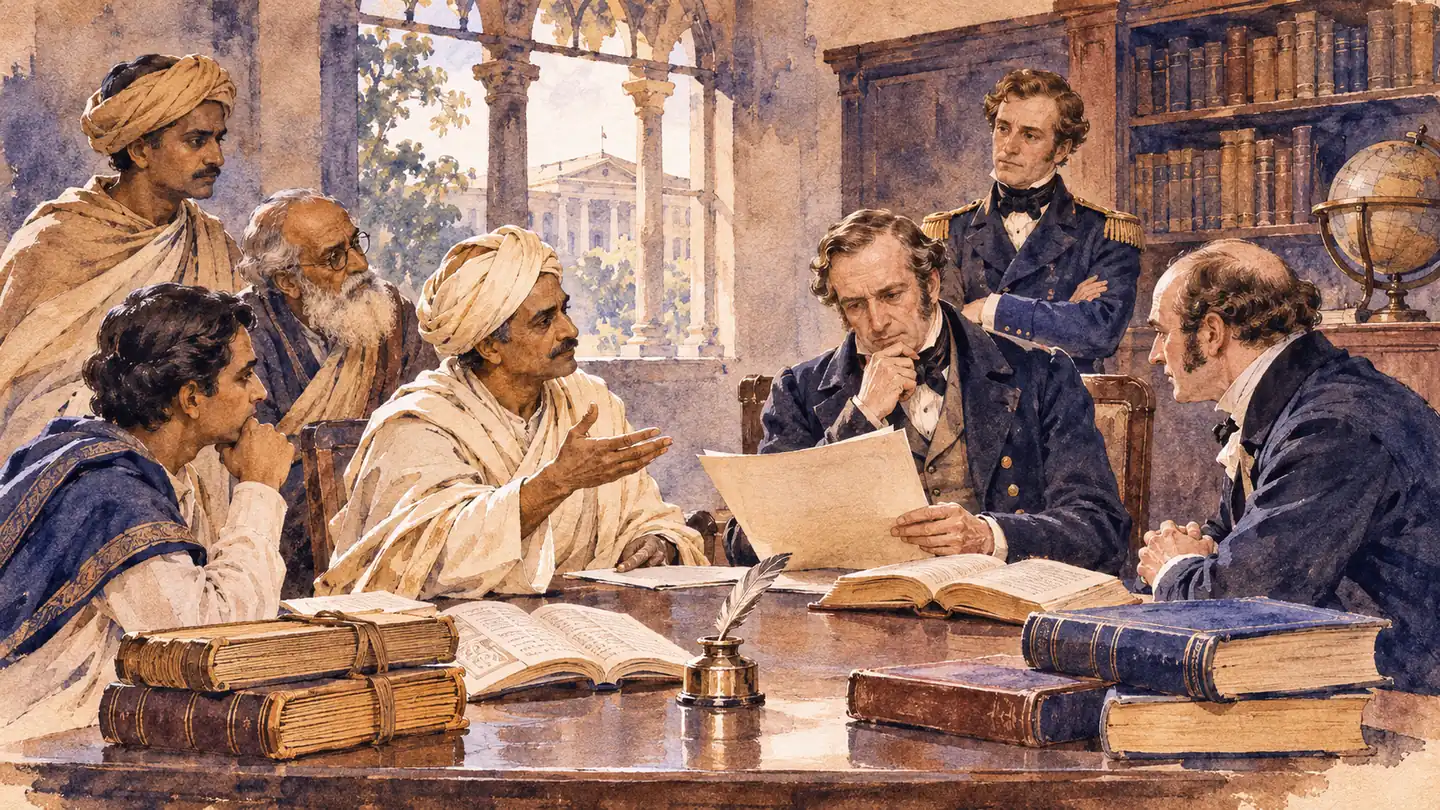
Iyengar stresses the last words. The plan was not to teach the masses in English. Government would run secondary schools and colleges with the funds it had. The young men who left them were expected to join government service as clerks, or to go back to their villages and pass the new learning on. In this way the new culture would filter down from the educated classes to the villages.
Iyengar judges that the plan looked admirable on paper but refused to work. The average educated Indian would not return to his village. He often copied the European in dress, speech and thought. Even so, English stayed. Iyengar observed in 1945 that men and women in India, in very considerable numbers, still read, wrote and talked in English, and often thought in it.
The first Indians who wrote in English felt no doubt about the matter. Western culture and English literature seemed good things to them, and they hoped to join the best of the West and the East. Rammohan Roy and Keshub Chandra Sen wrote in their mother tongue to reach the masses. On weighty occasions they wrote or spoke in English, so that their words could travel across India, or even to the rulers in far-off Britain. They began to write in English out of necessity, and Iyengar says they made a virtue of that necessity.
Did you know?
In the foreword to Iyengar's book of 1945, Sir Bomanji Wadia noted how much the English language had grown. In Shakespeare's time, he wrote, about four million people spoke it. In his own time about two hundred million did. He used these figures to argue that an Indian who writes in English opens a door to a very large audience.
Important points to remember
- The East India Company received its charter on 31 December 1600.
- From 1834 the Company acted as a managing agency for the British government in India.
- Hicky's Bengal Gazette was started at Calcutta in 1780 and is called India's first newspaper by Iyengar.
- Warren Hastings founded the Calcutta Madrassa in 1781.
- Sir William Jones founded the Bengal Asiatic Society and published English versions of Sakuntala and Hitopadesa.
- A Committee of Public Instruction was formed in 1823.
- Iyengar names three forces: Rammohan Roy, the missionaries and Macaulay's Minute.
- The Hindu College at Calcutta opened in 1817 with about one hundred students.
- Serampore College was founded in 1818 by Carey, Ward and Marshman.
- On 7 March 1835 the Governor-General in Council resolved to spend education funds on English education alone.
What Indian English literature is
The names
The writing has carried several names. In the 1940s the usual words were Anglo-Indian and Indo-Anglian, and a third, Indo-English, was also in use. Some writers of that time used "Anglo-Indian" for everything. Principal P. Seshadri placed Sir Edwin Arnold, an Englishman, beside Tagore and Sarojini Naidu in his short survey of "Anglo-Indian Poetry". George Sampson, in his Concise Cambridge History of English Literature, gave a section to "Anglo-Indian Literature" and named Tagore, Manmohan Ghose and Sri Aurobindo in it.
Iyengar wished to separate two groups. Englishmen who write on Indian themes he called Anglo-Indian. Indians who use English as the medium of artistic expression he called Indo-Anglian. He explains this choice in the preface of his book, which is dated 15 August 1945.
Later historians chose other words. Iyengar's larger history is titled Indian Writing in English, and this is also the name by which the field is known. M. K. Naik's history, published in 1982 by the Sahitya Akademi, India's national academy of letters, is titled A History of Indian English Literature. This series uses the name Indian English literature. The Sahitya Akademi accepts the writing as a legitimate part of Indian literature, because it represents different expressions of the Indian ethos.
Who counts as a writer
Iyengar's rule was simple. A writer belongs to the subject when an Indian uses English as the medium of artistic expression. The rule raised hard cases, and Iyengar discussed two of them in his preface.
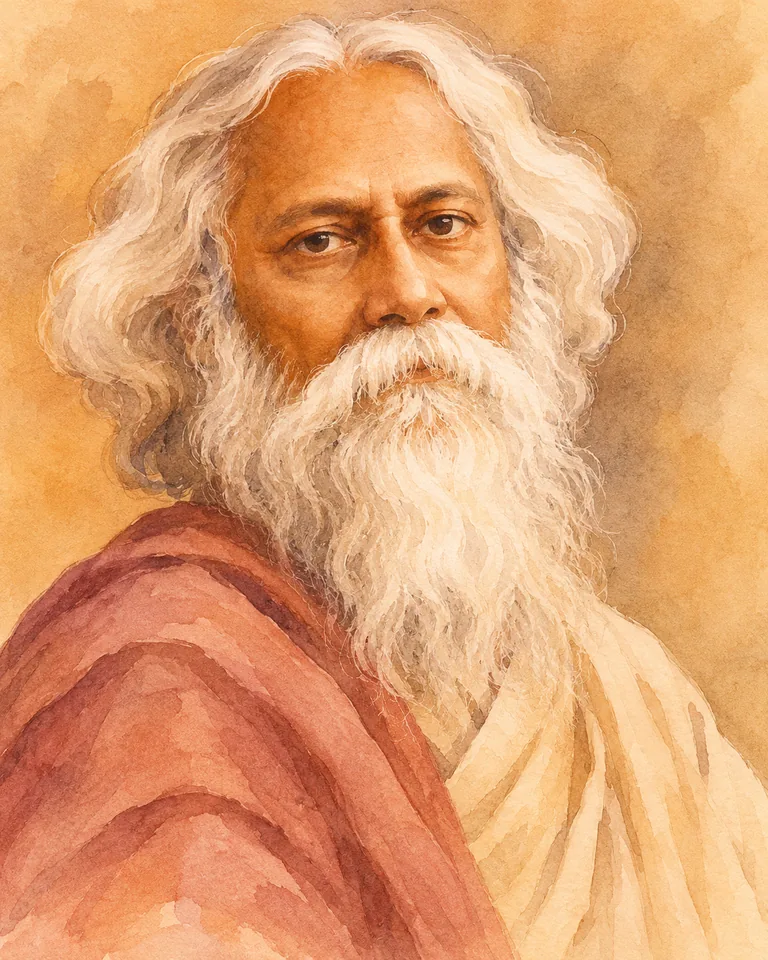
The first was Rabindranath Tagore, a classic of Bengali literature who also has a place in English. Iyengar notes that Tagore wrote works such as Sadhana and Personality, and even a poem, "The Child", in English alone in the first instance. Several other works were first written in Bengali and then put into English by Tagore himself, or under his supervision. Iyengar chose to accept Tagore's first rank among Bengali writers and also to assess his importance for Indian English writing.
The second case was Mahatma Gandhi's My Experiments with Truth. Gandhi wrote it in Gujarati. It was later put into English, with his full approval, by Mahadev Desai and revised by V. S. Srinivasa Sastri. Iyengar compared this with Sir Thomas More's Utopia, which was written in Latin, yet every historian of English literature describes it. He also pointed out that the Authorized Version of the Bible is a translation and is still an English classic.
Iyengar gave the word "literature" a wide meaning. He included poets, dramatists and novelists, and also critics, historians, philosophers, jurists, journalists and orators. He called their work applied literature, and he saw no reason to treat it as untouchable. Sir Bomanji Wadia took a stricter view in his foreword. He wrote that everything Indians write in English cannot be called literature, and that only a small part of the prose and verse in the survey had the real qualities of literature.
The language question
The use of English has been argued over from the start. In the last chapter of his book, Iyengar lists three complaints and answers each one. He writes that Indians had been trying to express themselves in English for nearly one hundred years.
The first complaint was that Indians who write in English are symbols of slavery. Iyengar replied that Indians were obliged to study English and made a virtue of that necessity. English kept its place in the curriculum because it worked as a link between the different language areas of India, and between India and the wider world. He also held that the vernacular literatures, meaning the writing in Indian languages such as Bengali, Tamil or Kannada, had gained from contact with English literature. He called this cross-fertilization, and he thought it had helped to start a new Indian renaissance.
The second complaint was that most of the work was poor. Iyengar answered that second-rate and third-rate writers exist in England and America as well. He added that an Indian who writes bad English verse would not necessarily write first-rate poetry in Tamil or Bengali. He expected that most Indians would go on writing only in their own mother tongue, though some would still turn to English.
The third complaint was that the English of Indians is not pure enough. Iyengar replied that Indian English need not be exactly like the King's English. He cited Bernard Shaw's remark that there is no such thing as "correct English". He also cited the report of the Sadler Commission on Calcutta University, which said that the English of an Indian would be marked by special qualities, not by faults. Professor Amaranatha Jha, Vice-Chancellor of Allahabad University, went further. He hoped that with courage and a respect for Indian idioms there would soon be "a virile, vigorous Indian English". Indian English here means a form of the language with a character of its own.
Iyengar also described the hard conditions of the Indian writer in the 1940s. He found few enterprising publishers, few competent reviewers, few good literary journals and no well organised book trade. Many authors printed about one hundred copies of a book, gave them to reviewers and friends, and waited for orders that never came.
The first books
Iyengar writes that the earliest writings of Indians in English were, naturally, in prose. Indians of about a century earlier often had to speak or write to their English rulers on public matters. A speech had to be prepared, or a pamphlet printed. As the number of Indians who knew the language grew, English publications grew in number and variety. Even English verse was boldly tried.
Iyengar's survey starts with Raja Rammohan Roy (1772-1833), a Bengali reformer who also founded a Bengali journal, Sambad Kaumudi. Iyengar calls him a master of effective English prose. In 1820 Rammohan Roy published The Precepts of Jesus, the Guide to Peace and Happiness. In 1822 came a short work on the rights of women under the Hindu law of inheritance, and in 1832 a study of the judicial and revenue systems of India.
A few other early books can still be found in old libraries. Iyengar judged that their importance was small. Hasan Ali's Observations on the Mussalmans of India (1832) is among the earliest books by a Muslim on Muslims. P. Rajagopaul's Mission to Siam (1820) and Mohan Lal's Travels in the Punjab (1834) are early travel books or memoirs. Kasi Prasad Ghose's The Shair and Other Poems (1830) is, in Iyengar's words, one of the first exhibits of Indo-Anglian verse.
Dean Mahomet's Travels of 1794 is older than all of these books. Before he became an author, Mahomet had served in the Company's army as a camp-follower, a servant and a junior officer. The University of California Press calls his book the first one written in English by an Indian.
An interesting story
Who first called this writing Indo-Anglian? K. R. Srinivasa Iyengar did not know. In the preface to his book of 1945 he wrote that he could not say who coined the term. At any rate, he knew of a book published at Calcutta in 1883 with the title Indo-Anglian Literature. It held specimen compositions from native students. Iyengar chose the word because it works both as a noun and as an adjective, while "Indo-English writer" is awkward to repeat. Sir Bomanji Wadia, who wrote the foreword, did not agree. He called the expression "not a very happy one". Iyengar kept the term all the same and used it throughout his book.
Key terms
- East India Company - the English trading company chartered on 31 December 1600 that later governed large parts of India.
- Medium of instruction - the language in which lessons are taught in a school or college.
- Minute - an official written note; Macaulay's Minute of 1835 urged that Indians be made good English scholars.
- Governor-General - the highest British official in India in this period.
- Missionary - a person who travels to spread a religion; in India, mostly Christian teachers and preachers.
- Asiatic Society - the society founded by Sir William Jones at Calcutta for the study of Asian history and literature.
- Hindu College - the Calcutta college opened in 1817 with the help of Rammohan Roy, later the Presidency College.
- Serampore College - the college founded in 1818 by Carey, Ward and Marshman.
- Mother tongue - a person's first language, such as Bengali, Tamil or Gujarati.
- Vernacular - an Indian language such as Bengali, Tamil or Kannada, as opposed to English.
- Cross-fertilization - Iyengar's word for the mutual gain of English and the Indian languages from contact with each other.
- Anglo-Indian - in Iyengar's usage, an Englishman who writes on Indian themes.
- Indo-Anglian - Iyengar's term for an Indian who uses English as the medium of artistic expression.
- Indo-English - another older name for the same writing, which Iyengar did not prefer.
- Indian Writing in English - the title of Iyengar's larger history, and a common name for the field.
- Indian English literature - the name used in this series; Naik's history is titled A History of Indian English Literature.
- Indian English - the English used by Indians, which Amaranatha Jha hoped would become vigorous and distinct.
- Applied literature - Iyengar's name for writing such as history, philosophy and journalism, which he still counted as literature.
- Sahitya Akademi - India's national academy of letters, publisher of Naik's history.
Criticism and scholarship
Iyengar called his own book of 1945, The Indian Contribution to English Literature, a pioneering work. A grant from the University of Bombay in December 1940 paid for the study, and a short survey for the P.E.N. All-India Centre was published in 1943. In the preface Iyengar admits that many writers were bound to escape his notice. He also admits that accessible data were scarce, and that he had not kept a strict sense of proportion in the space given to each writer.
Sir Bomanji Wadia, the Vice-Chancellor of the University of Bombay, wrote the foreword. He knew of no other survey so wide and detailed, and he called the book a mine of information. He also said that it included much writing at the level of "well-cultivated mediocrity". The book covered poetry, drama, the essay, fiction, history, philosophy, biography, criticism and journalism.
Iyengar later wrote a larger history, Indian Writing in English (Asia Publishing House, 1962), and revised editions followed. M. K. Naik's A History of Indian English Literature (Sahitya Akademi, 1982) is the second full history used in this series. Naik and Shyamala Narayan later wrote Indian English Literature 1980-2000, published in 2001, which deals with the last two decades of the twentieth century.
Important points to remember
- Iyengar preferred the name Indo-Anglian to Anglo-Indian and Indo-English.
- Iyengar used Anglo-Indian for Englishmen who write on Indian themes.
- A book called Indo-Anglian Literature was published at Calcutta in 1883.
- Wadia called the term Indo-Anglian "not a very happy one".
- Tagore wrote Sadhana and Personality in English in the first instance.
- Gandhi's My Experiments with Truth was written in Gujarati and put into English by Mahadev Desai.
- Iyengar counted critics, historians, philosophers and journalists as part of literature.
- The earliest writings of Indians in English were in prose.
- Amaranatha Jha hoped for "a virile, vigorous Indian English".
- Iyengar's histories are dated 1945 and 1962, and Naik's history is dated 1982.
How this series is arranged
Seven articles in order
The series has seven articles. This one is the introduction. The other six follow the history in order, and each covers one period. Historians draw the lines between periods in different places, so the dates below are working boundaries chosen for this series.
The second article covers the beginnings up to 1857. It starts with Dean Mahomet and Rammohan Roy and moves to the first poets, such as Henry Derozio and Michael Madhusudan Dutt. The third covers 1857 to 1920, the years of Toru Dutt, Sri Aurobindo, Rabindranath Tagore and Sarojini Naidu. The fourth covers 1920 to 1947, the years of the novelists Mulk Raj Anand, R. K. Narayan and Raja Rao. Raja Rao's Kanthapura came out in 1938.
The fifth article covers 1947 to 1980, the first decades after independence, with poets, dramatists and novelists such as Nissim Ezekiel, Girish Karnad and Kamala Markandaya. The sixth covers 1980 to 2000 and includes Salman Rushdie and Amitav Ghosh. The seventh covers 2000 to the present and includes Kiran Desai and Jhumpa Lahiri.
How each article is built
Each period article has the same shape. It first describes the world of the period, and then the writing that grew out of it. Poetry, fiction, drama and prose are subsections inside each article, because the same events shaped all four forms. Every article ends with a table of writers and works, fifty short points for quick revision, a quiz and answers to common questions.
Each writer is explained fully in one article only, and is named briefly in the others. Facts are taken first from the histories of Iyengar and Naik, and are checked against Encyclopaedia Britannica and the pages of the Sahitya Akademi.
Important points to remember
- The series has seven articles, and this introduction is the first.
- The second article covers the beginnings up to 1857.
- The third article covers 1857 to 1920.
- The fourth article covers 1920 to 1947.
- The fifth article covers 1947 to 1980.
- The sixth article covers 1980 to 2000, and the seventh covers 2000 to the present.
- Poetry, fiction, drama and prose are subsections inside each period article.
- Raja Rao's Kanthapura was published in 1938.
Writers and works
| Writer | Dates | Main works | Remembered for |
|---|---|---|---|
| Dean Mahomet | born 1759 | The Travels of Dean Mahomet (1794) | A travel book described as the first one written in English by an Indian |
| Raja Rammohan Roy | 1772-1833 | The Precepts of Jesus, the Guide to Peace and Happiness (1820); Brief Remarks regarding Modern Encroachments on the Ancient Rights of Females according to the Hindu Law of Inheritance (1822); Exposition of the Practical Operation of the Judicial and Revenue Systems of India (1832) | Early English prose on religion, women's rights and the law |
| Rabindranath Tagore | 1861-1941 | Sadhana; Personality | A Bengali classic who also wrote in English and put his own works into English |
| Mahatma Gandhi | 1869-1948 | My Experiments with Truth | An autobiography written in Gujarati and put into English by Mahadev Desai |
| K. R. Srinivasa Iyengar | 1908-1999 | The Indian Contribution to English Literature (1945); Indian Writing in English (1962) | A pioneering survey of the field in 1945 and the choice of the name Indo-Anglian |
| Raja Rao | 1908-2006 | Kanthapura (1938) | A novelist whose work belongs to the fourth article |
Quick revision - 50 points
Open the 50 pointsClose the list
- In 1794 The Travels of Dean Mahomet was printed in Cork, in Ireland.
- Dean Mahomet served in the East India Company's army from 1769 to 1784.
- The University of California Press calls his book the first one written in English by an Indian.
- The East India Company received its charter on 31 December 1600.
- From 1834 the Company acted as a managing agency for the British government in India.
- After the revolt of 1857 the Company lost even that role.
- K. R. Srinivasa Iyengar wrote one of the first wide surveys of Indian writing in English in 1945.
- Iyengar says the British took "his language and his literature" wherever they went.
- Warren Hastings founded the Calcutta Madrassa in 1781.
- James Augustus Hicky started Hicky's Bengal Gazette at Calcutta in 1780.
- Iyengar calls Hicky's Bengal Gazette India's first newspaper.
- Sir William Jones founded the Bengal Asiatic Society.
- Jones published English versions of Sakuntala and Hitopadesa.
- Jones's verse tale The Enchanted Fruit is based on an episode of the Mahabharata.
- Jonathan Duncan started the Sanskrit College at Benares.
- A Committee of Public Instruction was formed in 1823.
- The debate was whether to teach in English or to revive Sanskrit and Persian and teach in the mother tongues.
- Iyengar names three forces: Rammohan Roy, the missionaries and Macaulay's Minute.
- The Hindu College at Calcutta opened in 1817 with about one hundred students.
- David Hare and Sir Edward Hyde East helped Rammohan Roy with the Hindu College.
- Serampore College was founded in 1818 by Carey, Ward and Marshman.
- Macaulay's Minute urged that Indians be made good English scholars.
- Lord William Bentinck was the Governor-General when the decision of 1835 was made.
- On 7 March 1835 the Governor-General in Council resolved to spend education funds on English education alone.
- Educated young men were expected to become government clerks or to return to their villages.
- Iyengar judged that the plan of 1835 refused to work.
- Wadia wrote that about four million people spoke English in Shakespeare's time.
- Wadia wrote that about two hundred million people spoke English in his own time.
- In the 1940s the usual words were Anglo-Indian, Indo-Anglian and Indo-English.
- George Sampson gave a section to "Anglo-Indian Literature" in his Concise Cambridge History of English Literature.
- Iyengar called Englishmen who write on Indian themes Anglo-Indian.
- Iyengar called Indians who use English as a medium of art Indo-Anglian.
- A book called Indo-Anglian Literature was published at Calcutta in 1883.
- Wadia called the term Indo-Anglian "not a very happy one".
- Iyengar's larger history is titled Indian Writing in English.
- Naik's A History of Indian English Literature was published by the Sahitya Akademi in 1982.
- Naik and Shyamala Narayan wrote Indian English Literature 1980-2000, published in 2001.
- Tagore wrote Sadhana and Personality in English in the first instance.
- Gandhi wrote My Experiments with Truth in Gujarati.
- Mahadev Desai put Gandhi's autobiography into English and V. S. Srinivasa Sastri revised it.
- Iyengar compared Gandhi's case with More's Utopia, which was written in Latin.
- Iyengar called writing such as history and philosophy applied literature.
- Iyengar thought that contact with English had helped the Indian vernacular literatures, a gain he called cross-fertilization.
- Amaranatha Jha hoped for "a virile, vigorous Indian English".
- Many Indian authors of the 1940s printed only about one hundred copies of a book.
- The earliest writings of Indians in English were in prose.
- Rammohan Roy published The Precepts of Jesus, the Guide to Peace and Happiness in 1820.
- Kasi Prasad Ghose's The Shair and Other Poems (1830) is called one of the first exhibits of Indo-Anglian verse.
- Raja Rao's Kanthapura came out in 1938.
- The series has seven articles, and this introduction is the first.
Quick quiz - 25 questions
Tap an answer to see at once if it is right. You do not need to log in.
Open the 25 questionsClose the quiz
1In which year did the English East India Company receive its charter?
Answer: B. The charter was given on 31 December 1600.
2Whose travel book of 1794 is described as the first book written in English by an Indian?
Answer: A. The University of California Press describes The Travels of Dean Mahomet in these words.
3The resolution of 7 March 1835 said that education funds were best spent on what?
Answer: C. The Governor-General in Council chose English education alone.
4Who started Hicky's Bengal Gazette at Calcutta in 1780?
Answer: D. Iyengar calls his paper India's first newspaper.
5Which name did Iyengar prefer for Indians who write in English?
Answer: C. He kept Anglo-Indian for Englishmen who write on Indian themes.
6Who founded the Calcutta Madrassa in 1781?
Answer: A. Warren Hastings founded and liberally endowed it, says Iyengar.
7In which language did Gandhi write My Experiments with Truth?
Answer: D. It was put into English later, by Mahadev Desai.
8Which society did Sir William Jones found at Calcutta?
Answer: B. The society was meant for the study of Asian history and literature.
9In which year did the Hindu College at Calcutta open with about one hundred students?
Answer: C. It opened in 1817 and later became the Presidency College.
10Which three forces did Iyengar say settled the question of education?
Answer: A. Iyengar names these three forces in this order.
11Who revised the English version of Gandhi's autobiography?
Answer: D. Mahadev Desai made the English version and Sastri revised it.
12Which work, written in Latin, did Iyengar compare with Gandhi's autobiography?
Answer: B. Sir Thomas More wrote Utopia in Latin, yet historians of English literature describe it.
13Whose short survey of "Anglo-Indian Poetry" placed Sir Edwin Arnold beside Tagore and Sarojini Naidu?
Answer: C. Sampson wrote a different work, which gave a section to "Anglo-Indian Literature".
14What did Iyengar call the mutual gain of English and the Indian-language literatures from contact?
Answer: A. He thought this gain had helped to start a new Indian renaissance.
15Who wrote that about four million people spoke English in Shakespeare's time?
Answer: D. He wrote this in his foreword to Iyengar's book.
16What is the title of Iyengar's larger history of 1962?
Answer: B. The Indian Contribution to English Literature is his earlier book of 1945.
17Which Calcutta book of 1883 held "specimen compositions from native students"?
Answer: C. Iyengar mentions it in his preface, where he discusses who coined the term.
18In what form did the earliest writings of Indians in English appear?
Answer: A. Indians first wrote speeches, pamphlets and appeals to their rulers.
19Which book of 1830 does Iyengar call one of the first exhibits of Indo-Anglian verse?
Answer: D. It was written by Kasi Prasad Ghose.
20Who hoped for "a virile, vigorous Indian English"?
Answer: B. Jha was the Vice-Chancellor of Allahabad University.
21What did Iyengar say about the plan that educated young men would carry the new learning to the villages?
Answer: C. The average educated Indian would not return to his village.
22In which year was a Committee of Public Instruction formed, according to Iyengar?
Answer: A. The committee was formed while opinion on education was still divided.
23How many copies of a book did many Indian authors print in the 1940s, according to Iyengar?
Answer: D. They gave the copies to reviewers and friends and waited for orders.
24Which article of the series covers 1920 to 1947?
Answer: B. The third covers 1857 to 1920 and the fifth covers 1947 to 1980.
25In which year did Raja Rao's Kanthapura come out?
Answer: C. It was published in 1938, in the years covered by the fourth article.
Frequently asked questions
What is Indian English literature?
It is the writing in English by Indians, in poetry, fiction, drama, essays, histories and life stories. K. R. Srinivasa Iyengar gave a simple rule in 1945. A writer belongs to the subject when an Indian uses English as the medium of artistic expression. The Sahitya Akademi accepts the writing as a legitimate part of Indian literature.
What is the difference between Anglo-Indian and Indo-Anglian literature?
In Iyengar's usage, Anglo-Indian refers to Englishmen who write on Indian themes. Indo-Anglian refers to Indians who use English as the medium of artistic expression. Later writers use the names Indian Writing in English and Indian English literature instead.
Why did Indians begin to write in English?
English became the language of higher education after the resolution of 7 March 1835, which said that education funds were best spent on English education alone. Reformers such as Rammohan Roy also wanted a Western type of education. Iyengar says Indians began to write in English out of necessity and made a virtue of that necessity.
Who wrote the first book in English by an Indian?
The University of California Press describes The Travels of Dean Mahomet, printed in Cork in 1794, as the first book written in English by an Indian. Iyengar's survey of 1945 begins with Raja Rammohan Roy, whose The Precepts of Jesus, the Guide to Peace and Happiness came out in 1820.
What was Macaulay's Minute?
It was an official written note in which Macaulay argued that it was necessary and possible to make the natives of India good English scholars. The Governor-General, Lord William Bentinck, read it and hesitated no longer. On 7 March 1835 the Governor-General in Council resolved to spend education funds on English education alone.
Which books give the history of Indian English literature?
Iyengar wrote The Indian Contribution to English Literature in 1945 and Indian Writing in English in 1962. M. K. Naik wrote A History of Indian English Literature, published by the Sahitya Akademi in 1982. Naik and Shyamala Narayan later wrote Indian English Literature 1980-2000, published in 2001.
Sources
- K. R. Srinivasa Iyengar, The Indian Contribution to English Literature, Karnatak Publishing House, 1945.
- K. R. Srinivasa Iyengar, Indian Writing in English, Asia Publishing House, 1962.
- M. K. Naik, A History of Indian English Literature, Sahitya Akademi, 1982.
- Michael H. Fisher (ed.), The Travels of Dean Mahomet: An Eighteenth-Century Journey through India, University of California Press, 1997.
- Encyclopaedia Britannica, entries "East India Company", "Ram Mohan Roy" and "Raja Rao".
- Sahitya Akademi, National Academy of Letters, India, official website.
Afsar Khan, Ph.D. English
Test your knowledge
Check what you have learned with quizzes and MCQs.