
On this page
Three remarkable Indian English novels appeared in the space of four years. Mulk Raj Anand's Untouchable (1935) followed one day in the life of a young sanitation worker. R. K. Narayan's Swami and Friends (1935) introduced the schoolboy Swami and the fictional town of Malgudi. Raja Rao's Kanthapura (1938) carried India's freedom struggle into a South Indian village. Each writer used English for a distinctly Indian story, but each chose a different kind of hero and a different way of telling it.
This article covers Indian English literature from 1920 to 1947. The first date marks the beginning of Gandhi's mass Non-Cooperation Movement; the second marks Independence and Partition. M. K. Naik calls this historical stage the Gandhian Whirlwind in A History of Indian English Literature (1982). The dates describe a period, not a rule that every writer's career had to fit inside it. Some important books appeared later, and their actual publication years are clearly stated here.
First we will examine the political, social, economic and religious world of these writers. Then we will study novels, short stories, poetry, drama, autobiographies and political prose. The major literary terms are explained in simple English. A writer-and-works table, fifty revision facts, twenty-five questions and six FAQs will help you revise the material after reading it.
The world of this period
Political life
In 1920 India was still governed under British colonial rule. Indians had taken part in public protest and political organisations for decades, but the scale of protest now changed. The Indian National Congress increasingly became the centre of a mass nationalist movement. Farmers, workers, students, merchants and women joined public action, although their aims and opportunities were not identical. Political questions were no longer discussed only in meetings of educated leaders.
Mahatma Gandhi helped organise the Non-Cooperation Movement of 1920-1922. Supporters withdrew cooperation from colonial institutions. They encouraged the boycott of foreign cloth, government honours and some state-controlled schools and courts. The movement also promoted swadeshi, or support for goods made in India. Khadi, cloth made from hand-spun and hand-woven yarn, became a visible sign of this commitment. These ideas later entered novels as part of everyday village and town life.
In February 1922 Gandhi stopped the movement after violence at Chauri Chaura. That decision divided opinion among nationalists, but the attempt to involve ordinary people in political action had already changed public life. It also changed what writers could imagine as a political story. The people in a novel did not need to be kings or famous leaders. A village meeting, a shopkeeper's decision or a student's boycott could now carry national meaning.
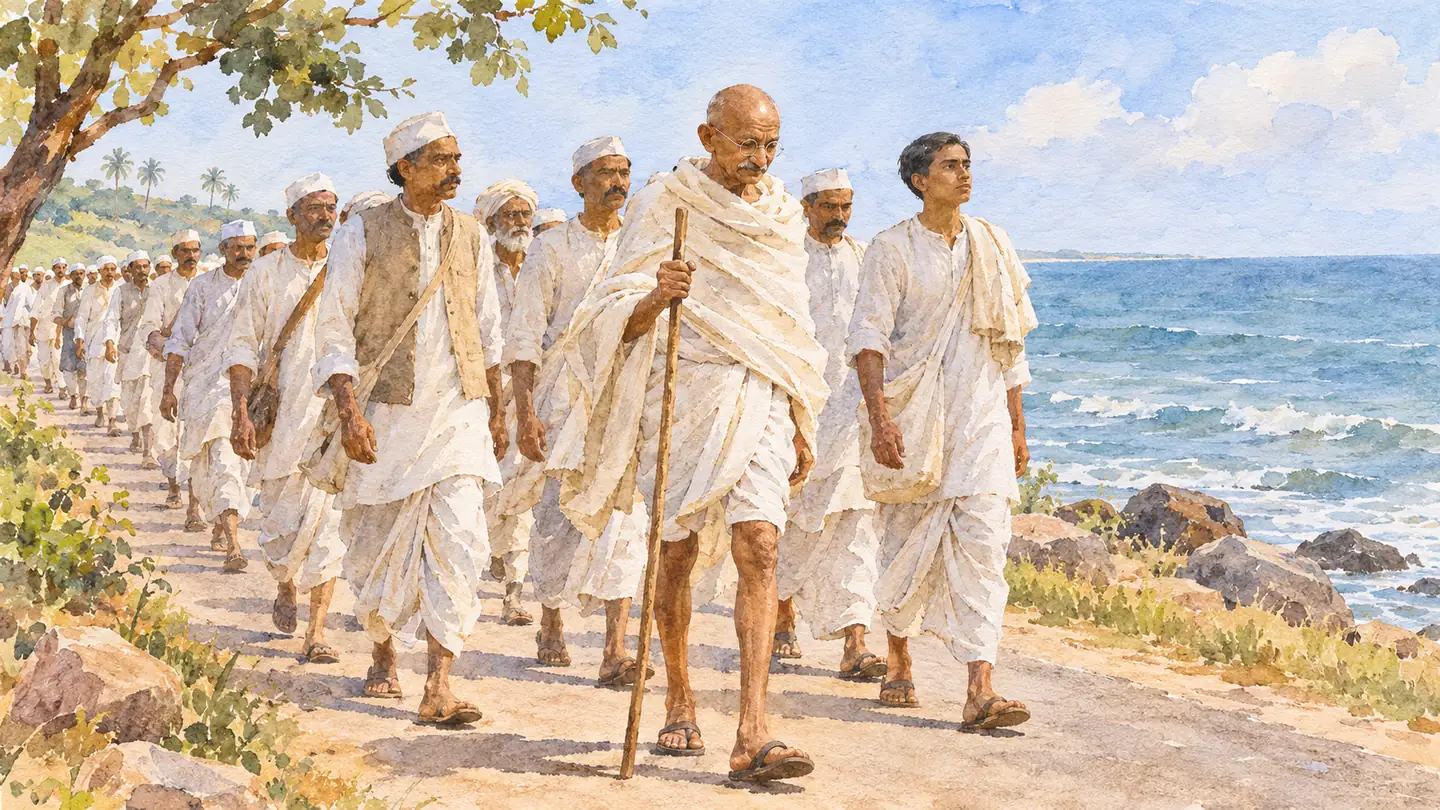
The Civil Disobedience Movement began in 1930. Civil disobedience means openly breaking a law judged unjust, generally through nonviolent action. Gandhi's Salt March from Sabarmati to Dandi made a common household necessity into a political symbol. The campaign showed that government power could be challenged through the actions of ordinary people. It also gave novelists scenes and language that connected national politics with local life.
The Second World War began in 1939 and brought new uncertainty. India became involved in the war while remaining under British rule. The Congress launched the Quit India Movement in August 1942, demanding an end to colonial government. Many leaders were arrested, and the movement faced strong repression. Jawaharlal Nehru was imprisoned during these years, and some of his most important English prose emerged from prison.
British rule ended in August 1947. At the same time, Partition created India and Pakistan as independent states and brought violence and mass displacement. Independence was a political achievement, but it did not erase poverty, caste exclusion or religious conflict. Later Indian English writers would return to the human cost of Partition. The novels discussed in this article mainly belong to the years before that great break.
Social life
India was not one uniform society. Language, caste, class, religion, gender and region shaped the opportunities available to individuals. A reader in a large city could experience colonial life differently from a farmer, a mill worker or someone denied entry to public spaces because of caste. English education reached only a part of the population, yet it helped create a new group of writers and readers.
Untouchability involved the exclusion and humiliation of communities treated as outside the accepted caste order. People affected by it could face restrictions on work, water, education and social contact. Gandhi campaigned against untouchability, but B. R. Ambedkar argued that the deeper caste system itself had to be challenged. They disagreed about important methods and goals. That disagreement matters when we read political prose beside social novels.
In Anand's Untouchable, Bakha is not simply a figure in a debate. He is a person who has wishes, embarrassment, anger and pride. A novel can make its reader experience the human results of a social rule that an essay might describe in abstract terms. This is one reason the social realist novel became important. Social realism uses plausible characters and events to examine the difficulties of ordinary people.
The period also saw wider participation by women in public activity, education and political protest. These changes did not end the unequal expectations placed upon women inside many families. Narayan's The Dark Room (1938), for example, examines a woman's difficult position within marriage. Its treatment of domestic power shows that a novel of this age did not have to describe a political march to be concerned with freedom.
English created another social problem for writers. People often spoke one or more Indian languages in daily life, but an English novel might be read far from its setting. How could a writer convey the habits, speech and thoughts of Indian characters without making them sound like English characters? Anand, Narayan and Rao developed different solutions. Their work helped make Indian English a literary medium: English adapted to Indian experience, place and patterns of expression.
Economic life
A large share of India's population depended on agriculture. Landholding, rent, debt and unstable prices made life uncertain for many farmers and labourers. Towns also depended on people employed in factories, domestic work and other poorly paid occupations. Economic hardship often crossed caste and community boundaries, though it affected groups in different ways.
The Great Depression, beginning in 1929, reduced the prices paid for many agricultural products. Farmers could earn less while still owing rent or debt. The crisis became part of a wider discussion about colonial trade, national self-reliance and India's economic future. Gandhi promoted village industries and khadi. Nehru later gave greater attention to industrial development and economic planning. Their emphases were different, but both saw economic life as inseparable from political freedom.
Anand's Coolie (1936) presents the journey of Munoo, a poor boy who moves through several workplaces. His suffering is linked to the power of employers and the lack of protection for the poor. Two Leaves and a Bud (1937) turns to labour on an Assam tea plantation. These books show how an individual life can be used to expose a larger economic system. The reader sees work and poverty as causes of suffering rather than merely background scenery.
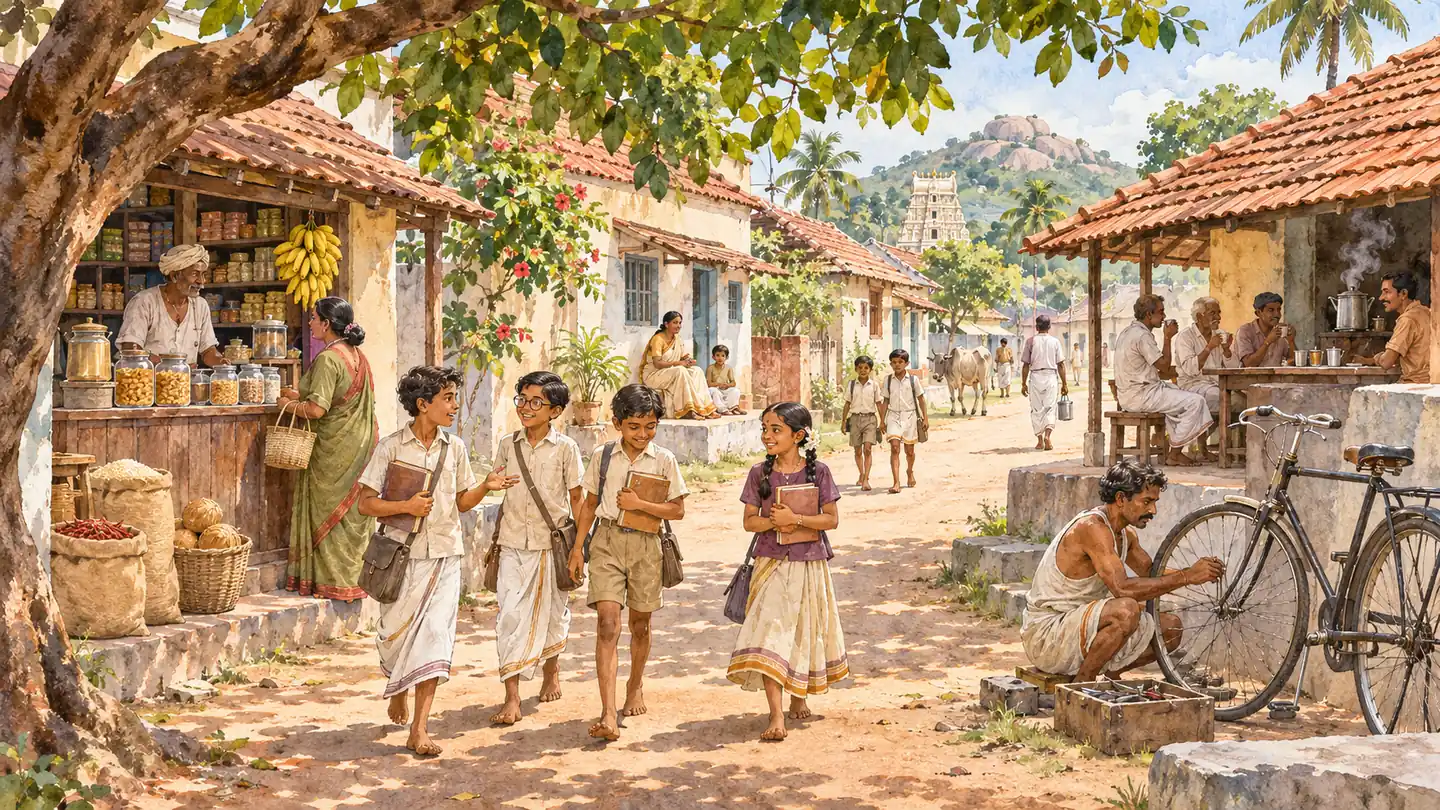
Economic life also appears in Narayan's Malgudi, but his method is quieter. Shops, offices, schools and middle-class homes form part of the town's everyday world. People hope for jobs, social respect and family security. Small ambitions may reveal how strongly public changes affect private lives. Thus Anand and Narayan describe different social worlds without one being more Indian than the other.
Schools, colleges and the press
Schools and colleges helped create readers who could study English and write in it. Access was unequal, however, and literary English did not represent the everyday speech of most Indians. The tension between English education and Indian languages became an important issue for the novelists of the 1930s.
Newspapers and journals connected writers with political debates. Gandhi's Young India carried the English translation of his autobiography, and Harijan began in 1933. Such periodicals made nonfiction part of public action. Books also crossed national borders: Anand's, Narayan's and Rao's major early novels appeared through British publishers while their subjects remained firmly Indian.
Religion
Religion remained central to public and family life, but people did not agree about its social or political meaning. Hindu, Muslim, Sikh, Christian and other communities had distinct practices and internal differences. Nationalist politics sometimes drew upon religious language. Such language could encourage collective action, but it could also sharpen disagreements about identity and belonging.
Gandhi's ideas of ahimsa and satyagraha gave his political programme a moral language. Ahimsa means nonviolence or the principle of not causing harm. Satyagraha is the practice of resisting injustice through truth, nonviolent action and moral discipline. Gandhi believed that public conduct should be connected with personal ethical responsibility. His writings often combine political questions with reflection on individual conduct.
Ambedkar challenged religious and social beliefs used to justify caste inequality. In Annihilation of Caste (1936), he argued for fundamental change in the caste order. This was not merely a disagreement about manners or charitable reform. It raised a deeper question: could a nation call itself free if social relationships continued to deny equality to some of its people?
Raja Rao's Kanthapura connects politics with storytelling shaped by religious tradition. Villagers interpret current events through familiar legends, rituals and ideas of moral duty. The novel makes use of myth, a traditional story through which a community explains values or events. Its religious imagery is part of the characters' way of seeing the world, not proof that everybody in the village thinks alike.
The growth of communal divisions and the Partition of 1947 exposed another side of religious politics. It would be misleading to describe this period as an uncomplicated story of national unity. Indian English writing emerged from a society where many groups struggled both for political independence and for a more equal place within the nation.
Did you know?
Gandhi's The Story of My Experiments with Truth was not first written in English. Its original language was Gujarati, and Mahadev Desai translated most of it into English while it appeared in serial form. It belongs to the study of Indian writing in English because the English version became widely influential, but students should remember that it is a translation, not an originally English autobiography.
Important points to remember
- M. K. Naik named 1920-1947 the Gandhian Whirlwind.
- The Non-Cooperation Movement ran from 1920 to 1922.
- Gandhi stopped Non-Cooperation after the Chauri Chaura violence in February 1922.
- The Salt March helped launch Civil Disobedience in 1930.
- The Quit India Movement began in August 1942.
- Indian independence and Partition took place in August 1947.
- Caste and economic inequality are central subjects of the period's social fiction.
- Gandhi and Ambedkar differed about the means of ending caste injustice.
- Gandhi's autobiography was originally in Gujarati and translated into English.
Literature in this period
The language and the new novel
The most striking literary development of these years was the rise of the Indian novel in English. Poetry and prose had existed earlier, but novels of the 1930s gave the field a wider public identity. The three best-known pioneers were Mulk Raj Anand, R. K. Narayan and Raja Rao. Their major early books were first published in Britain, although they described Indian people and places. Each writer worked out a distinct relationship between English language and Indian life.
Anand used the novel to expose social injustice. Narayan built a believable world of everyday experiences. Raja Rao reshaped English to suggest the movement of Indian speech and storytelling. These distinctions help explain why the three writers should not be treated as copies of one another. They share a literary period, but they differ in style, character and artistic purpose.
A regional novel is fiction closely connected to a particular place and its customs. A fictional geography is an invented setting that becomes familiar through several books. Malgudi is the best example in this period. Irony occurs when a situation or statement reveals a meaning different from what is expected. Narayan uses gentle irony to show the mistakes, hopes and pretensions of ordinary people. Anand uses sharper scenes of humiliation and hardship. Raja Rao brings the form of the village tale into the English novel.
Mulk Raj Anand
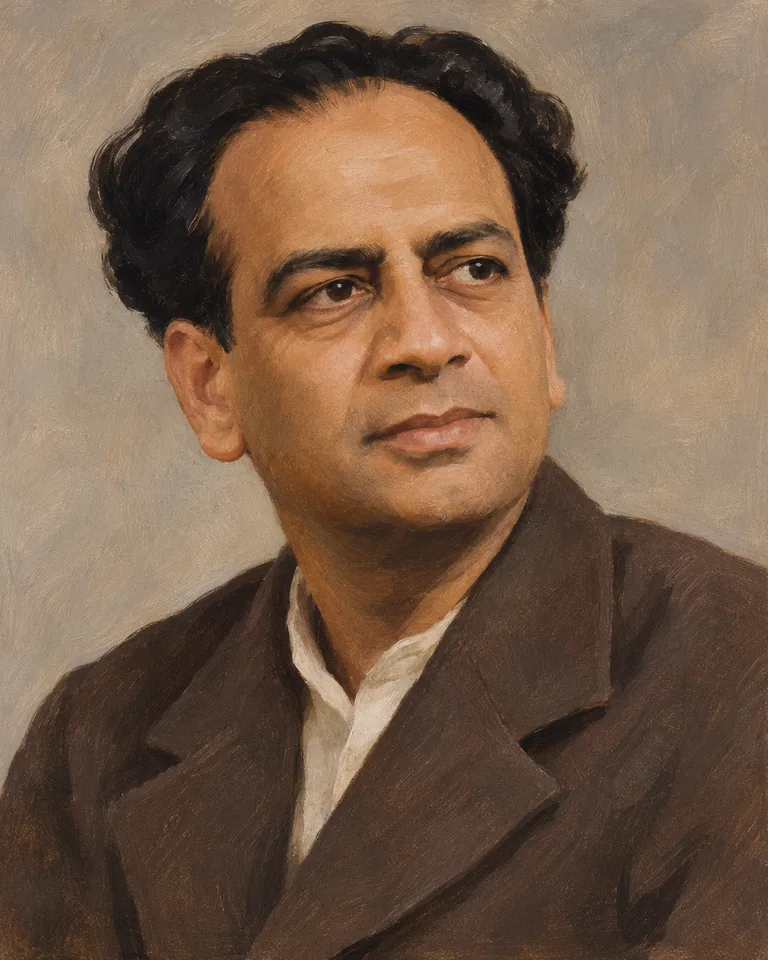
Mulk Raj Anand (1905-2004) was a novelist concerned with people denied dignity by caste, poverty and unequal power. His writing is often described as social realism because it brings difficult conditions of labour and society into fiction. He does not treat the poor merely as objects of sympathy. His characters have feelings, desires and the capacity to question the world around them.
Untouchable (1935) follows a single day in the life of Bakha, a young sanitation worker. The one-day structure gives the book a strong sense of unity. The reader encounters humiliations and conflicts almost as Bakha does. His wish to be respected is placed against the rules of a society that marks him as inferior. The novel does not present caste as an ancient custom without living consequences. It makes discrimination immediate and personal.
The book also places different proposed responses to untouchability beside one another. Gandhi's anti-untouchability message forms part of its political setting. The novel's attention to Bakha, however, should not be confused with a claim that a single speech solves caste inequality. Anand leaves readers thinking about the relation between compassion, social change and practical conditions.
Coolie (1936) has a wider journey. Its central character, Munoo, is a poor boy who passes through different places and forms of work. The movement from one setting to another reveals exploitation in homes, factories and other workplaces. Munoo's vulnerability makes the economic world of colonial India visible. Whereas Untouchable concentrates on one day, Coolie builds its criticism through a sequence of experiences.
Two Leaves and a Bud (1937) examines labour and injustice on an Assam tea plantation. The Village (1939), Across the Black Waters (1940) and The Sword and the Sickle (1942) follow the life of Lal Singh through village society, war and political change. The Big Heart (1945) turns to artisans whose work is threatened by industrial change. Together these novels show Anand's continuing interest in ordinary workers and the systems that shape their lives.
Anand's achievement is literary as well as social. He uses dialogue, scenes of conflict and the reader's closeness to his protagonists to create sympathy. A question about his fiction should therefore consider both the injustice described and the way the story makes that injustice felt.
R. K. Narayan
Rasipuram Krishnaswami Narayan (1906-2001) developed a different kind of Indian English fiction. His novels often begin with familiar people and everyday difficulties. Instead of declaring a political argument, he lets characters reveal themselves through their actions, mistakes and relationships. His prose is usually clear, controlled and quietly humorous.
Narayan's first novel, Swami and Friends (1935), introduces Swaminathan, usually called Swami, and the town of Malgudi. School, friendship, discipline and family life become matters of real importance to the child. The novel also places childhood within the world of colonial education and nationalist excitement. Its central concerns are personal, but its social setting is recognisably Indian.
Malgudi is a fictional South Indian town, not a precise copy of one real town. It allows Narayan to return to families, streets and institutions while introducing new characters. This creates a sense of continuity across books. The town itself becomes one of his great literary inventions. Readers can recognise the habits of its people even when a new story concerns a different profession or generation.
The Bachelor of Arts (1937) follows Chandran through college life, love and growing maturity. The novel belongs beside Swami and Friends and The English Teacher (1945) as part of a loose sequence about education and personal development. They are not a continuous story about one hero. Rather, they explore different stages and experiences of young adulthood.
The Dark Room (1938) presents the unequal power within a marriage. Its attention to Savitri's experience shows Narayan's interest in domestic conflict and gender expectations. He does not need a dramatic national event to reveal the unfairness of an everyday situation. His restraint can make that unfairness more disturbing.
The early story collection Malgudi Days appeared in 1943. Narayan's short stories develop the town through small incidents, comic misunderstandings and moments of disappointment. The title has also been used for later collections and adaptations, so the date of a particular edition matters. The English Teacher (1945) concerns Krishna, a teacher whose life is profoundly changed by personal loss. It joins ordinary institutional life with questions of grief and spiritual experience.
Narayan's The Guide was published in 1958, after the period covered by this article. It follows Raju, whose changing public identity and relationship with others raise questions about performance, belief and moral responsibility. It belongs in a study of Narayan's career, but its correct year must never be moved back to the 1930s or 1940s merely to fit this chapter.
Raja Rao
Raja Rao (1908-2006) approached the English novel through philosophy, Indian narrative traditions and the freedom movement. The problem of language mattered especially to him. He wanted English to carry the rhythms of people whose lives and stories were shaped by other languages. He developed a method that can be called an oral narrative, a story told as though a speaker were addressing listeners.
His first novel, Kanthapura (1938), describes how the Gandhian movement reaches a South Indian village. The narrator is Achakka, an older woman who remembers the village and the events that changed it. Her voice gives the story the movement of a spoken account. It circles around people, stories and beliefs rather than behaving like a neutral official history.
Moorthy, a young man inspired by Gandhi, becomes an important organiser in the village. The story also involves people such as Rangamma, whose participation challenges expectations about women's roles. National politics enters through meetings, religious language and changes in village relationships. Gandhi remains a powerful influence even when the narrative concentrates on local characters.
Rao often connects current events with myth and the storytelling form of the purana, a traditional narrative associated with religious and cultural memory. This method matters because it allows villagers to understand unfamiliar political action through familiar ideas. The novel's style is therefore part of its subject: Indian experience is being expressed through an English that has been adapted to Indian narrative habits.
Rao's later The Serpent and the Rope (1960) develops a more philosophical inquiry into identity, knowledge and spiritual understanding. It belongs to his larger achievement, but it was published thirteen years after independence. The title should be remembered alongside Kanthapura without confusing their publication dates or their different kinds of narrative.
Mahatma Gandhi and political prose
Mohandas Karamchand Gandhi (1869-1948) was not primarily a novelist. His importance for Indian English literature lies in his political prose, speeches, journalism and autobiographical writing, as well as the influence of his ideas on fiction. Political prose is nonfiction writing that argues about public life, government and social responsibility. Gandhi often addressed practical questions in direct language intended for public readers.
His Hind Swaraj was written originally in Gujarati in 1909 and translated into English by Gandhi in 1910 under the title Indian Home Rule. It is older than this article's period, but its ideas remained important during the freedom struggle. It questions aspects of modern civilisation and explores the meaning of genuine self-rule. For Gandhi, freedom involved ethical conduct and society's way of living, not only the replacement of one government by another.
The Story of My Experiments with Truth was written in Gujarati and published serially in Navajivan from 1925 to 1929. The English version appeared serially in Young India through the translation work of Mahadev Desai, with some assistance from Pyarelal. Gandhi revised the English text. The work is an autobiography, a person's account of his or her own life, but it is organised around moral experiments rather than the celebration of personal achievement.
The narrative discusses his upbringing, experiences in England and South Africa, and efforts to connect truth with action. Its form reminds readers that a public leader is also presenting and interpreting his own past. An autobiography is a valuable historical document, but its personal point of view is not the same as an impartial record of every event.
Gandhi edited or contributed to influential periodicals, including Young India and Harijan. The weekly Harijan began in 1933 and became one forum for his campaigns against untouchability and for social reform. His journalism shows how writing could be part of political action. It also helped make debates about conduct, work, community and freedom accessible to a broad public.
Jawaharlal Nehru and historical prose
Jawaharlal Nehru (1889-1964) wrote major works of nonfiction in English. His prose often combines history, personal reflection and the question of India's future. Several of his books grew out of periods of imprisonment. Unlike Gandhi's Gujarati autobiography, Nehru's principal literary works discussed here were composed in English.
Glimpses of World History (1934) grew from letters written to his daughter Indira, many of them during imprisonment. He used the form of letters to explain societies, empires, revolutions and the changing world. The form makes large historical subjects feel like part of a conversation. It also shows that education and explanation could be literary activities, not merely the delivery of facts.
Nehru's An Autobiography (1936) reflects on his personal development and India's political struggle. Its account is shaped by the experience of a participant in the freedom movement. The book is therefore both personal narrative and an interpretation of public history. It asks readers to see political life through a thinking individual rather than through a list of events alone.
The Discovery of India (1946) was written during Nehru's imprisonment at Ahmadnagar Fort in 1944. It explores India's long cultural and intellectual history as well as modern nationalism. The book discusses different traditions and the difficulties of understanding a diverse country. Its literary quality comes partly from the movement between historical explanation and personal reflection.
Nehru's books illustrate historical interpretation: a writer selects and connects events to explain their meaning. Students should distinguish his broad vision of Indian history from an undisputed account accepted by every historian. His works are important not because they settle every argument, but because they show how a political leader used English prose to think about national identity.
B. R. Ambedkar and the argument for equality
Bhimrao Ramji Ambedkar (1891-1956) was a major thinker, lawyer and critic of caste hierarchy. His writing is essential to the period because it forces a different question into the debate about national freedom: what would independence mean without equality within society? His prose is analytical and argumentative. It aims to examine the rules and beliefs by which unequal relations are maintained.
Annihilation of Caste (1936) was prepared as an address for the Jat-Pat-Todak Mandal, a caste-reform organisation in Lahore. The organisers withdrew their invitation after disagreeing with the proposed speech. Ambedkar then published it. The text questions the social and religious foundations of caste and argues for structural change. It is a central example of social criticism, writing that examines and challenges the organisation of society.
Gandhi and Ambedkar both opposed untouchability, but their positions were not interchangeable. Gandhi's campaigns emphasised moral reform and nonviolence within his wider political programme. Ambedkar insisted that the caste order itself required fundamental criticism. Treating the two as though they expressed one argument would hide a central intellectual conflict of the period.
Ambedkar's English prose also reminds us that Indian English literature is not restricted to poems and novels. Speeches, essays and works of argument helped shape public thought. Their language could be urgent, exact and persuasive. A literary history of these decades becomes incomplete if it studies nationalism while ignoring the claims of those excluded from social equality.
Poetry and drama
The period was not entirely dominated by fiction. Indian English poetry continued to develop, though the main new public visibility came from the novel. Harindranath Chattopadhyaya (1898-1990), a poet, dramatist and performer, published The Magic Tree (1922) and Poems and Plays (1927). His writing shows the continuing interest in lyrical expression and dramatic forms. The earlier poetry of Sri Aurobindo and Sarojini Naidu also remained part of the literary background, but their main treatment belongs to the preceding article.
Indian English drama developed more slowly than prose fiction. T. P. Kailasam, who also wrote in Kannada, turned to Indian epic subjects in English plays. His The Burden (1933) and The Purpose (commonly dated 1944) draw upon epic narratives. The Purpose concerns Ekalavya, whose story raises questions about education, duty and exclusion. Such plays show how familiar material from Indian traditions could be reconsidered through modern English-language drama.
Poetry and drama are important reminders that a literary period cannot be reduced to its three best-known novelists. Nevertheless, the strongest feature of the 1930s was the new confidence of Indian English fiction, while nonfiction continued to register urgent political and moral debates.
An interesting story
When R. K. Narayan was trying to publish Swami and Friends, his manuscript met with little success in London. A friend in Oxford was helping him approach publishers, but Narayan became so discouraged that he suggested throwing the returned manuscript into the Thames. The friend instead showed it to the novelist Graham Greene. Greene read it and helped secure its publication in October 1935. The incident matters because Narayan was not writing a London novel. He had created Malgudi, a fictional Indian town whose children, families and small troubles seemed worth telling in English. A novel nearly lost to the river became the beginning of a long and influential literary career.
Key terms
- Gandhian Whirlwind - M. K. Naik's name for the 1920-1947 stage of Indian English literature.
- Mass nationalist movement - a campaign for national political change involving large sections of the public.
- Swadeshi - the promotion of locally made goods instead of imported products.
- Khadi - cloth made from hand-spun and hand-woven yarn, associated with the freedom struggle.
- Civil disobedience - the open, generally nonviolent breaking of a law considered unjust.
- Untouchability - caste-based exclusion imposed upon people treated as socially inferior.
- Social realism - literature that gives serious attention to ordinary people and social inequality.
- Indian English - English adapted to the experience, settings and expression of Indian society.
- Ahimsa - the ethical principle of nonviolence or avoiding harm.
- Satyagraha - resistance based on truth, nonviolence and moral commitment.
- Regional novel - fiction strongly rooted in the life and customs of a particular area.
- Fictional geography - an invented location developed as a believable setting across literary works.
- Irony - a gap between what is expected or said and what actually happens or is meant.
- Oral narrative - a written story shaped to resemble a speaker's account to listeners.
- Myth - a traditional story through which people express cultural beliefs or values.
- Autobiography - an account of a person's life written by that person.
- Political prose - nonfiction that discusses public affairs, government and social duties.
- Social criticism - writing that questions existing social customs, institutions or inequalities.
Criticism and scholarship
M. K. Naik's A History of Indian English Literature (1982) gives this period the name the Gandhian Whirlwind. The name places politics in the foreground without claiming that every work is directly about Gandhi. Naik's historical arrangement is useful for revision, but it is a framework rather than an absolute boundary for a writer's career.
Meenakshi Mukherjee's The Twice Born Fiction: Themes and Techniques of the Indian Novel in English (1971) studies how themes and narrative methods work together in Indian novels. Her approach helps explain why the choice of storyteller matters in Kanthapura, why Malgudi feels coherent and why Anand's close attention to vulnerable characters shapes the meaning of his novels. A novel's argument is partly created by its form, not merely by its subject.
Priyamvada Gopal's The Indian English Novel: Nation, History, and Narration (2009) considers the relation of English-language fiction to nation and history. Her study includes a chapter on Gandhi's place in literary India. This later scholarship encourages readers not to treat the freedom movement as a single, simple story. The novels can be read for their arguments about nationalism, but also for the different social experiences they portray.
The three novelists must therefore be compared carefully. Anand's social realism, Narayan's controlled irony and Rao's orally patterned village narrative give three different methods of creating Indian fiction in English. Gandhi, Nehru and Ambedkar add forms of autobiographical, historical and argumentative prose that broaden what students should study in the period.
Important points to remember
- Anand's Untouchable (1935) follows a day in Bakha's life.
- Anand's Coolie (1936) follows the exploited boy Munoo.
- Narayan introduced Malgudi in Swami and Friends (1935).
- Narayan's The Dark Room (1938) examines marriage and gendered power.
- Achakka narrates Raja Rao's Kanthapura (1938).
- Gandhi's English autobiography was translated mainly by Mahadev Desai.
- Nehru's The Discovery of India appeared in 1946.
- Ambedkar's Annihilation of Caste appeared in 1936.
- Harindranath Chattopadhyaya wrote The Magic Tree (1922).
- Meenakshi Mukherjee studied themes and techniques in The Twice Born Fiction (1971).
How the period ends
In 1947 India became independent, but the political change did not bring every social conflict to an end. Partition left communities and families facing loss and displacement. The questions raised by Anand's accounts of caste and labour, Narayan's studies of everyday life, Rao's village nationalism and Ambedkar's arguments about social equality remained urgent. They did not disappear with the end of British rule.
The period boundary also did not end the careers of the major writers. Gandhi died in 1948 and Ambedkar in 1956. Nehru continued to write and lead independent India until his death in 1964. Anand's later work extended his social concerns. Narayan's The Guide (1958) and Raja Rao's The Serpent and the Rope (1960) belong to their individual careers but were published after independence. Their true dates matter more than a convenient period label.
The next article, Indian English Literature (1947-1980), begins with the new political nation and the expansion of post-independence writing. Its novelists, poets and dramatists inherited both the possibilities and the unanswered questions of the freedom years. Indian English literature would become more varied in form, subject and readership, but this period had helped give it a lasting foundation.
Important points to remember
- British colonial rule ended in August 1947.
- Partition produced displacement and communal violence.
- Anand, Narayan and Raja Rao helped establish Indian English fiction in the 1930s.
- The English Teacher was published in 1945.
- The Guide was published in 1958, after independence.
- The Serpent and the Rope was published in 1960.
- Gandhi died in 1948, after this article's period.
- The following period article covers Indian English literature from 1947 to 1980.
Writers and works
| Writer | Dates | Main works | Remembered for |
|---|---|---|---|
| Mulk Raj Anand | 1905-2004 | Untouchable (1935); Coolie (1936); Two Leaves and a Bud (1937); The Village (1939); Across the Black Waters (1940); The Sword and the Sickle (1942); The Big Heart (1945) | Social realism, caste, poverty and labour |
| R. K. Narayan | 1906-2001 | Swami and Friends (1935); The Bachelor of Arts (1937); The Dark Room (1938); Malgudi Days (1943); The English Teacher (1945); The Guide (1958) | Fictional Malgudi, irony and everyday life |
| Raja Rao | 1908-2006 | Kanthapura (1938); The Serpent and the Rope (1960) | Village nationalism, oral narration and philosophy |
| Mahatma Gandhi | 1869-1948 | Hind Swaraj (Gujarati 1909; English 1910); The Story of My Experiments with Truth (Gujarati and English serials, 1925-1929; mainly translated by Mahadev Desai) | Ethical and political prose; satyagraha; autobiography in translation |
| Jawaharlal Nehru | 1889-1964 | Glimpses of World History (1934); An Autobiography (1936); The Discovery of India (1946) | Historical interpretation and nationalist autobiography |
| B. R. Ambedkar | 1891-1956 | Annihilation of Caste (1936) | Argumentative prose and criticism of caste hierarchy |
| Harindranath Chattopadhyaya | 1898-1990 | The Magic Tree (1922); Poems and Plays (1927) | Indian English poetry and dramatic writing |
| T. P. Kailasam | Active in the 1930s-1940s | The Burden (1933); The Purpose (commonly dated 1944) | English plays based on Indian epic material |
Quick revision - 50 points
Open the 50 pointsClose the list
- M. K. Naik called the years 1920-1947 the Gandhian Whirlwind.
- Gandhi's Non-Cooperation Movement lasted from 1920 to 1922.
- Gandhi withdrew the movement after the Chauri Chaura violence in February 1922.
- Swadeshi encouraged people to buy and use goods made in India.
- Khadi became a public symbol of the freedom movement.
- The Civil Disobedience Movement began in 1930.
- The Salt March took Gandhi from Sabarmati towards Dandi.
- The Quit India Movement began in August 1942.
- British colonial rule ended in August 1947.
- Partition in 1947 brought violence and large-scale displacement.
- English education was not available equally to all groups in colonial India.
- Untouchability denied dignity and opportunities to caste-oppressed communities.
- Gandhi campaigned against untouchability within his wider programme of reform.
- Ambedkar argued for fundamental changes to the caste order.
- The Great Depression reduced prices received by many Indian farmers.
- Mulk Raj Anand lived from 1905 to 2004.
- Anand's Untouchable (1935) presents one day in Bakha's life.
- Anand's Coolie (1936) follows the poor boy Munoo.
- Anand's Two Leaves and a Bud (1937) examines plantation labour in Assam.
- Anand's The Village was published in 1939.
- Anand's Across the Black Waters appeared in 1940.
- Anand's The Sword and the Sickle appeared in 1942.
- Anand's The Big Heart (1945) describes artisans facing industrial change.
- R. K. Narayan lived from 1906 to 2001.
- Swami and Friends (1935) introduced the schoolboy Swami and Malgudi.
- Malgudi is Narayan's fictional South Indian town.
- The Bachelor of Arts (1937) follows Chandran's early adult life.
- The Dark Room (1938) examines Savitri's experience within marriage.
- Narayan's early Malgudi Days collection appeared in 1943.
- The English Teacher (1945) follows Krishna through personal loss.
- Narayan's The Guide (1958) centres on Raju and his changing identity.
- Raja Rao lived from 1908 to 2006.
- Raja Rao published Kanthapura in 1938.
- Achakka is the narrator of Kanthapura.
- Moorthy brings Gandhian ideas into the village in Kanthapura.
- Kanthapura uses an oral storytelling style shaped by Indian traditions.
- Raja Rao's The Serpent and the Rope appeared in 1960.
- Gandhi's Hind Swaraj was written in Gujarati in 1909 and translated into English in 1910.
- The Story of My Experiments with Truth was originally written in Gujarati.
- Mahadev Desai translated most of Gandhi's autobiography into English.
- The English autobiography appeared in serial form in Young India.
- Gandhi's weekly Harijan began in 1933.
- Nehru's Glimpses of World History (1934) grew from letters to Indira.
- Nehru's An Autobiography appeared in 1936.
- Nehru wrote The Discovery of India during imprisonment at Ahmadnagar Fort in 1944.
- The Discovery of India was published in 1946.
- Ambedkar's Annihilation of Caste (1936) was a speech never delivered at its planned meeting.
- Harindranath Chattopadhyaya published The Magic Tree in 1922.
- T. P. Kailasam's The Purpose tells the story of Ekalavya.
- Meenakshi Mukherjee published The Twice Born Fiction in 1971.
Quick quiz - 25 questions
Tap an answer to see at once if it is right. You do not need to log in.
Open the 25 questionsClose the quiz
1Which name did M. K. Naik give to Indian English literature between 1920 and 1947?
Answer: A. Naik called the 1920-1947 period the Gandhian Whirlwind.
2Which major nationalist movement lasted from 1920 to 1922?
Answer: B. Gandhi led the Non-Cooperation Movement from 1920 to 1922.
3Which event became the symbol of Civil Disobedience in 1930?
Answer: C. Gandhi's Salt March used an everyday necessity to challenge colonial law.
4Which movement began in August 1942?
Answer: D. The Congress launched the Quit India Movement during the Second World War.
5What does social realism chiefly examine in literature?
Answer: A. Social realism gives serious attention to ordinary people and their conditions.
6Who is the central character of Mulk Raj Anand's Untouchable?
Answer: B. Untouchable follows one day in the life of Bakha.
7Which boy is the central character of Anand's Coolie?
Answer: C. Coolie follows Munoo through different forms of work and exploitation.
8Which Anand novel concerns labour on an Assam tea plantation?
Answer: D. Two Leaves and a Bud (1937) examines injustice on a tea plantation.
9What is the name of Narayan's fictional South Indian town?
Answer: A. Narayan created Malgudi as the recurring setting of his fiction.
10In which year was Swami and Friends first published?
Answer: B. Swami and Friends appeared in 1935 and introduced Swami and Malgudi.
11Which Narayan novel published in 1945 follows Krishna through personal loss?
Answer: C. The English Teacher follows Krishna, a teacher whose life is changed by grief.
12When did Narayan's early Malgudi Days collection appear?
Answer: D. The early Malgudi Days story collection appeared in 1943.
13Who narrates Raja Rao's Kanthapura?
Answer: A. Achakka recounts the changes experienced by the village in an oral style.
14Which character brings Gandhian ideas into the village of Kanthapura?
Answer: B. Moorthy is inspired by Gandhi and becomes a village organiser.
15Which novel by Raja Rao was published after independence, in 1960?
Answer: C. Rao's The Serpent and the Rope was published in 1960.
16Who translated most of Gandhi's Gujarati autobiography into English?
Answer: D. Mahadev Desai translated most of The Story of My Experiments with Truth.
17In which language did Gandhi originally write Hind Swaraj in 1909?
Answer: A. Gandhi wrote Hind Swaraj in Gujarati before translating it into English.
18In which periodical did the English translation of Gandhi's autobiography appear serially?
Answer: B. The English translation appeared serially in Young India.
19Which major prose work did Nehru publish in 1936?
Answer: C. Nehru's An Autobiography was published in 1936.
20Where did Nehru write The Discovery of India during imprisonment?
Answer: D. Nehru wrote the book at Ahmadnagar Fort in 1944.
21Which 1936 text by Ambedkar was prepared for a speech that was not delivered?
Answer: A. Ambedkar published Annihilation of Caste after the planned invitation was withdrawn.
22Which Harindranath Chattopadhyaya collection appeared in 1922?
Answer: B. Harindranath Chattopadhyaya published The Magic Tree in 1922.
23The central story of T. P. Kailasam's The Purpose concerns which epic figure?
Answer: C. The Purpose uses the story of Ekalavya to explore duty and exclusion.
24Who wrote The Twice Born Fiction (1971)?
Answer: D. Meenakshi Mukherjee studied the themes and techniques of Indian novels in this book.
25Who wrote The Indian English Novel: Nation, History, and Narration (2009)?
Answer: A. Priyamvada Gopal examined English-language Indian fiction in relation to nation and history.
Frequently asked questions
Why is 1920-1947 an important period in Indian English literature?
The dates cover Gandhi's major mass movements and end with Indian independence and Partition. M. K. Naik called the literary stage the Gandhian Whirlwind. During these years Indian fiction in English gained new strength, especially through Anand, Narayan and Raja Rao.
Who are the three major Indian English novelists of the 1930s?
Mulk Raj Anand, R. K. Narayan and Raja Rao are the best-known trio. Anand wrote social realist fiction, Narayan created Malgudi and Raja Rao developed an oral style rooted in Indian storytelling. Their methods are different, although they belong to the same literary period.
How are Anand's Untouchable and Coolie different?
Untouchable (1935) follows a single day in Bakha's life and examines caste discrimination. Coolie (1936) follows Munoo across different places of work and shows economic exploitation. Both centre on characters denied dignity and security.
Why is Kanthapura important to Indian English fiction?
Raja Rao's novel of 1938 connects the freedom struggle with life in a South Indian village. It is narrated by Achakka and shaped like a spoken tale. Its language, village setting and religious imagery help make its form distinctly Indian.
Was Gandhi's autobiography originally written in English?
No. The Story of My Experiments with Truth was written in Gujarati. Mahadev Desai translated most of it into English, and the English version appeared serially in Young India.
Why should students study Ambedkar alongside Gandhi and Nehru?
Ambedkar's Annihilation of Caste (1936) questioned the social structure of caste inequality. Reading him alongside Gandhi and Nehru shows that political freedom, economic change and social equality were related but distinct debates. Indian English prose includes argument and criticism as well as autobiography and history.
Sources
- Naik, M. K., A History of Indian English Literature, Sahitya Akademi, 1982.
- Mukherjee, Meenakshi, The Twice Born Fiction: Themes and Techniques of the Indian Novel in English, Heinemann Educational Books, 1971.
- Gopal, Priyamvada, The Indian English Novel: Nation, History, and Narration, Oxford University Press, 2009.
- Anand, Mulk Raj, Untouchable, Wishart, 1935.
- Narayan, R. K., Swami and Friends, Hamish Hamilton, 1935.
- Rao, Raja, Kanthapura, George Allen & Unwin, 1938.
Afsar Khan, Ph.D. English
Test your knowledge
Check what you have learned with quizzes and MCQs.