

On this page
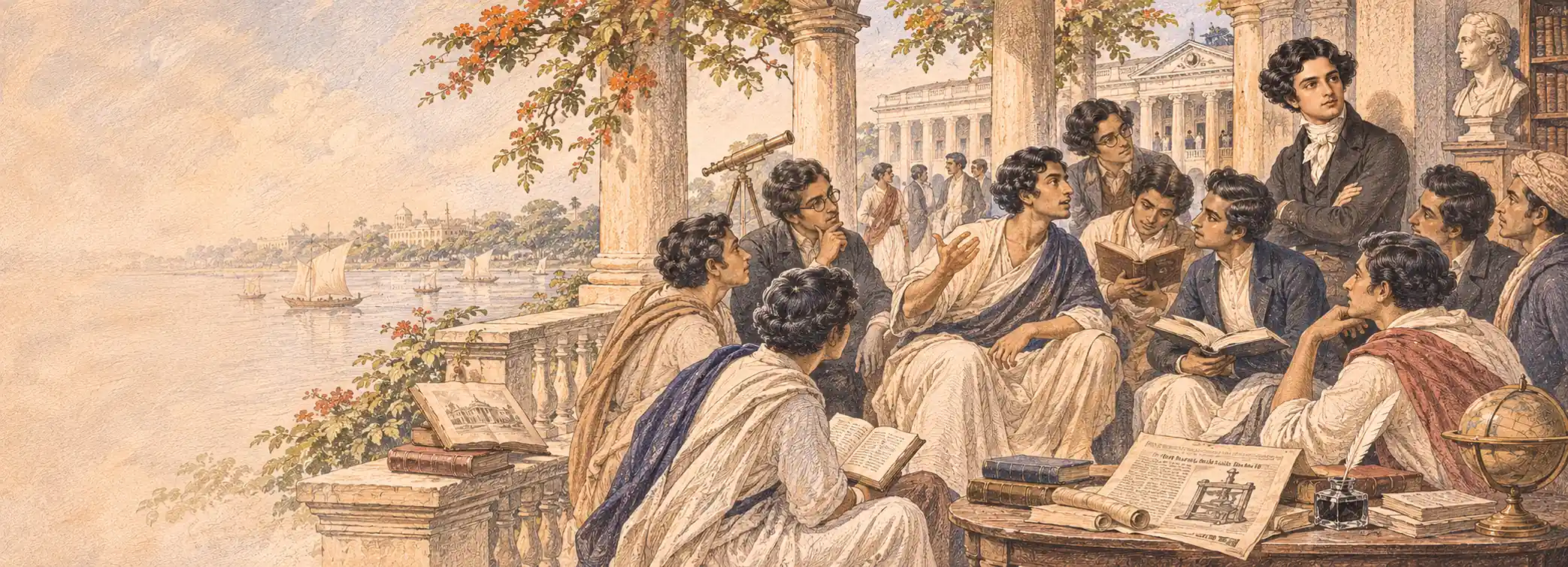
Young Indians of the early nineteenth century read Shakespeare, Milton and Byron. They also read aloud a poem by an Englishman about an Indian coin, John Leyden's Ode to an Indian Gold Coin. K. R. Srinivasa Iyengar says that these readers began to ask a bold question. If an Indian could read English and speak it in public, could he not write it as well?
This article covers the years from 1794 to 1857. The first date is the year of Dean Mahomet's Travels, the book that is usually called the first one written in English by an Indian. The second is the year of the great revolt against Company rule, and also the year the first Indian universities were founded. Historians draw such lines in different places, so both dates are working boundaries.
The article first describes the world of these years, and then the writing that grew out of it. Every hard term is explained where it first appears.
The world of this period
Political life
In these years the East India Company still ruled large parts of India, though its role was changing. From 1834 it no longer traded and acted as a managing agency for the British government. Lord William Bentinck, who accepted Macaulay's policy on education in 1835, had been Governor-General since 1828. Iyengar says that by the end of the eighteenth century the old quarrels between Indian rulers were over. The country was at peace, though under what he calls the dubious shadow of foreign rule.
The period closed with the revolt of 1857, which British writers called the Mutiny. After it the Company lost even its role as a managing agency. For the writers of this article the revolt is an end point, and the next article begins with the world that followed it.
Social life
Two groups of English speakers lived side by side in the cities. The first was the English in India. Iyengar writes that, in the India of over a century before his time, an Englishman tried to speak the local language when he dealt with the public, because few Indians knew English. At home or at the club he spoke English, read English books and wrote English letters. Books from England came only rarely and were luxuries. Many Englishmen therefore started writing to the press and publishing books of their own, in prose and verse, for readers in India and in Britain.
The second group was the small body of educated Indians. They had become accustomed to talk in English in public and to use their mother tongue at home. Iyengar says that such a man was becoming semi-English in his habits.
Social reform was the great public cause of these years. Sati was the practice in which a widow was burned on her husband's funeral pyre. Rammohan Roy campaigned against it. In 1829 the Sati Regulation, passed under Governor-General Bentinck, made the practice illegal and punishable. The students of the Hindu College at Calcutta, who came to be known as Young Bengal, later became prominent in social reform, law and journalism.
Economic life
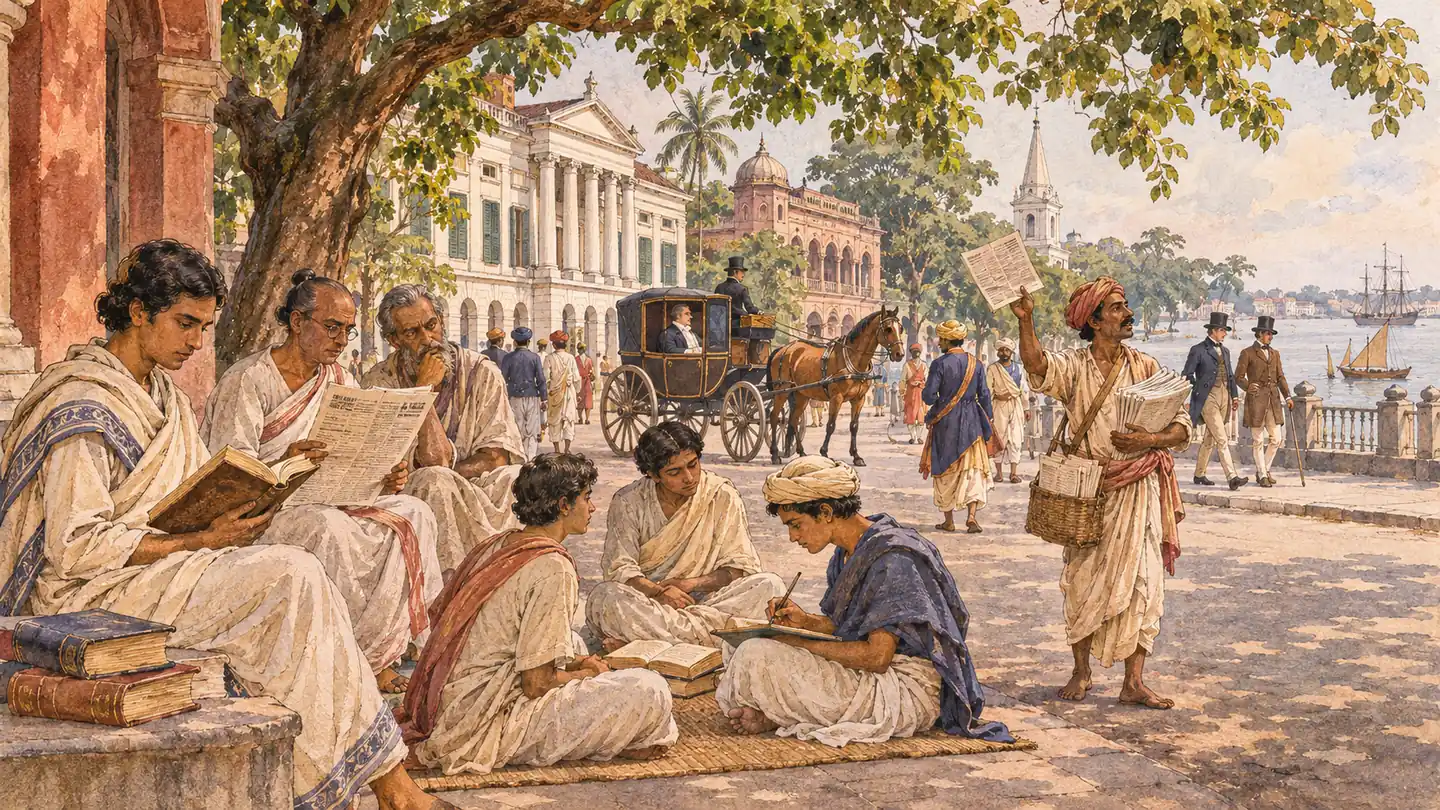
The English education described in the first article had a practical purpose. It was meant mainly to train clerks and officials for the Company's government. Iyengar says that the young men who left the new schools were expected to join government service as clerks or to return to their villages.
Careers of the time show the same pattern. Rammohan Roy worked on and off for the Company from about 1805 to 1815. Henry Derozio, at the age of fourteen, entered a firm of merchants at Calcutta, Messrs. James, Scott and Company, and was soon sent to Bhagalpur. Dean Mahomet had begun as a boy in the service of an officer in the Company's army.
Schools, colleges and the press
The Hindu College, which opened in 1817, was the most important school for the new writers. Derozio taught there as a very young man. Kasi Prasad Ghose, an early poet, graduated from it in 1828.
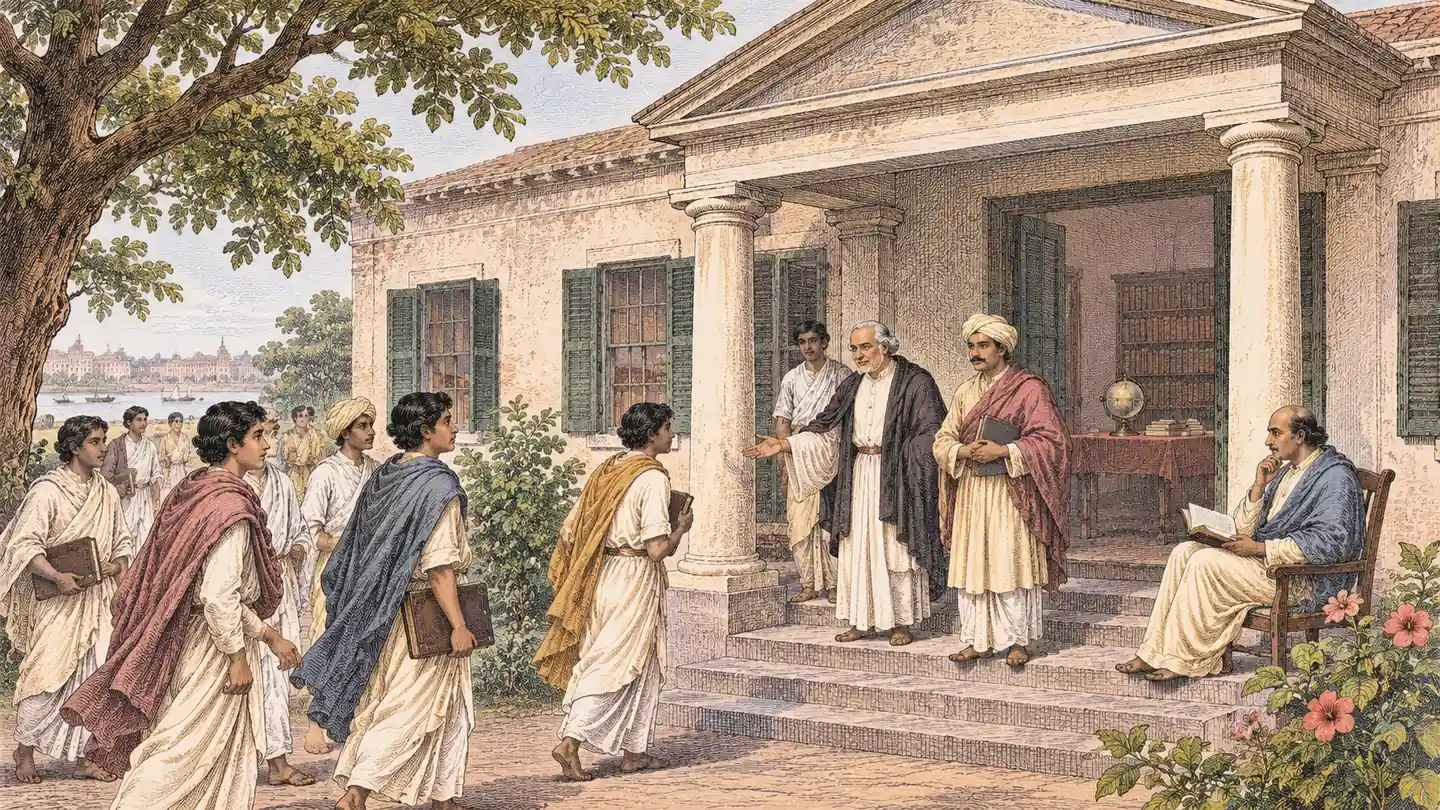
The government's next great step on education was the Dispatch of 1854. It was an official letter on education written by Sir Charles Wood. It led to a separate education department in each province and a system of grants-in-aid, which were government payments to schools. It also led to the founding of the universities of Calcutta, Bombay and Madras in 1857. Iyengar says the universities led to a gradual spread of education, and that the next two or three decades produced a new class of educated readers.
The press grew more slowly. Iyengar writes that the first newspaper run by Indians was started only in 1818. English journalists in India had already done the early work, and Rammohan Roy supported the new Indian papers. He founded a Bengali journal, Sambad Kaumudi. Iyengar says that restrictions on the press were removed in the 1830s, and that Indian journalism then went well under way. Even so, most Indian newspapers lived a hand-to-mouth life, short of funds, readers and staff.
Religion
Rammohan Roy was the leading religious reformer. Iyengar says that he found Hindu society decadent and that many customs seemed to him abhorrent. He responded to the message of Christ, and in 1820 he published The Precepts of Jesus, the Guide to Peace and Happiness. Iyengar writes that Rammohan wished to draw a form of theism, the belief in one God, out of Hinduism by removing practices he thought questionable. In 1826 he founded the Vedanta College, and in 1828 he founded the Brahmo Samaj, first called the Brahmo Sabha. It taught belief in one God and rejected the worship of idols.
Religion also decided the career of Derozio. In 1828 his students at the Hindu College founded the Academic Association, a debating society on religion and philosophy. Both Britons and Indians took part. In 1831 orthodox Hindu parents accused Derozio of irreverence, and he was forced to resign. Missionaries, whom the first article described, kept working through their schools during the same years.
Did you know?
Dean Mahomet, the author of the first book in English by an Indian, moved to London in 1807. There he opened what seems to have been the first Indian restaurant in that city. He later worked as a shampooing surgeon and barber in London and Brighton. In 1822 he published a short tract on the benefits of shampooing.
Important points to remember
- The East India Company acted as a managing agency for the British government from 1834.
- Lord William Bentinck was Governor-General from 1828.
- The Sati Regulation of 1829 made sati illegal and punishable.
- The Hindu College at Calcutta opened in 1817.
- Sir Charles Wood wrote the Dispatch of 1854 on education.
- The universities of Calcutta, Bombay and Madras were founded in 1857.
- The first newspaper run by Indians was started in 1818, according to Iyengar.
- Rammohan Roy founded the Vedanta College in 1826 and the Brahmo Samaj in 1828.
- Derozio's students founded the Academic Association in 1828.
- Derozio resigned from the Hindu College in 1831 after a charge of irreverence.
Literature in this period
The language and the readers
Iyengar explains why Indians began to write English in the first place. The educated Indian could read the language and speak it. There were models he could copy. Iyengar names Sir William Jones, John Leyden, Meredith Parker and David Lester Richardson. He also names the great poets of the British Romantic Revival, the group of English poets who wrote in the years around 1800. Anything the Indian wrote was also sure of readers, namely the Englishmen in India and his educated fellow Indians. Iyengar uses the word Indo-Anglian for an Indian who writes in English. In his words, this is how the earliest Indo-Anglian poets argued in the depths of their being and bravely asked the English muse for help.
The first writing, as the introduction showed, was in prose. Poetry came soon after, in the late 1820s and the 1830s. This article follows the prose first and then the poetry.
The Anglo-Indian models
Iyengar uses the word Anglo-Indian for Englishmen who lived in India and wrote about it. He writes that many of them published packets of meritorious English verse on Indian themes. He names Sir William Jones, John Leyden, Bishop Heber, Haldane Rattray, David Lester Richardson, Meredith Parker and Calder Campbell. Fiction and drama were attempted as well. Leyden's Ode to an Indian Gold Coin was the poem that young Indians read aloud.
These writers mattered to the new Indian poets for a simple reason. They showed that English verse could take India as its subject. The Indian poets of this age mostly copied the forms of English poetry, and they added feelings and subjects of their own.
Prose: Dean Mahomet and Rammohan Roy
Dean Mahomet was born in 1759 at Patna, in what is now Bihar. At the age of eleven he joined the service of an Anglo-Irish officer in the army of the East India Company, and he campaigned in Bengal. In 1787 he went with the officer to Ireland. He lived in Cork for about twenty years, married there and became a Christian. His Travels was printed in Cork in 1794. It is an account of his life in India, and the University of California Press calls it an autobiographical travel narrative, which means a book that tells the story of a journey. He moved to London in 1807 and died in 1851, little known by then.
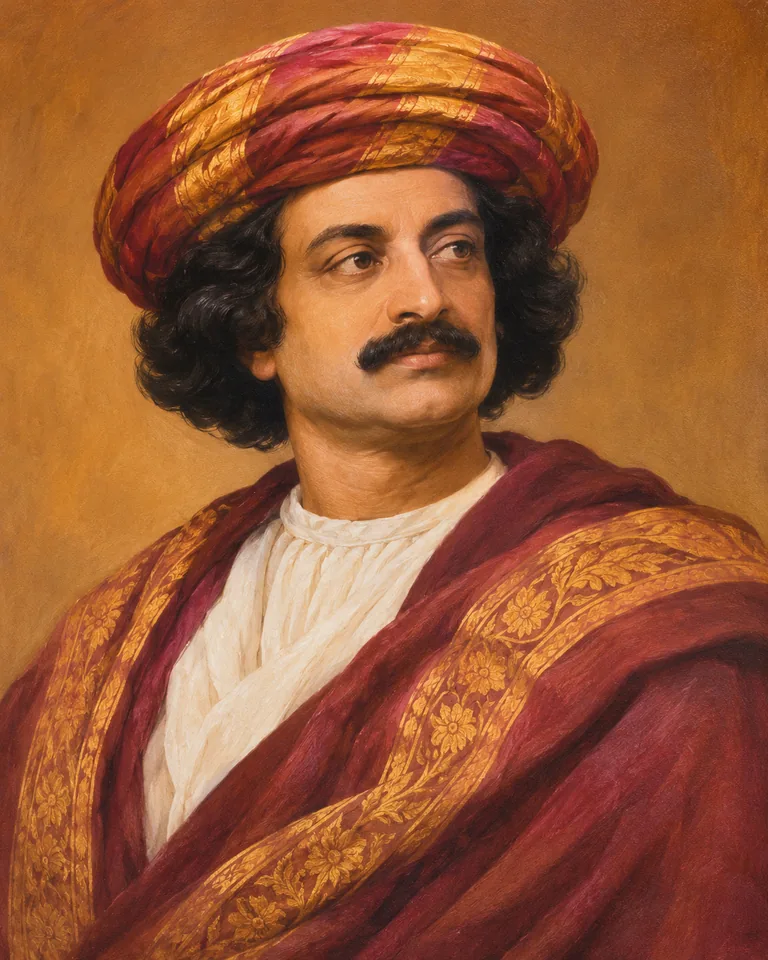
Raja Rammohan Roy was born on 22 May 1772 at Radhanagar in Bengal. He knew Sanskrit, Persian, Arabic, English, Bengali and Hindi. Iyengar says that he did pioneering work in Bengali prose and that he was also a master of effective English prose. He wrote in English when he wished to reach readers across India, or the rulers in Britain.
His English books show what he cared about. In 1820 he published The Precepts of Jesus, the Guide to Peace and Happiness. Iyengar says that Rammohan had read the Gospels again and again and found in them what he had been too hasty to find in Hinduism. Rammohan wrote that he found the doctrines of Christ more favourable to moral principles, and better suited to rational beings, than any other he knew. In 1822 he published a short work on the rights of women under the Hindu law of inheritance. In 1832 he published a study of the courts and the revenue system of India and of the condition of its people. He also wrote many papers and pamphlets on almost every side of national life. Rammohan went to England to press for reforms in India, and he died at Bristol on 27 September 1833.
Iyengar's verdict is clear. Rammohan was sincere, hard-working and perhaps too sure of his own positions, but in a pioneer this was a merit. He met the Englishman on equal terms. He forced the Englishman to admit that even a so-called native could be first-rate in character and in mind. The first article named other early books, such as the travel books of P. Rajagopaul and Mohan Lal and the study of Muslims by Hasan Ali. They belong to the same years, and Iyengar thought them small in value.
Poetry
Iyengar calls Henry Derozio one of the first Indian poets in English, and the best of them. His contemporary Kasi Prasad Ghose published The Shair and Other Poems, which Iyengar dates to 1830. Ghose studied at the Hindu College and later edited a weekly newspaper. Iyengar lists two other poets of these years. Sashichandra Dutt published Miscellaneous Verses in 1848, and Harachandra Dutt published Fugitive Pieces in 1851.
Henry Louis Vivian Derozio was born at Calcutta on 18 April 1809. His father was Portuguese and his mother was Indian. At fourteen he entered the merchants' firm of James, Scott and Company. He was sent to Bhagalpur, where, as Iyengar tells it, he suddenly found that he was a poet. His early pieces drew the notice of Dr. John Grant and others who counted in Calcutta. While still in his teens he became a teacher of English at the Hindu College, and Iyengar calls him one of the earliest teachers of English in the country. He was an example and an inspiration to his pupils. One sonnet, a short poem of fourteen lines, was written to them. It begins "Expanding like the petals of young flowers" and goes on to watch the gentle opening of their minds.
Derozio's books were published in his short career. He brought out Poems in 1827. In 1828 he published The Fakeer of Jungheera, a Metrical Tale and Other Poems at Calcutta. A metrical tale is a long story told in verse. The poem was dedicated to Horace Hayman Wilson, the Secretary of the Asiatic Society at Calcutta, which Sir William Jones had founded. Iyengar calls it Derozio's most ambitious work. Its heroine is Nuleeni, a Brahmin widow who escapes sati at the last moment when a robber-chief carries her away. She later loses him, clasps his dead body, and finds her peace in death.
Iyengar finds many Byronic echoes in the poem, meaning that it follows the manner of Lord Byron, the English Romantic poet. He says that the language reminds a reader of Byron and Thomas Moore. He also says that the love of country, the passion for social reform and the tender and brave humanity in Derozio's verse are entirely his own. In a patriotic sonnet Derozio asks where the glory and the reverence of India's past have gone. He says that he will dive into the depths of time to bring back a few fragments, and that he wants one kind word for his fallen country. Iyengar adds that Derozio has been called, not inaptly, the National Bard of modern India.
The end of his life came quickly. After he left the Hindu College he turned to journalism and edited a paper called The East Indian. He died of cholera at Calcutta in December 1831, aged twenty-two. His tomb is in the South Park Street burial-ground in the city.
The next outstanding name in the story of Indo-Anglian poetry, in Iyengar's phrase, is Michael Madhusudan Dutt. He was born on 25 January 1824 at Sagardari in Bengal. In 1843 he became a Christian, and he took the name Michael. His family was upset and his father cut off his money. He moved to Madras, where he taught in schools and edited newspapers. Iyengar says that he married a European lady, qualified for the bar in England and tried to make a living as a lawyer. His career was uneven, and he died in a Calcutta hospital on 29 June 1873.
His best-known English work is The Captive Ladie, which came out in 1849 under the pen name Timothy Penpoem. A pen name is a name that a writer uses in place of his own. The poem is a long metrical romance, a story of love and adventure told in verse. It tells the story of Prithvi Raj, the Rajput king of Delhi, and it won general approval for its Byronic fluency and gusto. Another English poem, Visions of the Past, is written in blank verse, which is verse without rhyme. In his later years Dutt wrote mainly in Bengali, and his fame rests on his Bengali epic Meghnad Badh Kavya. Its English rendering appeared in 1879. His later English work includes a farce, a short comic play, called Is This Called Civilization? (1871).
Iyengar writes that Dutt was a great inspiration to later poets. Nabokissen Ghose, who wrote as Ram Sharma, wrote an In Memoriam piece for him. Sri Aurobindo wrote a commemoration ode on him.
An interesting story
In 1828 the students of the Hindu College at Calcutta founded the Academic Association, a debating society on religion and philosophy. Both Britons and Indians came to its meetings. Their teacher was Henry Derozio, who was then about nineteen. His pupils later became known as Young Bengal. In 1831 orthodox Hindu parents accused him of irreverence, and he was forced to resign from the college. He turned to journalism and edited a paper, The East Indian. Before the year ended he was dead of cholera at the age of twenty-two. His tomb is in the South Park Street burial-ground at Calcutta.
Key terms
- Anglo-Indian - in Iyengar's usage, an Englishman who lived in India and wrote about it.
- Indo-Anglian - Iyengar's term for an Indian who writes in English.
- Romantic Revival - the group of English poets who wrote in the years around 1800, such as Byron.
- Byronic - in the manner of Lord Byron, with fluency, energy and strong feeling.
- Metrical tale - a long story told in verse; Derozio's The Fakeer of Jungheera is one.
- Metrical romance - a long verse story of love and adventure; Dutt's The Captive Ladie is one.
- Blank verse - verse without rhyme, used by Dutt in Visions of the Past.
- Sonnet - a short poem of fourteen lines, a form Derozio used.
- Pen name - a name a writer uses in place of his own, such as Timothy Penpoem.
- Young Bengal - the name for the students of Derozio at the Hindu College.
- Academic Association - the debating society his students founded in 1828.
- Brahmo Samaj - the religious society founded by Rammohan Roy in 1828, first called the Brahmo Sabha.
- Sati - the practice in which a widow was burned on her husband's funeral pyre.
- Dispatch of 1854 - Sir Charles Wood's official letter on education, which led to the universities of 1857.
- Grants-in-aid - government payments to schools.
- Hindu College - the Calcutta college opened in 1817, where Derozio taught.
- Farce - a short comic play, such as Dutt's Is This Called Civilization?.
- Travel narrative - a book that tells the story of a journey, such as Dean Mahomet's Travels.
Criticism and scholarship
The main early account of these writers is Iyengar's The Indian Contribution to English Literature (1945). He calls Derozio one of the first of the Indian poets in English, and the best of them. He says that Derozio is chiefly to be admired for the great promise in his published work. He compares Derozio with Keats and Chatterton, and also with Aru Dutt and Toru Dutt, who died young. Iyengar finds Derozio's technique mostly derivative and his language close to Byron and Moore. Yet he judges that the love of country, the zeal for reform and the humanity were Derozio's own.
On Rammohan Roy, Iyengar writes that his strong personality shows in his many English prose writings, and that for this reason his countrymen will always treasure them. On Dutt, Iyengar says that The Captive Ladie won general approval and that Dutt became an inspiration to later poets. Sri Aurobindo's ode on Dutt is a poet's tribute to him.
For Dean Mahomet, the modern work is an edition of the Travels by Michael H. Fisher, published by the University of California Press in 1997. The edition places the book in the life of its author, with a section on his youth in Bihar from 1759 to 1769.
Important points to remember
- Iyengar names Sir William Jones, Leyden, Heber, Richardson and Parker among the Anglo-Indian poets.
- Leyden's Ode to an Indian Gold Coin was read aloud by young Indians.
- Dean Mahomet's Travels was printed in Cork in 1794.
- Rammohan Roy published The Precepts of Jesus, the Guide to Peace and Happiness in 1820.
- Rammohan Roy died at Bristol on 27 September 1833.
- Kasi Prasad Ghose's The Shair and Other Poems is dated 1830 by Iyengar.
- Derozio published The Fakeer of Jungheera at Calcutta in 1828.
- Derozio died of cholera in December 1831 at the age of twenty-two.
- Michael Madhusudan Dutt published The Captive Ladie in 1849 under the pen name Timothy Penpoem.
- Dutt's later fame rests on his Bengali epic Meghnad Badh Kavya.
How the period ends
The year 1857 closed the period in two ways. The revolt against Company rule broke out, and afterwards the Company lost even its role as a managing agency. In the same year the universities of Calcutta, Bombay and Madras were founded, which carried out the plan of the Dispatch of 1854. Iyengar says that the universities began a slow spread of education, and that the next two or three decades brought a new class of educated readers.
The pioneers of this article had mostly gone by then. Derozio had died in 1831 and Rammohan Roy in 1833, and Dean Mahomet died in obscurity in 1851. Michael Madhusudan Dutt had turned from English to Bengali, reluctantly according to Encyclopaedia Britannica. His main Bengali works were written between 1858 and 1862, and they include Sarmistha in 1859, which Encyclopaedia Britannica calls the first Bengali play, and Meghnad Badh Kavya in 1861. These works lie outside this article.
The next article begins with the world after 1857 and with writers who grew up once the universities had been founded. Toru Dutt, Sri Aurobindo, Rabindranath Tagore and Sarojini Naidu belong to it.
Important points to remember
- The revolt of 1857 was followed by the end of the Company's role as a managing agency.
- The universities of Calcutta, Bombay and Madras were founded in 1857.
- Iyengar says the universities produced a new class of educated readers.
- Derozio died in 1831 and Rammohan Roy in 1833.
- Dean Mahomet died in obscurity in 1851.
- Dutt's main Bengali works were written between 1858 and 1862.
- Encyclopaedia Britannica calls Sarmistha of 1859 the first Bengali play.
- Meghnad Badh Kavya appeared in 1861.
Writers and works
| Writer | Dates | Main works | Remembered for |
|---|---|---|---|
| Dean Mahomet | 1759-c. 1851 | The Travels of Dean Mahomet (1794) | A travel narrative usually called the first work in English by an Indian author |
| Raja Rammohan Roy | 1772-1833 | The Precepts of Jesus, the Guide to Peace and Happiness (1820); Brief Remarks regarding Modern Encroachments on the Ancient Rights of Females according to the Hindu Law of Inheritance (1822); Exposition of the Practical Operation of the Judicial and Revenue Systems of India (1832) | Master of early English prose, and founder of the Brahmo Samaj |
| Kasi Prasad Ghose | 1809-1873 | The Shair and Other Poems (1830, as dated by Iyengar) | An early poet in English and a newspaper editor |
| Henry Derozio | 1809-1831 | Poems (1827); The Fakeer of Jungheera, a Metrical Tale and Other Poems (1828) | A young poet and teacher whose pupils were called Young Bengal |
| Michael Madhusudan Dutt | 1824-1873 | The Captive Ladie (1849); Visions of the Past; Is This Called Civilization? (1871) | A poet who began in English and became a great Bengali poet |
Quick revision - 50 points
Open the 50 pointsClose the list
- Young Indians read aloud John Leyden's Ode to an Indian Gold Coin.
- Iyengar says educated Indians used English in public and their mother tongue at home.
- Dean Mahomet's Travels of 1794 is usually called the first book in English by an Indian.
- From 1834 the Company acted as a managing agency for the British government.
- Lord William Bentinck was Governor-General from 1828.
- British writers called the revolt of 1857 the Mutiny.
- The Sati Regulation of 1829 made sati illegal and punishable.
- Derozio's students became known as Young Bengal.
- Rammohan Roy worked on and off for the Company from about 1805 to 1815.
- Derozio entered the merchants' firm of James, Scott and Company at the age of fourteen.
- The Hindu College at Calcutta opened in 1817.
- Kasi Prasad Ghose graduated from the Hindu College in 1828.
- Sir Charles Wood wrote the Dispatch of 1854.
- The Dispatch led to grants-in-aid and an education department in each province.
- The universities of Calcutta, Bombay and Madras were founded in 1857.
- Iyengar says the first newspaper run by Indians was started in 1818.
- Rammohan Roy founded a Bengali journal, Sambad Kaumudi.
- Rammohan Roy founded the Vedanta College in 1826.
- Rammohan Roy founded the Brahmo Samaj in 1828, and it was first called the Brahmo Sabha.
- Derozio's students founded the Academic Association in 1828.
- Derozio resigned in 1831 after orthodox parents accused him of irreverence.
- Dean Mahomet moved to London in 1807 and opened what seems to have been the first Indian restaurant there.
- Iyengar names Jones, Leyden, Parker and Richardson as models for the first Indian poets.
- Dean Mahomet was born in 1759 at Patna.
- Mahomet joined the service of an Anglo-Irish officer at the age of eleven.
- Mahomet went to Ireland in 1787 and lived in Cork for about twenty years.
- Dean Mahomet died in 1851.
- Rammohan Roy was born on 22 May 1772 at Radhanagar.
- Rammohan Roy knew Sanskrit, Persian, Arabic, English, Bengali and Hindi.
- Rammohan Roy published The Precepts of Jesus, the Guide to Peace and Happiness in 1820.
- In 1832 Rammohan Roy published a study of the judicial and revenue systems of India.
- Rammohan Roy died at Bristol on 27 September 1833.
- Iyengar says Rammohan Roy met the Englishman on equal terms.
- Iyengar dates Kasi Prasad Ghose's The Shair and Other Poems to 1830.
- Sashichandra Dutt published Miscellaneous Verses in 1848.
- Derozio was born at Calcutta on 18 April 1809, with a Portuguese father and an Indian mother.
- Derozio found at Bhagalpur that he was a poet.
- Derozio published Poems in 1827.
- The Fakeer of Jungheera of 1828 was dedicated to Horace Hayman Wilson.
- The heroine of The Fakeer of Jungheera is Nuleeni, a Brahmin widow who escapes sati.
- Iyengar finds Byronic echoes in The Fakeer of Jungheera.
- Derozio edited a paper called The East Indian.
- Derozio died of cholera in December 1831, aged twenty-two.
- Michael Madhusudan Dutt was born on 25 January 1824 at Sagardari.
- Dutt became a Christian in 1843 and moved to Madras.
- The Captive Ladie of 1849 appeared under the pen name Timothy Penpoem.
- The Captive Ladie tells the story of Prithvi Raj, the Rajput king of Delhi.
- Dutt's Visions of the Past is written in blank verse.
- Dutt's Bengali epic Meghnad Badh Kavya appeared in 1861.
- Encyclopaedia Britannica calls Sarmistha of 1859 the first Bengali play.
Quick quiz - 25 questions
Tap an answer to see at once if it is right. You do not need to log in.
Open the 25 questionsClose the quiz
1In which year did Dean Mahomet's Travels appear?
Answer: C. The book was printed in Cork in 1794.
2Whose Ode to an Indian Gold Coin did young Indians read aloud?
Answer: A. Young Indians read Leyden's poem aloud.
3In which year were the universities of Calcutta, Bombay and Madras founded?
Answer: D. They were founded in 1857, after the Dispatch of 1854.
4Who wrote the Dispatch of 1854 on education?
Answer: B. Sir Charles Wood wrote the Dispatch, which led to the universities.
5What was the Brahmo Samaj first called?
Answer: A. Rammohan Roy founded it in 1828 under the name Brahmo Sabha.
6Who was Governor-General when the Sati Regulation of 1829 was passed?
Answer: C. Bentinck had been Governor-General since 1828.
7What did the students of Derozio found in 1828?
Answer: B. It was a debating society on religion and philosophy.
8Which poem by Derozio tells of Nuleeni, a Brahmin widow who escapes sati?
Answer: D. It is a metrical tale published at Calcutta in 1828.
9In which city did Dean Mahomet live for about twenty years after 1787?
Answer: A. He went to Ireland with an Anglo-Irish officer in 1787.
10Under what pen name did Michael Madhusudan Dutt publish The Captive Ladie?
Answer: C. Dutt published The Captive Ladie in 1849 under this pen name.
11Of which king does The Captive Ladie tell the story?
Answer: D. Prithvi Raj was the Rajput king of Delhi.
12What did Derozio edit after he left the Hindu College?
Answer: B. He turned to journalism after his resignation.
13In which month and year did Derozio die?
Answer: C. He died of cholera at the age of twenty-two.
14Which Bengali journal did Rammohan Roy found?
Answer: A. Rammohan Roy founded this Bengali journal and supported the new Indian papers.
15To whom was The Fakeer of Jungheera dedicated?
Answer: D. Wilson was the Secretary of the Asiatic Society at Calcutta.
16Which two poets does Iyengar say Derozio's language recalls?
Answer: B. Iyengar says the language of the poems reminds a reader of Byron and Thomas Moore.
17Which Dutt published Miscellaneous Verses in 1848?
Answer: C. Harachandra Dutt published Fugitive Pieces in 1851.
18Which of these did the Dispatch of 1854 lead to?
Answer: A. It also led to the universities of 1857.
19Where was Dean Mahomet born?
Answer: D. He was born in 1759 at Patna, in what is now Bihar.
20At what age did Derozio enter the merchants' firm of James, Scott and Company?
Answer: B. He was soon sent to Bhagalpur, where he found he was a poet.
21Which book by Rammohan Roy appeared in 1820?
Answer: C. The other two works came in 1822 and 1832.
22In which year did Michael Madhusudan Dutt become a Christian?
Answer: D. He then took the name Michael and moved to Madras.
23Which work of Michael Madhusudan Dutt does Encyclopaedia Britannica call the first Bengali play?
Answer: A. Dutt wrote this play in 1859, just after the period of this article had closed.
24Where did Rammohan Roy die?
Answer: B. He died at Bristol on 27 September 1833.
25According to Iyengar, when was the first newspaper run by Indians started?
Answer: C. Iyengar writes that the first newspaper run by Indians was started only in 1818.
Frequently asked questions
When did Indian English literature begin?
The usual starting point is Dean Mahomet's Travels, printed in Cork in 1794 and usually called the first book in English by an Indian. K. R. Srinivasa Iyengar starts his survey of 1945 with Raja Rammohan Roy, and he says that the earliest writings of Indians in English were in prose. Poetry followed, and Derozio published The Fakeer of Jungheera in 1828.
Who was Henry Derozio?
Henry Louis Vivian Derozio was born at Calcutta on 18 April 1809, and his father was Portuguese and his mother Indian. He taught English at the Hindu College, and his students were later called Young Bengal. He published The Fakeer of Jungheera in 1828 and died of cholera in December 1831, at the age of twenty-two.
Who were the first Indian poets in English?
Iyengar calls Derozio one of the first of these poets and the best of them. Kasi Prasad Ghose, whose The Shair and Other Poems Iyengar dates to 1830, was his contemporary. After Derozio, Iyengar names Michael Madhusudan Dutt as the next outstanding name.
What did Rammohan Roy contribute to Indian English writing?
Rammohan Roy wrote English prose on religion, the rights of women and the law, including The Precepts of Jesus in 1820. Iyengar calls him a master of effective English prose. He also founded the Bengali journal Sambad Kaumudi and the Brahmo Samaj.
Did Michael Madhusudan Dutt write in English or in Bengali?
He wrote in both. His English poem The Captive Ladie appeared in 1849 under the pen name Timothy Penpoem. Later he turned to Bengali, and his main Bengali works, including Meghnad Badh Kavya of 1861, were written between 1858 and 1862.
What was the Dispatch of 1854?
It was an official letter on education written by Sir Charles Wood. It led to a separate education department in each province, a system of grants-in-aid and the founding of the universities of Calcutta, Bombay and Madras in 1857.
Sources
- K. R. Srinivasa Iyengar, The Indian Contribution to English Literature, Karnatak Publishing House, 1945.
- Michael H. Fisher (ed.), The Travels of Dean Mahomet: An Eighteenth-Century Journey through India, University of California Press, 1997.
- Encyclopaedia Britannica, entries "Henry Louis Vivian Derozio", "Michael Madhusudan Dutt", "Ram Mohan Roy", "Dispatch of 1854" and "East India Company".
- Britannica Kids, entries "Indian Renaissance" and "Rammohan Ray".
- Amardeep Singh (ed.), Collected Poems of Henry Derozio, preface by Manu Samriti Chander, online edition, Lehigh University.
- Representative Poetry Online, University of Toronto Libraries, entry on Kasiprasad Ghose.
- JSTOR Daily, article on Dean Mahomet.
- Fordham University, Internet Modern History Sourcebook, "Lord William Bentinck on the Suppression of Sati, 8 November 1829".
Afsar Khan, Ph.D. English
Test your knowledge
Check what you have learned with quizzes and MCQs.