

On this page
In 1855, Walt Whitman published the first edition of Leaves of Grass. Its daring voice treated ordinary bodies, working people and the American landscape as subjects worthy of poetry. Only a few years earlier, other writers had produced novels about hidden guilt, dangerous ambition and the struggle against slavery. This variety helps explain why the period is called the American Renaissance.
The American Renaissance is studied here from 1830 to 1865, a useful teaching range rather than an exact beginning and ending of a literary movement. Much of its most famous writing appeared between 1850 and 1855. Its authors lived in a growing country whose democratic ideals stood beside slavery, dispossession, restricted rights and deep social conflict.
To understand the literature, we first need its political, social, economic and religious background. We can then follow its major forms: Transcendentalist essays, dark romance, Gothic tales, democratic poetry, women's writing and antislavery narratives. These forms did not give one simple answer to the meaning of American freedom.
The world of this period
Political life
The United States grew in population and territory during these decades. Yet expansion brought severe conflict over land, citizenship and slavery. The Indian Removal Act of 1830 authorized a federal policy that forced many Native peoples from their homelands. Such dispossession challenges any account that presents national expansion only as progress. Native communities remained politically and culturally active despite the pressure placed upon them.
The question of slavery divided public life. Enslaved African Americans worked under a legal system that treated people as property, while antislavery activists demanded change. Newspapers, speeches, petitions and personal narratives turned political arguments into public debates. Frederick Douglass's testimony became especially important because it directly challenged the claims made by defenders of slavery. Literature was not separate from politics; it was one of the places where politics happened.
The Mexican-American War of 1846-1848 sharpened arguments about territorial expansion and the possible extension of slavery. The Fugitive Slave Act of 1850 placed greater federal power behind the return of people who had escaped enslavement. It also brought the moral question into Northern communities, where residents faced demands to cooperate with the system. Harriet Beecher Stowe's antislavery fiction gained force from this setting.
The movement for women's rights also took a more organized public form. In July 1848, a convention at Seneca Falls, New York, issued the Declaration of Sentiments, which called attention to women's unequal legal and political position. Margaret Fuller's earlier writing had already argued for women's intellectual and personal independence. These reform campaigns were connected, although their members did not always agree about priorities or methods.
The Civil War began in 1861 and ended in 1865. In 1863, the Emancipation Proclamation changed the war's declared purpose and declared freedom for enslaved people in areas still in rebellion, within its stated limits. The Thirteenth Amendment, ratified in December 1865, abolished slavery except as punishment for crime. The ending of the war did not remove racial inequality or settle the meaning of citizenship. These unresolved questions would shape the next period of American writing.
Social life
American society was changing rapidly. Cities expanded, migration continued and more people encountered the ideas of strangers through schools, lectures and print. Literacy and access to education were unequal, but books and periodicals reached a wider reading public. This growth encouraged the essay, short story, newspaper serial and inexpensive book. Writers learned to speak to readers outside small educated circles.
At the same time, family and gender expectations placed many women within a narrow domestic ideal. The ideology of separate spheres imagined public action as chiefly masculine and home life as chiefly feminine. Actual lives were more complex, especially for working women, enslaved women and reformers. Margaret Fuller resisted the assumption that intellectual development belonged mainly to men. Her writing asks who has the freedom to become an independent person.
Abolitionism, the organized effort to end slavery, developed through Black and white activists, many religious communities and independent organizations. People who had experienced enslavement published autobiographical accounts that exposed its violence and its attack on family, learning and identity. Such accounts were often called slave narratives. Douglass and Harriet Jacobs used first-person storytelling to assert knowledge that slaveholders tried to deny. Their texts are both literature and historical testimony.
The period also contained utopian experiments, meaning attempts to build communities around a better model of life. Some reformers questioned private ownership, conventional schooling, religious hierarchy or rigid family roles. The Brook Farm community in Massachusetts became one example of a social experiment linked to reform-minded intellectuals. These efforts often faced practical problems. Their importance lies partly in showing how seriously some Americans examined everyday habits.
Social experience therefore shaped literary form. The Gothic tale could represent fears hidden beneath a respectable home. Domestic fiction could make readers feel the moral cost of injustice within a family. A speech or autobiographical narrative could call upon a reader's conscience. A poem could enlarge the imagined community by including people whom elite culture tended to ignore.
Economic life
Agriculture remained central to the economy, but factories, trade and transportation changed daily life. Northern industrial growth created new forms of paid labour, while cotton production in the South depended heavily on enslaved labour. Wealth and economic opportunity were distributed unevenly. The same national marketplace connected people through goods while separating them through unequal power.
Canals and expanding railway networks made travel and trade faster. The telegraph offered even more dramatic speed. In May 1844, Samuel Morse sent a famous message over the line between Washington and Baltimore. Faster communication helped news circulate and made national political events feel closer. Writers could address a larger country, even when they wrote from one town or home.
Commercial publishing also changed the position of the author. Magazine editors needed material, readers expected regular issues and writers tried to earn money from their work. Edgar Allan Poe worked within this competitive periodical culture. Herman Melville's career shows how artistic ambition did not always bring commercial reward. An important distinction emerges: a book's later reputation may be very different from its first reception.
These material changes entered stories and poems. In Melville's “Bartleby, the Scrivener,” an office worker copies legal documents in the commercial world of Wall Street. His repeated refusal unsettles the habits of a business that treats productivity as normal. Thoreau's Walden, by contrast, asks how many possessions and comforts a person really needs. Both texts question the assumption that an efficient economy produces a good life.
Print also made reform literature influential. Stowe's Uncle Tom's Cabin appeared first in an antislavery newspaper before becoming a bestselling book. A serial publication arrives in parts, which allows readers to follow a story over time. The relationship between market success and moral action was complicated, but authors could use popular formats to bring difficult questions before a large audience.
Religion
Protestant Christianity remained powerful in American public and private life. Revival movements emphasized conversion, personal responsibility and moral improvement. The religious energy often called the Second Great Awakening began earlier but helped form the culture of reform that continued into these decades. Some believers treated opposition to slavery as a religious duty. Others defended slavery with religious arguments, revealing the sharp disagreements within American Christianity.
New England Unitarianism encouraged a more liberal approach to doctrine and gave several important writers an intellectual starting point. Ralph Waldo Emerson was once a Unitarian minister. His later ideas placed greater trust in intuition, nature and the individual's spiritual insight. Transcendentalism emerged from this setting, but it was not simply another church. It was a loose movement of philosophical, literary and religious thought.
Transcendentalists argued that human beings could discover truth through direct insight rather than inherited authority alone. They believed nature could lead the mind toward spiritual meaning. Their thinking drew on European Romanticism, German philosophy and religious ideas available through translation, including Asian traditions. Members did not share every doctrine. Some stressed personal cultivation, while others gave increasing attention to slavery and social reform.
Religious language also informed writers who questioned easy optimism. Nathaniel Hawthorne repeatedly explored sin, judgment, hypocrisy and the weight of the Puritan past. In “Young Goodman Brown,” religious certainty becomes painfully unstable. Herman Melville's fiction raises questions about evil, fate and the limits of knowledge. Their works often resist a final moral answer, which is one reason they are associated with dark Romanticism.
Religion cannot therefore be reduced to a single period label. Emerson discovers spiritual possibility in the natural world; Hawthorne investigates the damage caused by harsh moral judgment; Douglass exposes the difference between Christian principles and the conduct of slaveholders. Each writer makes belief a question of lived action, not merely a set of doctrines.
Did you know?
The Transcendentalist journal The Dial appeared from 1840 to 1844. Margaret Fuller edited it first, from 1840 to 1842, before Emerson took over. It published literary criticism, creative writing and some early work by Thoreau.
Important points to remember
- The American Renaissance is studied here within the teaching range 1830-1865.
- The Indian Removal Act became law in 1830.
- The Mexican-American War took place from 1846 to 1848.
- The Fugitive Slave Act of 1850 intensified the national conflict over slavery.
- The Seneca Falls women's rights convention met in July 1848.
- The American Civil War lasted from 1861 to 1865.
- The first major Washington-to-Baltimore telegraph message was sent in 1844.
- The Dial, a Transcendentalist periodical, appeared from 1840 to 1844.
Literature in this period
What makes this an American Renaissance?
A renaissance means a revival or flowering of artistic and intellectual activity. The label does not mean that American literature began in 1830. Colonial, Indigenous, African American and early national writing already had long histories. Rather, the phrase identifies a remarkable concentration of influential nineteenth-century works. The most famous books of the early 1850s made literary independence a central question.
American Romanticism provides a broad background. Romantic writers valued imagination, emotion, individuality and a living relationship with nature. Yet the American version developed in specific historical conditions. It addressed slavery, settlement, religious dissent and a democracy that did not grant equal rights to everyone. Its imaginative freedom could coexist with serious doubts about actual freedom.
It is useful to distinguish several related movements. Transcendentalism trusted individual spiritual insight and often celebrated nature. Dark Romanticism explored guilt, obsession, moral uncertainty and destructive impulses. Gothic writing used disturbing spaces, secrets and psychological fear. These terms overlap, but they are not identical. Poe's Gothic stories, for instance, need not teach Emerson's optimistic view of the self.
Emerson: independence of mind and nature
Ralph Waldo Emerson (1803-1882) helped give the period its philosophical language. His book Nature (1836) presents the natural world as more than scenery. It becomes a way of thinking about the relation between the mind and a larger spiritual reality. Emerson's essays do not offer a simple scientific account of nature. They explore what happens when habitual perception gives way to fresh awareness.
In “The American Scholar” (1837), first delivered as an address, Emerson calls for intellectual independence. Learning should draw upon nature, earlier books and active experience. Books are valuable, but they should not replace personal thought. This concern has a national dimension: American scholarship should not imitate Europe without question. His argument joins the freedom of the mind to the search for a distinct literary voice.
“Self-Reliance” (1841), published in Essays: First Series, argues that people should examine their own judgment instead of surrendering it to social approval. Self-reliance does not simply mean doing everything alone or rejecting all moral duties. It concerns the courage to think and act sincerely. His style uses bold claims, surprising comparisons and shifts in perspective to disturb passive agreement.
Emerson's optimism has limits. Confidence in the individual may overlook differences in power, race and opportunity. Readers should ask who could practice the freedom he described in the society of his time. That question makes his writing more interesting, not less valuable. His essays remain a major point of reference for both supporters and critics of American individualism.
Thoreau: living deliberately and resisting injustice
Henry David Thoreau (1817-1862), associated with Emerson and Concord, tested ideas about freedom in ordinary life. In Walden (1854), he describes a period living near Walden Pond in a small house that he built. His residence began in 1845 and lasted just over two years, although the book reshapes that experience into a carefully organized literary work. It is not a day-by-day diary.
Thoreau asks readers to notice how work, possessions and public expectations control their time. Simplicity in Walden is not merely poverty or escape. It is an experiment in deciding what is necessary. The book mixes descriptions of animals and seasons with humour, argument and close observation. A pond can become both a real environment and a symbol of renewed perception.
His essay “Resistance to Civil Government” (1849), later widely known as “Civil Disobedience,” examines the duty to resist an unjust state. Thoreau had refused to pay a poll tax and was jailed briefly. He opposed slavery and the Mexican-American War. The essay does not claim that every personal preference is more important than law. It asks when obedience would make a person complicit in injustice.
Thoreau is therefore more than a nature writer. His environmental attention and political dissent meet in a shared demand for deliberate action. Where Emerson often sounds like a lecturer inviting intellectual change, Thoreau tests that invitation through practical decisions. Both insist that social customs deserve examination rather than automatic acceptance.
Margaret Fuller: the question of equality
Margaret Fuller (1810-1850) was a major Transcendentalist thinker, editor, journalist and advocate for women's rights. She served as the first editor of The Dial from 1840 to 1842. Its pages helped circulate new philosophical arguments and creative writing. Fuller also organized educational conversations for women, challenging their exclusion from many established intellectual spaces.
Her Woman in the Nineteenth Century (1845) expands an earlier argument first developed in The Dial. It challenges the belief that gender should determine a person's education, vocation or inner development. Fuller connects the ideal of individual growth with the social arrangements that make such growth possible. Her place beside Emerson and Thoreau is essential, not an optional addition to their history.
Fuller's thought also exposes a tension within the period. If every person has a spiritual and intellectual life, why should a society deny women equal opportunity to develop it? Her writing turns a philosophical principle into a demand for institutional change. It helps explain why the Renaissance includes public debate as well as private reflection.
Hawthorne: guilt, symbols and moral ambiguity
Nathaniel Hawthorne (1804-1864) wrote fiction that probes the darker side of moral certainty. His short story “Young Goodman Brown” (1835) follows a young man whose experience in a forest unsettles his trust in his neighbours and his wife, Faith. The story leaves important matters uncertain. Readers must consider whether its central encounter is literal, dreamed or psychologically revealing.
In The Scarlet Letter (1850), set in Puritan New England, Hester Prynne must wear a public sign of punishment after having a child outside marriage. The scarlet letter becomes a symbol, an object that carries several layers of meaning. Hester's conduct challenges the community's simple judgment, while Reverend Dimmesdale's concealed guilt damages him. Hawthorne asks whether a society devoted to morality can become cruel through its methods of correction.
The House of the Seven Gables (1851) traces the shadow of an inherited wrong upon a family and its home. Its old house suggests the continuing power of the past. Hawthorne often uses romance, a form allowing heightened, symbolic or unusual events rather than strict everyday probability. His stories are neither straightforward sermons nor celebrations of evil. They ask how people interpret signs when their knowledge is incomplete.
Hawthorne's fiction also looks back toward Puritan history, but it belongs to the concerns of the nineteenth century. Secrecy, public reputation and inherited privilege mattered in his own society too. His interest in the limits of judgment is a useful contrast to Emerson's confidence in intuition. Both examine the individual conscience, but they differ sharply about how reliable it may be.
Melville: obsession, work and the limits of knowledge
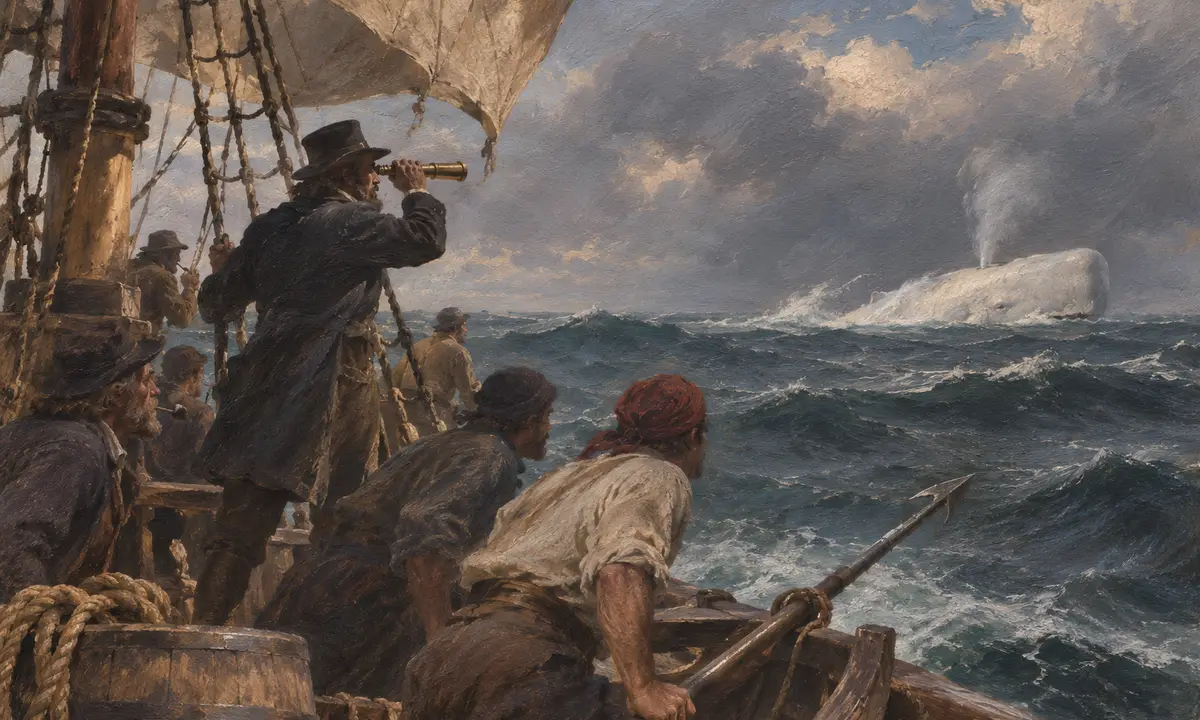
Herman Melville (1819-1891) made moral and philosophical uncertainty central to his fiction. Moby-Dick (1851) tells of Captain Ahab's pursuit of a white whale, narrated mainly through Ishmael. The voyage is an adventure, but it is also an inquiry into obsession and interpretation. Ahab forces the whale to bear the meaning of his anger. Ishmael is more open to multiple explanations, histories and human experiences.
The novel shifts among narrative, dramatic exchanges, sermons and detailed discussions of whaling. This formal variety matters: the world is too large for a single method of understanding it. Ahab's destructive certainty contrasts with Ishmael's curiosity. The whale may suggest nature's vastness, the unknowable, or the limits of human control. No single symbol solves the book's meaning.
“Bartleby, the Scrivener” (1853) moves from the sea to a Wall Street law office. A clerk begins declining tasks, and his employer struggles to understand him. Bartleby's refusal exposes the limits of a workplace organised around obedience and usefulness. The story offers no easy psychological explanation. That uncertainty makes the reader confront the employer's response as well as Bartleby's behaviour.
Melville's Billy Budd was written near the end of his life and first published posthumously in 1924, well beyond this period's dates. The novella's innocent sailor, hostile officer and troubled captain raise questions of justice, law and moral responsibility. It belongs in this writer's study because it continues his concerns, not because it was published before 1865.
Poe: Gothic fear and the craft of effect
Edgar Allan Poe (1809-1849) developed carefully controlled tales of psychological terror and uncertainty. In “The Fall of the House of Usher” (1839), a decaying mansion appears connected to the suffering of the family within it. The setting produces fear even before events can be explained. It is a major example of the Gothic mode, in which atmosphere and hidden disturbance shape the reader's response.
“The Tell-Tale Heart” (1843) is narrated by a speaker who insists upon his sanity while describing murder and growing panic. The conflict between what the narrator claims and what readers infer creates an unreliable narrator. The story's sounds and repetitions make guilt feel almost physically present. Poe does not need a lengthy account of the outside world to create intense psychological drama.
His poem “The Raven” (1845) uses repetition, musical pattern and a grieving speaker to produce an overwhelming mood of loss. In “The Philosophy of Composition” (1846), Poe describes the poem as the result of deliberate artistic choices. That essay is a statement of his literary method; readers need not assume it offers a complete documentary record of every actual decision. His concern with a unified emotional effect influenced later ideas about the short story and modern poetic craft.
Poe's work also shows that the American Renaissance did not have one emotional key. Against Emerson's trust in spiritual possibility, Poe explores minds trapped by fear or compulsive thought. Artistic discipline is shared by both the imaginative essay and the Gothic tale, even when their conclusions are very different.
Whitman and Dickinson: two new poetic voices
Walt Whitman (1819-1892) made poetic form express a broad idea of democracy. The first Leaves of Grass appeared in 1855. Its long, flexible lines move across occupations, bodies and landscapes, using free verse, poetry without a fixed regular metrical pattern. Whitman's inclusive speaker attempts to imagine a connection among different lives. That ambition is powerful, although his poetry must still be read beside the unequal society he inhabited.
The long poem now known as “Song of Myself” was printed without that title in the 1855 edition. It received different names in later editions and reached the familiar title in 1881. Its expanding first-person voice moves between a single person and a larger human community. Repetition and catalogues, or long lists, give the poem movement and scale. Whitman keeps revising the relationship between the individual and the many.
“O Captain! My Captain!” (1865), written in response to Abraham Lincoln's death, takes a more regular and elegiac form. The captain stands for Lincoln, and the completed voyage suggests the Union's survival of the Civil War. The poem first appeared in November 1865. It reminds us that Whitman's style was not confined to free verse. He could also use familiar rhythm and a sustained metaphor for public mourning.
Emily Dickinson (1830-1886), writing largely in Amherst, followed a contrasting path. Her short lyric poems compress thought into abrupt turns, dashes, pauses and unexpected images. They often question death, faith, nature and the possibility of knowing another mind. Her writing is not the opposite of Whitman's simply because it is shorter. Both poets transform the ordinary speaking voice into something formally new.
“Because I could not stop for Death” was probably composed around 1862-1863 and first published in 1890, after Dickinson's death, under the editorial title “The Chariot.” It imagines Death as a courteous carriage companion. The polite manner makes the journey disturbing rather than reassuring. A familiar social scene becomes a way to consider mortality and eternity. The poem's uncertain destination prevents an easy conclusion.
Antislavery writing: Stowe, Douglass and Jacobs
Harriet Beecher Stowe (1811-1896) used sentimental fiction, writing designed to engage readers' feelings, to challenge slavery. Uncle Tom's Cabin was serialized in 1851-1852 and published as a book in 1852. Its scenes of family separation and suffering ask readers to connect domestic affection with political responsibility. The novel had enormous public reach, although modern criticism also examines its racial stereotypes and the limits of its representation.
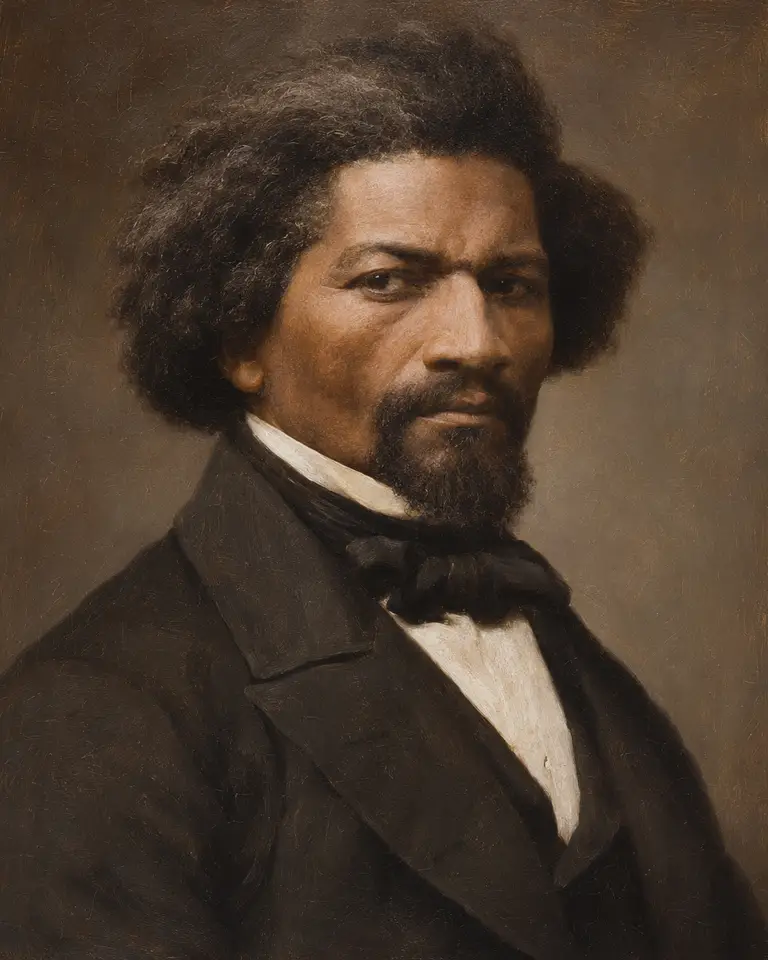
Frederick Douglass (c. 1818-1895) published Narrative of the Life of Frederick Douglass, an American Slave, Written by Himself in 1845. It recounts his experiences of enslavement, struggle for literacy, resistance and escape. The account insists upon Douglass's authority to tell his own life. Learning to read becomes especially significant because access to knowledge is tied to the struggle for freedom.
An autobiographical slave narrative differs from a novel in its claim to document the author's lived experience. It also uses literary methods such as scene, characterization and narrative pacing. A reader should not treat those methods as evidence that the events are invented. The form made personal testimony a means of exposing an unjust legal and social system.
Harriet Jacobs (1813-1897) added an essential perspective in Incidents in the Life of a Slave Girl (1861). She described the particular threats faced by enslaved women and the difficulties of protecting family ties. Her work complements but does not duplicate Douglass's account. Together, these narratives widen the literature of the period beyond a narrow list of white male authors.
An interesting story
In August 1850, a group of friends went hiking on Monument Mountain near Stockbridge, Massachusetts. Among them were Nathaniel Hawthorne and Herman Melville, who met during the outing. A sudden shower sent the party looking for shelter, but the meeting helped begin an important literary friendship. Melville was developing the novel that became Moby-Dick (1851). When it appeared, he dedicated it to Hawthorne, whose dark imagination he admired. The story shows that the American Renaissance was shaped by friendships as well as books. Writers read one another, debated ideas and sometimes found new confidence in the work of a contemporary. Their novels remained very different, yet both examined the hidden and troubling sides of human experience.
Key terms
- American Renaissance - A name for the mid-nineteenth-century flowering of influential American writing.
- American Romanticism - Writing that stresses imagination, individuality, feeling and nature.
- Transcendentalism - A movement that values spiritual insight, self-development and nature.
- Dark Romanticism - Writing that explores human weakness, guilt, fear and moral uncertainty.
- Gothic writing - Literature using disturbing settings, secrets and fear to create unease.
- Abolitionism - The organized movement to end slavery.
- Slave narrative - An account of enslavement written by a person who experienced it.
- Autobiography - A person's account of their own life.
- Sentimental fiction - Fiction that uses emotion and family experience to engage moral questions.
- Serial publication - A work released in successive parts, often in a newspaper or magazine.
- Symbol - An object, action or image carrying meaning beyond its literal presence.
- Romance - Fiction allowing heightened or symbolic events beyond strict realism.
- Unreliable narrator - A storyteller whose account readers have reason to question.
- Free verse - Poetry without a fixed regular metrical pattern.
- Catalogue - An extended list used to build poetic movement, breadth or emphasis.
- Elegy - A poem that expresses sorrow or remembrance for the dead.
- Utopian experiment - An attempt to organize a community around an ideal social model.
- Individualism - An emphasis on personal judgment, agency and independence.
Criticism and scholarship
The phrase American Renaissance became especially influential through F. O. Matthiessen's American Renaissance: Art and Expression in the Age of Emerson and Whitman (1941). Matthiessen focused on Emerson, Thoreau, Hawthorne, Melville and Whitman. He argued that their artistic achievement gave American literature a powerful and distinctive form. His account helped establish a literary canon: a set of writers and works regularly treated as central to a tradition.
A canon is useful for organizing study, but it can hide exclusions. Matthiessen's five-author focus did not give equal attention to women writers or to African American antislavery literature. Nina Baym's Woman's Fiction: A Guide to Novels by and about Women in America, 1820-1870 (1978) helped recover the importance of fiction by and about women. Jane Tompkins's Sensational Designs (1985) asked readers to consider the cultural work of popular and sentimental fiction rather than dismissing it for not resembling a modern ideal of literary difficulty.
David S. Reynolds's Beneath the American Renaissance (1988) connected major writers to popular culture, reform movements and controversial writing of their time. Eric J. Sundquist's To Wake the Nations (1993) placed race and African American expression near the centre of American literary history. Philip F. Gura's American Transcendentalism: A History (2007) examined the religious, philosophical and reform networks behind the movement. These studies do not make older books useless; they show how the questions asked by critics change what appears important.
An inclusive history places Emerson and Hawthorne beside Fuller, Stowe, Douglass and Jacobs without pretending they all wrote in the same way. It studies differences in genre, authority, audience and opportunity. Such a history also recognizes Indigenous writing and histories rather than treating expanding US territory as an empty stage. The Renaissance then becomes a field of argument about American life, not simply a parade of masterpieces.
Important points to remember
- Emerson's Nature (1836) made the natural world central to spiritual and intellectual reflection.
- Emerson delivered “The American Scholar” in 1837 and published “Self-Reliance” in 1841.
- Thoreau published Walden in 1854 and “Resistance to Civil Government” in 1849.
- Margaret Fuller published Woman in the Nineteenth Century in 1845.
- Hawthorne published The Scarlet Letter in 1850 and The House of the Seven Gables in 1851.
- Melville published Moby-Dick in 1851; Billy Budd appeared posthumously in 1924.
- Poe published “The Raven” in 1845 and “The Philosophy of Composition” in 1846.
- Whitman's Leaves of Grass began in 1855; Dickinson's first poetry volume appeared in 1890.
- Stowe's Uncle Tom's Cabin appeared as a book in 1852, and Douglass's Narrative in 1845.
How the period ends
By 1865, the Civil War had broken the political world in which many leading Renaissance writers had begun their careers. The war's end and the abolition of slavery changed the questions facing the nation, although freedom was not followed by equal security or opportunity. Whitman's wartime poetry made national loss visible, while the wider debate over citizenship and race continued into Reconstruction.
Literary styles also continued beyond neat date boundaries. Dickinson's poems became widely known after 1890, and Melville's Billy Budd appeared in 1924. Meanwhile, later writers would place greater emphasis on detailed social observation, regional experience and changing economic conditions. These developments help explain the next teaching period, American Realism and Naturalism, without implying that Romantic habits disappeared overnight.
Important points to remember
- The Civil War ended in 1865.
- The Thirteenth Amendment was ratified in December 1865.
- Reconstruction followed the Civil War and raised continuing questions about citizenship.
- Romantic and Gothic writing remained influential after 1865.
- Dickinson's poetic reputation grew largely through posthumous publication.
- Melville's Billy Budd was published in 1924, not during the Renaissance years.
- American Realism and Naturalism form the next period in this teaching sequence.
Writers and works
| Writer | Dates | Main works | Remembered for |
|---|---|---|---|
| Ralph Waldo Emerson | 1803-1882 | Nature (1836); “The American Scholar” (1837); “Self-Reliance” (1841) | Transcendentalist essays and intellectual independence |
| Henry David Thoreau | 1817-1862 | “Resistance to Civil Government” / “Civil Disobedience” (1849); Walden (1854) | Simplicity, nature and principled dissent |
| Margaret Fuller | 1810-1850 | Woman in the Nineteenth Century (1845); work in The Dial (1840-1842) | Women's equality and Transcendentalist criticism |
| Nathaniel Hawthorne | 1804-1864 | “Young Goodman Brown” (1835); The Scarlet Letter (1850); The House of the Seven Gables (1851) | Guilt, symbolic romance and moral ambiguity |
| Herman Melville | 1819-1891 | Moby-Dick (1851); “Bartleby, the Scrivener” (1853); Billy Budd (1924, posthumous) | Obsession, complex narration and ethical uncertainty |
| Edgar Allan Poe | 1809-1849 | “The Fall of the House of Usher” (1839); “The Tell-Tale Heart” (1843); “The Raven” (1845); “The Philosophy of Composition” (1846) | Gothic fiction, poetic effect and unreliable narration |
| Walt Whitman | 1819-1892 | Leaves of Grass (1855); “Song of Myself” (1855, untitled; title adopted 1881); “O Captain! My Captain!” (1865) | Free verse and a broad democratic poetic voice |
| Emily Dickinson | 1830-1886 | “Because I could not stop for Death” (written c. 1862-1863; published 1890) | Compressed lyrics, dashes and uncertainty |
| Harriet Beecher Stowe | 1811-1896 | Uncle Tom's Cabin (1852; serialized 1851-1852) | Antislavery sentimental fiction |
| Frederick Douglass | c. 1818-1895 | Narrative of the Life of Frederick Douglass, an American Slave (1845) | Autobiographical antislavery testimony |
| Harriet Jacobs | 1813-1897 | Incidents in the Life of a Slave Girl (1861) | Enslaved women's experience and first-person testimony |
Quick revision - 50 points
Open the 50 pointsClose the list
- The American Renaissance is studied here within the period 1830-1865.
- The term describes a concentrated flowering of influential American literature.
- American Romanticism valued imagination, feeling, individuality and nature.
- The Indian Removal Act became law in 1830.
- The Mexican-American War lasted from 1846 to 1848.
- The Fugitive Slave Act was passed in 1850.
- The Seneca Falls women's rights convention took place in 1848.
- The Civil War ran from 1861 to 1865.
- The Thirteenth Amendment was ratified in December 1865.
- Morse sent a major Washington-to-Baltimore telegraph message in 1844.
- The Dial appeared from 1840 to 1844.
- Margaret Fuller edited The Dial from 1840 to 1842.
- Transcendentalism emphasizes individual spiritual insight and nature.
- Dark Romanticism explores guilt and moral uncertainty.
- Gothic writing often uses unsettling settings and secrets.
- Emerson published Nature in 1836.
- Emerson delivered “The American Scholar” in 1837.
- Emerson's “Self-Reliance” appeared in 1841.
- “The American Scholar” urges independent intellectual life.
- Thoreau published Walden in 1854.
- Thoreau began living near Walden Pond in 1845.
- “Resistance to Civil Government” first appeared in 1849.
- “Civil Disobedience” is the widely known later title of Thoreau's essay.
- Fuller published Woman in the Nineteenth Century in 1845.
- Fuller challenged limits placed on women's education and development.
- Hawthorne published “Young Goodman Brown” in 1835.
- Hawthorne published The Scarlet Letter in 1850.
- Hester Prynne is the central woman in The Scarlet Letter.
- Hawthorne published The House of the Seven Gables in 1851.
- The House of the Seven Gables explores the burden of inherited wrong.
- Melville published Moby-Dick in 1851.
- Ishmael mainly narrates Moby-Dick.
- Captain Ahab pursues the white whale in Moby-Dick.
- Melville published “Bartleby, the Scrivener” in 1853.
- Billy Budd first appeared posthumously in 1924.
- Poe published “The Fall of the House of Usher” in 1839.
- Poe published “The Tell-Tale Heart” in 1843.
- The narrator of “The Tell-Tale Heart” is unreliable.
- Poe published “The Raven” in 1845.
- Poe published “The Philosophy of Composition” in 1846.
- Whitman's Leaves of Grass first appeared in 1855.
- “Song of Myself” appeared untitled in the 1855 Leaves of Grass.
- “Song of Myself” received that title in 1881.
- Whitman's “O Captain! My Captain!” first appeared in 1865.
- “O Captain! My Captain!” mourns Abraham Lincoln.
- Dickinson's “Because I could not stop for Death” appeared in print in 1890.
- Dickinson's poem presents Death as a carriage companion.
- Stowe's Uncle Tom's Cabin was published as a book in 1852.
- Douglass's autobiographical Narrative was published in 1845.
- Harriet Jacobs published Incidents in the Life of a Slave Girl in 1861.
Quick quiz - 25 questions
Tap an answer to see at once if it is right. You do not need to log in.
Open the 25 questionsClose the quiz
1Which date range is used for this American Renaissance lesson?
Answer: A. The roadmap treats 1830-1865 as the period's teaching range.
2Who wrote Nature (1836)?
Answer: B. Emerson published Nature in 1836.
3Which journal was associated with Transcendentalists?
Answer: C. The Dial published Transcendentalist writing between 1840 and 1844.
4In what year was Walden published?
Answer: D. Thoreau published Walden in 1854.
5Who published Woman in the Nineteenth Century?
Answer: A. Margaret Fuller's work appeared in 1845.
6In which year did Hawthorne publish The Scarlet Letter?
Answer: B. Hawthorne's The Scarlet Letter was published in 1850.
7Who mainly narrates Moby-Dick?
Answer: C. Ishmael is the novel's principal narrator.
8Which Poe story appeared in 1843?
Answer: D. Poe published “The Tell-Tale Heart” in 1843.
9Which event occurred in Seneca Falls in 1848?
Answer: A. The Seneca Falls women's rights convention met in July 1848.
10Which work first appeared as a book in 1852?
Answer: B. Stowe's antislavery novel appeared as a book in 1852.
11What is a slave narrative?
Answer: C. Slave narratives present lived experience of enslavement as testimony.
12Which poem mourns Abraham Lincoln?
Answer: D. Whitman's 1865 poem presents Lincoln through the figure of a fallen captain.
13Which term best fits writing that explores guilt and moral uncertainty?
Answer: A. Dark Romanticism focuses on the troubling aspects of human experience.
14What was the original 1849 title of Thoreau's essay later called “Civil Disobedience”?
Answer: B. “Resistance to Civil Government” was its first publication title.
15Who is Hester Prynne?
Answer: C. Hester wears the public mark of punishment in Hawthorne's novel.
16Which work is set partly in a Wall Street law office?
Answer: D. Melville sets Bartleby's refusal within a commercial law office.
17When was the first edition of Leaves of Grass published?
Answer: A. Whitman published the first edition in 1855.
18When did Whitman's long poem receive the title “Song of Myself”?
Answer: B. The familiar title appeared in the 1881 edition of Leaves of Grass.
19Which poem presents Death as a courteous carriage companion?
Answer: C. Dickinson turns a carriage ride into a meditation on mortality.
20Which Melville work was first published in 1924?
Answer: D. Billy Budd appeared posthumously in 1924.
21Which critic wrote American Renaissance in 1941?
Answer: A. Matthiessen's 1941 study helped establish the period's familiar literary canon.
22Which researcher wrote Woman's Fiction in 1978?
Answer: B. Baym studied once-neglected American fiction by and about women.
23Which work is Douglass's autobiography published in 1845?
Answer: C. Douglass published his first autobiography in 1845.
24What is an unreliable narrator?
Answer: D. Poe's “The Tell-Tale Heart” provides a striking example of questionable narration.
25What was the purpose of Emerson's “The American Scholar” (1837)?
Answer: A. Emerson calls for learning that draws upon books without surrendering individual judgment.
Frequently asked questions
What does the American Renaissance mean in literature?
It refers to a remarkable flowering of American writing in the middle of the nineteenth century. Its famous works raised questions about nature, identity, morality, freedom and democracy. The teaching range used here is 1830-1865.
Is the American Renaissance the same as Transcendentalism?
No. Transcendentalism was one influential movement within the broader period. Gothic fiction, dark Romanticism, antislavery narratives and new forms of poetry were also central to its literature.
Who are the major writers of the American Renaissance?
Important figures include Emerson, Thoreau, Fuller, Hawthorne, Melville, Poe, Whitman and Dickinson. Stowe, Douglass and Jacobs are also essential to understanding the period's debates about slavery, equality and authorship. No single list captures every important voice.
What is the difference between Emerson and Hawthorne?
Emerson often values the possibilities of individual intuition and spiritual growth. Hawthorne frequently shows how judgment, secrecy and guilt complicate claims to moral certainty. Their different attitudes are important features of the same broad literary era.
Why are Billy Budd and Dickinson's poetry included if they were published later?
The articles' author-based coverage includes important works that appeared after the period ended. Melville's Billy Budd was first published in 1924, and Dickinson's poem “Because I could not stop for Death” first appeared in 1890. Their actual dates should never be changed to fit an exam period label.
How does the Civil War relate to American Renaissance literature?
The war grew out of deep political conflicts, especially over slavery, that already shaped earlier writing. Antislavery novels, autobiographies and essays confronted those conflicts before 1861. Wartime poetry, including Whitman's elegy for Lincoln, registered the nation's grief and transformation.
Sources
- F. O. Matthiessen, American Renaissance: Art and Expression in the Age of Emerson and Whitman, Oxford University Press, 1941.
- Nina Baym, Woman's Fiction: A Guide to Novels by and about Women in America, 1820-1870, Cornell University Press, 1978.
- Jane Tompkins, Sensational Designs: The Cultural Work of American Fiction, 1790-1860, Oxford University Press, 1985.
- David S. Reynolds, Beneath the American Renaissance: The Subversive Imagination in the Age of Emerson and Melville, Alfred A. Knopf, 1988.
- Eric J. Sundquist, To Wake the Nations: Race in the Making of American Literature, Belknap Press of Harvard University Press, 1993.
- Philip F. Gura, American Transcendentalism: A History, Hill and Wang, 2007.
Afsar Khan, Ph.D. English
Test your knowledge
Check what you have learned with quizzes and MCQs.