

On this page
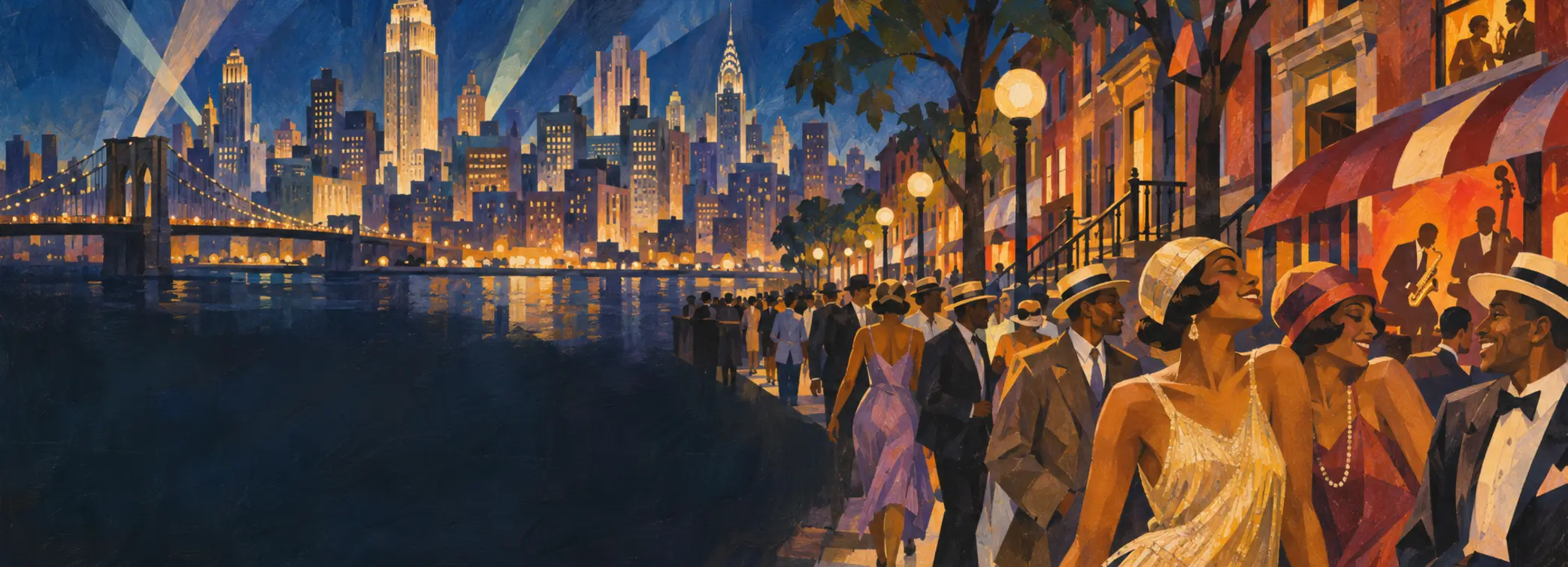
In the 1920s, some American writers worked in Paris while others found a new cultural center in Harlem, New York. Their books did not sound alike. Some used short, plain sentences; others broke stories into voices, memories and unfinished thoughts. Both groups were asking how literature could describe a rapidly changing world.
This article covers American Modernism from 1914 to 1945, the years between the beginning of the First World War and the end of the Second. These dates are a useful teaching boundary, not the exact birth and death of a literary movement. Some modernist experiments began earlier, and several writers produced important later works.
First comes the political, social, economic and religious world that shaped these writers. Then come the novels, poems, plays and movements that changed American writing. Literary terms are explained as they appear, so the discussion can be read without a separate glossary.
The world of this period
Political life
The First World War began in Europe in 1914, and the United States entered in April 1917. The war exposed soldiers and civilians to large-scale mechanized violence. For many writers, the old belief that modern technology always brought moral progress became difficult to accept. Literature began to show broken hopes, uncertain values and people struggling to explain what had happened.
After the fighting ended in 1918, the United States became more active in world finance and international affairs. Yet the peace did not end political conflict at home. Racist violence, restrictions on immigration and struggles over workers' rights challenged claims of equal opportunity. Modernist writers often treated the nation as a place of competing experiences rather than one shared story.
Women's political position changed when the Nineteenth Amendment was ratified in 1920. It prohibited denial of the vote on account of sex, but discriminatory laws and practices still prevented many women of color from voting. Campaigns for greater freedom also changed debates about marriage, work and public life. Fiction could now question older ideas about whose choices mattered and who had the right to speak.
During the 1930s, economic hardship increased demands for government action. Franklin D. Roosevelt became president in 1933 and introduced the New Deal, a group of programs aimed at relief, recovery and reform. Writers argued about unemployment, wages, farming, labor unions and political responsibility. These questions are central to the socially engaged fiction of John Steinbeck and other Depression-era authors.
The Second World War began in Europe in 1939, and the United States entered in December 1941. Wartime restrictions and the forced incarceration of Japanese Americans showed the dangers of prejudice and state power. The war ended in 1945, but its effects shaped writing well beyond that year. The literary period therefore ends here as a practical division rather than a clean artistic break.
Social life
Large numbers of people moved from rural areas to expanding cities during the early twentieth century. Cars, cinemas, radio programs and mass newspapers offered new experiences and reached wide audiences. Urban life could feel full of possibility and also lonely. Writers experimented with fragmentation, the presentation of a story through pieces rather than a smooth sequence, to express this unsettled experience.
The Great Migration was the movement of large numbers of African Americans from the South to other parts of the United States, especially northern and midwestern cities. Many left to escape segregation and racist violence while seeking work and education. Harlem in New York became an important center of Black artistic activity. Migration changed the subjects, audiences and sounds of American literature.
The Harlem Renaissance was a major flowering of African American literature, visual art, music and debate, especially during the 1920s and early 1930s. It was never a single style. Some writers drew on jazz and blues; others used sonnets, fiction or folklore to examine history and identity. Their works made Black cultural life a central part of modern American expression.
Racial inequality did not disappear as artistic opportunities expanded. The laws and customs called Jim Crow enforced segregation and unequal treatment, particularly in the South. In 1919, racist attacks and clashes occurred in several American cities during what became known as the Red Summer. Black poets and novelists answered these conditions with work about dignity, fear, resistance and belonging.
Women writers also faced arguments about respectability and who could become an accepted literary voice. Some modernist writers questioned fixed expectations about women's lives and relationships. At the same time, writers such as Zora Neale Hurston recorded forms of speech and storytelling that publishers sometimes treated as less prestigious. Their choices challenged the idea that serious literature must sound socially elite.
Economic life
The 1920s brought rapid industrial growth, consumer advertising and expanding credit to many parts of the United States. Assembly lines made goods more widely available, while radio and newspapers helped sell them. Yet this prosperity was unevenly shared. Farming communities, low-paid workers and many African American families did not enjoy the same economic security as wealthy urban consumers.
In F. Scott Fitzgerald's fiction, the pursuit of money often becomes a pursuit of status and acceptance. His characters may own impressive houses and attend fashionable parties, yet remain dissatisfied. Consumer culture, a way of life shaped by buying and displaying goods, becomes part of their personal identity. The contrast between appearance and reality helps explain why modernist novels so often question success.
The stock market crash of October 1929 became a symbol of the beginning of the Great Depression. Banks failed, businesses closed and millions faced unemployment during the years that followed. Many families lost homes or traveled in search of work. Literature written during this crisis asked whether personal effort could overcome poverty caused by larger economic forces.
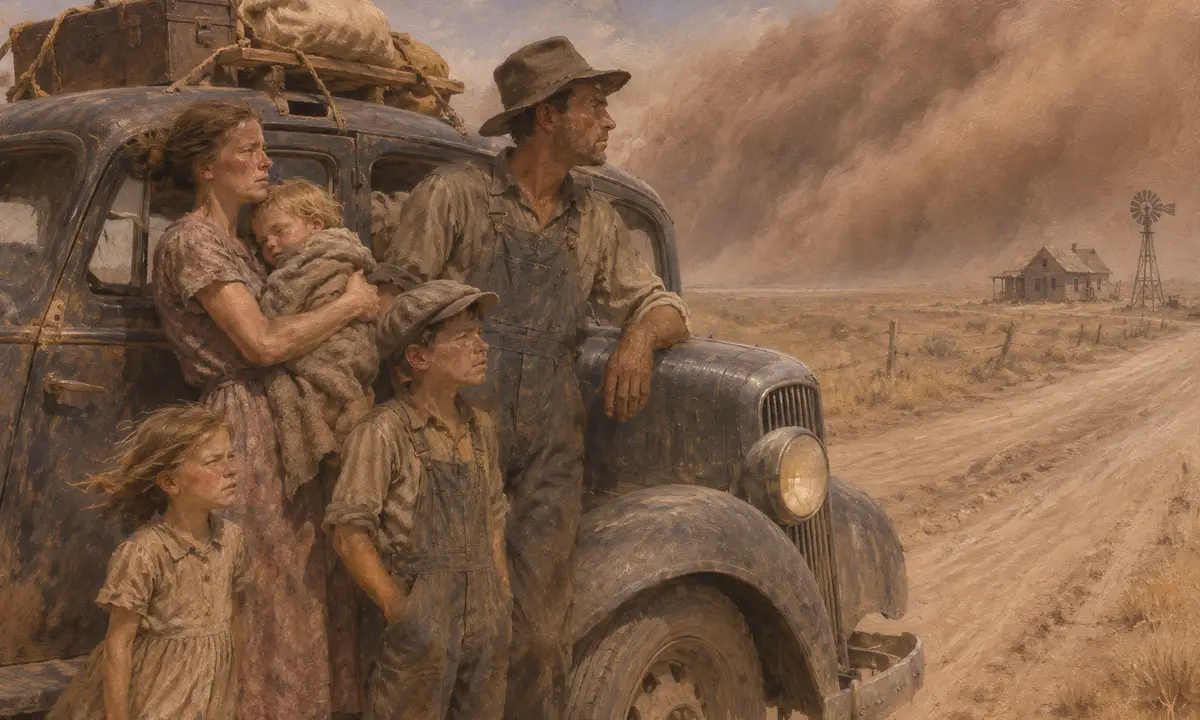
Dust storms and severe drought made conditions worse for farming families in parts of the Great Plains during the 1930s. The Dust Bowl helped drive migration, including journeys west to California. Steinbeck's The Grapes of Wrath (1939) connects a family's hardships to land ownership, labor markets and public policy. Its story shows why economic events cannot be reduced to individual moral failure.
Religion
Religious life remained important in modern America, but public debates over belief became more visible. Scientific discoveries, changing social customs and the experience of war challenged established certainties for some readers. Other Americans defended traditional teachings more strongly. Modernist writing registers these different reactions rather than presenting a simple disappearance of religion.
In 1925, the Scopes trial in Tennessee drew national attention to the teaching of evolution in schools. The dispute involved questions about biblical interpretation, science and public education. Fundamentalism, a movement stressing the authority of core religious teachings, became especially visible in these debates. Such conflicts reflected wider arguments about knowledge and modern life.
African American churches also played vital roles in local communities and cultural networks. Sermons, spirituals and gospel traditions shaped the rhythms and images available to Black writers. Langston Hughes used musical patterns and religious language without simply repeating church teaching. His poetry sometimes joins hope with sharp criticism of the inequalities around him.
Other authors explored spiritual uncertainty through ordinary choices and private doubts. Robert Frost's speakers frequently face a world that does not supply easy answers. William Faulkner's novels present moral guilt, memory and judgment through several competing perspectives. Religious language remained powerful even when writers questioned what people could know with confidence.
Did you know?
The anthology The New Negro, edited by Alain Locke and published in 1925, brought together writing and art connected with the Harlem Renaissance. It helped introduce the movement to a wider reading public. The anthology shows that a literary period can grow through magazines and editors as well as through individual books.
Important points to remember
- The First World War began in 1914, and the United States entered in 1917.
- The Nineteenth Amendment was ratified in 1920.
- The Great Migration helped make Harlem a center of African American culture.
- The Harlem Renaissance flourished especially during the 1920s and early 1930s.
- The stock market crash of 1929 preceded the worst years of the Great Depression.
- The New Deal began after Franklin D. Roosevelt took office in 1933.
- The Dust Bowl worsened hardship for many Great Plains farming families.
- The Scopes trial of 1925 centered on evolution and education.
- The United States entered the Second World War in 1941.
Literature in this period
What made writing modern?
Modernism is a broad name for experiments in literature and art that questioned inherited ways of presenting experience. American modernists did not agree on one method. Some kept traditional forms while changing their meanings; others broke older rules of rhythm and storytelling. What united many of them was the belief that familiar forms could not fully express the changed world around them.
A conventional novel often moves from beginning to middle to end under a steady guiding voice. Modernist fiction may use a nonlinear narrative, one that moves backward and forward through time. A writer may also use multiple narrators, allowing several speakers to tell parts of the same event. The reader must compare their accounts and notice what each person fails to understand.
Stream of consciousness is a technique that tries to suggest the changing flow of a character's thoughts and perceptions. An interior monologue presents thoughts directly, sometimes without ordinary spoken dialogue. These terms are related but not identical: a stream of consciousness can include sensations and associations beyond a direct speech-like monologue. Modernist writers used both methods to show that inner experience is difficult to arrange neatly.
The new forms were not always distant from daily life. Advertisements, city traffic, popular songs and changing speech patterns entered poems and novels. Juxtaposition, placing unlike images or scenes next to each other, could reveal contrasts without lengthy explanation. A simple object might become a symbol, something that suggests a meaning beyond its literal presence. These methods invited the reader to take an active part in making sense of a work.
The Lost Generation and the novel of disappointment
The Lost Generation is a name associated with writers who came of age around the First World War and questioned the values they inherited. Gertrude Stein's phrase became widely known through Ernest Hemingway's The Sun Also Rises (1926). The label does not mean that every writer in the group shared one political opinion. Their fiction often follows people looking for purpose after war or sudden social change.
An expatriate is someone living outside their home country. Some American writers spent important years in Europe, particularly Paris, where artistic networks crossed national borders. Hemingway and F. Scott Fitzgerald wrote about people who moved between countries and social circles. Their settings may look glamorous, but travel does not necessarily free the characters from disappointment or self-deception.
F. Scott Fitzgerald (1896-1940) made wealth, ambition and social division central subjects. The Great Gatsby (1925) follows Nick Carraway as he observes Jay Gatsby's pursuit of Daisy Buchanan. Gatsby's wealth cannot erase the divisions between established privilege and newly acquired money. The green light across the water functions as a symbol of desire that remains beyond his reach.
Fitzgerald's Tender Is the Night (1934) follows Dick and Nicole Diver and studies the fragile relationship between identity, marriage and emotional strain. Its arrangement of events makes readers reconsider their first impressions of the characters. Fitzgerald connects personal difficulties to the money and status of an international social circle. His novels show that attractive surfaces can hide damage rather than cure it.
Ernest Hemingway (1899-1961) developed prose marked by short sentences, concrete actions and carefully limited explanation. His method often leaves feelings implied rather than openly described. The Sun Also Rises (1926) follows Jake Barnes and other disillusioned expatriates through Paris and Spain. The characters' conversations and activities reveal the difficulty of finding lasting direction after war.
Hemingway's A Farewell to Arms (1929) joins a love story to the destruction of the First World War. Its narrator, Frederic Henry, comes to distrust noble-sounding claims about military sacrifice. For Whom the Bell Tolls (1940) is set during the Spanish Civil War and follows Robert Jordan, who must weigh duty against individual life. Hemingway's choices of scene and dialogue make political violence feel personal and immediate.
Hemingway also wrote The Old Man and the Sea, published in 1952, seven years after this article's end date. The short novel follows an aging Cuban fisherman and his struggle with a large marlin. It belongs to Hemingway's later career, not to the 1914-1945 publication period. The roadmap includes it because students commonly study the writer's major books together.
William Faulkner and the problem of memory
William Faulkner (1897-1962) placed many of his stories in the fictional Mississippi region of Yoknapatawpha County. His writing connects families to the history of slavery, racial hierarchy and the American South. He often presents events through incomplete memories rather than through one trustworthy account. The result is a world where the past continues to shape present choices.
In The Sound and the Fury (1929), Faulkner tells the decline of the Compson family through sections with different points of view. The opening section follows Benjy's perceptions, so memories interrupt the apparent present without clear warnings. This technique makes chronology difficult on purpose. A reader slowly reconstructs the family's history by comparing voices and time periods.
As I Lay Dying (1930) uses numerous speakers to tell the story of the Bundren family's journey to bury Addie Bundren. Because the speakers differ in knowledge and motives, no single voice controls the meaning of the journey. Light in August (1932) examines race, identity, religion and violence in the South. Its intersecting stories show how community judgments can shape a person's fate.
Faulkner's methods ask an ethical question as well as a formal one: who gets to tell the story? A confident narrator may hide as much as an uncertain one. His use of interior monologue, changing chronology and competing perspectives fits modernism's search for new narrative forms. Yet his subject is also a particular region with a deeply contested history.
John Steinbeck and the Depression
John Steinbeck (1902-1968) brought questions of work, land and inequality into fiction about ordinary families. Compared with Faulkner, his storytelling is often more direct, but it is not simple in its moral concerns. He gives attention to people whose opportunities are narrowed by poverty and harsh labor conditions. His stories combine individual lives with forces that no single character can control.
Of Mice and Men (1937) follows two migrant ranch workers, George Milton and Lennie Small, who hope to own a place of their own. Their dream gives the story direction even as their circumstances threaten it. The work also appeared in a form suitable for stage performance. Its short scenes and repeated conversations make the struggle for security immediate.
In The Grapes of Wrath (1939), the Joad family leaves Oklahoma and travels toward California during the Depression and Dust Bowl era. The book alternates the family's story with chapters that describe wider social conditions. This movement between private and collective experience expands the meaning of hardship. Steinbeck argues through narrative that economic injustice is more than an isolated family's misfortune.
The novel's anger about labor exploitation belongs to the political concerns of the 1930s. Still, it remains fiction, not a complete historical record of every migrant family. Readers should distinguish its created characters from the documented economic crisis behind them. That distinction allows the work to be studied as both literary art and social criticism.
Imagism and experiments in poetry
Imagism was a transatlantic poetry movement that favored precise images, direct language and economy of words. Rather than explaining an idea at length, an Imagist poem often lets the reader examine one sharply presented moment. Its poets commonly used free verse, poetry without a fixed pattern of meter or rhyme. However, not every modernist poet was an Imagist, and not every modernist poem rejected traditional forms.
Amy Lowell (1874-1925) helped promote Imagism in the United States. She was associated with the Some Imagist Poets anthologies issued from 1915 through 1917 and worked actively to bring new poetry to readers. Her lectures and editorial efforts mattered as well as her poems. The movement developed across America and Europe, so it should not be treated as an entirely American invention.
William Carlos Williams (1883-1963), a physician and poet, wrote about ordinary objects and American speech. His poem “The Red Wheelbarrow” first appeared in Spring and All (1923), under a numbered heading. It directs attention to a wheelbarrow, rainwater and nearby chickens. The carefully arranged image asks readers to notice how much meaning can rest in an apparently simple scene.
Robert Frost (1874-1963) followed a different path, often keeping meter, rhyme and recognizable rural speech. “Mending Wall” appeared in North of Boston (1914) and presents two neighbors repairing a boundary. The poem raises questions about habit, property and separation without resolving them for the reader. Frost's familiar settings often contain serious uncertainty.
Frost's “The Road Not Taken” first appeared in 1915 and was collected in Mountain Interval (1916). Its speaker considers two roads, but the poem complicates any easy claim that one was clearly different. “Stopping by Woods on a Snowy Evening” (1923) places an attractive pause beside the speaker's obligations. In each case, a plain scene becomes difficult when the reader examines its implications.
Wallace Stevens (1879-1955) explored how imagination changes human experience of the world. “The Emperor of Ice-Cream” first appeared in 1922 and was later collected in Harmonium (1923). The poem places everyday activity beside death, creating a sharp contrast between pleasure and mortality. Its strange repeated phrase is less a puzzle with one answer than an invitation to think about appearance and reality.
Marianne Moore (1887-1972) combined close observation, exact description and unusual stanza patterns. Her collection Observations (1924) shows an interest in animals, objects and the habits of looking. She can sound precise while leaving space for doubt. Her work demonstrates that experiment does not always mean disorder; it may involve careful design.
E. E. Cummings (1894-1962) experimented with spacing, punctuation, capitalization and the arrangement of words on a page. His collection Tulips and Chimneys appeared in 1923. These visible changes affect how a reader pauses and connects words. The striking appearance of his poems matters, but their subjects also include love, nature, conflict and personal freedom.
Hart Crane (1899-1932) used dense images and ambitious rhythms to write about modern America. His long poem The Bridge (1930) treats the Brooklyn Bridge as a focus for questions about history and national possibility. Its imaginative connections can be challenging to follow. Crane represents a side of modernist poetry that seeks large patterns rather than the small, concentrated image alone.
The Harlem Renaissance and many voices
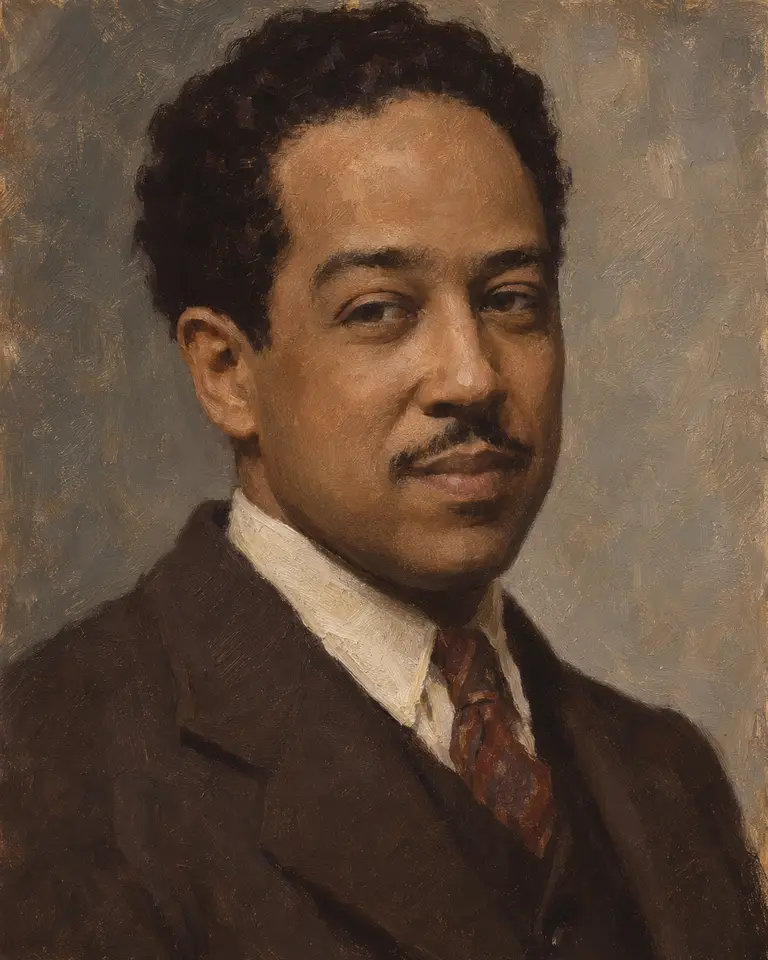
The Harlem Renaissance was linked to migration, urban culture, publishing networks and Black political organization. Writers used different forms to discuss freedom, memory, art and unequal treatment. The movement included women and men with different religious beliefs and ideas about social change. Seeing it as a single voice would hide the debates that made it productive.
Langston Hughes (1901-1967, though some references still give 1902 as his birth year) drew on the rhythms and concerns of blues, a musical tradition expressing experience through repeated lines, changing phrases and emotional tension. He also used jazz and spoken language. His poem “The Negro Speaks of Rivers” (1921) connects African American history with a longer human past through images of rivers. The speaker's voice is personal, historical and collective at once.
Hughes's “Harlem,” also called “Dream Deferred,” appeared in Montage of a Dream Deferred in 1951. It therefore belongs to his later writing, although it continues concerns present during the Harlem Renaissance. Through brief questions and images, the poem considers what happens when hopes are repeatedly delayed. The roadmap lists the poem with his earlier work, so its later year must remain visible.
Zora Neale Hurston (1891-1960) studied African American folklore and used the spoken vernacular, the everyday language of a community, as an artistic resource. In Their Eyes Were Watching God (1937), Janie Crawford seeks a life and voice of her own. Hurston places storytelling, relationships and community judgment at the center of the novel. Speech is part of how characters claim authority, not merely a local decoration.
Claude McKay (1889-1948), who was born in Jamaica, brought Caribbean and American experiences into his writing. His sonnet “If We Must Die” (1919) responds to the danger of racist violence with a call for dignity and resistance. A sonnet is a fourteen-line poem that normally follows a formal pattern. McKay shows that a traditional form can carry a forceful modern political message.
Countee Cullen (1903-1946) likewise worked with established verse forms while writing about identity, faith and racial injustice. His collection Color (1925) includes poems that test the distance between ideals of equality and actual experience. Cullen's style differs from Hughes's blues-influenced writing. Both approaches belong within the Harlem Renaissance, rather than one being the only authentic form of Black poetry.
Alain Locke's 1925 anthology The New Negro helped readers encounter writing and ideas associated with this movement. Magazines such as The Crisis and Opportunity also supported literary exchange. These print networks mattered because talented writers still faced barriers to publication and recognition. The Harlem Renaissance was therefore a movement of institutions, arguments and communities as well as individual artists.
Modern drama and the changing stage
American modernist drama also questioned simple realism. Expressionism is a style that changes outward scenes to represent inner pressure or feeling. Eugene O'Neill (1888-1953) used experiment and psychological conflict to explore family life, power and isolation. His plays helped make serious American drama an important part of twentieth-century literature.
O'Neill's The Emperor Jones was first produced in 1920. Its action follows Brutus Jones, a ruler whose fears emerge through sound, movement and disturbing scenes. The play uses expressionist effects to present a mind under strain, while its treatment of race needs careful historical reading. Its stage techniques offer more than a realistic sequence of conversations.
O'Neill completed Long Day's Journey Into Night in 1941, but it was published and first performed posthumously in 1956. Set within one day in the Tyrone family home, the drama explores illness, addiction, blame and regret. Although written within this period, its public reception belongs to a later era. The distinction between composition and publication is essential when dating the play.
Henry Miller (1891-1980) illustrates another kind of prose experiment. His autobiographical novel Tropic of Cancer (1934) was first published in Paris and uses an unusually candid first-person voice. Its publication history involved debates over literary freedom and obscenity. Miller's writing differs greatly from O'Neill's plays, but both tested limits on what serious literature could represent.
An interesting story
In the summer of 1920, a young Langston Hughes traveled by train toward Mexico to visit his father. As the train crossed the Mississippi River, the sight drew his mind to the history of Black Americans and to older civilizations connected with other rivers. Hughes later described this journey in his autobiography The Big Sea. The experience helped inspire “The Negro Speaks of Rivers,” which appeared in The Crisis in 1921. The poem does not present the trip as ordinary travel writing. It gives one speaker a voice that seems to carry memories across many places and ages. A passing view from a train became the starting point for a poem about identity and historical memory.
Key terms
- Modernism - experiments that question inherited artistic forms and ways of representing experience.
- Fragmentation - showing experience in pieces instead of one smooth sequence.
- Great Migration - large-scale movement of African Americans from the South to other regions.
- Harlem Renaissance - flowering of African American art and literature, especially in the 1920s and early 1930s.
- Jim Crow - laws and customs that enforced racial segregation and inequality.
- Consumer culture - social life strongly shaped by buying and displaying goods.
- Dust Bowl - drought and dust storms that damaged Great Plains farming during the 1930s.
- Fundamentalism - a religious movement stressing the authority of core teachings.
- Nonlinear narrative - storytelling that does not follow a simple time order.
- Multiple narrators - more than one speaker presenting parts of a story.
- Stream of consciousness - writing that suggests the flow of thoughts and perceptions.
- Interior monologue - direct presentation of a character's thoughts.
- Juxtaposition - placing different things side by side to make a contrast.
- Symbol - an object or detail suggesting meaning beyond its literal presence.
- Lost Generation - label linked to writers shaped by the First World War and its aftermath.
- Imagism - poetry that stresses concise language and exact images.
- Free verse - poetry without a fixed meter or regular rhyme scheme.
- Vernacular - the ordinary spoken language of a community.
- Blues - a musical tradition whose patterns influenced writers such as Langston Hughes.
- Expressionism - an artistic style that alters outer reality to convey inner feelings.
Criticism and scholarship
Houston A. Baker Jr., in Modernism and the Harlem Renaissance (1987), argues for recognizing African American cultural expression as central to accounts of modernism. His study helps challenge a history that treats the Harlem Renaissance as separate from experimental twentieth-century literature. It also links cultural form to Black self-definition. This is an argument about literary history, not a claim that every Harlem writer used the same technique.
Michael North, in The Dialect of Modernism: Race, Language, and Twentieth-Century Literature (1994), studies how debates over race and language shaped modernist experiments. He examines tensions between writers who borrowed forms of nonstandard speech and Black authors defining their own artistic voices. The book helps readers see that questions of language involve power as well as style. Modernism cannot be understood through formal innovation alone.
George Hutchinson's The Harlem Renaissance in Black and White (1995) examines the movement's complex collaborations, relationships and cultural divisions. It shows why a simple story of complete separation between Black and white literary circles is inadequate. Lawrence Rainey's Institutions of Modernism: Literary Elites and Public Culture (1998) examines publishing, patronage and literary markets. Together these studies remind readers that writers worked inside social networks, not outside history.
Important points to remember
- Modernism used new forms to represent unstable or changing experience.
- The Lost Generation is associated with writers shaped by the First World War.
- Fitzgerald's The Great Gatsby was published in 1925.
- Hemingway's The Sun Also Rises was published in 1926.
- Faulkner used different narrators in As I Lay Dying (1930).
- Steinbeck's The Grapes of Wrath appeared in 1939.
- Imagism favored precise images and economical language.
- Hughes's “The Negro Speaks of Rivers” appeared in 1921.
- Hurston's Their Eyes Were Watching God appeared in 1937.
- O'Neill's Long Day's Journey Into Night was published in 1956.
How the period ends
By 1945, the United States had passed through two world wars and the Great Depression. Modernist methods had moved from experimental magazines into recognized novels, poetry collections and theater. This did not mean every writer began using the same style. Instead, fragmentation, shifting viewpoints and attention to everyday speech became available choices for later generations.
The Harlem Renaissance had already changed the possibilities of African American literary expression, although racism continued to limit opportunities. Writers who published after 1945 took up questions of migration, identity, historical memory and artistic freedom in new conditions. Other postwar writers responded to the Holocaust, the atomic bomb and changing global power. The period's ending is therefore a change in historical setting, not a final end to modernist art.
The next period, Postwar and Contemporary American Literature (1945-Present), follows those later debates and developments. Several books discussed in this article first appeared after 1945 because their authors belong to the Modernism roadmap. Their actual dates are preserved rather than moved backward to fit the teaching boundary.
Important points to remember
- American Modernism is treated here as the period from 1914 to 1945.
- The Second World War ended in 1945.
- Modernist methods continued to influence literature after 1945.
- The Harlem Renaissance shaped later African American writing.
- Hemingway published The Old Man and the Sea in 1952.
- Hughes published “Harlem” in 1951.
- O'Neill's Long Day's Journey Into Night appeared publicly in 1956.
- The next roadmap period is Postwar and Contemporary American Literature.
Writers and works
| Writer | Dates | Main works | Remembered for |
|---|---|---|---|
| F. Scott Fitzgerald | 1896-1940 | The Great Gatsby (1925); Tender Is the Night (1934) | Wealth, class and disillusionment |
| Ernest Hemingway | 1899-1961 | The Sun Also Rises (1926); A Farewell to Arms (1929); For Whom the Bell Tolls (1940); The Old Man and the Sea (1952, later work) | Spare prose and war's effects |
| William Faulkner | 1897-1962 | The Sound and the Fury (1929); As I Lay Dying (1930); Light in August (1932) | Changing voices and Southern memory |
| John Steinbeck | 1902-1968 | Of Mice and Men (1937); The Grapes of Wrath (1939) | Working lives and economic injustice |
| Robert Frost | 1874-1963 | “Mending Wall” (1914); “The Road Not Taken” (1915, collected 1916); “Stopping by Woods on a Snowy Evening” (1923) | Rural scenes with complex meanings |
| Wallace Stevens | 1879-1955 | “The Emperor of Ice-Cream” (1922); Harmonium (1923) | Imagination and perception |
| William Carlos Williams | 1883-1963 | “The Red Wheelbarrow” (1923); Spring and All (1923) | Exact images and American speech |
| E. E. Cummings | 1894-1962 | Tulips and Chimneys (1923) | Visual experiments in poetry |
| Marianne Moore | 1887-1972 | Observations (1924) | Precise description and form |
| Hart Crane | 1899-1932 | The Bridge (1930) | Ambitious images of American history |
| Eugene O'Neill | 1888-1953 | The Emperor Jones (first produced 1920); Long Day's Journey Into Night (completed 1941; published and first performed 1956) | Psychological and expressionist drama |
| Langston Hughes | 1901-1967 | “The Negro Speaks of Rivers” (1921); “Harlem” (1951, later work) | Black history and musical rhythms |
| Zora Neale Hurston | 1891-1960 | Their Eyes Were Watching God (1937) | Folklore, speech and women's voices |
| Claude McKay | 1889-1948 | “If We Must Die” (1919); Harlem Shadows (1922) | Resistance and traditional verse forms |
| Countee Cullen | 1903-1946 | Color (1925) | Formal poetry about race and belief |
| Amy Lowell | 1874-1925 | Some Imagist Poets anthologies (1915-1917, contributor and promoter) | Promotion of Imagist poetry |
| Henry Miller | 1891-1980 | Tropic of Cancer (1934) | Candid autobiographical experiments |
Quick revision - 50 points
Open the 50 pointsClose the list
- The First World War began in 1914.
- The United States entered the First World War in 1917.
- The Nineteenth Amendment was ratified in 1920.
- The Great Migration moved many African Americans away from the South.
- Harlem became a major African American cultural center.
- The Harlem Renaissance flourished especially during the 1920s and early 1930s.
- Jim Crow laws and customs enforced racial segregation.
- Racist violence marked the Red Summer of 1919.
- The American stock market crashed in October 1929.
- Franklin D. Roosevelt introduced New Deal programs after taking office in 1933.
- The Dust Bowl damaged Great Plains farming during the 1930s.
- The United States entered the Second World War in 1941.
- The Second World War ended in 1945.
- The Scopes trial took place in 1925.
- Alain Locke edited The New Negro (1925).
- Modernism questioned inherited ways of representing experience.
- Fragmentation presents experience in pieces.
- A nonlinear narrative changes ordinary chronological order.
- Multiple narrators offer different accounts of events.
- Stream of consciousness suggests the flow of thought.
- The Lost Generation is associated with writers shaped by the First World War.
- Gertrude Stein's phrase became famous through Hemingway's The Sun Also Rises.
- F. Scott Fitzgerald published The Great Gatsby in 1925.
- Nick Carraway narrates The Great Gatsby.
- Fitzgerald published Tender Is the Night in 1934.
- Hemingway published The Sun Also Rises in 1926.
- Hemingway published A Farewell to Arms in 1929.
- Hemingway published For Whom the Bell Tolls in 1940.
- Hemingway published The Old Man and the Sea in 1952.
- Faulkner published The Sound and the Fury in 1929.
- Faulkner's As I Lay Dying (1930) follows the Bundren family.
- Faulkner published Light in August in 1932.
- Steinbeck published Of Mice and Men in 1937.
- The Joad family travels west in The Grapes of Wrath (1939).
- Imagism favored exact images and economical wording.
- Amy Lowell promoted the Some Imagist Poets anthologies of 1915-1917.
- Williams's “The Red Wheelbarrow” appeared in Spring and All (1923).
- Frost's “Mending Wall” appeared in North of Boston (1914).
- Frost's “The Road Not Taken” first appeared in 1915.
- Frost's “Stopping by Woods on a Snowy Evening” appeared in 1923.
- Stevens's “The Emperor of Ice-Cream” first appeared in 1922.
- Marianne Moore published Observations in 1924.
- E. E. Cummings published Tulips and Chimneys in 1923.
- Hart Crane published The Bridge in 1930.
- Hughes's “The Negro Speaks of Rivers” appeared in 1921.
- Hurston published Their Eyes Were Watching God in 1937.
- Claude McKay wrote “If We Must Die” in 1919.
- Countee Cullen published Color in 1925.
- O'Neill's The Emperor Jones was first produced in 1920.
- O'Neill's Long Day's Journey Into Night was published in 1956.
Quick quiz - 25 questions
Tap an answer to see at once if it is right. You do not need to log in.
Open the 25 questionsClose the quiz
1When did the United States enter the First World War?
Answer: A. The United States entered the First World War in 1917.
2Which year saw ratification of the Nineteenth Amendment?
Answer: B. The Nineteenth Amendment was ratified in 1920.
3What does the Great Migration describe in this article?
Answer: C. The Great Migration included the movement of many African Americans from the South to other regions.
4Which year is associated with the American stock market crash?
Answer: D. The stock market crashed in October 1929.
5Which conflict especially shaped the writers called the Lost Generation?
Answer: A. The Lost Generation is associated with the First World War and its aftermath.
6When was Fitzgerald's The Great Gatsby published?
Answer: B. Fitzgerald published The Great Gatsby in 1925.
7Who narrates Fitzgerald's The Great Gatsby?
Answer: C. Nick Carraway narrates The Great Gatsby.
8Which Hemingway novel follows expatriates through Paris and Spain?
Answer: D. The Sun Also Rises follows Jake Barnes and other expatriates.
9Which Hemingway novel is set during the Spanish Civil War?
Answer: A. For Whom the Bell Tolls follows Robert Jordan during the Spanish Civil War.
10Which character's perceptions shape the opening of Faulkner's The Sound and the Fury?
Answer: B. Benjy's perceptions shape the opening section of The Sound and the Fury.
11Which family is central to Faulkner's As I Lay Dying?
Answer: C. As I Lay Dying follows the Bundren family on a burial journey.
12Which family travels toward California in The Grapes of Wrath?
Answer: D. The Joad family travels west in The Grapes of Wrath.
13Which pair of workers is central to Steinbeck's Of Mice and Men?
Answer: A. George Milton and Lennie Small are migrant ranch workers in Of Mice and Men.
14What did Imagism especially value?
Answer: B. Imagism valued exact images and direct, economical wording.
15Who helped promote the Some Imagist Poets anthologies?
Answer: C. Amy Lowell helped promote the Imagist anthologies of 1915-1917.
16In which 1923 book did Williams's The Red Wheelbarrow first appear?
Answer: D. The Red Wheelbarrow first appeared in Spring and All in 1923.
17Which Robert Frost poem appeared in North of Boston in 1914?
Answer: A. Mending Wall appeared in North of Boston in 1914.
18When did The Road Not Taken first appear?
Answer: B. The Road Not Taken first appeared in 1915, before its 1916 collection.
19Who wrote The Emperor of Ice-Cream?
Answer: C. Wallace Stevens wrote The Emperor of Ice-Cream, first published in 1922.
20Who wrote the long poem The Bridge (1930)?
Answer: D. Hart Crane wrote The Bridge, published in 1930.
21Which Langston Hughes poem appeared in 1921?
Answer: A. The Negro Speaks of Rivers appeared in 1921.
22Who wrote Their Eyes Were Watching God (1937)?
Answer: B. Zora Neale Hurston wrote Their Eyes Were Watching God.
23Which book was published by Countee Cullen in 1925?
Answer: C. Cullen published his poetry collection Color in 1925.
24When was O'Neill's Long Day's Journey Into Night first published?
Answer: D. Long Day's Journey Into Night was completed in 1941 but published in 1956.
25Which critic wrote Modernism and the Harlem Renaissance (1987)?
Answer: A. Houston A. Baker Jr. published Modernism and the Harlem Renaissance in 1987.
Frequently asked questions
What is American Modernism in literature?
American Modernism refers to varied experiments in writing that challenged familiar ways of presenting experience. The 1914-1945 dates describe a useful period of study, not an exact boundary for every author's work.
Who were the Lost Generation writers?
The Lost Generation is a label associated with writers affected by the First World War and its aftermath. Ernest Hemingway and F. Scott Fitzgerald are frequently discussed in this connection, although their individual styles differed.
How was the Harlem Renaissance connected with modernism?
Harlem Renaissance writers explored new forms, voices and cultural identities in a changing American society. They combined techniques from African American music and speech with traditional and experimental literary forms.
What is the difference between Imagism and modernism?
Modernism is a wide grouping of artistic experiments and includes many approaches. Imagism is a more specific poetry movement that values precise images and economical language.
Why is The Old Man and the Sea listed in a 1914-1945 article?
The book was published in 1952, so it is not a publication from the period itself. It is included because the roadmap groups major works with Hemingway, whose earlier career belongs to this discussion.
When was Long Day's Journey Into Night written and published?
Eugene O'Neill completed the play in 1941. It was published and first performed after his death in 1956, making it a useful example of the difference between composition and public release.
Sources
- Langston Hughes, The Big Sea, Alfred A. Knopf, 1940.
- Houston A. Baker Jr., Modernism and the Harlem Renaissance, University of Chicago Press, 1987.
- Michael North, The Dialect of Modernism: Race, Language, and Twentieth-Century Literature, Oxford University Press, 1994.
- George Hutchinson, The Harlem Renaissance in Black and White, Belknap Press of Harvard University Press, 1995.
- Lawrence Rainey, Institutions of Modernism: Literary Elites and Public Culture, Yale University Press, 1998.
Afsar Khan, Ph.D. English
Test your knowledge
Check what you have learned with quizzes and MCQs.