


On this page
In 1988, Toni Morrison's Beloved won the Pulitzer Prize for Fiction. The novel asks how the history of enslavement can remain present in family memory long after emancipation. Its success showed that American fiction could join private experience to difficult national history without making either simple.
This article covers American literature from the end of the Second World War in 1945 to the present. The period has no agreed final year because writers are still producing new work. It includes the Cold War, the civil rights movement, later changes in public life, and many different literary styles.
The discussion begins with the world in which the books appeared. It then explains the fiction, poetry, drama, movements and terms that help readers understand those books. Difficult literary terms are explained as they arise.
The world of this period
Political life
The Second World War ended in 1945, leaving the United States with enormous military and economic power. It also left questions about mass violence, the use of atomic weapons, and the meaning of freedom. Postwar writers asked what national success meant to people who still felt anxious, isolated or excluded. Their characters often doubted public claims that prosperity automatically produced happiness.
The Cold War was a long period of rivalry between the United States and the Soviet Union. Fear of communism affected American politics, schools, workplaces and cultural life. In the early 1950s, accusations of disloyalty could damage careers without fair evidence. Arthur Miller connected this atmosphere with the earlier Salem witch trials in The Crucible (1953). The play shows how fear and accusation can replace careful judgment.
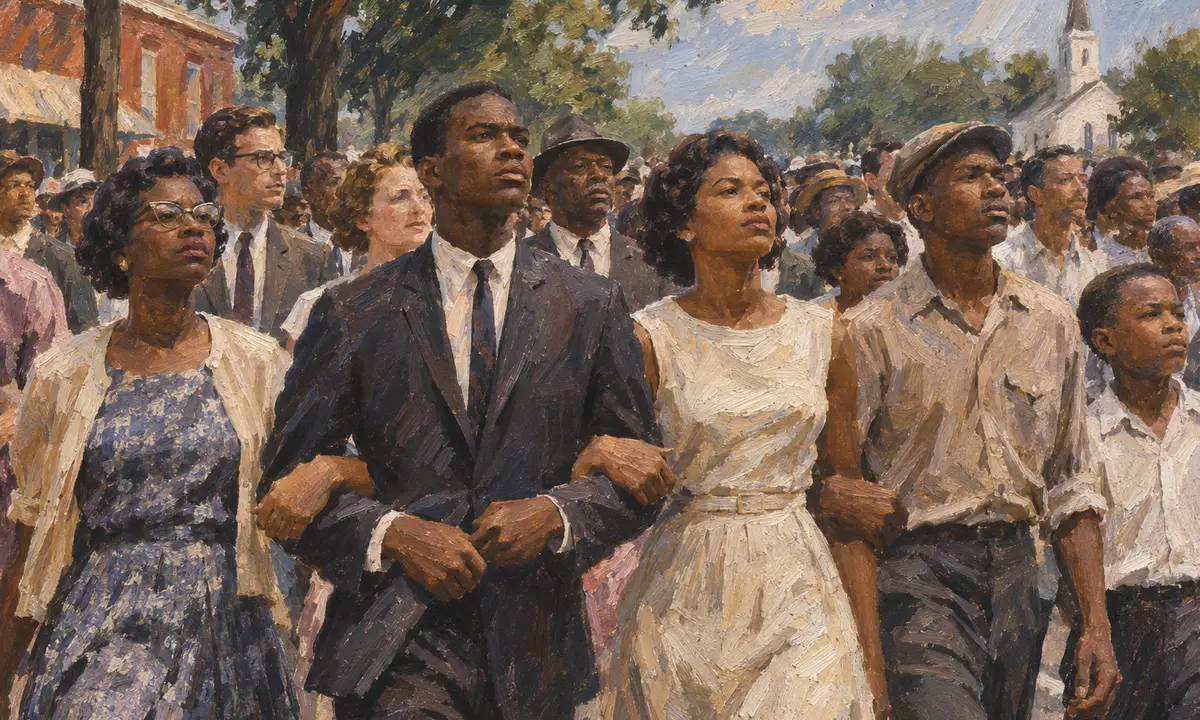
The civil rights movement challenged racial segregation and discrimination. The Supreme Court's Brown v. Board of Education decision came in 1954. The Civil Rights Act of 1964 and Voting Rights Act of 1965 brought major legal changes. Yet laws alone could not end unequal treatment. Ralph Ellison, James Baldwin, Toni Morrison and August Wilson explored the gap between formal freedom and everyday experience in different generations.
American involvement in the Vietnam War and protests against it made public disagreement more visible in the 1960s and early 1970s. Writers questioned government authority, military language and the presentation of events through the media. Kurt Vonnegut's fiction used strange structures and dark humour to challenge familiar stories about war. Later writers addressed surveillance, political violence, environmental loss and the effect of international events on ordinary lives.
The period also includes the end of the Cold War, the attacks of September 11, 2001, and growing debate over race, migration and national identity. These events do not create a single literary style. Instead, they provide different pressures under which authors decide whom to represent, what to remember and which public stories to question. Literature becomes a place where official accounts meet personal testimony.
Social life
After 1945, more Americans moved to suburban homes, while cities changed through migration and new patterns of work. Television entered many households and helped spread similar images of the successful family. Such images did not match every person's experience. The lonely young narrator of J. D. Salinger's The Catcher in the Rye (1951) finds familiar adult behaviour hard to trust. His discomfort helps explain the appeal of stories about outsiders.
African American communities continued to confront segregation, unequal opportunity and violence. The growing public role of Black writers changed what readers could hear about family life, education, work and faith. Women also challenged narrow expectations about marriage and domestic roles. Sylvia Plath, Anne Sexton, Adrienne Rich and Alice Walker approached private experience from very different positions. Their writing shows that family life and personal speech can also be public questions.
The counterculture of the 1950s and 1960s questioned social obedience, material success and fixed rules of behaviour. Beat writers travelled, experimented with rhythm and brought informal speech into literature. Later movements for women's rights and LGBTQ rights made further room for voices that had been pushed aside. The audience for American writing became harder to describe as one single community with one shared history.
Economic life
Postwar manufacturing, expanding universities and a growing consumer economy created opportunities for many Americans. The consumer culture of advertising encouraged people to connect identity with possessions and success. The same economy produced pressure to compete and maintain a public image. Arthur Miller's Death of a Salesman (1949) follows a man who measures his worth through sales, popularity and promises that fail him.
Economic growth was uneven. Many Black families faced barriers to housing, credit and jobs, while poor rural communities were often neglected. Industrial decline in some cities later brought new insecurity. John Updike's Rabbit, Run (1960) presents a man searching for freedom amid domestic and social duties. Other authors examine the people left behind by stories that treat growth as proof that everyone is doing well.
From the late twentieth century, international trade, financial markets and digital technology changed work and communication. Shopping, news and entertainment reached people through expanding electronic systems. Don DeLillo's White Noise (1985) examines the fear and confusion produced by constant commercial messages and technological risk. The changes also affected publishing: readers found literature through television discussions, colleges, independent presses and later online communities.
Religion
Religion remained a force in public arguments and private choices throughout this period. Protestant churches had important roles in some civil rights campaigns, although religious institutions also differed sharply over segregation and reform. James Baldwin's Go Tell It on the Mountain (1953) uses a church community to examine faith, family authority and personal conflict. Its religious language cannot be separated from the social lives of its characters.
Flannery O'Connor wrote fiction shaped by Catholic belief, moral uncertainty and moments of startling change. Her characters may resist the truth they seem to need. Other writers treated religious traditions through doubt, satire or new forms of spirituality. Faith in this literature is neither always comforting nor always rejected. It can create belonging, but it can also become a source of conflict and difficult self-examination.
Did you know?
Vladimir Nabokov's Lolita first appeared in Paris in 1955. It was not published in the United States until 1958. The two dates describe different editions, not two different novels.
Important points to remember
- The Second World War ended in 1945.
- The Cold War shaped American political anxiety.
- The Crucible (1953) uses the Salem trials to explore fear and accusation.
- The Brown v. Board of Education decision came in 1954.
- The Civil Rights Act became law in 1964.
- The Voting Rights Act followed in 1965.
- Suburban growth and advertising influenced postwar social life.
- The period remains open because contemporary American literature is still being written.
Literature in this period
The postwar novel and the troubled individual
Postwar fiction often places a troubled person inside a confident-looking society. The antihero is a central character who lacks the traditional hero's certainty or admirable conduct. Holden Caulfield, the teenage narrator of J. D. Salinger's The Catcher in the Rye (1951), distrusts adult pretence. His restless first-person voice helps readers understand his confusion without requiring them to approve every judgment he makes. The novel makes voice as important as outward action.
Saul Bellow wrote about restless intellectual life, moral decisions and the difficulties of city living. In Herzog (1964), Moses Herzog composes letters, many of which he never sends. The unusual form places private thought at the centre of the story. Instead of moving neatly through public events, the novel follows a mind trying to understand love, failure and responsibility. This method makes inner conflict visible through literary structure.
Ralph Ellison's Invisible Man (1952) follows a Black narrator whose individuality is repeatedly ignored by others. The word invisibility here means social refusal to see a person fully, not a magical condition. The novel combines realistic scenes with dreamlike and symbolic episodes. Its shifting manner shows how political groups and social institutions try to define a man who wants to speak for himself.
James Baldwin's Go Tell It on the Mountain (1953) examines a young boy, his family and a religious community in Harlem. Baldwin links intimate family history to broader forms of racial pressure. His writing frequently asks how love, fear and power shape human relationships. Together, Baldwin and Ellison show that a novel can expose injustice without reducing its characters to simple examples of a political argument.
The Beat Generation and freedom of expression
The Beat Generation developed around writers who opposed social conformity and valued personal experiment. Conformity means following accepted rules simply because society expects it. Jack Kerouac's On the Road (1957) follows travel across the United States through the narrator Sal Paradise. The road promises movement and discovery, but the book also reveals unstable friendships and uncertain goals. Its loose, energetic prose tries to resemble remembered speech and quick experience.
Allen Ginsberg's Howl (published in 1956) uses long lines, repeated patterns and forceful public address. The poem challenges accepted attitudes to sexuality, authority and people treated as outsiders. Its rhythm suggests a voice speaking urgently before listeners rather than a calm account on a page. The book Howl and Other Poems became involved in a 1957 obscenity case, making questions about literary freedom part of its history.
The Beats were not the only postwar experimenters, and their lives should not be treated as one model of freedom. They worked with different forms and beliefs. Their importance lies partly in a new permission to use everyday language, personal movement and open disagreement as literary materials. Later countercultural readers found in these works alternatives to official accounts of the successful American life.
Confessional poetry and the changing lyric voice
Confessional poetry is a term applied to poems that draw openly on intimate personal experience. It does not mean that every detail in a poem is a literal record. Robert Lowell's Life Studies (1959) helped establish this approach through family memory, illness and less formal verse. Critics connected the label to M. L. Rosenthal's discussion of that collection in 1959. The poetry asks readers to attend to craft as well as disclosure.
Sylvia Plath's The Bell Jar (1963), first published under the name Victoria Lucas, is a novel rather than a poem. It follows Esther Greenwood's experience of depression and social pressure. Plath's poetry collection Ariel appeared after her death, in 1965, and is known for intense imagery and startling changes in voice. Images in these poems are carefully made literary devices, not direct medical reports about the writer's life.
Anne Sexton's collection Live or Die (1966) explores personal conflict through deliberate patterns of sound and dramatic address. John Berryman uses a changing speaker called Henry in 77 Dream Songs (1964), part of the larger sequence eventually gathered as The Dream Songs. The speaker is a constructed figure, so the poems should not be read as a diary copied into verse. Both poets remind readers that confession in poetry is shaped by form.
Elizabeth Bishop offers a useful contrast. Her North & South (1946) observes places and objects with exact attention. Her work can suggest private loss indirectly rather than announce it. Adrienne Rich's Diving into the Wreck (1973) connects self-discovery with a criticism of inherited ideas about gender. John Ashbery's Self-Portrait in a Convex Mirror (1975) follows thought through shifting images and uncertain connections. These writers show several ways postwar poetry moved beyond a single voice.
New directions in American drama
American drama turned ordinary homes into spaces of public argument. In Arthur Miller's Death of a Salesman (1949), Willy Loman's fading hopes expose the cost of measuring human value by success. The Crucible (1953) places a story of accusation in seventeenth-century Salem, while also inviting comparison with the politics of Miller's own time. The plays use family pressure and public judgment to examine difficult moral choices.
Tennessee Williams wrote a memory play, a drama presented through someone's recollection, in The Glass Menagerie. It first appeared on stage in Chicago in 1944, before its 1945 Broadway success. Tom remembers his mother Amanda and sister Laura, so the audience sees a past filtered through his feelings. Williams's A Streetcar Named Desire (1947) brings Blanche DuBois and Stanley Kowalski into a tense conflict about desire, power and illusion.
Edward Albee's Who's Afraid of Virginia Woolf? (1962) follows two married couples during a night of harsh verbal games. Its dialogue tests the stories people tell about themselves. August Wilson's Fences first premiered in 1985 and reached Broadway in 1987. It centres on Troy Maxson, a Black working-class father whose hopes and disappointments affect his family. Wilson places personal choices within a changing history of racial opportunity.
Black experience, historical memory and the novel
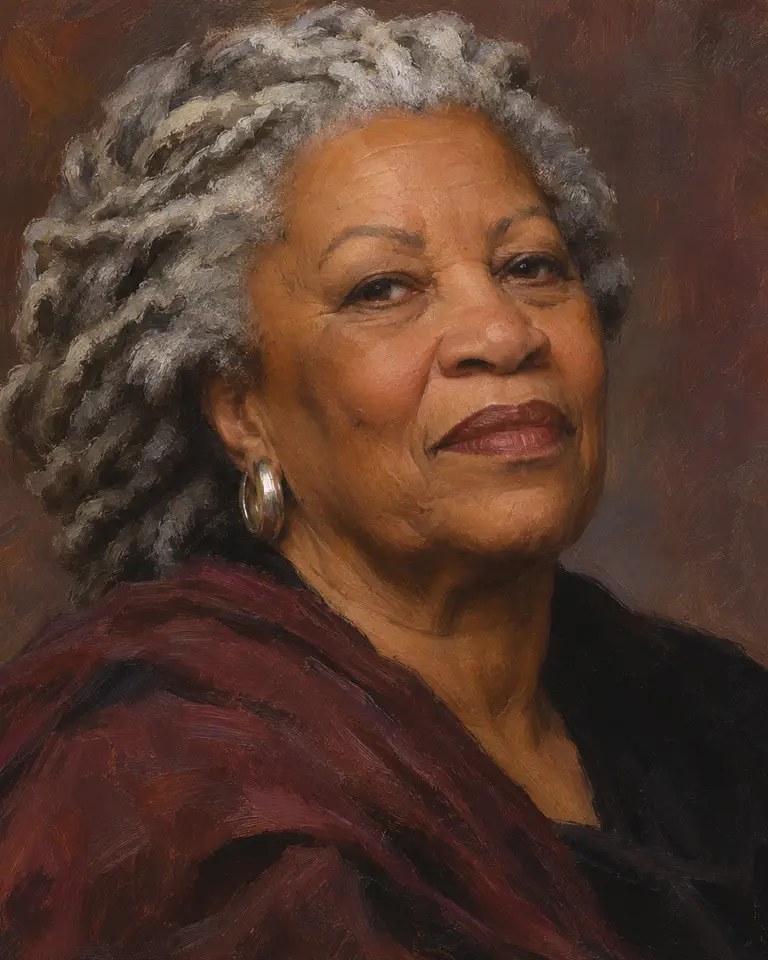
Toni Morrison gave sustained attention to memory, family relationships and the consequences of slavery. Her first novel, The Bluest Eye (1970), follows a Black girl harmed by destructive ideas about beauty. Sula (1973) explores friendship, difference and the judgments placed on women in a community. These novels show how social standards enter intimate life. Morrison writes from within the experiences of her characters instead of treating them as distant subjects.
In Beloved (1987), Morrison follows Sethe and the disturbing return of a past shaped by enslavement. The novel's unusual time order makes nonlinear narrative central to its meaning: earlier suffering keeps interrupting the present. This can be read as a formal image of painful memory. Its supernatural elements resist the idea that history can be closed simply by giving a date. The book won the Pulitzer Prize for Fiction in 1988.
Alice Walker's The Color Purple (1982) uses the epistolary form, telling much of its story through letters. Celie's voice changes as she gains support and the ability to describe her own life. Maya Angelou's I Know Why the Caged Bird Sings (1969) is an autobiography, an account of the writer's life shaped into a literary work. Its childhood scenes connect racist treatment with language, family influence and growing self-respect.
These works differ in genre, form and attitude. They should not be described as one single Black American viewpoint. Baldwin's religious family novel, Ellison's symbolic journey, Morrison's memory-centred fiction, Walker's letters and Angelou's life narrative ask different questions. What joins them is a refusal to let inherited stereotypes decide the meaning of a person's life. Their distinctive narrative choices are part of their intellectual arguments.
Postmodern fiction and uncertain truth
Postmodernism is a broad label for writing that questions fixed meanings, stable stories and easy distinctions between fact and invention. It is not a single school with rules followed by every writer after 1945. Metafiction is a story that draws attention to the act of making stories. Parody imitates familiar forms while changing them to reveal hidden assumptions. These methods encourage readers to question how books construct what they call reality.
Vladimir Nabokov's Lolita (first published in Paris in 1955) uses an unreliable narrator, Humbert Humbert, whose polished language attempts to manipulate readers as he recounts his abuse of a child. The narrator's account must not be mistaken for the author's endorsement. Thomas Pynchon's Gravity's Rainbow (1973) uses numerous voices, scientific ideas and broken narrative paths to question systems of power. The book rarely offers a single stable viewpoint.
Kurt Vonnegut's Slaughterhouse-Five (1969) returns repeatedly to the destruction of Dresden in the Second World War. Its jumps through time disturb the familiar order of war stories. Don DeLillo's White Noise (1985) places a family amid advertising, television and anxiety about death. It uses satire, criticism through humour and exaggeration, to examine the language of consumer culture. Both novels connect unusual form to recognizable social fears.
Family, identity and contested American dreams
John Updike's Rabbit, Run (1960) follows Harry Angstrom as he tries to escape family duties and dissatisfaction. Philip Roth's Portnoy's Complaint (1969) uses an extended comic monologue to explore desire, guilt and family expectations. Saul Bellow and Roth are both interested in Jewish American identity, but their styles and characters differ. Their writing gives private conflict a place in discussions about nationality and belonging.
Flannery O'Connor's “A Good Man Is Hard to Find” first appeared in 1953 and later gave its name to a 1955 collection. It is an example of Southern Gothic, writing that uses strange or troubling events to test moral beliefs in the American South. O'Connor's abrupt turns force readers to reconsider easy ideas about goodness. Her Catholic vision differs from the more openly secular anxiety of many postwar novels.
Cormac McCarthy's Blood Meridian (1985) examines violence in the nineteenth-century American borderlands without presenting conquest as a simple heroic story. His later novel The Road (2006) follows a father and son across a devastated country. Its spare language makes survival and care central concerns. The two books have very different settings, yet both question what remains of moral choice when institutions or familiar rules fail.
Writing after the century turns
The later decades brought more attention to immigration, mixed identities, environmental damage and global connections. Intertextuality means that one work speaks to other texts, stories or cultural forms. Contemporary books may use earlier literary models while placing them under new pressure. Film, television and electronic media have also changed how narratives move between audiences, although printed books remain important.
The term pluralism describes a cultural space with many traditions rather than one ruling model. This does not mean that every group receives equal attention or opportunity. Writers keep asking who is permitted to speak and which histories are left out. Memoir, fiction, verse and theatre often cross familiar borders, so period labels are useful starting points rather than final judgments about a work.
Colson Whitehead's The Underground Railroad (2016) reimagines a network of escape routes as an actual railway. Its historical invention makes readers reconsider both the violence of slavery and how history is told. Jesmyn Ward's Sing, Unburied, Sing (2017) moves among family voices to explore grief, racism and inherited memory. These novels show that new writing can return to old events without merely repeating established accounts of them.
Native American writing offers further important perspectives. Tommy Orange's There There (2018) follows several Native characters whose lives meet around an event in Oakland. Louise Erdrich's The Night Watchman (2020) examines a Native community resisting federal threats to its rights in the 1950s. Both works challenge the mistaken idea that Indigenous experience belongs only to the distant past. Their different forms bring community history into continuing public debate.
The period's range is also visible within poetry. Rich makes social power a subject of lyric speech; Bishop develops exact observation; Ashbery lets meaning shift as a thought unfolds. Drama uses another route by placing competing voices on stage. The lasting feature of postwar literature is not one technique but the possibility of choosing different forms for different experiences.
An interesting story
On October 7, 1955, a poetry reading took place at the Six Gallery in San Francisco. Poet Kenneth Rexroth helped organize and introduce the event. Allen Ginsberg read part of “Howl” to an audience that included other young writers. The poem's long lines and open treatment of forbidden subjects made the reading an important moment for the Beat movement. Lawrence Ferlinghetti's City Lights press published Howl and Other Poems in 1956. In 1957, the book became the subject of an obscenity case. A judge ruled that it had social importance and was not obscene under the law. What began as a public reading became part of a wider argument about artistic expression.
Key terms
- Cold War - a long political rivalry between the United States and the Soviet Union.
- Civil rights movement - organized struggle against racial segregation and discrimination.
- Counterculture - people and movements that challenge accepted social values.
- Consumer culture - a society where buying and advertising strongly shape daily life.
- Antihero - a main character without the usual qualities of an ideal hero.
- Invisibility - in Ellison's novel, the refusal to recognize a person's full humanity.
- Beat Generation - postwar writers who questioned conformity and experimented with language.
- Conformity - following accepted social rules without seriously questioning them.
- Confessional poetry - poetry that openly uses intimate personal experience as material.
- Memory play - drama arranged through a character's recollection of the past.
- Nonlinear narrative - storytelling that does not move through time in a simple sequence.
- Epistolary form - storytelling through letters or other written messages.
- Autobiography - a person's written account of their own life.
- Postmodernism - a broad approach that questions stable meaning and settled accounts.
- Metafiction - fiction that draws attention to its own storytelling process.
- Parody - imitation used to question or expose features of an earlier form.
- Unreliable narrator - a storyteller whose account should not be fully trusted.
- Satire - writing that uses humour or exaggeration to criticize behaviour.
- Southern Gothic - Southern writing using unsettling scenes to explore moral problems.
- Intertextuality - connections through which one text speaks to other texts.
Criticism and scholarship
Linda Hutcheon's A Poetics of Postmodernism: History, Theory, Fiction (1988) examines how postmodern writing questions the ways history is represented. She explains the idea of historiographic metafiction, novels that mix historical reference with an awareness that accounts of history are constructed. This helps explain why an unusual narrative form can be part of a book's argument rather than a mere ornament.
Henry Louis Gates Jr.'s The Signifying Monkey: A Theory of Afro-American Literary Criticism (1988) studies how African American texts develop meaning through verbal traditions, repetition and revision. His work asks readers to notice relationships among Black literary works instead of measuring them only against an outside standard. Toni Morrison's Playing in the Dark: Whiteness and the Literary Imagination (1992) examines how ideas about Blackness and whiteness have shaped major American writing, including works by white authors.
These critics do not offer one answer to every text. Hutcheon studies history and narrative, Gates examines distinctive traditions of reading, and Morrison asks how racial ideas operate inside literary imagination. Their methods demonstrate why close reading needs both careful attention to words and awareness of the social history around them.
Important points to remember
- The Catcher in the Rye (1951) is narrated by Holden Caulfield.
- Invisible Man (1952) uses invisibility as a social metaphor.
- Kerouac published On the Road in 1957.
- Ginsberg's Howl and Other Poems appeared in 1956.
- Lowell's Life Studies appeared in 1959.
- Plath's Ariel appeared after her death in 1965.
- Beloved (1987) examines the continuing effects of enslavement.
- Gravity's Rainbow (1973) is associated with experimental postmodern fiction.
- Fences premiered in 1985 and reached Broadway in 1987.
How the period ends
Unlike the earlier literary periods, postwar and contemporary American literature has not ended. The year 1945 marks a major historical change, but there is no settled event that closes the writing which followed it. As new authors appear, historians may divide the long span into smaller periods. Such divisions help organize study; they cannot tell the full story of every book.
The writing continues to respond to technology, changing communities and debates about national memory. Older forms also continue: novels still follow families, poems still investigate language, and plays still place people in conflict. A contemporary author may combine realistic detail with the methods of postmodern fiction, or use an older form to answer a new question.
This open ending is worth keeping in mind when reading American literary history. Realism, modernism and postmodernism overlap rather than replacing one another overnight. The best way to understand this period is to connect each work's form to its particular history, and then notice what makes its voice different from the rest.
Important points to remember
- The contemporary period has no agreed final year.
- The year 1945 marks the end of the Second World War.
- Postwar fiction often questions easy promises of success.
- The Beat writers experimented with public voice and everyday speech.
- Confessional poetry uses private experience through crafted literary forms.
- Black American writers developed varied forms for history and identity.
- Postmodern writing can question the making of historical accounts.
- Different literary movements continue to overlap.
Writers and works
| Writer | Dates | Main works | Remembered for |
|---|---|---|---|
| Saul Bellow | 1915-2005 | Herzog (1964) | Intellectual conflict and the modern self |
| J. D. Salinger | 1919-2010 | The Catcher in the Rye (1951) | A teenage narrator questioning adult values |
| Ralph Ellison | 1914-1994 | Invisible Man (1952) | Symbolic fiction about racial identity |
| James Baldwin | 1924-1987 | Go Tell It on the Mountain (1953) | Race, faith, family and moral responsibility |
| Vladimir Nabokov | 1899-1977 | Lolita (1955; US edition 1958) | Language and an unreliable narrator |
| Jack Kerouac | 1922-1969 | On the Road (1957) | Beat fiction and restless travel |
| Allen Ginsberg | 1926-1997 | Howl (1956) | Long-line Beat poetry and free expression |
| Robert Lowell | 1917-1977 | Life Studies (1959) | The development of confessional poetry |
| Sylvia Plath | 1932-1963 | The Bell Jar (1963); Ariel (1965, posthumous) | Intense imagery and psychological experience |
| Anne Sexton | 1928-1974 | Live or Die (1966) | Crafted poetry using personal experience |
| Elizabeth Bishop | 1911-1979 | North & South (1946) | Precise observation and restrained emotion |
| John Berryman | 1914-1972 | 77 Dream Songs (1964) | A distinctive poetic persona, Henry |
| Flannery O'Connor | 1925-1964 | “A Good Man Is Hard to Find” (1953; collected 1955) | Southern Gothic and moral surprise |
| Arthur Miller | 1915-2005 | Death of a Salesman (1949); The Crucible (1953) | Family tragedy and public accusation |
| Tennessee Williams | 1911-1983 | The Glass Menagerie (1944 stage premiere; Broadway 1945); A Streetcar Named Desire (1947) | Memory, desire and dramatic conflict |
| Edward Albee | 1928-2016 | Who's Afraid of Virginia Woolf? (1962) | Psychological conflict and harsh dialogue |
| Toni Morrison | 1931-2019 | The Bluest Eye (1970); Sula (1973); Beloved (1987) | Memory, slavery and Black women's experience |
| John Updike | 1932-2009 | Rabbit, Run (1960) | Ordinary life and dissatisfaction |
| Philip Roth | 1933-2018 | Portnoy's Complaint (1969) | Jewish American identity and comic confession |
| Thomas Pynchon | b. 1937 | Gravity's Rainbow (1973) | Complex postmodern narrative |
| Kurt Vonnegut | 1922-2007 | Slaughterhouse-Five (1969) | Antiwar fiction and broken chronology |
| Don DeLillo | b. 1936 | White Noise (1985) | Consumer culture, media and anxiety |
| Alice Walker | b. 1944 | The Color Purple (1982) | Women's voices and letters as narrative |
| Maya Angelou | 1928-2014 | I Know Why the Caged Bird Sings (1969) | Literary autobiography and resilience |
| Adrienne Rich | 1929-2012 | Diving into the Wreck (1973) | Feminism and the politics of poetry |
| John Ashbery | 1927-2017 | Self-Portrait in a Convex Mirror (1975) | Shifting thought and experimental lyric |
| Cormac McCarthy | 1933-2023 | Blood Meridian (1985); The Road (2006) | Violence, survival and moral choice |
| August Wilson | 1945-2005 | Fences (1985 stage premiere; Broadway 1987) | Black family life and historical change |
| Colson Whitehead | b. 1969 | The Underground Railroad (2016) | Historical invention and the legacy of slavery |
| Jesmyn Ward | b. 1977 | Sing, Unburied, Sing (2017) | Family memory and the contemporary South |
| Tommy Orange | b. 1982 | There There (2018) | Urban Native American voices |
| Louise Erdrich | b. 1954 | The Night Watchman (2020) | Indigenous community and historical resistance |
Quick revision - 50 points
Open the 50 pointsClose the list
- The Second World War ended in 1945.
- The Cold War was a rivalry between the United States and the Soviet Union.
- Arthur Miller's The Crucible uses the Salem witch trials to examine accusation.
- The Brown v. Board of Education decision came in 1954.
- The Civil Rights Act became law in 1964.
- The Voting Rights Act followed in 1965.
- Opposition to the Vietnam War shaped public debate in the 1960s and early 1970s.
- Postwar suburban growth changed American social life.
- Consumer culture connected identity with advertising and buying.
- Death of a Salesman questions the measurement of human value by commercial success.
- Baldwin's Go Tell It on the Mountain explores family life within a religious community.
- Nabokov's Lolita first appeared in Paris in 1955.
- The United States edition of Lolita appeared in 1958.
- The civil rights movement challenged racial segregation and discrimination.
- An antihero lacks the usual qualities of an ideal hero.
- Salinger published The Catcher in the Rye in 1951.
- Holden Caulfield narrates The Catcher in the Rye.
- Saul Bellow's Herzog appeared in 1964.
- Moses Herzog writes letters that he often does not send.
- Ralph Ellison's Invisible Man appeared in 1952.
- In Invisible Man, invisibility is a metaphor for social disregard.
- James Baldwin's Go Tell It on the Mountain appeared in 1953.
- Jack Kerouac's On the Road appeared in 1957.
- Sal Paradise narrates On the Road.
- Ginsberg's Howl and Other Poems appeared in 1956.
- Howl and Other Poems became the subject of an obscenity case in 1957.
- Robert Lowell published Life Studies in 1959.
- Confessional poetry draws openly on intimate personal experience.
- Plath published The Bell Jar under the name Victoria Lucas in 1963.
- Plath's Ariel was published after her death in 1965.
- Anne Sexton's Live or Die appeared in 1966.
- John Berryman's 77 Dream Songs appeared in 1964.
- Elizabeth Bishop's North & South appeared in 1946.
- Adrienne Rich's Diving into the Wreck appeared in 1973.
- John Ashbery's Self-Portrait in a Convex Mirror appeared in 1975.
- Arthur Miller's Death of a Salesman opened in 1949.
- Miller's The Crucible appeared in 1953.
- Tennessee Williams's The Glass Menagerie first appeared on stage in Chicago in 1944.
- Williams's A Streetcar Named Desire appeared in 1947.
- Edward Albee's Who's Afraid of Virginia Woolf? appeared in 1962.
- August Wilson's Fences first premiered in 1985.
- Morrison's Beloved won the Pulitzer Prize for Fiction in 1988.
- Morrison's The Bluest Eye appeared in 1970.
- Morrison's Sula appeared in 1973.
- Walker's The Color Purple (1982) uses the epistolary form.
- Angelou's I Know Why the Caged Bird Sings (1969) is an autobiography.
- Pynchon's Gravity's Rainbow appeared in 1973.
- Vonnegut's Slaughterhouse-Five appeared in 1969.
- DeLillo's White Noise appeared in 1985.
- The period called contemporary American literature has no agreed final year.
Quick quiz - 25 questions
Tap an answer to see at once if it is right. You do not need to log in.
Open the 25 questionsClose the quiz
1In which year did the Second World War end?
Answer: A. The war ended in 1945, which begins this literary period.
2Which American law was passed in 1965?
Answer: B. The Voting Rights Act followed the Civil Rights Act of 1964.
3Which group of writers challenged 1950s conformity?
Answer: C. The Beat Generation questioned accepted rules and experimented with language.
4What is the name for storytelling through letters?
Answer: D. An epistolary story is presented through letters or written messages.
5Which novel is narrated by Holden Caulfield?
Answer: A. Holden Caulfield narrates Salinger’s 1951 novel.
6Who wrote the novel Herzog?
Answer: B. Saul Bellow published Herzog in 1964.
7Who wrote Invisible Man (1952)?
Answer: C. Ralph Ellison uses invisibility to explore social disregard.
8Which 1953 novel was written by James Baldwin?
Answer: D. Baldwin’s novel explores family and religious experience.
9Which novel did Jack Kerouac publish in 1957?
Answer: A. On the Road is the central Beat travel novel discussed here.
10Which Ginsberg book appeared in 1956?
Answer: B. Howl and Other Poems was published by City Lights in 1956.
11Which collection helped establish confessional poetry in 1959?
Answer: C. Robert Lowell’s Life Studies helped establish the confessional approach.
12Which Sylvia Plath poetry collection appeared posthumously in 1965?
Answer: D. Ariel appeared two years after Plath’s death.
13Which poet wrote 77 Dream Songs (1964)?
Answer: A. Berryman uses the constructed speaker Henry in that sequence.
14Which Arthur Miller play opened in 1949?
Answer: B. Death of a Salesman follows Willy Loman’s struggle with success.
15Which Miller play uses the Salem witch trials?
Answer: C. The Crucible uses Salem to explore fear and accusation.
16Which Tennessee Williams work is a memory play?
Answer: D. Tom presents The Glass Menagerie through recollection.
17Which Edward Albee play first appeared in 1962?
Answer: A. Albee’s 1962 play follows two couples in harsh verbal conflict.
18Which Toni Morrison novel appeared in 1970?
Answer: B. The Bluest Eye was Morrison’s first novel.
19Which author wrote Beloved (1987)?
Answer: C. Morrison’s novel examines the continuing weight of enslavement.
20Which 1982 novel tells much of its story through letters?
Answer: D. Walker’s The Color Purple uses an epistolary form.
21Which novel was first published in Paris in 1955?
Answer: A. Nabokov’s Lolita reached the United States in 1958.
22Which Thomas Pynchon novel was published in 1973?
Answer: B. Gravity’s Rainbow is a complex postmodern novel.
23Which Vonnegut novel uses broken chronology to revisit Dresden?
Answer: C. Slaughterhouse-Five repeatedly returns to wartime Dresden.
24Which DeLillo novel explores media and consumer anxiety?
Answer: D. White Noise (1985) examines advertising and technological fear.
25Who wrote the play Fences?
Answer: A. Wilson’s Fences premiered in 1985 and reached Broadway in 1987.
Frequently asked questions
What is postwar American literature?
Postwar American literature covers writing after the Second World War ended in 1945. It includes fiction, poetry and drama shaped by political change and varied social experiences. The contemporary part of the period is still continuing.
What is the Beat Generation in American literature?
The Beat Generation was associated with writers such as Jack Kerouac and Allen Ginsberg. Its writing questioned conformity and experimented with spoken rhythm, travel and public expression. On the Road and Howl are two major examples.
What does confessional poetry mean?
Confessional poetry uses intimate personal experience as poetic material. Robert Lowell, Sylvia Plath, Anne Sexton and John Berryman are often discussed in relation to it. Their poems are crafted literary works, not simple transcripts of real events.
What is the difference between modernism and postmodernism?
Modernist writers often experimented with form to describe a changing world. Postmodern writing may also question the possibility of a stable story or single meaning. These are broad labels, and techniques from both can appear together.
Which works are important in postwar African American literature?
Ralph Ellison’s Invisible Man, James Baldwin’s Go Tell It on the Mountain and Toni Morrison’s Beloved are key examples. Alice Walker’s The Color Purple and Maya Angelou’s I Know Why the Caged Bird Sings use different forms to tell further stories. Their voices should not be treated as interchangeable.
Why does contemporary American literature have no end date?
Contemporary means that the period extends into the present. Writers are still publishing, so historians have no shared final year for it. Future scholarship may divide the period into smaller sections.
Sources
- Linda Hutcheon, A Poetics of Postmodernism: History, Theory, Fiction, Routledge, 1988.
- Henry Louis Gates Jr., The Signifying Monkey: A Theory of Afro-American Literary Criticism, Oxford University Press, 1988.
- Toni Morrison, Playing in the Dark: Whiteness and the Literary Imagination, Harvard University Press, 1992.
Afsar Khan, Ph.D. English
Test your knowledge
Check what you have learned with quizzes and MCQs.