
On this page
- The world of this age
- The language
- Manuscripts and readers
- Poetry and dream vision
- Chaucer and his contemporaries
- Criticism and scholarship
- Literature in focus
- The road is a way of organising voices
- Love changes when the story changes its scale
- Langland: a dream puts society under examination
- Gower: a frame can make stories into an argument
- Reading across the page and the manuscript
- A final comparison: what makes a voice convincing?
- Key terms
- Writers and works
- Important points to remember
- Quick revision - 11 points
- Quick quiz - 16 questions
- Frequently asked questions
- Sources and further reading
In the Anglo-Norman period, stories travelled between Latin, French and English. By the later fourteenth century, English could carry an extraordinary range of voices of its own. Chaucer puts pilgrims on a road and lets their differences shape the storytelling. Langland asks what a truthful life might look like in a troubled society. Gower turns confession into a frame for moral stories. These writers share a world, but they do not give it one answer. Think of this age as a crowded conversation: courtly love meets work, religious ideals meet human weakness, and polished speech can hide an uncertain motive. The pleasure of reading comes from hearing those differences, not from memorising a single description of medieval life.
The later fourteenth century made English a major literary language again. Geoffrey Chaucer wrote for a courtly and urban readership, but he also drew on French and Italian literature. The age's major writers did not share one voice: their works range from comic tale-telling to moral allegory and political reflection.
The world of this age
In the summer of 1348 the Black Death reached England by sea from France. Estimates of the death toll vary, but it may have killed as many as half of the people. Whole villages were emptied. Workers became scarce, and the survivors could ask for higher wages. Lords and the government tried to hold wages down by law, and that angered the poor. Historians often see this long quarrel as one root of the revolt of 1381. In the longer run, many peasants gained more freedom and better pay.
The Catholic Church shaped daily life, and its language was Latin. Parish priests, monks, nuns and friars were part of every community. Pilgrimage was a popular form of devotion, and Canterbury drew crowds to the shrine of Thomas Becket, the archbishop murdered in his cathedral in 1170. The poets of the age knew the Church well and often laughed at its failings, especially greedy friars and sellers of pardons.
Some wanted deeper change. John Wyclif, a teacher at Oxford, argued that ordinary people should be able to read the Bible, and he criticised the wealth of the clergy. He died on the last day of 1384, but his followers, called Lollards, kept his ideas alive. An English Bible, translated from the Latin Vulgate, appeared in the early 1380s, and a smoother revision followed about 1388. In the early fifteenth century Church leaders moved against the Lollards and their Bible. Alongside this protest, hermits and anchoresses lived in prayer and wrote guides for others.
The language
No other period changed English so fast. The old system of word endings, which Old English used to show who did what, wore away. Nouns lost their grammatical gender, and word order became much more fixed, with the subject first, then the verb, then the object, as it is today.
There was no standard language. Scholars usually describe five main dialects: Northern, East Midland, West Midland, Southern and Kentish. Sir Gawain and the Green Knight was written in a dialect of the north-west Midlands and Piers Plowman in the west Midlands. Chaucer wrote in the English of London, a form of East Midland.
The status of English rose slowly. By the late fourteenth century even many nobles were using it, and French was turning into a language learned at school. In 1362 the Pleading in English Act, often called the Statute of Pleading, ruled that court cases must be argued in English, though the records were still kept in Latin. Historians debate how much difference it made. In the early fifteenth century, under Henry V, the royal writing office, the Chancery, began to use a form of London English for official papers. This Chancery Standard, together with the printing press, helped to fix the written language. Around 1400 the long vowels also began to change in the Great Vowel Shift, which later set Chaucer's sounds apart from our own.
Manuscripts and readers
The poems of the Gawain poet survive in a single book, now called Cotton Nero A.x, made around 1400. If that one manuscript had been lost, Pearl, Cleanness, Patience and Sir Gawain and the Green Knight would be unknown. Piers Plowman had the opposite fate. More than fifty manuscripts of it survive, a sign of how widely it was read.
Poetry and dream vision
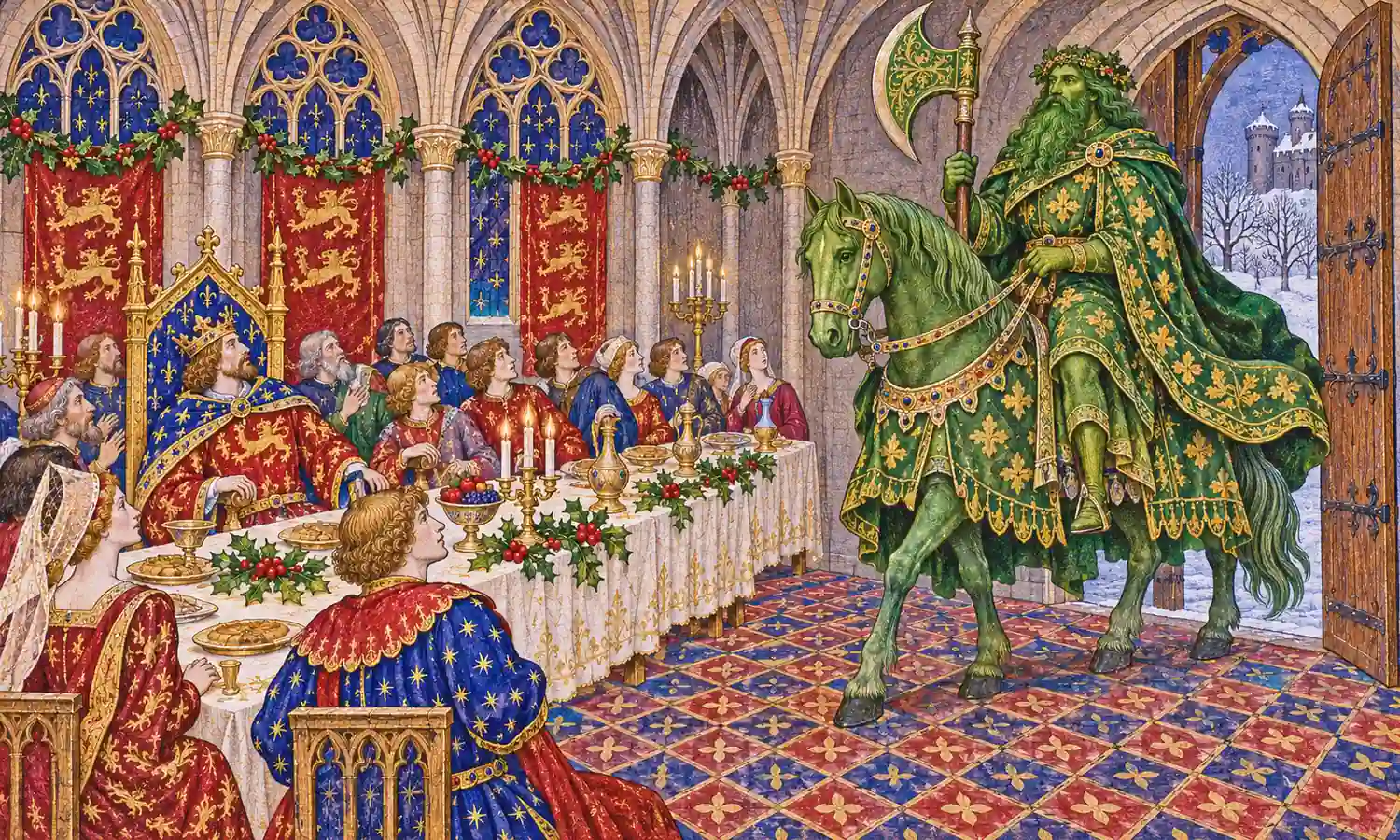
In the later fourteenth century the old unrhymed, alliterative verse came back in what is called the alliterative revival. Sir Gawain and the Green Knight, about 2,530 lines in 101 stanzas, is its finest romance. The poet is unknown, and the same hand is credited with Pearl, a dream vision in which a grieving speaker meets a young girl who has died, and with Cleanness and Patience. Each stanza of Gawain ends in five short rhymed lines called the bob and wheel. The story opens at Camelot at Christmas, when a green giant challenges the court to a beheading game. Gawain cuts off his head, and the giant picks it up and tells Gawain to meet him in a year. On the way Gawain stays in a castle, where the lady tempts him and he hides a green girdle that she says will protect his life. At the Green Chapel the Green Knight swings his axe three times and leaves only a small cut, because Gawain kept the girdle. The knight is the lord of the castle. The poem tests the ideal of the perfect knight and finds that he is human.
William Langland's Piers Plowman belongs to the same alliterative tradition but has a different spirit. It is a dream vision. A dreamer named Will falls asleep on the Malvern Hills and sees a field full of folk, rich and poor, who stand for the whole of society. In later dreams he sees the seven deadly sins confess and meets an honest ploughman named Piers. He searches for the answer to how a man should live, which the poem calls Do-Well, Do-Better and Do-Best. Langland attacks corrupt clergy and the greed of the powerful. The poem exists in versions called A (1360s), B (late 1370s) and C (1380s). It also holds the earliest certain mention of Robin Hood tales, when the lazy priest Sloth admits that he knows rhymes of Robin Hood better than his prayers.
Chaucer and his contemporaries
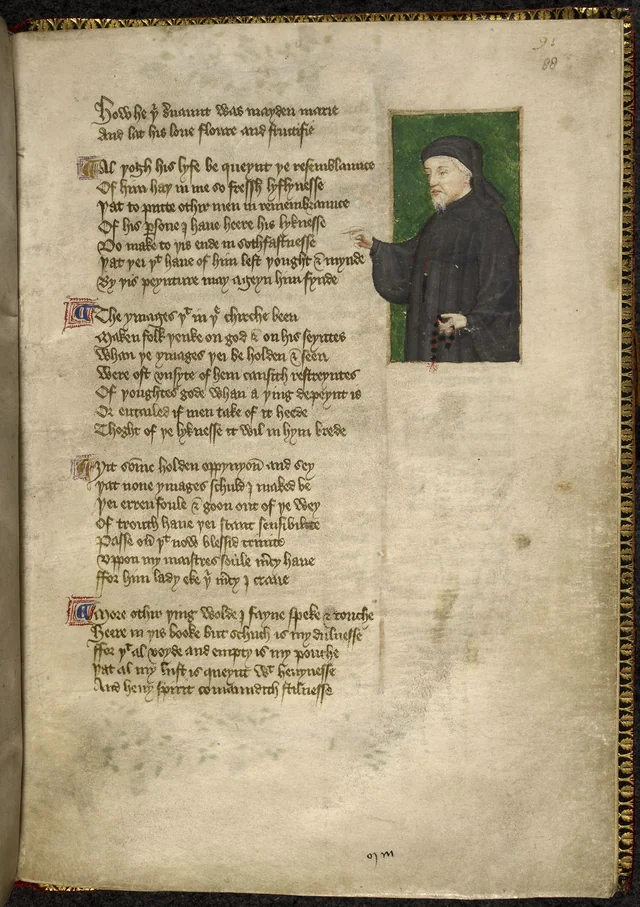
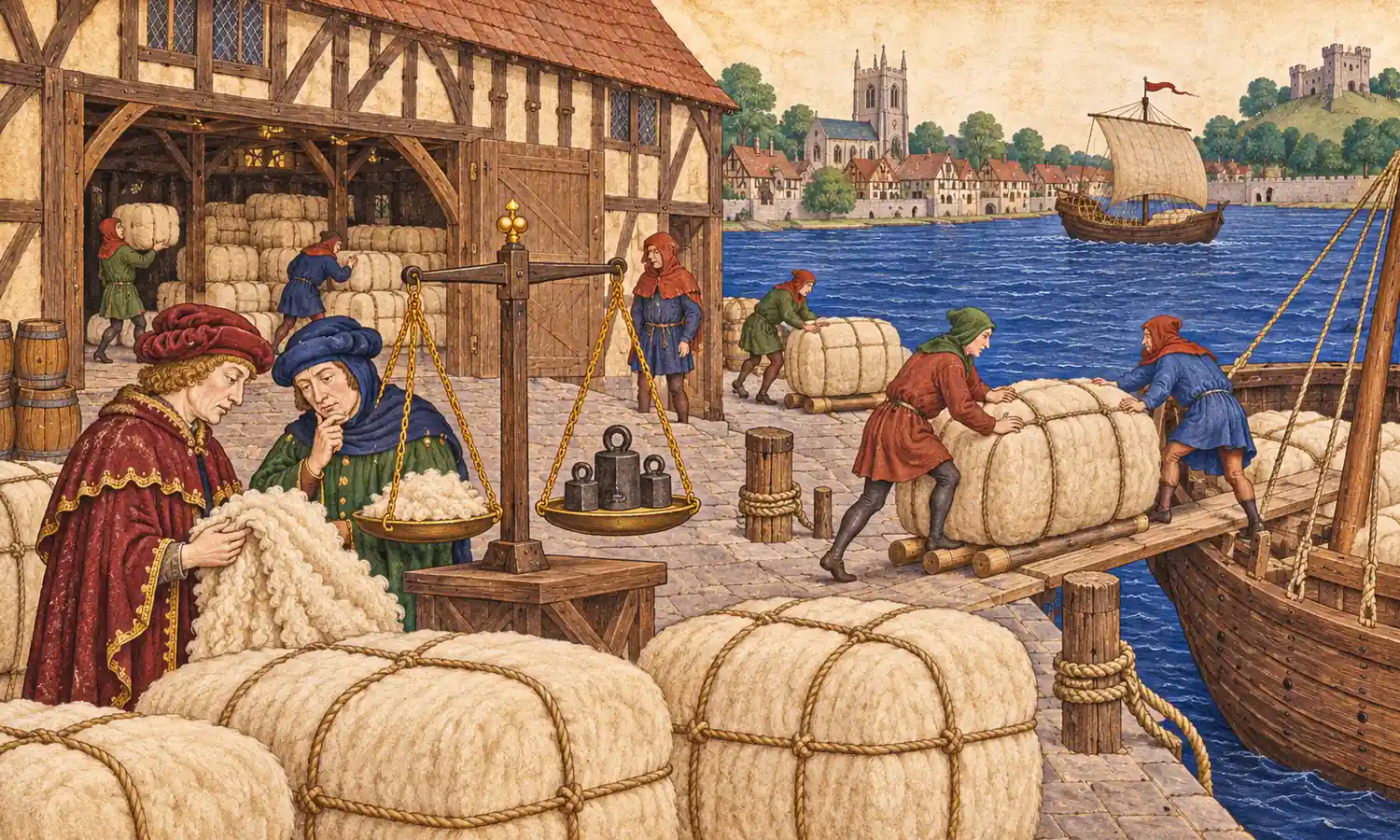
Geoffrey Chaucer was born in London around 1343, the son of a wine merchant. As a young man he served as a page in a noble household, and in 1359 he was captured in France, where the king helped to pay his ransom. He later worked as a soldier, a diplomat who visited Italy, controller of wool customs in London from 1374, and Clerk of the King's Works from 1389. He died in 1400 and was buried in Westminster Abbey, in what later became Poets' Corner.
His poetry is often divided into three phases. In the first he followed French models. The Book of the Duchess mourns Blanche, the wife of John of Gaunt, who died in 1368. In the second he learned from Italian writers such as Boccaccio. The Parliament of Fowls and Troilus and Criseyde, a long love story set in the Trojan War and written in rhyme royal, belong here. In the third he turned to English life, and the result was The Canterbury Tales. He also translated Boethius and wrote a Treatise on the Astrolabe for his young son.
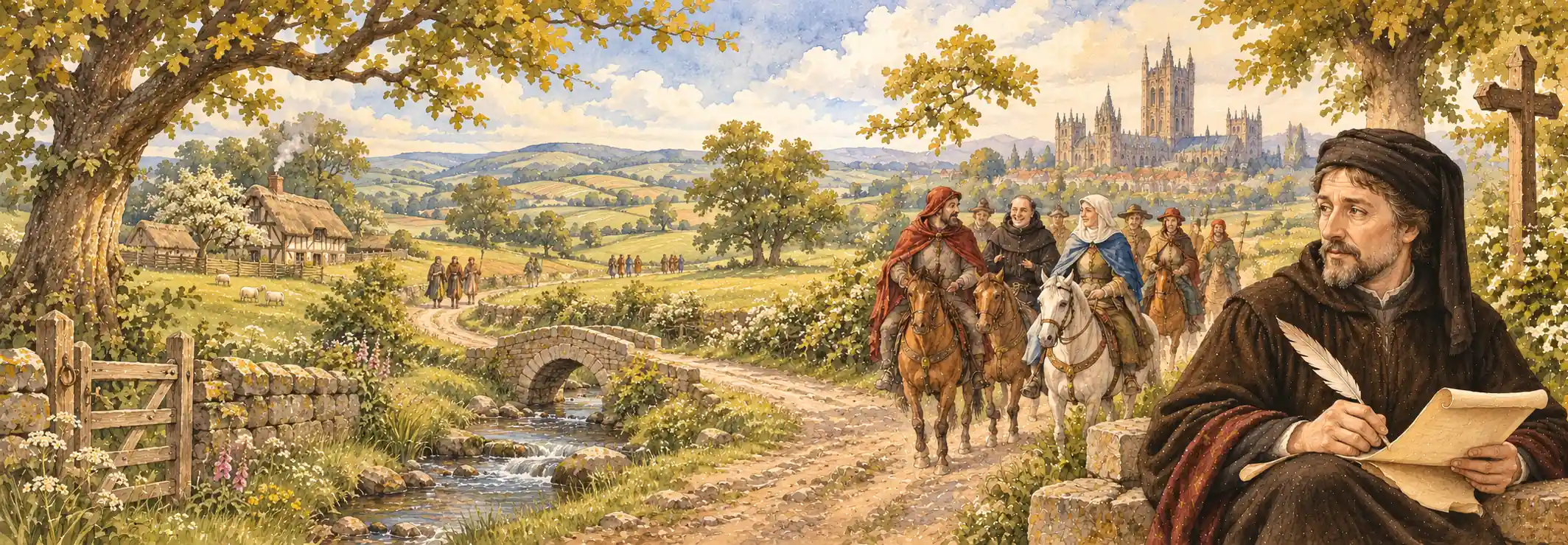
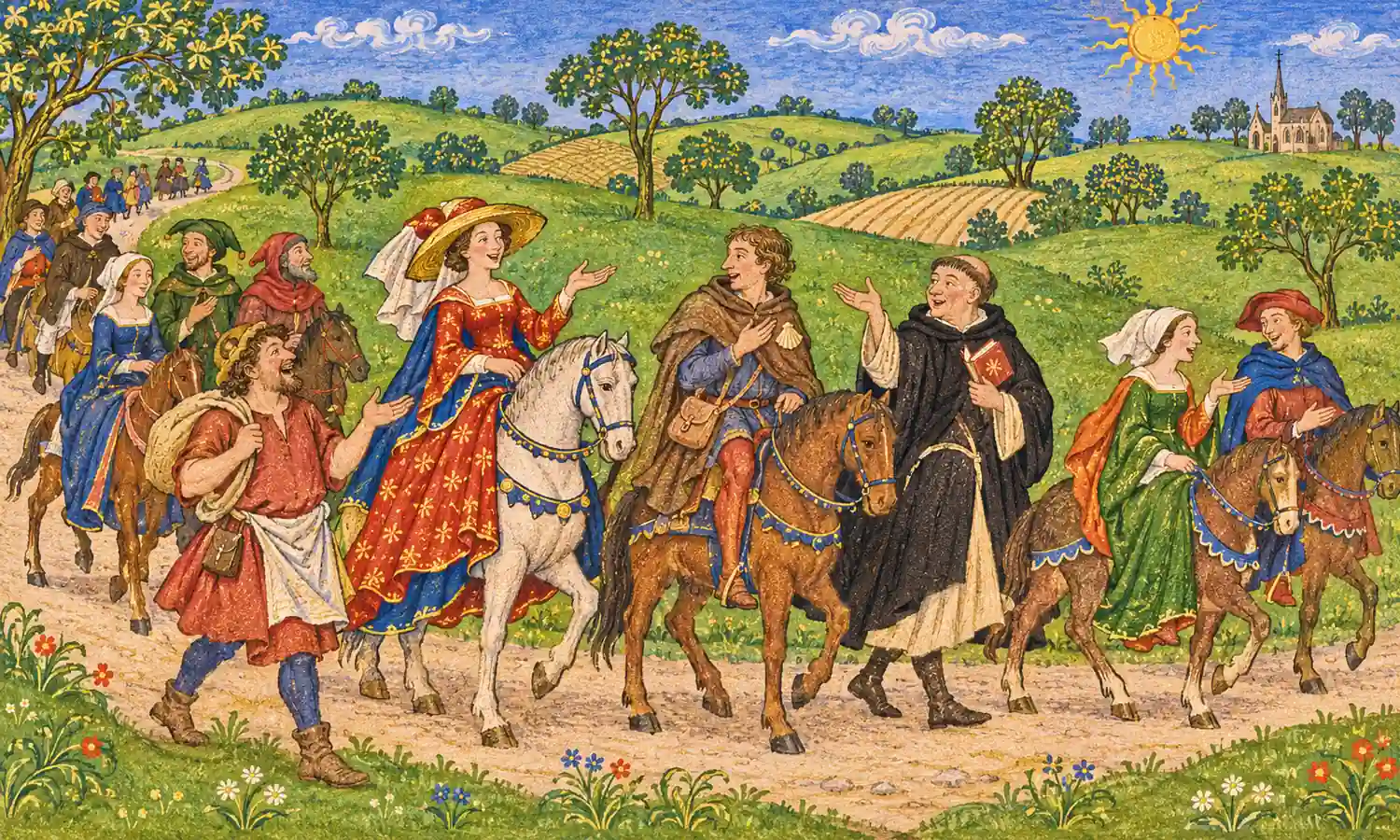
The Canterbury Tales, begun about 1387, is a frame story. About thirty pilgrims meet at the Tabard Inn in Southwark on their way to the shrine of Thomas Becket at Canterbury. Their host, Harry Bailly, suggests that each of them should tell tales on the road, and that the best storyteller should win a free supper. Chaucer planned four tales from each pilgrim, two on the way there and two on the way back. He finished only 24, and some of those are incomplete. The General Prologue gives a sharp portrait of each traveller, from the Knight to the Miller, the Wife of Bath and the Pardoner. The tales that follow come in every style: a noble romance, a rude comic story called a fabliau, a beast fable, a sermon in prose. Most are in rhyming couplets of ten syllables, and Chaucer is usually credited with bringing both this couplet and the rhyme royal stanza into English poetry.
Criticism and scholarship
Chaucer's reputation stayed high long after his death. In 1700, in the Preface to his Fables, Ancient and Modern, John Dryden called him the father of English poetry, and said of the pilgrims, "here is God's plenty". Dryden also thought Chaucer's lines were rough, because nobody then understood how Middle English had been pronounced.
Proper scholarship began in the nineteenth century. In 1864 F. J. Furnivall founded the Early English Text Society to print early texts that survived only in manuscript, and in 1868 he founded the Chaucer Society. Walter W. Skeat produced a three-text edition of Piers Plowman in 1886 and a six-volume Complete Works of Geoffrey Chaucer in 1894, with a supplement in 1897. Matthew Arnold, in "The Study of Poetry" (1880), admired Chaucer's "liquid" diction but said he lacked the "high seriousness" of Homer, Dante, Shakespeare and Milton.
In the twentieth century C. S. Lewis's The Allegory of Love (1936) studied courtly love and allegory, and D. W. Robertson's A Preface to Chaucer (1962) argued that medieval writers should be read in the light of Christian teaching. Carolyn Dinshaw's Chaucer's Sexual Poetics (1989) brought questions of gender and desire to Chaucer. The standard edition today is The Riverside Chaucer (1987), edited by Larry D. Benson.
Literature in focus
Gower and the range of English writing
John Gower wrote in French, Latin and English. His Confessio Amantis uses a lover's confession as a frame for moral stories. It offers a useful comparison with the pilgrimage frame of The Canterbury Tales: both can contain many narratives, but the organising situation and the narrator's task are different.
Religious writing remained central. Julian of Norwich described the revelations she experienced in 1373, first in a shorter account and later in a longer text. The chronology of an experience is not automatically the date of every surviving version of its written account. An exam answer should keep those dates separate.
Reading Chaucer carefully
The narrator of a tale and the writer of the whole collection are different levels of the work. A pilgrim can speak with confidence while the framing narrative invites us to question that confidence. The General Prologue introduces occupations, manners and claims to status; the tales then develop or complicate those impressions. This variety matters more than treating every speaker as Chaucer's own opinion.
Chaucer's unfinished collection includes prose as well as verse and twenty-four tales, some incomplete. It is therefore inaccurate to say that he completed all twenty-four. The surviving collection and the much larger proposed storytelling scheme must be distinguished.
The road is a way of organising voices
A pilgrimage provides Chaucer with movement, but its literary value is greater than the journey from one place to another. People who might not normally tell stories together now share a road and an audience. Their occupations, manners and claims to authority travel with them. The frame makes difference part of the work's design. It is not simply a convenient box into which unrelated stories have been placed.
A teller can choose a story that presents a view of the world, then discover that another voice challenges it. The reader moves between the pleasure of the tale and the social situation in which it is told. That movement prevents us from treating the narrative as a single lesson delivered by a single speaker. Meaning grows through the relation among voices.
Start with a small question: why might this person want this audience to hear this kind of story? A tale can entertain, defend a value, compete for attention or answer another person indirectly. More than one purpose may operate at once. The frame invites us to notice that telling a story is itself an action within a group.
A portrait can praise and question at the same time
The General Prologue introduces the company, but an introduction need not give a final judgement. A detail that first sounds flattering can become less secure when placed beside another detail. The reader learns to listen for the distance between what a person wishes to appear and what the description allows us to see. That distance is one source of Chaucer's irony.
Do not turn irony into a rule that every pleasant sentence secretly means the opposite. A portrait can hold admiration, amusement and criticism together. Explain the tension through a particular feature: clothing, speech, an occupation or a claim to learning. The evidence matters more than the label. A short, exact observation can show more than a general statement that Chaucer laughed at everyone.
Love changes when the story changes its scale
Troilus and Criseyde gives extended attention to love, expectation and the uncertain knowledge people have of one another. Unlike a short lyric, a long narrative can place a feeling within time. A promise is made in one situation and tested in another. The reader sees what the characters hope, what they fear and what they cannot securely predict.
This makes the relationship between love and knowledge important. A person may feel certain without knowing enough. A narrator may offer an account that leaves a reader asking how much it explains. Read the changes in situation carefully before making a quick moral judgement about a character. The interest of the narrative includes the difficulty of judgement itself.
The relation to continental models also connects Chaucer with the previous age. English writing continues to grow through encounters with other languages and traditions. Originality does not require a writer to invent every plot. It can lie in the way an inherited story is shaped, voiced and made to matter to a new audience.
Langland: a dream puts society under examination
A dream vision allows a writer to move between an individual experience and a larger picture of the world. In Piers Plowman, the dreamer Will encounters figures and situations that demand interpretation. The reader is not merely watching a familiar social scene. The form turns the search for a good life into a process of questions, discoveries and renewed difficulties.
Allegory makes that search visible. A person or encounter can carry a meaning beyond its literal place in the story. Yet it would be a mistake to assume that every meaning is settled as soon as a name is explained. The poem keeps testing what its ideals require in practice. Words about truth and good conduct are easier to pronounce than to live by.
The contrast with Chaucer is useful. A gathering of pilgrims creates one kind of social variety; a dreamer's search creates another. Both can reveal the distance between an ideal and human conduct, but their methods and tones differ. An exam answer becomes stronger when it names the shared concern and then explains the different form through which each writer approaches it.
Gower: a frame can make stories into an argument
Confessio Amantis places narratives within the situation of a lover's confession. That situation gives a tale a reason to be told. A story may illustrate a fault, complicate a judgement or invite the listener to recognise something about himself. The frame therefore changes what a reader expects from the material inside it.
Compare this with the pilgrimage. Chaucer can make an audience respond to competing tellers; Gower can make the relation between tale and instruction more explicit. Neither frame is simply a list. Each gives a reader a path through varied material. The comparison teaches an important literary skill: ask not only what stories a work contains, but how it tells us to connect them.
Reading across the page and the manuscript
The surviving witnesses of medieval writing remind us that a text has a material history. A modern edition presents a readable arrangement, but that arrangement depends on editorial work. Different manuscripts may preserve different readings or sequences. This does not make serious reading impossible. It makes the explanation of an edition and the evidence behind it worth noticing.
For a first reading, the priority is to understand the movement of the passage. Use a glossary where needed, follow the sentence and listen to its rhythm. Then return to the terms that describe the form. Rhyme royal, alliteration and the bob and wheel become easier to remember when they name an effect you have actually heard. Technical vocabulary is most useful after it has been connected with experience.
The next century inherits these works as well as these problems of preservation. Later poets read Chaucer, printers choose texts, and readers continue to interpret a body of writing that was never completely uniform. The Age of Chaucer leads forward through those acts of reading, not simply through a date at the end of a timeline.
A final comparison: what makes a voice convincing?
Choose a speaker from Chaucer and compare that voice with the dreamer's search in Langland. A voice can seem convincing because it is confident, familiar or witty, but those qualities do not necessarily make its judgement sound. The surrounding work may give the reader reasons to hesitate. A useful comparison identifies the appeal of the voice before explaining its limit.
This is one of the age's most lasting pleasures. We hear people explaining themselves, then discover that explanation is not the same as complete self-knowledge. The writing allows us to recognise pride, hope and uncertainty without reducing every person to a single fault. That makes the social picture vivid. The connection with later literature lies partly here: a narrator or character can reveal more than he or she intends.
As you move into the fifteenth century, remember that later writers inherit this range of voices, not merely a famous name. Their admiration for Chaucer makes sense because the works offer ways to organise experience as well as forms to imitate.
Key terms
- Alliterative revival - the return of unrhymed alliterative verse in the later fourteenth century, as in Gawain and Piers Plowman.
- Bob and wheel - the five short rhyming lines that close each stanza of Sir Gawain and the Green Knight.
- Dream vision - a poem in which the narrator falls asleep and sees a vision, as in Piers Plowman and Pearl.
- Rhyme royal - a seven-line stanza rhyming ababbcc, used by Chaucer in Troilus and Criseyde.
Writers and works
| Writer | Works | What to remember |
|---|---|---|
| John Gower | Confessio Amantis | Moral narratives within a confession frame |
Important points to remember
- The timeline uses 1340–1400 for this chapter. Literary boundaries are approximate.
- Check the date of a work separately from its writer's lifetime.
- Read this chapter alongside the wider period guide when comparing neighbouring ages.
Quick revision - 11 points
Open the 11 pointsClose the list
- The Black Death — The Black Death came by sea from France in the summer of 1348.
- Cotton Nero A.x — If this one manuscript had been lost, the four poems would be unknown.
- Five short rhyming lines at the end of each stanza — Each of the 101 stanzas ends with these five short lines.
- William Langland — Langland wrote it in A, B and C versions.
- London — He checked wool, skins and leather at the port of London.
- The Tabard Inn — The Tabard Inn stood in Southwark.
- Rhyme royal — Rhyme royal rhymes ababbcc.
- John Gower — His English poem is the Confessio Amantis, of about 33,000 lines.
- Matthew Arnold — He said so in "The Study of Poetry".
- It is unfinished and includes twenty-four tales, some incomplete — The surviving collection differs from the much larger proposed scheme.
- A lover’s confession — Gower organises moral narratives within a confession frame.
Quick quiz - 16 questions
Tap an answer to see at once if it is right. You do not need to log in.
Open the 16 questionsClose the quiz
1Which disease reached England in 1348 and may have killed about half of the people?
Answer: D. The Black Death came by sea from France in the summer of 1348.
2Which single manuscript preserves Pearl, Cleanness, Patience and Sir Gawain and the Green Knight?
Answer: D. If this one manuscript had been lost, the four poems would be unknown.
3What is the "bob and wheel" in Sir Gawain and the Green Knight?
Answer: A. Each of the 101 stanzas ends with these five short lines.
4Who wrote Piers Plowman?
Answer: B. Langland wrote it in A, B and C versions.
5In which port did Chaucer become controller of customs in 1374?
Answer: D. He checked wool, skins and leather at the port of London.
6Where do the pilgrims of The Canterbury Tales meet before they set out?
Answer: B. The Tabard Inn stood in Southwark.
7What is the name of the seven-line stanza that Chaucer used in Troilus and Criseyde?
Answer: C. Rhyme royal rhymes ababbcc.
8Which poet wrote major works in French, Latin and English?
Answer: D. His English poem is the Confessio Amantis, of about 33,000 lines.
9Which critic said in 1880 that Chaucer lacked "high seriousness"?
Answer: B. He said so in "The Study of Poetry".
10Which description of The Canterbury Tales is accurate?
Answer: B. The surviving collection differs from the much larger proposed scheme.
11What provides the narrative frame of Confessio Amantis?
Answer: C. Gower organises moral narratives within a confession frame.
12What does the pilgrimage frame allow Chaucer to bring together?
Answer: D. The act of telling occurs within a company whose members differ.
13Why is a tale's speaker not automatically Chaucer himself?
Answer: A. The character's words and the arrangement of the whole collection are different levels.
14What is the main form of Piers Plowman?
Answer: B. The dreamer's encounters organise a search about truth and conduct.
15What is a useful first question about a tale told within a frame?
Answer: C. A tale has meaning within the situation of its telling.
16How should technical terms such as rhyme royal be used?
Answer: D. The form is easier to understand when connected with rhythm and meaning.
Frequently asked questions
Does this chapter use exact historical boundaries?
The dates are the timeline's study convention. Language, literary forms and writers' careers can cross them. Use the date of the particular work when a question asks about a narrower age.
Where can I read the wider historical context?
The full period guide contains the longer background. This chapter concentrates on the age named above and keeps its own revision and practice sections.
Are these pictures historical documents?
The artwork is illustrative. Captions identify representative or imagined scenes and modern painted interpretations; those images are not evidence that the pictured scene happened exactly as shown.
How should I use the quiz?
Read the explanations after answering. Questions about earlier events or later criticism are background questions, not claims that every named date falls inside the chapter's boundaries.
Sources and further reading
The relevant background, text references and public practice material are retained from the original middle english guide. Publication dates, authorship and period boundaries should be checked against the source editions listed there.
Afsar Khan, Ph.D. English
Test your knowledge
Check what you have learned with quizzes and MCQs.