
The Victorian Age in English Literature: An Era of Transition and Contradiction
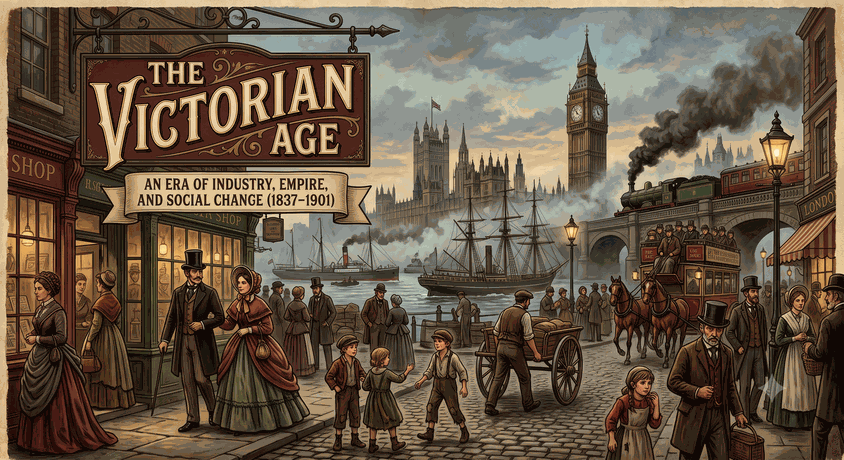
The Victorian Age (1837–1901) stands as one of the most pivotal and complex epochs in the history of English literature. Corresponding with the reign of Queen Victoria, this period marked a definitive departure from the intense emotionalism and unrestrained imagination of the Romantic Age, moving toward a more realistic, pragmatic, and socially conscious literary movement. Often characterized as an "Age of Transition," the Victorian era witnessed radical transformations across society, politics, and culture. The Industrial Revolution reached its zenith, driving a massive demographic shift from agrarian landscapes to rapidly industrializing urban centers. Concurrently, the British Empire expanded to its greatest territorial extent, an imperial dominance encapsulated by the phrase "the sun never sets on the British Empire." However, beneath this veneer of unprecedented material progress and imperial glory lay a harsh reality of severe poverty, child labor, and the systemic exploitation of the working class. The prominent statesman and novelist Benjamin Disraeli aptly described this stark socio-economic dichotomy as the "Two Nations," a profound division between the rich and the poor that became a central preoccupation of Victorian literature.
Perhaps the most defining intellectual crisis of the Victorian era was the profound conflict between orthodox religion and emerging scientific discoveries. The publication of Charles Darwin’s On the Origin of Species in 1859, alongside the geological revelations of Charles Lyell, fundamentally challenged the literal interpretation of biblical creation. This influx of new scientific paradigms generated widespread skepticism and a pervasive crisis of faith among the Victorian populace. The agonizing struggle to reconcile religious doctrine with empirical evidence became a dominant theme in both poetry and prose. Matthew Arnold’s seminal poem Dover Beach serves as the quintessential articulation of this spiritual melancholy, capturing the agonizing retreat of the "Sea of Faith" and the resulting sense of existential isolation in a rapidly changing world.
The Victorian period is rightfully celebrated as the "Age of the Novel," as the form achieved unprecedented popularity and became the dominant mode of literary expression. The expansion of the reading public, facilitated by cheaper printing methods and the prevalent practice of serial publication in periodicals, allowed literature to permeate the daily lives of the masses. Charles Dickens emerged as the towering literary figure of the era, utilizing his fiction as a powerful instrument for social critique. Through masterpieces like Oliver Twist, David Copperfield, and Hard Times, Dickens meticulously exposed institutional cruelty, poverty, and the dehumanizing effects of utilitarianism. In stark contrast, Thomas Hardy offered a deeply pessimistic and deterministic vision of the human condition, portraying individuals as tragic figures inextricably bound by the indifferent forces of nature, fate, and rigid social conventions. Furthermore, the era witnessed profound psychological and moral explorations by female novelists; the Brontë sisters (Charlotte and Emily) and George Eliot (Mary Ann Evans) introduced a remarkable depth of realism and psychological complexity, challenging the restrictive gender norms of the time.
In the realm of poetry, the Victorian aesthetic sought to negotiate the tension between the romantic legacy and contemporary anxieties. Alfred, Lord Tennyson, the quintessential Victorian Poet Laureate, embodied the era's compromises and melancholic introspection, often weaving classical myths and Arthurian legends with the pressing moral questions of his day. Conversely, Robert Browning revolutionized the poetic landscape by perfecting the dramatic monologue, a technique he employed masterfully to delve into the grotesque, complex, and often dark recesses of human psychology, moving away from lyrical subjectivism toward objective character study. Accompanying these poetic advancements was a formidable tradition of non-fiction prose. Eminent essayists and critics such as Thomas Carlyle, John Ruskin, and Walter Pater vigorously attacked the rampant materialism and utilitarianism of industrial capitalism, advocating instead for the preservation of moral integrity, aesthetic beauty, and spiritual depth in an increasingly mechanized society.
Ultimately, the Victorian Age was a multi-dimensional era defined by its inherent paradoxes—it was simultaneously a time of immense prosperity and crushing poverty, unwavering moral earnestness and pervasive hypocrisy, profound faith and debilitating doubt. The writers of this period not only held a mirror to the societal upheaval of their time but also established a rich, robust literary tradition. Their unflinching examination of the human condition amidst rapid modernization laid the indispensable groundwork for the subsequent literary innovations of the twentieth century, ensuring that the Victorian era remains a vital and endlessly rewarding field of academic inquiry.